


Achievable logoAchievable logo
CMA Part 1
Sign in
Sign up
Purchase
Textbook
Practice exams
Support
How it works
Exam catalog
Mountain with a flag at the peak
Textbook
1. External financial reporting decisions
2. Planning, budgeting, and forecasting
3. Performance management
4. Cost management
5. Internal control
6. Technology and analytics
Achievable logoAchievable logo
3.1.3.2 Introduction to flexible budgets
Achievable CMA Part 1
3. Performance management
3.1. Cost and variance measures
3.1.3. Flexible budgets
Our CMA Part 1 course is currently in development and is a work-in-progress.

Introduction to flexible budgets

7 min read
Font
Discuss
Share
Feedback

Flexible budgets are a powerful tool in performance analysis, offering a dynamic approach to evaluating actual results relative to budgeted expectations. Building on the discussion of budgeting methodologies in the previous chapter, this section delves into the definition, purpose, and benefits of flexible budgets, as well as how they differ from static budgets.

Definition and purpose of flexible budgets

Definitions
Flexible budget
A budget that adjusts budgeted figures based on the actual level of activity achieved during a period, while still using budgeted prices. Unlike a static budget, which is fixed at the start of a period, a flexible budget adapts to changes in production or sales volume, providing a more accurate benchmark for evaluating performance.

The primary purposes of a flexible budget are:

  • To account for the variability of costs and revenues as activity levels change.
  • To provide a relevant basis for comparison with actual results, enabling meaningful variance analysis.
  • To improve decision-making by offering a realistic view of performance under actual operating conditions.

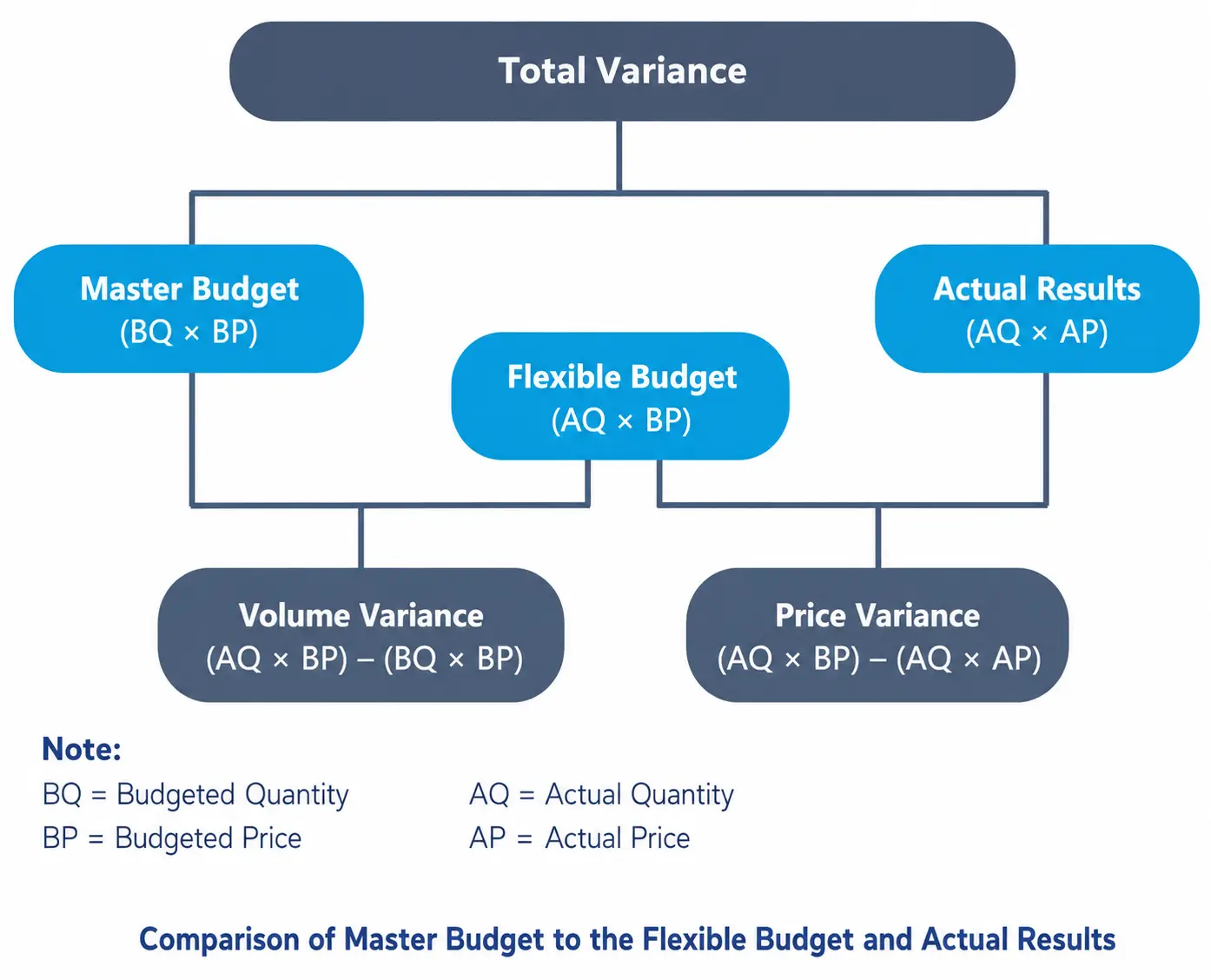
We can split the total variance into volume and price variances by comparing three financial data: the master budget, the flexible budget and the actual results. The diagram below illustrates better the split of the variances depending on what data you are comparing:

Formulas and variable definitions for materials cost, price, usage, mix, and yield variances.
Direct Material Variances

Example: Suppose a static budget assumes production of 10,000 units, with variable costs budgeted at $5 per unit (total of $50,000 budgeted variable costs). If actual production is 12,000 units, the static budgeted variable cost remains the same, even though actual costs would likely increase. A flexible budget, however, adjusts variable costs to $60,000 (12,000 units × $5 per unit) to reflect the actual output. More comprehensive examples are provided later.

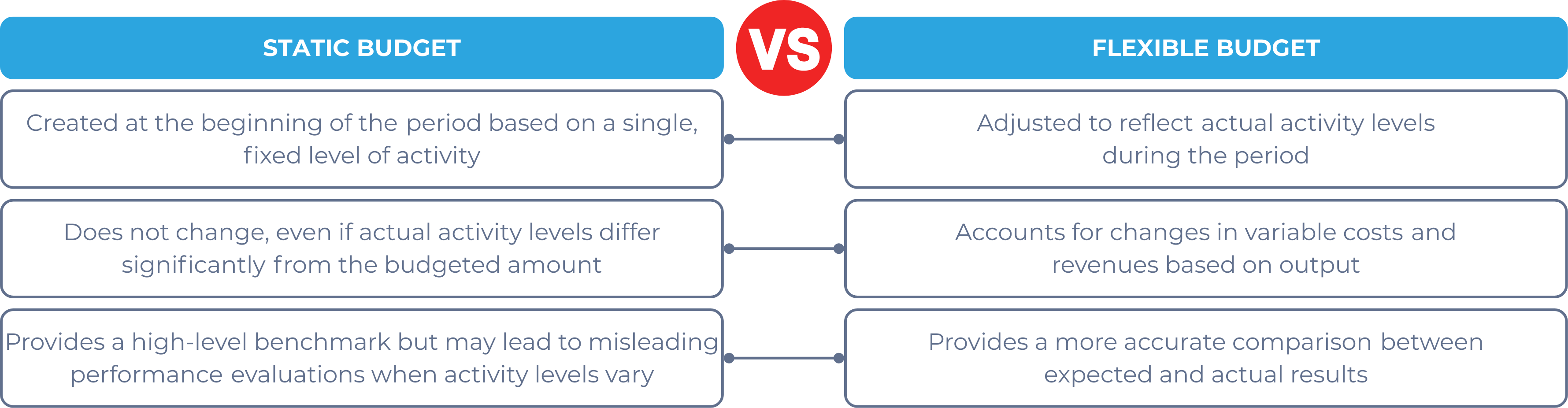
Static budget versus the flexible budget

Benefits of flexible budgets in performance analysis

Flexible budgets resolve the issue we encountered in the previous section about the explanations of total variances because flexible budgets help us split the total variance into price and volume variances. Aside from this flexible budgets offer several advantages in analyzing performance:

  1. More accurate variance analysis
    By accounting for changes in activity levels, flexible budgets provide a realistic basis for variance calculations. This ensures that performance deviations are not attributed solely to activity changes, but to controllable factors such as efficiency or price changes.
  2. Improved decision-making
    Flexible budgets highlight variances that truly reflect operational performance, helping managers identify areas requiring attention. For instance, identifying an unfavorable variance in material costs despite expected production levels allows managers to investigate potential inefficiencies or supplier issues.
  3. Enhanced accountability
    Flexible budgets adjust expectations to match actual conditions, ensuring that performance evaluations are fair and meaningful. This motivates managers to focus on controllable factors rather than external circumstances that could skew static budget comparisons.
  4. Adaptability to dynamic environments
    Flexible budgets are especially useful in industries with fluctuating demand or variable production levels. By adapting to real-time conditions, they provide a relevant framework for monitoring and managing performance.

Flexible budgets build on the foundation of static budgeting by introducing adaptability, precision, and relevance to performance analysis. By bridging the gap between budgeted expectations and actual activity levels, they empower organizations to make informed decisions and drive operational improvements.

Creating a flexible budget

Understanding how to adjust a budget based on actual sales or production levels is essential for accurate performance analysis. This section discusses how to modify a static budget into a flexible budget, emphasizing the importance of activity level adjustments and introducing the concept of more complex scenarios where both activity levels and prices per unit vary.

A static budget is prepared at the start of the period based on an expected level of activity. However, actual performance often deviates from these expectations, necessitating the creation of a flexible budget that adjusts for the actual output level.

Example scenario: A company budgets to produce and sell 10,000 units of its product in a month. Relevant data from the company’s budget are as follows:

  • Revenue of $10 per unit.
  • Variable costs of $4 per unit.
  • Fixed costs of $20,000.

At the end of the period, actual sales volume was 12,000 units while the units costs and sales price were the same as in the budget.

The static budget is coming from the budgetary data explained above. No further adjustments necessary.

Category Computation Static budget
(10,000 units)
Revenue 10,000 × $10 $100,000
Variable costs 10,000 × $4 ($40,000)
Fixed costs - ($20,000)
Operating profit $40,000

For the flexible budget, we adapt the computations of the static budget but using the actual volume of 12,000 instead of the planned 10,000.

Category Computation Flexible budget
(12,000 units)
Revenue 12,000 × $10 $120,000
Variable costs 12,000 × $4 ($48,000)
Fixed costs - ($20,000)
Operating profit $52,000

The static budget reflects the company’s original plan for 10,000 units while the flexible budget adjusts the revenue and variable costs to account for the actual output of 12,000 units. Fixed costs remain unchanged as they are not dependent on activity levels.

It is good to note that when the CMA problem provides for standard hours per unit (Direct Labor) or standard units of materials per unit (Direct Materials), the flexible budget computation is NOT based on the actual DL hours employed or actual DM used. The flexible budget is based on the amount of standard DL or DM allowed for the actual production. This is the same concept used in the variance computations.

In this simple example, only activity levels changed, while the price per unit for revenue and variable costs remained as the budgeted prices. In real-world scenarios and in the CMA examination, actual prices may also differ from budgeted assumptions. For instance, revenue per unit might increase due to a price hike, or variable costs per unit might rise due to input cost inflation. These price changes will make the analysis more complex which we will show in the next sections.

Definition and purpose of flexible budgets

  • Flexible budget: adjusts for actual activity levels using budgeted prices
  • Purpose: accounts for cost/revenue variability, enables meaningful variance analysis, improves decision-making
  • Variance analysis: separates total variance into volume variance (activity level) and price variance (rate/efficiency)

Benefits of flexible budgets in performance analysis

  • More accurate variance analysis by isolating controllable factors
  • Improved decision-making through relevant variance identification
  • Enhanced accountability by matching expectations to actual conditions
  • Adaptability for dynamic or variable environments

Creating a flexible budget

  • Static budget: based on expected activity, fixed at period start
  • Flexible budget: adjusts revenue and variable costs for actual output; fixed costs remain unchanged
  • Flexible budget uses standard input amounts for actual output, not actual input usage
    • Important for variance computations (e.g., standard hours allowed, not actual hours used)
  • Real-world: both activity levels and per-unit prices/costs may vary, increasing complexity

Sign up for free to take 12 quiz questions on this topic

Previous
Next  | 3.1.3.3.1 Total sales variance and sales price variance
All rights reserved ©2016 - 2026 Achievable, Inc.

Introduction to flexible budgets

Flexible budgets are a powerful tool in performance analysis, offering a dynamic approach to evaluating actual results relative to budgeted expectations. Building on the discussion of budgeting methodologies in the previous chapter, this section delves into the definition, purpose, and benefits of flexible budgets, as well as how they differ from static budgets.

Definition and purpose of flexible budgets

Definitions
Flexible budget
A budget that adjusts budgeted figures based on the actual level of activity achieved during a period, while still using budgeted prices. Unlike a static budget, which is fixed at the start of a period, a flexible budget adapts to changes in production or sales volume, providing a more accurate benchmark for evaluating performance.

The primary purposes of a flexible budget are:

  • To account for the variability of costs and revenues as activity levels change.
  • To provide a relevant basis for comparison with actual results, enabling meaningful variance analysis.
  • To improve decision-making by offering a realistic view of performance under actual operating conditions.

We can split the total variance into volume and price variances by comparing three financial data: the master budget, the flexible budget and the actual results. The diagram below illustrates better the split of the variances depending on what data you are comparing:

Example: Suppose a static budget assumes production of 10,000 units, with variable costs budgeted at $5 per unit (total of $50,000 budgeted variable costs). If actual production is 12,000 units, the static budgeted variable cost remains the same, even though actual costs would likely increase. A flexible budget, however, adjusts variable costs to $60,000 (12,000 units × $5 per unit) to reflect the actual output. More comprehensive examples are provided later.

Benefits of flexible budgets in performance analysis

Flexible budgets resolve the issue we encountered in the previous section about the explanations of total variances because flexible budgets help us split the total variance into price and volume variances. Aside from this flexible budgets offer several advantages in analyzing performance:

  1. More accurate variance analysis
    By accounting for changes in activity levels, flexible budgets provide a realistic basis for variance calculations. This ensures that performance deviations are not attributed solely to activity changes, but to controllable factors such as efficiency or price changes.
  2. Improved decision-making
    Flexible budgets highlight variances that truly reflect operational performance, helping managers identify areas requiring attention. For instance, identifying an unfavorable variance in material costs despite expected production levels allows managers to investigate potential inefficiencies or supplier issues.
  3. Enhanced accountability
    Flexible budgets adjust expectations to match actual conditions, ensuring that performance evaluations are fair and meaningful. This motivates managers to focus on controllable factors rather than external circumstances that could skew static budget comparisons.
  4. Adaptability to dynamic environments
    Flexible budgets are especially useful in industries with fluctuating demand or variable production levels. By adapting to real-time conditions, they provide a relevant framework for monitoring and managing performance.

Flexible budgets build on the foundation of static budgeting by introducing adaptability, precision, and relevance to performance analysis. By bridging the gap between budgeted expectations and actual activity levels, they empower organizations to make informed decisions and drive operational improvements.

Creating a flexible budget

Understanding how to adjust a budget based on actual sales or production levels is essential for accurate performance analysis. This section discusses how to modify a static budget into a flexible budget, emphasizing the importance of activity level adjustments and introducing the concept of more complex scenarios where both activity levels and prices per unit vary.

A static budget is prepared at the start of the period based on an expected level of activity. However, actual performance often deviates from these expectations, necessitating the creation of a flexible budget that adjusts for the actual output level.

Example scenario: A company budgets to produce and sell 10,000 units of its product in a month. Relevant data from the company’s budget are as follows:

  • Revenue of $10 per unit.
  • Variable costs of $4 per unit.
  • Fixed costs of $20,000.

At the end of the period, actual sales volume was 12,000 units while the units costs and sales price were the same as in the budget.

The static budget is coming from the budgetary data explained above. No further adjustments necessary.

Category Computation Static budget
(10,000 units)
Revenue 10,000 × $10 $100,000
Variable costs 10,000 × $4 ($40,000)
Fixed costs - ($20,000)
Operating profit $40,000

For the flexible budget, we adapt the computations of the static budget but using the actual volume of 12,000 instead of the planned 10,000.

Category Computation Flexible budget
(12,000 units)
Revenue 12,000 × $10 $120,000
Variable costs 12,000 × $4 ($48,000)
Fixed costs - ($20,000)
Operating profit $52,000

The static budget reflects the company’s original plan for 10,000 units while the flexible budget adjusts the revenue and variable costs to account for the actual output of 12,000 units. Fixed costs remain unchanged as they are not dependent on activity levels.

It is good to note that when the CMA problem provides for standard hours per unit (Direct Labor) or standard units of materials per unit (Direct Materials), the flexible budget computation is NOT based on the actual DL hours employed or actual DM used. The flexible budget is based on the amount of standard DL or DM allowed for the actual production. This is the same concept used in the variance computations.

In this simple example, only activity levels changed, while the price per unit for revenue and variable costs remained as the budgeted prices. In real-world scenarios and in the CMA examination, actual prices may also differ from budgeted assumptions. For instance, revenue per unit might increase due to a price hike, or variable costs per unit might rise due to input cost inflation. These price changes will make the analysis more complex which we will show in the next sections.

Key points

Definition and purpose of flexible budgets

  • Flexible budget: adjusts for actual activity levels using budgeted prices
  • Purpose: accounts for cost/revenue variability, enables meaningful variance analysis, improves decision-making
  • Variance analysis: separates total variance into volume variance (activity level) and price variance (rate/efficiency)

Benefits of flexible budgets in performance analysis

  • More accurate variance analysis by isolating controllable factors
  • Improved decision-making through relevant variance identification
  • Enhanced accountability by matching expectations to actual conditions
  • Adaptability for dynamic or variable environments

Creating a flexible budget

  • Static budget: based on expected activity, fixed at period start
  • Flexible budget: adjusts revenue and variable costs for actual output; fixed costs remain unchanged
  • Flexible budget uses standard input amounts for actual output, not actual input usage
    • Important for variance computations (e.g., standard hours allowed, not actual hours used)
  • Real-world: both activity levels and per-unit prices/costs may vary, increasing complexity

More from Flexible budgets

  • Learning outcome statements
  • The flexible budget variance