


Achievable logoAchievable logo
CA Code and Ethics
Sign in
Sign up
Purchase
Textbook
Practice exams
Support
How it works
Exam catalog
Mountain with a flag at the peak
Textbook
Introduction
1. Basic insurance concepts and principles
2. The insurance marketplace
3. Required fraud training — CDI
3.1 Introduction and learning objectives
3.2 Fraud Division
3.3 Fraud Division programs
3.4 Fraud detection
3.4.1 Key tools and resources
3.4.2 Suspected insurance fraud: Agent duties
3.4.3 Legal consequences of fraud
Wrapping up
Achievable logoAchievable logo
3.4.2 Suspected insurance fraud: Agent duties
CA Code and Ethics
3. Required fraud training — CDI
3.4. Fraud detection
Our California Insurance Code and Ethics course is currently in development and is a work-in-progress.

Suspected insurance fraud: Agent duties

4 min read
Font
Discuss
Share
Feedback

Insurance agents are often the first to notice possible fraud because they work directly with applicants and policyholders. California law and industry standards place a duty on agents to help protect the insurance marketplace by serving as an early line of defense against fraud.

Recognize red flags and fraud indicators

Agents must stay alert to warning signs of possible fraud, which may include:

  • Inconsistent or incomplete application information
  • Requests for unusually high coverage limits without justification
  • Suspicious timing of claims (e.g., immediately after a policy is issued)
  • Signs of staged accidents, faked injuries, or inflated repair estimates
  • Applicants who resist providing standard documentation

These indicators don’t prove fraud by themselves. The key is to notice patterns, use sound judgment, and follow reporting procedures when something doesn’t add up.

Immediate notification to the insurer’s SIU

When you suspect fraud, your role is to report - not to investigate. Notify the insurer’s Special Investigation Unit (SIU) right away, and include all relevant details and documentation. Prompt reporting helps the SIU meet its legal obligations under Cal. Ins. Code §1872.41, which requires insurers to refer suspected fraud to CDI.

In most cases, the insurer’s SIU forwards suspected fraud to the California Department of Insurance (CDI). However, if the insurer instructs you to report directly, or if you discover suspected fraud before the SIU is involved, follow company policy to make sure CDI receives the required referral.

Document and report - Do not accuse

Agents must avoid directly accusing customers or claimants of fraud. Instead, agents should:

  • Carefully document observations and communications in writing
  • Maintain a professional, neutral tone in all reports
  • Leave the determination of fraud to the SIU and CDI investigators

You’re not acting as a fraud investigator. Your job is to spot concerns, document what you observed, and refer the matter to the proper unit. This approach helps reduce liability risk and ensures fraud concerns are handled lawfully and effectively by SIUs, CDI, and law enforcement.

Here’s a fraud red flags checklist you can use as a practical quick reference in your real-world interactions:
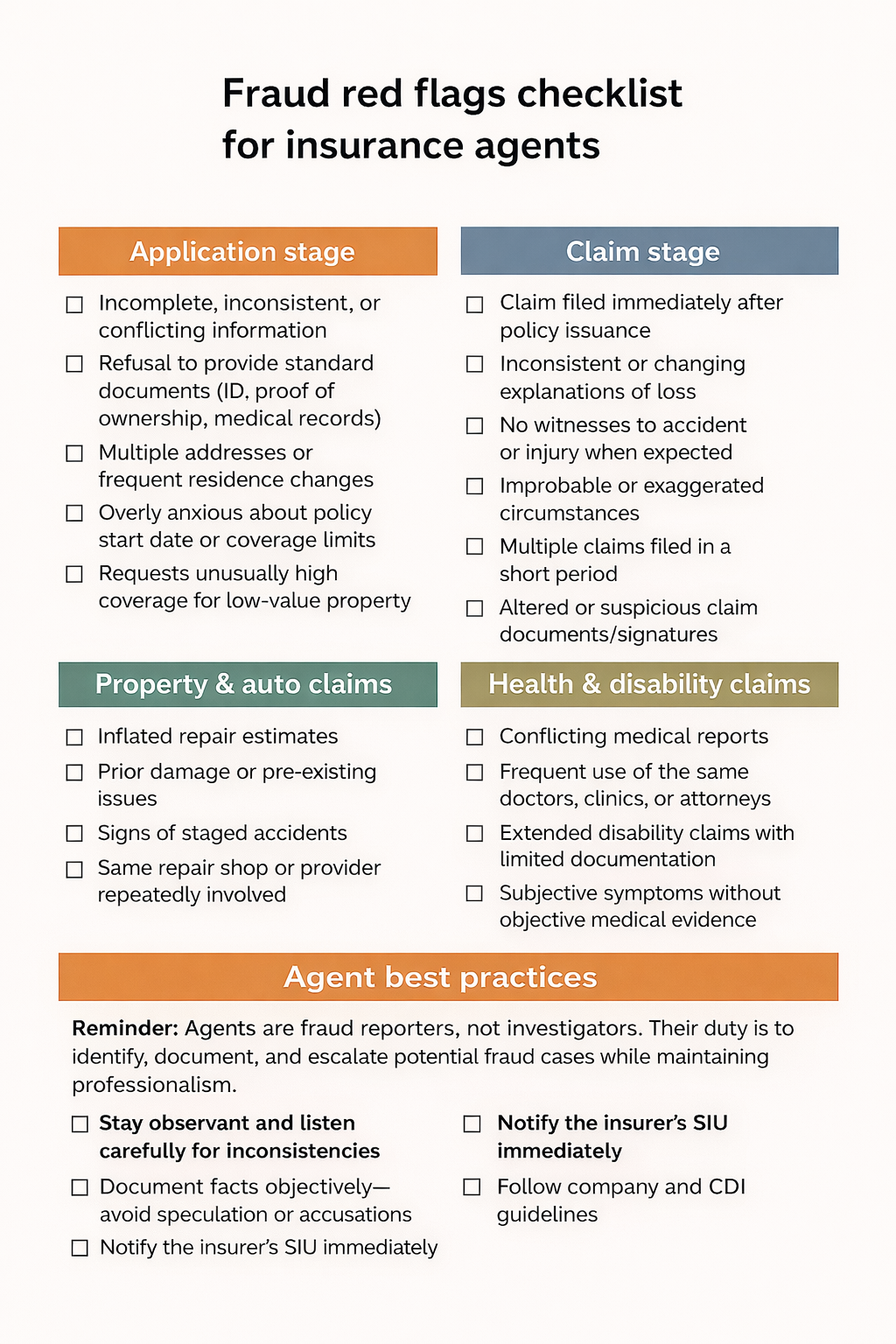
Fraud red flag checklist (For educational purposes - not exhaustive. Always follow company SIU and CDI reporting guidelines.)

Insurance professionals must be trained to recognize “red flags” that may indicate fraud during both the underwriting and claims stages. A single indicator doesn’t prove fraud, but several indicators together may justify closer review or a referral to the SIU.

Underwriting fraud indicators

  • Inconsistent personal or vehicle information - Mismatches between the applicant’s stated details and public records, such as incorrect VIN numbers, mismatched addresses, or false employment information, may suggest intentional misrepresentation.
  • Suspicious application patterns - Applications submitted with vague answers, frequent last-minute changes, or use of multiple addresses and phone numbers can raise concerns.
  • Prior cancellations for misrepresentation - A history of past policy cancellations due to misstatements or nonpayment is a strong signal of potential fraudulent intent.

Claims fraud indicators

  • Delays in reporting - Legitimate claims are usually reported promptly. Long delays in reporting losses may indicate the claimant is attempting to stage or exaggerate a loss.
  • History of frequent claims - A pattern of repeated claims, especially across different insurers, can point to organized fraud or abuse.
  • Suspicious documentation or photos - Altered invoices, inconsistent receipts, or staged photographs of damage are frequent fraud indicators.
  • Claims filed shortly after policy inception - A loss reported very soon after a policy is issued may suggest that the claimant never intended legitimate coverage, but instead purchased the policy to make a fraudulent claim.

Example question

Maya is a licensed property & casualty agent in California. A new auto client submits an application with inconsistent employment information and then reports a major injury claim less than a week after the policy is issued. Maya is suspicious and, during a phone call, angrily accuses the client of fraud and tells him she will “personally make sure” his claim is denied. She does not document her concerns or notify the insurer’s SIU.

Did Maya handle this situation in accordance with her fraud-related duties?

(spoiler)

No. Agents should recognize red flags, document and report their concerns to the insurer’s SIU, and allow the SIU/CDI to investigate. They should not directly accuse the client of fraud or attempt to act as the investigator or decision-maker on the claim.

Recognizing fraud red flags

  • Watch for inconsistent/incomplete applications, unjustified high coverage, suspicious claim timing
  • Look for staged accidents, faked injuries, inflated estimates, resistance to standard documentation
  • Patterns and multiple indicators matter more than single red flags

Immediate notification to SIU

  • Report suspicions to insurer’s Special Investigation Unit (SIU) promptly
  • Include all relevant details and documentation
  • SIU refers cases to California Department of Insurance (CDI) as required by Cal. Ins. Code §1872.41

Document and report - not accuse

  • Carefully document observations and communications in writing
  • Maintain a neutral, professional tone; do not accuse clients directly
  • Leave fraud determination to SIU and CDI investigators

Underwriting fraud indicators

  • Inconsistent personal/vehicle info (e.g., mismatched VIN, addresses, false employment)
  • Suspicious application patterns (vague answers, last-minute changes, multiple contacts)
  • Prior policy cancellations for misrepresentation or nonpayment

Claims fraud indicators

  • Delays in reporting losses
  • History of frequent claims, especially with different insurers
  • Suspicious documentation or staged photos
  • Claims filed shortly after policy inception

Agent responsibilities

  • Recognize and document red flags during underwriting and claims
  • Refer concerns to SIU, not investigate or accuse
  • Follow company and CDI reporting guidelines

Sign up for free to take 4 quiz questions on this topic

All rights reserved ©2016 - 2026 Achievable, Inc.

Suspected insurance fraud: Agent duties

Insurance agents are often the first to notice possible fraud because they work directly with applicants and policyholders. California law and industry standards place a duty on agents to help protect the insurance marketplace by serving as an early line of defense against fraud.

Recognize red flags and fraud indicators

Agents must stay alert to warning signs of possible fraud, which may include:

  • Inconsistent or incomplete application information
  • Requests for unusually high coverage limits without justification
  • Suspicious timing of claims (e.g., immediately after a policy is issued)
  • Signs of staged accidents, faked injuries, or inflated repair estimates
  • Applicants who resist providing standard documentation

These indicators don’t prove fraud by themselves. The key is to notice patterns, use sound judgment, and follow reporting procedures when something doesn’t add up.

Immediate notification to the insurer’s SIU

When you suspect fraud, your role is to report - not to investigate. Notify the insurer’s Special Investigation Unit (SIU) right away, and include all relevant details and documentation. Prompt reporting helps the SIU meet its legal obligations under Cal. Ins. Code §1872.41, which requires insurers to refer suspected fraud to CDI.

In most cases, the insurer’s SIU forwards suspected fraud to the California Department of Insurance (CDI). However, if the insurer instructs you to report directly, or if you discover suspected fraud before the SIU is involved, follow company policy to make sure CDI receives the required referral.

Document and report - Do not accuse

Agents must avoid directly accusing customers or claimants of fraud. Instead, agents should:

  • Carefully document observations and communications in writing
  • Maintain a professional, neutral tone in all reports
  • Leave the determination of fraud to the SIU and CDI investigators

You’re not acting as a fraud investigator. Your job is to spot concerns, document what you observed, and refer the matter to the proper unit. This approach helps reduce liability risk and ensures fraud concerns are handled lawfully and effectively by SIUs, CDI, and law enforcement.

Here’s a fraud red flags checklist you can use as a practical quick reference in your real-world interactions:

Fraud red flag checklist (For educational purposes - not exhaustive. Always follow company SIU and CDI reporting guidelines.)

Insurance professionals must be trained to recognize “red flags” that may indicate fraud during both the underwriting and claims stages. A single indicator doesn’t prove fraud, but several indicators together may justify closer review or a referral to the SIU.

Underwriting fraud indicators

  • Inconsistent personal or vehicle information - Mismatches between the applicant’s stated details and public records, such as incorrect VIN numbers, mismatched addresses, or false employment information, may suggest intentional misrepresentation.
  • Suspicious application patterns - Applications submitted with vague answers, frequent last-minute changes, or use of multiple addresses and phone numbers can raise concerns.
  • Prior cancellations for misrepresentation - A history of past policy cancellations due to misstatements or nonpayment is a strong signal of potential fraudulent intent.

Claims fraud indicators

  • Delays in reporting - Legitimate claims are usually reported promptly. Long delays in reporting losses may indicate the claimant is attempting to stage or exaggerate a loss.
  • History of frequent claims - A pattern of repeated claims, especially across different insurers, can point to organized fraud or abuse.
  • Suspicious documentation or photos - Altered invoices, inconsistent receipts, or staged photographs of damage are frequent fraud indicators.
  • Claims filed shortly after policy inception - A loss reported very soon after a policy is issued may suggest that the claimant never intended legitimate coverage, but instead purchased the policy to make a fraudulent claim.

Example question

Maya is a licensed property & casualty agent in California. A new auto client submits an application with inconsistent employment information and then reports a major injury claim less than a week after the policy is issued. Maya is suspicious and, during a phone call, angrily accuses the client of fraud and tells him she will “personally make sure” his claim is denied. She does not document her concerns or notify the insurer’s SIU.

Did Maya handle this situation in accordance with her fraud-related duties?

(spoiler)

No. Agents should recognize red flags, document and report their concerns to the insurer’s SIU, and allow the SIU/CDI to investigate. They should not directly accuse the client of fraud or attempt to act as the investigator or decision-maker on the claim.

Key points

Recognizing fraud red flags

  • Watch for inconsistent/incomplete applications, unjustified high coverage, suspicious claim timing
  • Look for staged accidents, faked injuries, inflated estimates, resistance to standard documentation
  • Patterns and multiple indicators matter more than single red flags

Immediate notification to SIU

  • Report suspicions to insurer’s Special Investigation Unit (SIU) promptly
  • Include all relevant details and documentation
  • SIU refers cases to California Department of Insurance (CDI) as required by Cal. Ins. Code §1872.41

Document and report - not accuse

  • Carefully document observations and communications in writing
  • Maintain a neutral, professional tone; do not accuse clients directly
  • Leave fraud determination to SIU and CDI investigators

Underwriting fraud indicators

  • Inconsistent personal/vehicle info (e.g., mismatched VIN, addresses, false employment)
  • Suspicious application patterns (vague answers, last-minute changes, multiple contacts)
  • Prior policy cancellations for misrepresentation or nonpayment

Claims fraud indicators

  • Delays in reporting losses
  • History of frequent claims, especially with different insurers
  • Suspicious documentation or staged photos
  • Claims filed shortly after policy inception

Agent responsibilities

  • Recognize and document red flags during underwriting and claims
  • Refer concerns to SIU, not investigate or accuse
  • Follow company and CDI reporting guidelines

More from Fraud detection

  • Key tools and resources
  • Legal consequences of fraud