



Cooling
Now that we’ve looked at engines, let’s talk about automobile cooling and lubrication systems. Both of these systems are vital to maintaining engine performance and reliability, so it’s important to understand how they work.
Cooling system
An internal combustion engine is also called a heat engine because it turns the heat released by burning fuel into mechanical work, and in the process it produces a tremendous amount of heat. However, only about 25% of that heat can be converted into useful work to power the vehicle. The other 75% of that heat production gets absorbed by the cooling system or released in the form of exhaust gases. Without this cooling system, the engine would quickly overheat, causing components to warp and seize.
But even though it’s called a “cooling system,” that’s not all it does for the engine. An engine’s cooling system performs four main functions:
- Keeps the car engine from overheating,
- Maintains a steady operating temperature,
- Helps the engine warm up quickly, and
- Prevents the coolant from freezing in cold weather.
Similar to how our bodies maintain a stable internal temperature in both warm and cool weather, a vehicle’s cooling system maintains an ideal operating temperature for the engine despite the conditions outside.
Components
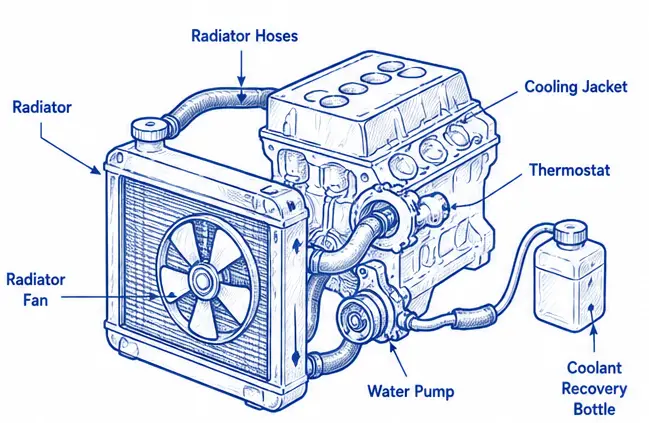
Coolant: a liquid that helps prevent the engine from overheating or freezing. It absorbs heat generated by the combustion process and carries it to the radiator.
Cooling jacket: hollow spaces in the engine block and cylinder head that allow coolant to flow around the cylinders and pull heat from the engine
Water pump: circulates coolant through the engine, radiator, and hoses
Thermostat: controls a valve that regulates the flow of coolant through the radiator
Radiator: releases that heat from the coolant into the air and then cycles the coolant back to the engine
Radiator hoses: hoses that connect the radiator to the engine so coolant can cycle through the cooling system
Radiator fan: pulls air through the radiator to help release heat from the coolant
Radiator cap: seals the radiator and contains a pressure valve; opens to release excess coolant into the recovery bottle when system pressure gets too high, and reseals once pressure drops
Coolant recovery bottle (overflow reservoir): collects the excess coolant when it expands from heat and overflows, then returns the coolant to the radiator
The flow
Most modern vehicles use a liquid cooling system, which is a closed, pressurized system. The coolant is contained within the car, continuously cycling through the engine and radiator. Because very little coolant is lost during normal operation, it needs infrequent topping up.
The water pump circulates the coolant through the cooling system. On many engines, the water pump is driven by a timing belt or serpentine belt, which is driven by the crankshaft. However, many modern vehicles now use electric water pumps to circulate the coolant.
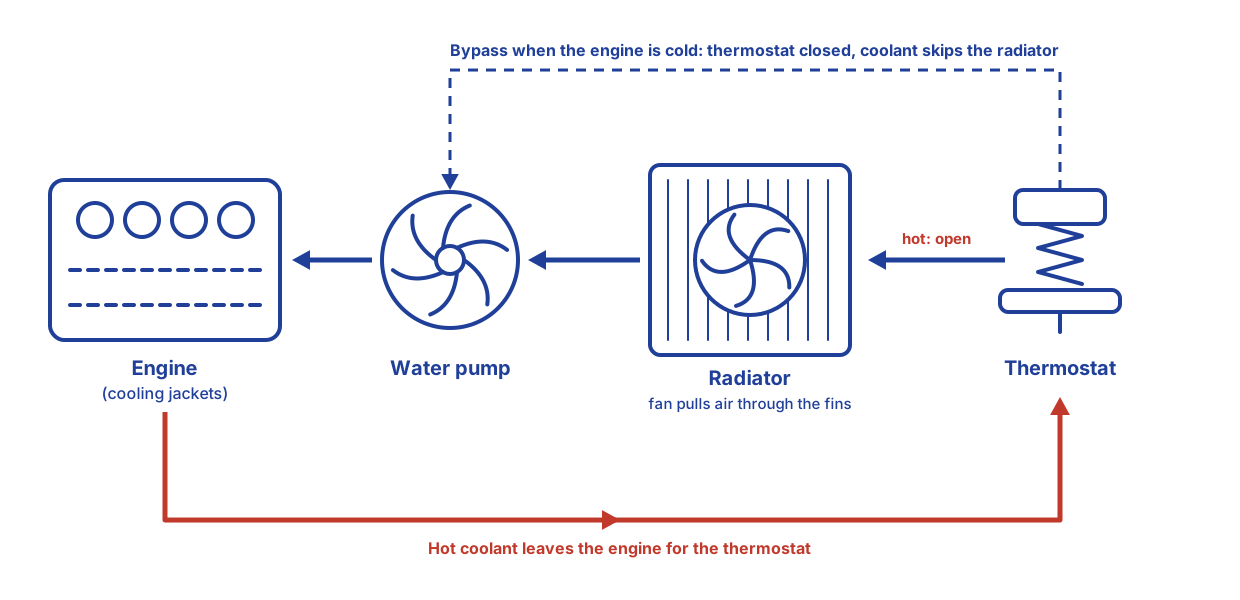
First, the water pump pushes the coolant into the cooling jackets, which surround the cylinders and other hot engine components. There, the coolant absorbs the heat produced by the combustion process. Once the heat has been transferred from the engine to the coolant, the coolant then flows to the thermostat housing.
The thermostat regulates a temperature-controlled valve. If the engine is hot enough, the valve opens and the water pump circulates the coolant to the radiator. If the engine is cold, the valve remains closed, and the coolant circulates through a smaller bypass back to the water pump. This helps the engine warm up quickly, reduces engine wear, and improves fuel efficiency.
When the coolant is hot, it is sent to the radiator to remove that heat. The radiator consists of two tanks linked together by many small tubes and cooling fins. The hot coolant first enters the upper radiator tank and flows down through the narrow tubes. This process provides a large contact surface between the liquid and the radiator, allowing heat to transfer from the coolant to the tubes and then to the surrounding air. At the same time, radiator fans mounted behind the radiator move air through the cooling fins. This air flows over the radiator fins, pulling heat from the tubes as the coolant passes through the radiator. The now-cooled liquid then returns to the water pump, where it will be circulated back to the engine to start the cycle again.
Lubrication system
As engine parts move, they generate friction and heat. Without lubrication, these parts would damage each other, and the engine would seize.
A vehicle’s lubrication system is a pressurized system that cycles engine oil through the engine, helping to reduce friction damage, and drawing away heat.
In addition to reducing friction, engine oil also helps keep the engine clean by collecting dirt and other particulates and passing them through the oil filter. Finally, engine oil creates a seal between the cylinder walls and piston rings, helping the rings create the compression needed for combustion.
Components
Oil pan: a reservoir at the bottom of the engine that stores engine oil
Oil pump: a pump that moves oil from the oil pan to the engine
Oil pickup screen: a mesh screen that prevents large debris from entering the oil pump
Pressure relief valve: a valve that opens when the oil pressure is too high, allowing excess oil to cycle back to the oil pan
Oil filter: filters dirt and other contaminants from the oil before it cycles through the engine
Oil galleries: passages that distribute oil to moving engine parts
The flow
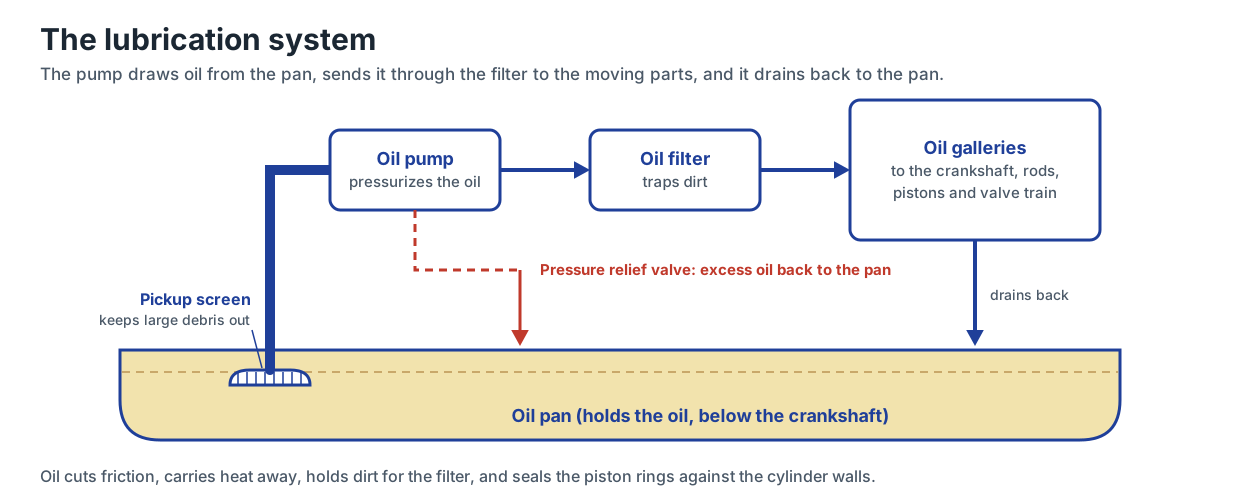
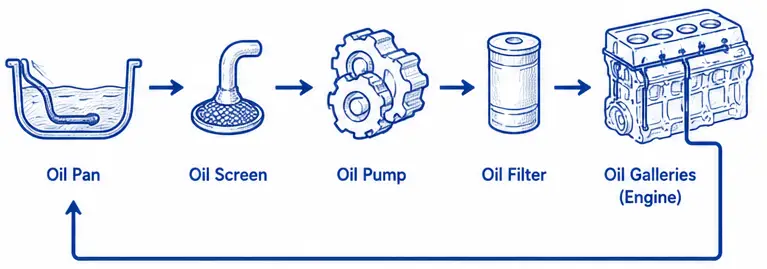
The lubrication cycle begins in the oil pan, which is a reservoir at the bottom of the engine, below the crankshaft. This pan holds several liters/quarts of engine oil and is where the oil is stored when not in use. It also helps cool the oil before it is cycled back through the engine.
As the engine runs, the oil pump draws oil up from the oil pan and into the engine. In the process, the oil passes through the oil pickup screen, which protects the oil pump from drawing up any large debris from the pan.
The oil pump then pressurizes the oil, allowing it to move through the narrow oil galleries. If the pressure ever gets too high, the pressure relief valve opens to allow excess oil to return to the oil pan.
From the oil pump, the oil flows through the oil filter, which filters out dirt and other small particulates. This prevents dirt from contaminating and harming the engine components.
The clean oil then enters the oil galleries, where it is distributed throughout the engine. The oil forms a thin film between the moving parts, allowing them to avoid direct contact. The oil also creates a seal between the piston rings and the cylinder walls, helping the rings create the compression needed for combustion.
As engine oil passes over engine components, the oil collects and suspends dirt, metal shavings, and other debris while simultaneously carrying away excess heat. Smaller particles are trapped as the oil passes through the oil filter, while larger debris tends to settle in the oil pan. Over time, these contaminants build up, and the filter becomes less effective at removing debris. That’s why it’s important to change the engine oil and oil filter regularly, to keep the engine running efficiently.
After circulating through and lubricating the engine components, the oil drains back into the oil pan. Then, the oil is drawn back up by the oil pump, and the cycle begins again.