



Chassis
Chassis
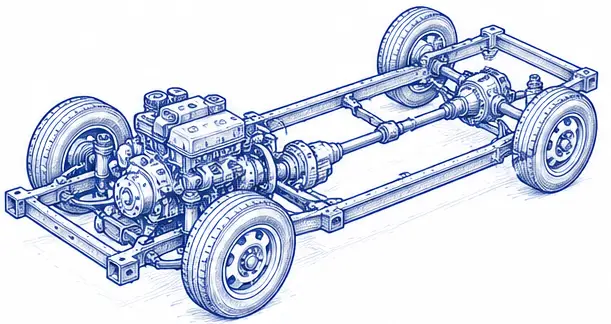
A chassis is the load-bearing framework of a vehicle. It holds the engine, supports the body, and connects to the vehicle’s major mechanical systems, including the transmission, suspension, steering, and braking systems.
Drivetrains
A drivetrain is a group of components that transfers mechanical power from the engine to the wheels. It includes the transmission, driveshafts, axles, and either the torque converter or the clutch, depending on whether the vehicle is automatic or manual.
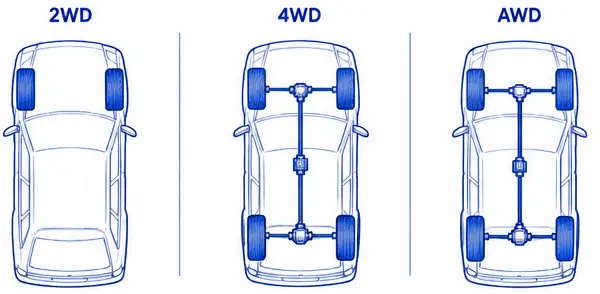
Vehicles can be classified as either two-wheel, four-wheel, or all-wheel drive, depending on how the drivetrain distributes power to the wheels.
Two-wheel drive (2WD): The power from the engine is sent to two wheels on the vehicle, either the front wheels (front-wheel drive), or the rear wheels (rear-wheel drive).
Four-wheel drive (4WD): The power from the engine can be sent to all four wheels of the vehicle. These vehicles are commonly used for off-road driving, as they help improve traction on uneven surfaces. Most 4WD systems need to be manually engaged, as they will stay in 2WD by default. Some new systems, however, will automatically switch between 2WD and 4WD as needed.
All-wheel drive (AWD): The power from the engine is distributed to all four wheels of the vehicle and is optimized for on-road driving rather than off-road. Most AWD systems automatically deliver varying power and torque to the wheels based on road conditions.
Transmission
The transmission transmits power from the engine to the wheels using gear ratios. It allows the engine to operate within an efficient RPM range by adapting the power and speed sent to the wheels. By utilizing the appropriate gear ratio for a vehicle’s load and speed, the transmission allows the vehicle to accelerate and maintain speed without stalling or overheating.
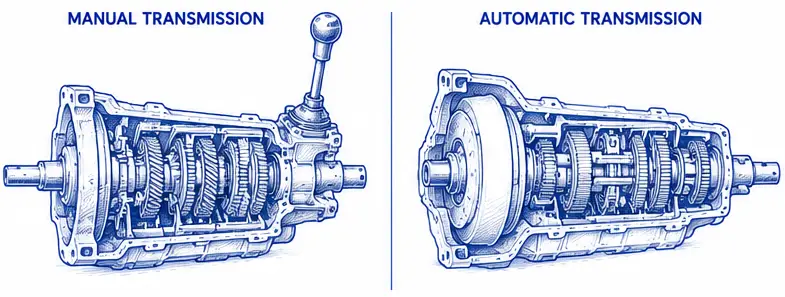
There are two types of transmission: manual and automatic.
Manual: In a manual transmission, the driver must manually select the appropriate gear ratio for the car’s current speed and torque. To do so, the driver engages a specific pedal called a clutch, which temporarily disconnects the engine from the transmission. Engine power briefly stops reaching the transmission, allowing the driver to shift gears up or down. To keep the engine running while stopped, the vehicle must either be in neutral or have the driver press the clutch pedal to disconnect the transmission from the engine.
Automatic: Automatic transmissions use a planetary gear system and internal clutches to change gear ratios without driver input. The torque converter is a key component of an automatic transmission, transferring torque from the engine to the transmission through transmission fluid. It also allows the engine to keep running while the vehicle is both in gear and stopped by letting the engine and transmission rotate at different speeds.
Suspension and Steering
The suspension system serves 3 purposes:
- Supports vehicle weight
- Maintains tire contact with the ground
- Absorbs shock
Suspension
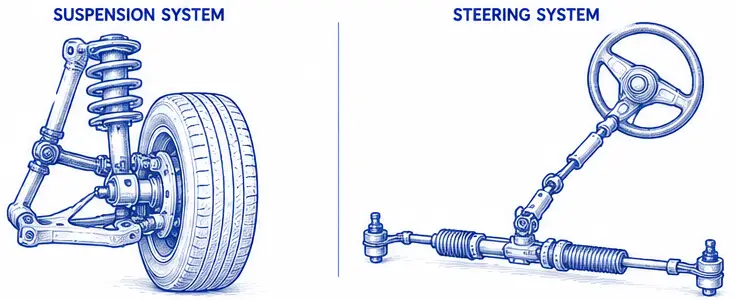
The chassis connects to the wheels via the vehicle’s suspension system, which supports the vehicle’s weight and movement. The suspension keeps the vehicle steady as it drives, allows it to absorb impact and shock from the road, and keeps the tires in contact with the ground by maximizing friction.
Without a suspension system, the chassis and wheels would move up and down together. Road bumps would transfer much more force upwards through the vehicle, jolting the entire body with each road imperfection. Instead, the suspension system absorbs and dissipates the force of the impact as the vehicle passes over a bump. This lets the wheels move vertically independent of the rest of the chassis and helps keep the wheels in contact with the road.
Suspension systems work to provide this smooth ride and handling through a combination of springs, dampers, and sway bars.
Springs
There are many different spring designs, including coil springs, leaf springs, and air springs. Each type of spring, however, fundamentally acts to absorb impact from the wheels by compressing and rebounding against the force transferred from the road through the wheels.
Dampers
While the springs absorb energy, the dampers help to dissipate it. Dampers can come in the form of shock absorbers or struts. Shock absorbers reduce the vibrations from the springs by converting kinetic energy into heat energy. Struts are essentially a combination of a coil spring and a shock absorber. They act to dissipate energy and provide additional structural support for the suspension.
Sway bars
Sway bars, also called “anti-roll bars,” provide additional stability to a vehicle by reducing body roll while cornering. The sway bar connects the left and right sides of the suspension with a torsion bar. As the vehicle turns, the outside suspension compresses more than the inside suspension. The sway bar resists that difference in movement by twisting and distributing that force more evenly between the two sides, stabilizing the vehicle.
Steering
The steering wheel is connected to the steering rack by the steering shaft. When the steering wheel turns, the shaft rotates the pinion gear, which connects the steering shaft to the steering rack. The gear converts the shaft’s rotational motion into linear motion, moving the rack left or right. This motion transfers through the tie rod to the knuckle attached to the wheel, turning it.
Brake System
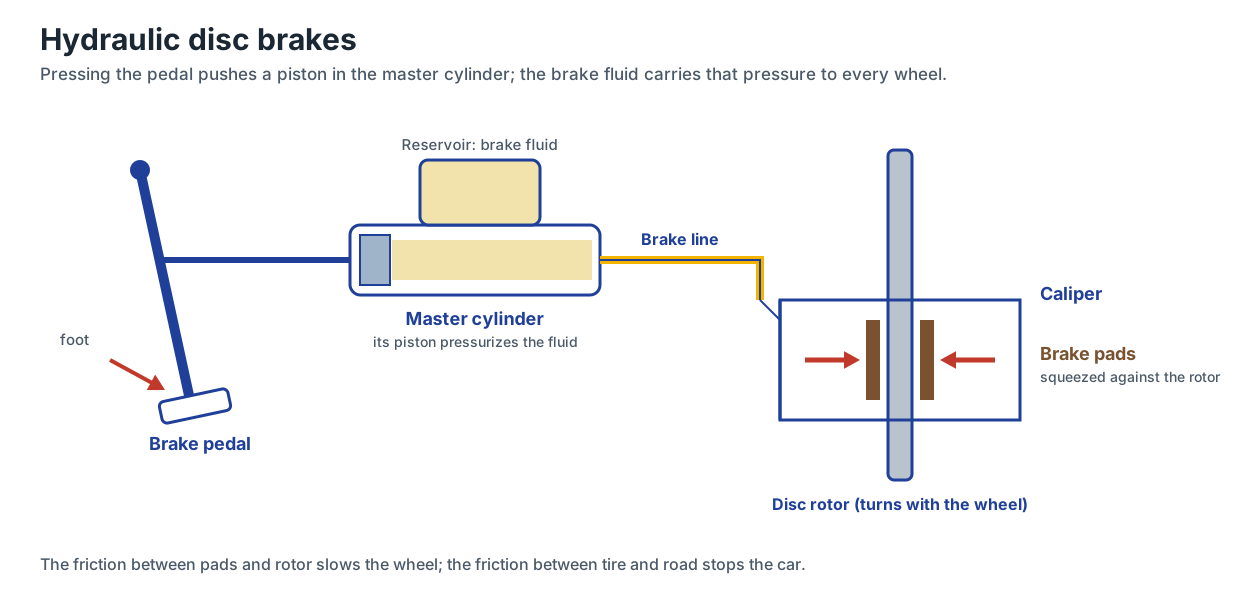
A vehicle’s braking system works through friction. Brake pads are squeezed against the rotor attached to the wheel hub, which slows the rotation of the wheels. The friction between the tires and the road then brings the vehicle to a stop.
When a driver presses the brake pedal, the force of the motion transfers to a piston. This piston is inside a brake cylinder called the master cylinder, which sits behind the brake pedal. Inside this cylinder is brake fluid. The piston then moves inside the cylinder, creating hydraulic pressure on the brake fluid and sending the fluid to each wheel through a series of brake lines.
The pressurized brake fluid then forces the pistons on each wheel to squeeze the brake pads against the wheel rotor, which is attached to the wheel. This creates the necessary friction that slows the wheels.