



Introduction to force and laws of motion
This subchapter explores the core ideas behind forces and motion. You’ll work with three main topics:
Newton’s first law: The law of inertia
Concept and explanation
Newton’s First Law says that an object will stay at rest, or keep moving in a straight line at constant speed, unless a net external force acts on it. This tendency to resist changes in motion is called inertia.
A useful way to state the law is: if the net force () is zero, the object’s velocity doesn’t change.
This is why forces are needed to change motion (speed up, slow down, or turn), not to maintain constant velocity. The law is stated for inertial frames of reference, meaning frames that aren’t accelerating.
Illustrative example
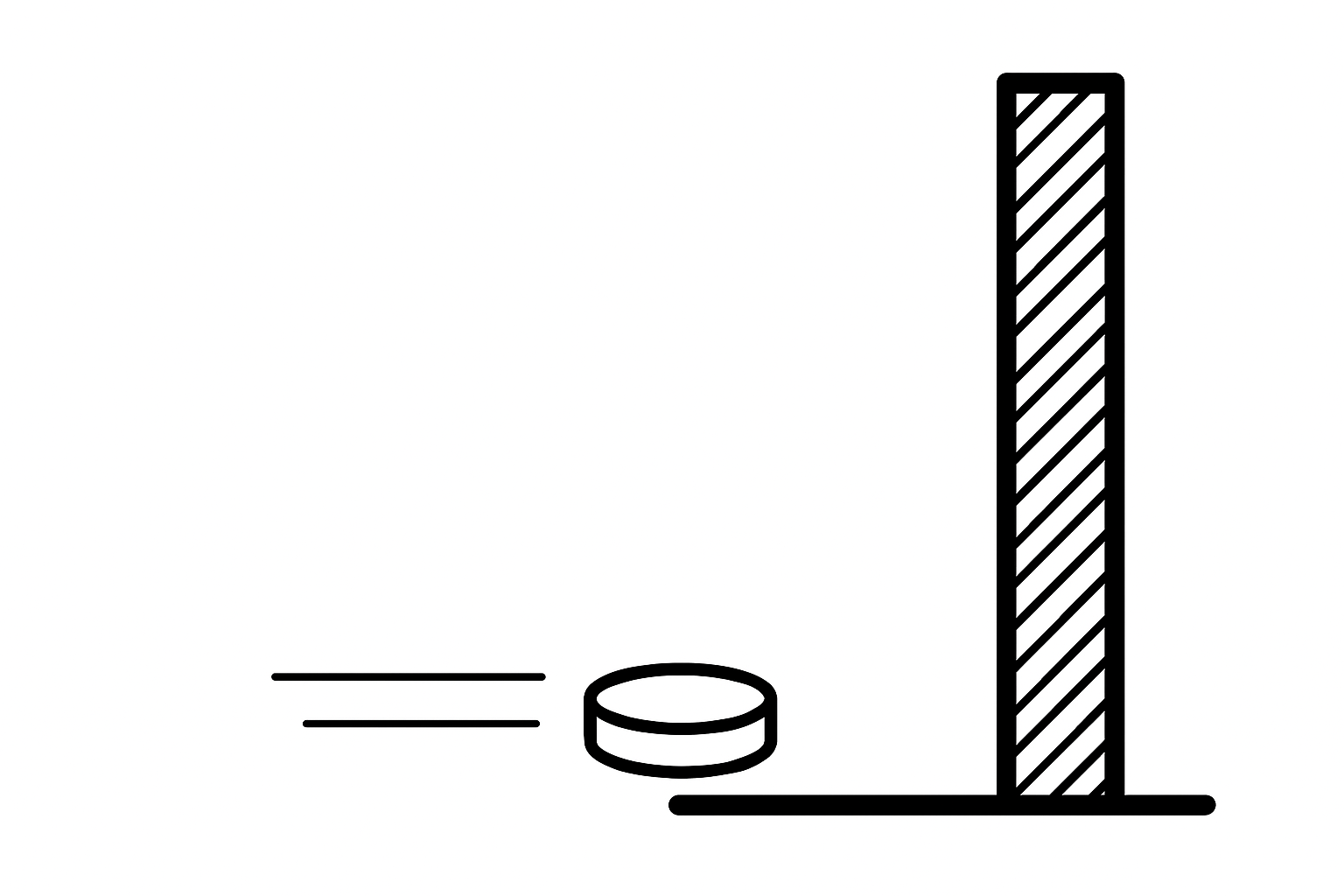
Consider a hockey puck sliding on nearly frictionless ice. With friction close to zero, the puck keeps moving in a straight line at nearly constant speed after it’s pushed. It only changes its motion if another force acts on it (for example, a collision with a barrier).
Newton’s second law: The law of acceleration
Concept and explanation
Newton’s Second Law connects net force, mass, and acceleration:
Here,
- is the vector sum of all forces acting on the object,
- is the mass of the object, and
- is the acceleration of the object.
This law tells you two key things:
- For a fixed net force, a larger mass produces a smaller acceleration.
- Because force and acceleration are vectors, direction matters just as much as magnitude.
Example problem 1
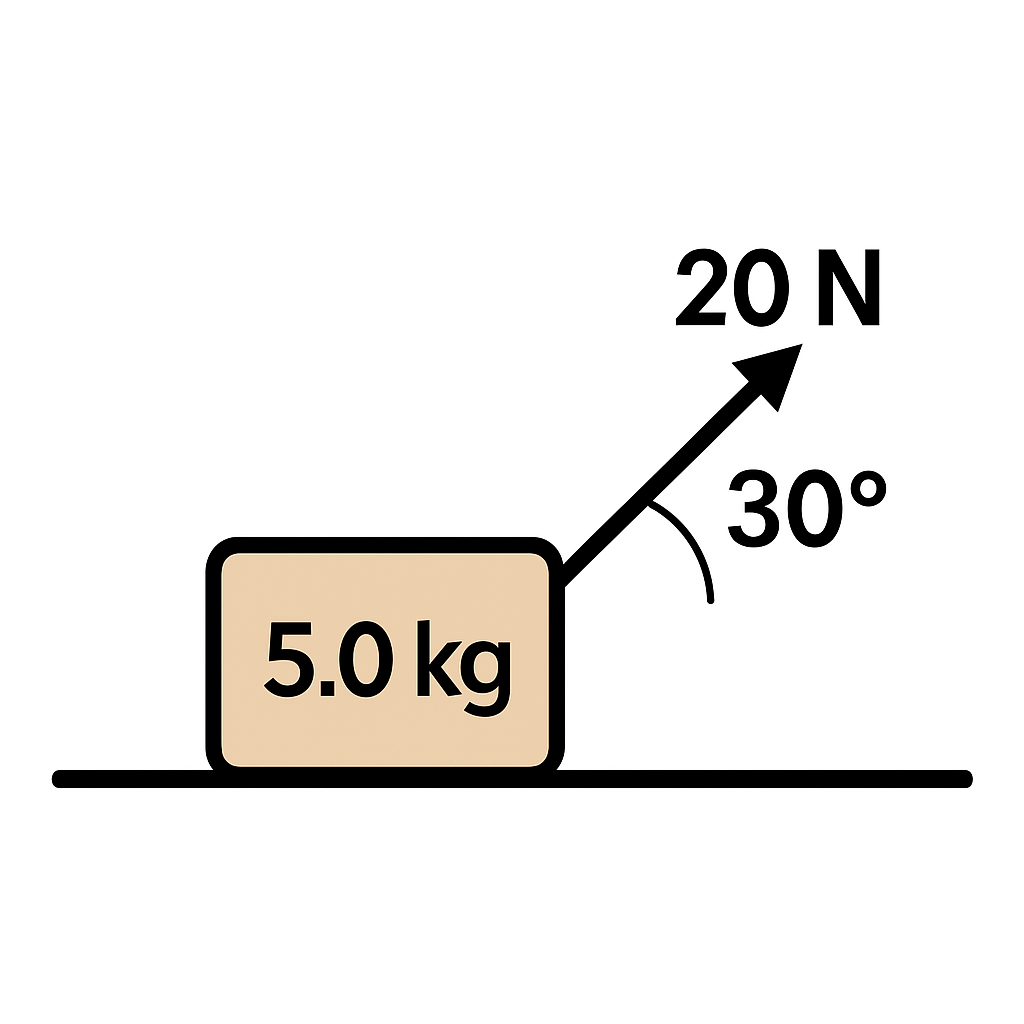
A block is pulled across a horizontal frictionless surface by a force of acting at an angle of above the horizontal. Determine the acceleration of the block.
Solution:
-
Resolve the applied force into components:
Using and :
-
Determine the net force in the horizontal direction:
The surface is frictionless, so there’s no horizontal friction force. The vertical forces balance (the normal force adjusts to account for the upward component ), so the only unbalanced force is horizontal:
-
Apply Newton’s Second Law:
The block accelerates at approximately in the horizontal direction.
Newton’s third law: Action and reaction
Concept and explanation
Newton’s Third Law says that forces come in pairs: if object A exerts a force on object B, then object B exerts an equal-magnitude force in the opposite direction on object A.
Mathematically, if object A exerts a force () on object B, then object B exerts a force
on object A. These two forces are equal in magnitude, opposite in direction, and (most importantly) they act on different objects.
Illustrative example
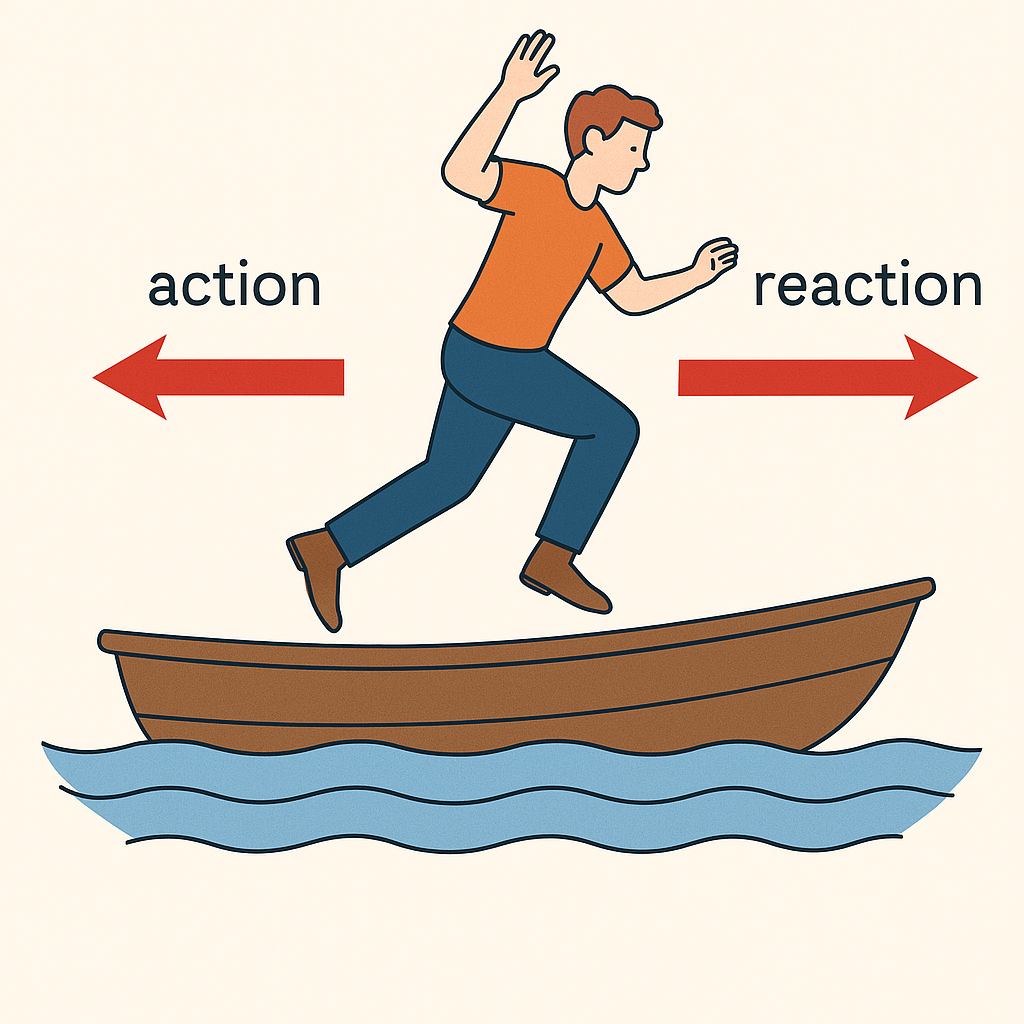
When you jump off a small boat, your legs push the boat backward. At the same time, the boat pushes you forward with an equal and opposite force. That’s why the boat moves in the opposite direction of your jump.
Example problem 2
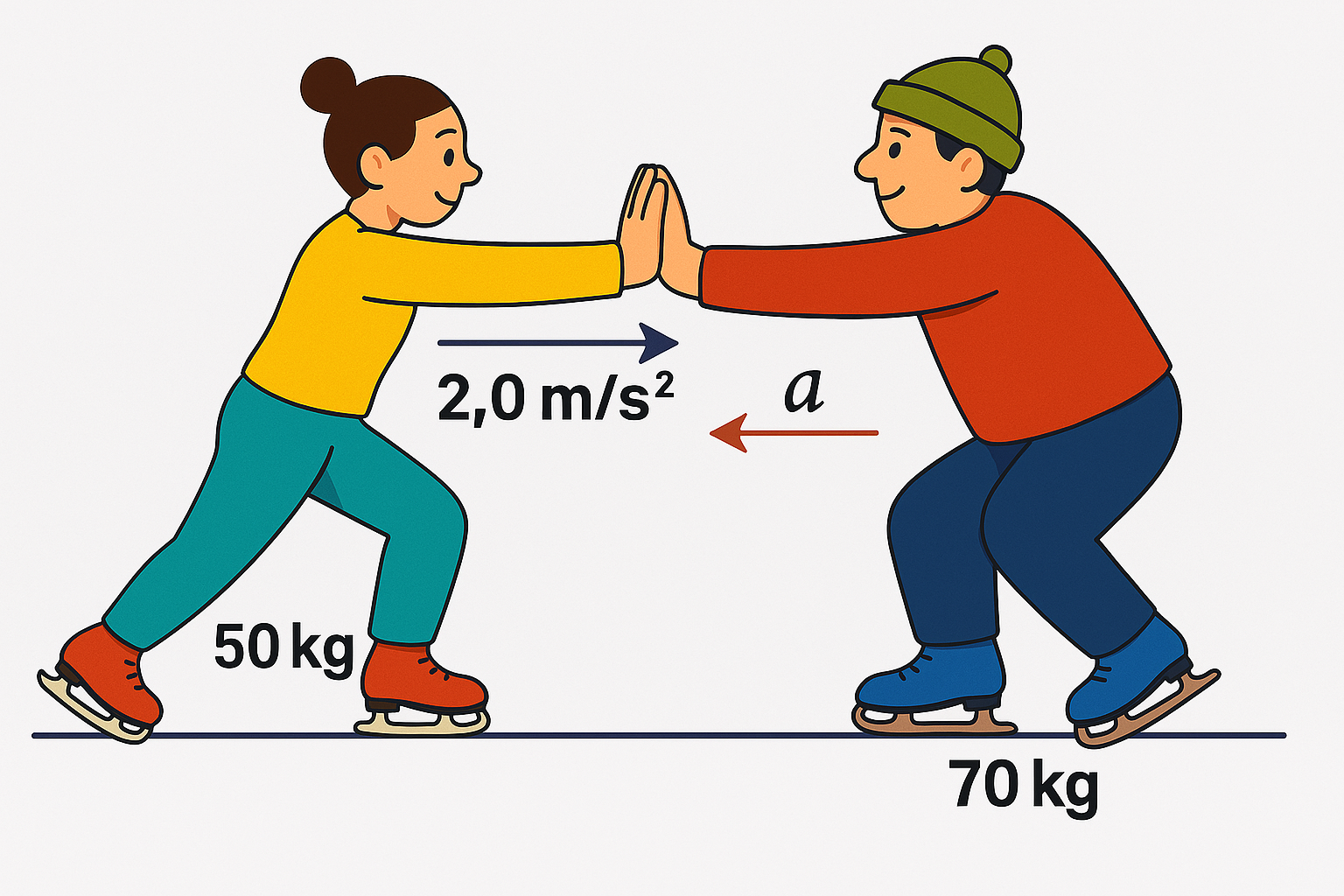
Two ice skaters initially at rest push off from each other. Skater A has a mass of and accelerates at to the right. Skater B has a mass of . Determine the acceleration of Skater B and verify that the forces between them are equal in magnitude and opposite in direction.
Solution:
-
Calculate the force associated with skater A’s acceleration:
By Newton’s Second Law,
-
Apply Newton’s Third Law:
Skater B experiences an equal-magnitude force in the opposite direction, so the force on B is to the left.
-
Determine the acceleration of skater B:
Using Newton’s Second Law for skater B,
Skater B accelerates at approximately to the left, and the forces between the skaters form an action-reaction pair of .
Example problem 3
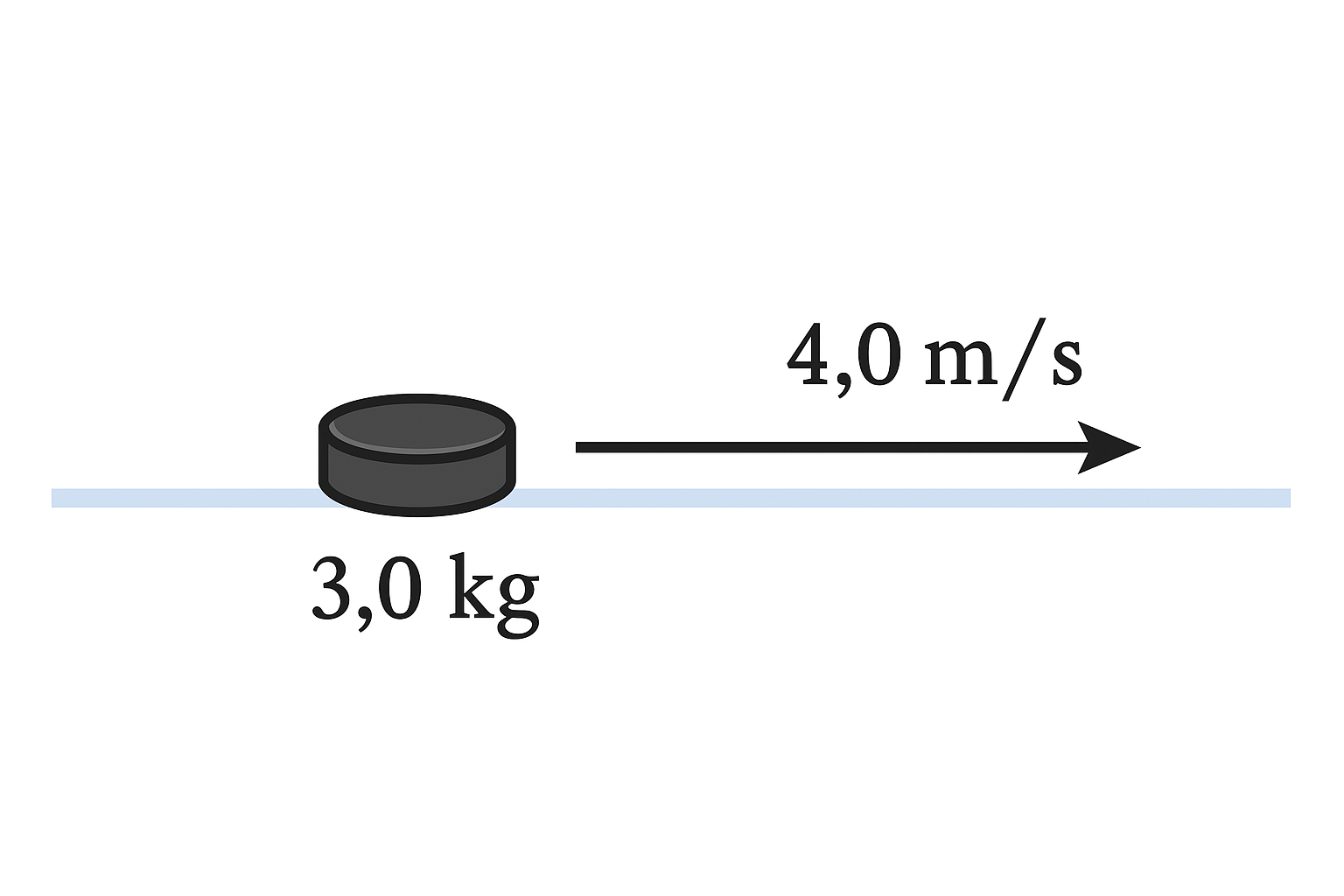
A hockey puck glides on a frictionless ice surface at a constant velocity of . No external forces act on the puck. Determine the puck’s acceleration and explain why its velocity remains constant.
Solution:
-
Apply Newton’s First Law:
Since no net external force is acting on the puck,
With , the acceleration must be zero:
-
Explanation:
With zero net force, there’s no change in velocity. So the puck keeps moving at the same constant speed of .
So the puck’s acceleration is ; it maintains a constant velocity due to the absence of any net external force.