



Friction and spring forces
In this subchapter, you’ll see how frictional forces oppose motion and how they affect the behavior of objects in contact with surfaces. We’ll focus on:
Introduction to friction
Friction is a resistive force that opposes the relative motion (or attempted motion) between two surfaces in contact. In introductory physics, we usually work with two main types of friction:
-
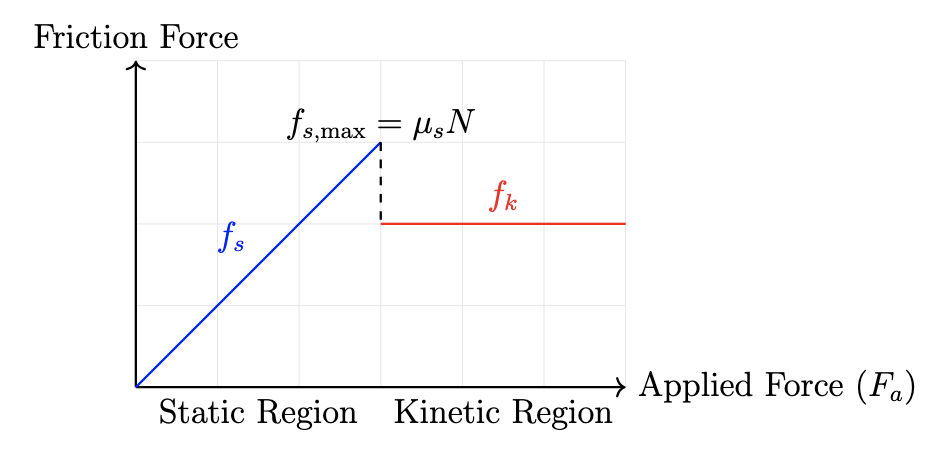
Static friction: Static friction prevents an object from starting to move. Its magnitude adjusts to match the applied force, up to a maximum value:
where is the coefficient of static friction and is the normal force.
-
Kinetic (sliding) friction: Once the object is sliding, kinetic friction opposes the motion with (approximately) constant magnitude:
where is the coefficient of kinetic friction.
As you increase an applied force, static friction increases to balance it until it reaches its maximum value . If the applied force exceeds , the object begins to slide and kinetic friction takes over. Typically, kinetic friction is smaller than .
Friction on an inclined plane
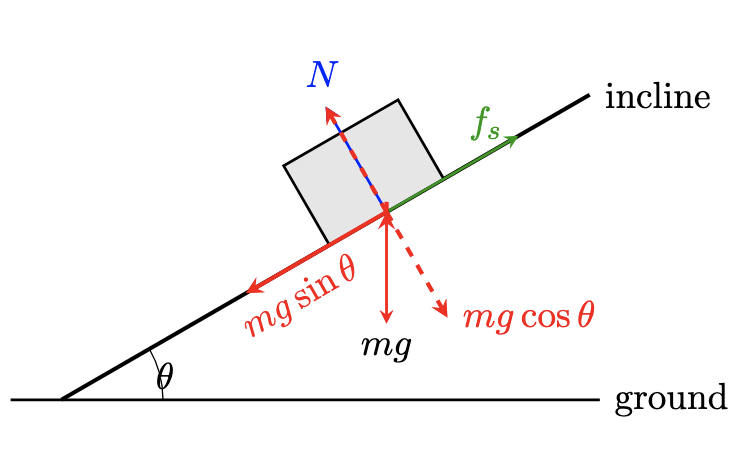
Consider a box of mass on an inclined plane that makes an angle with the horizontal. The weight of the box is . It’s helpful to resolve this weight into components relative to the plane:
- Parallel to the plane:
- Perpendicular to the plane:
The normal force exerted by the plane on the box is:
If friction is present, it acts along the surface of the incline and opposes the direction of motion (or the direction the box would move if it started sliding). Whether the friction is static or kinetic depends on whether the box is at rest or sliding.
Static equilibrium on an inclined plane
For the box to remain at rest, static friction must be able to balance the component of gravity parallel to the plane:
Rearranging the inequality gives the condition for no slipping:
The maximum angle before the box starts to slide is called the angle of repose. It is:
Motion on a frictional incline
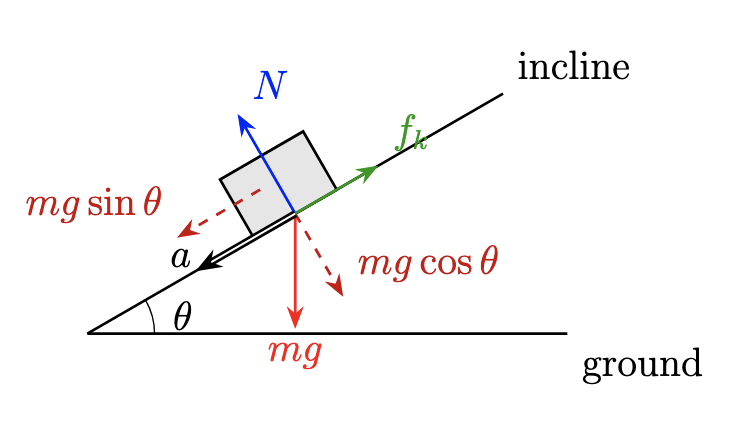
Once the box is sliding, kinetic friction applies:
Taking “down the incline” as the positive direction, the net force along the plane is:
so the acceleration is:
Example problem 1
A block rests on a horizontal table. The coefficient of static friction between the block and the table is . Determine the minimum horizontal force required to start moving the block.
Solution:
On a horizontal surface with no other vertical forces, the normal force equals the weight:
The maximum static friction is:
So you need a horizontal force slightly greater than to start the block moving.
Example problem 2
A block of mass is sliding on a horizontal frictional surface where the coefficient of kinetic friction is . If the initial speed of the block is , determine the deceleration and the distance required for the block to stop.
Solution:
First find the kinetic friction force. On a horizontal surface, , so:
Use Newton’s Second Law to find the acceleration magnitude:
Because friction opposes the motion, the acceleration is opposite the velocity (a deceleration).
Next use the kinematic equation:
with , , and :
So:
Spring forces
This part focuses on forces associated with springs: how springs exert restoring forces, how they store energy, and how combinations of springs behave. This section covers:
Hooke’s law and spring force
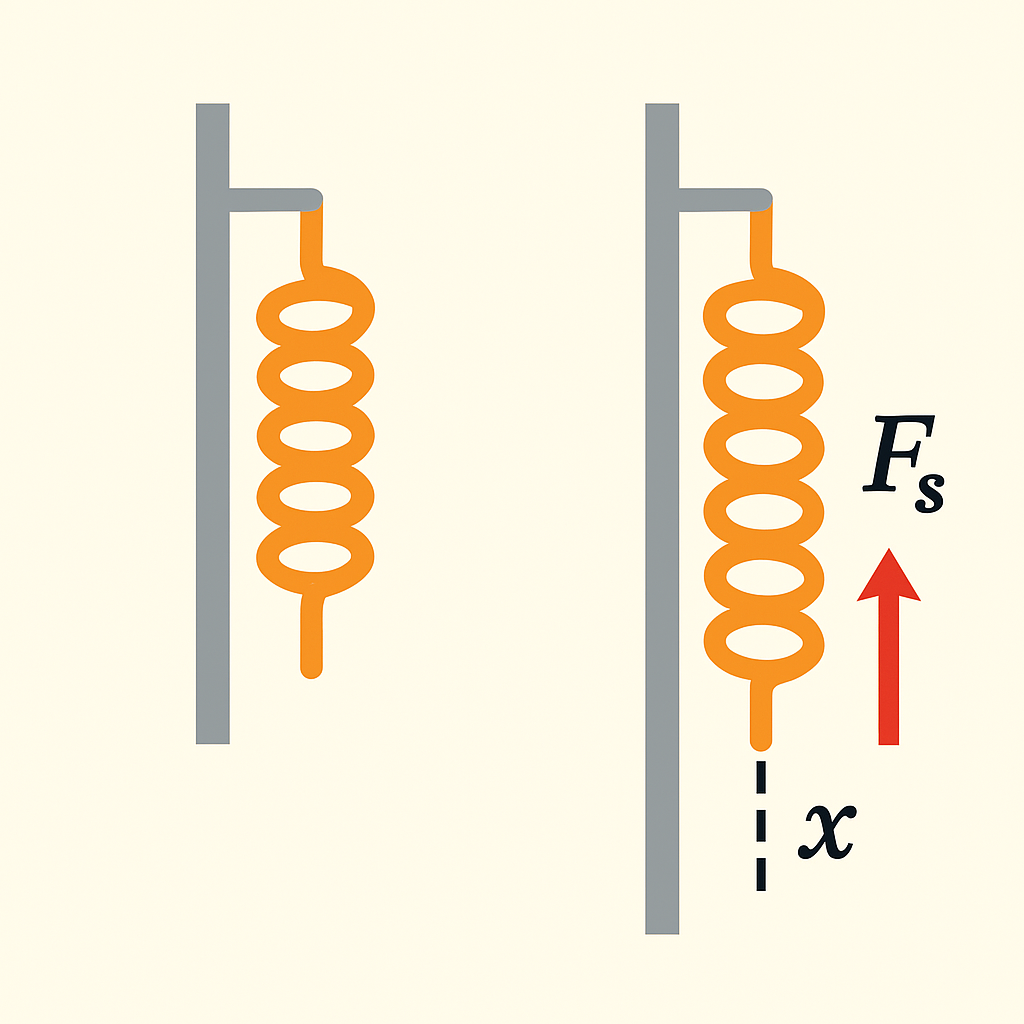
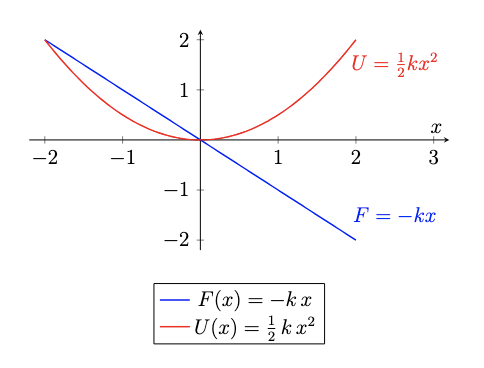
Hooke’s Law describes how an ideal spring responds to small stretches or compressions: the spring’s restoring force is proportional to the displacement from equilibrium.
where:
- is the restoring force exerted by the spring,
- is the displacement from the equilibrium position (the sign indicates direction),
- is the spring constant (a measure of stiffness).
The negative sign means the spring force always points opposite the displacement: stretch the spring to the right, and the spring pulls to the left; compress it to the left, and it pushes to the right.
Elastic potential energy
When a spring is stretched or compressed by a displacement , it stores elastic potential energy:
This stored energy can be converted back into kinetic energy (or other forms) as the spring returns toward equilibrium.
Series and parallel spring configurations
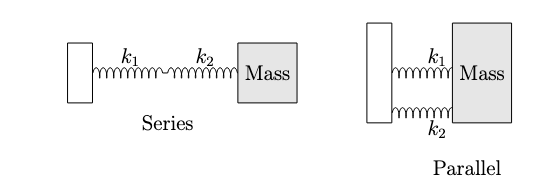
Springs can be combined in series or in parallel. The combination changes the system’s effective spring constant, .
Series combination
For springs in series with constants , the effective spring constant is:
A series combination behaves like a “softer” spring (smaller than the individual springs).
Parallel combination
For springs in parallel, the effective spring constant is the sum of the individual constants:
A parallel combination behaves like a “stiffer” spring (larger ).
Example problem 3
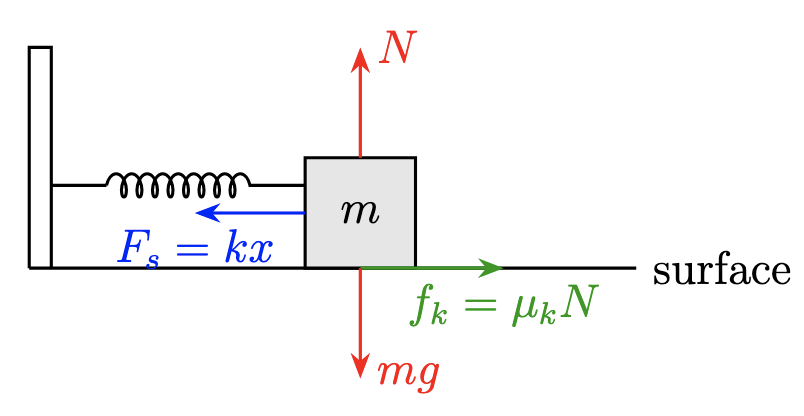
A block of mass is attached to a horizontal spring with spring constant and rests on a frictional horizontal surface with a coefficient of kinetic friction Initially, the block is displaced to the right from its equilibrium position and is released from rest. Assume that once released the block accelerates to the left (i.e., the spring force pulls it back toward equilibrium). Determine the initial acceleration of the block.
Solution:
Step 1: Identify the forces
-
Spring force: By Hooke’s Law,
With ,
The negative sign indicates the force is to the left (toward equilibrium).
-
Kinetic friction: The kinetic friction force is:
With and ,
Since the block accelerates to the left, friction acts to the right.
Step 2: Net force and acceleration
Take right as positive and left as negative. The spring force is negative (left), and friction is positive (right). Since the block accelerates left, the net force must be negative:
because the friction force acts opposite to the direction of acceleration (which is left). Thus,
Using Newton’s Second Law:
The negative sign indicates the acceleration is to the left, so the initial acceleration is approximately to the left.
Example Problem 4
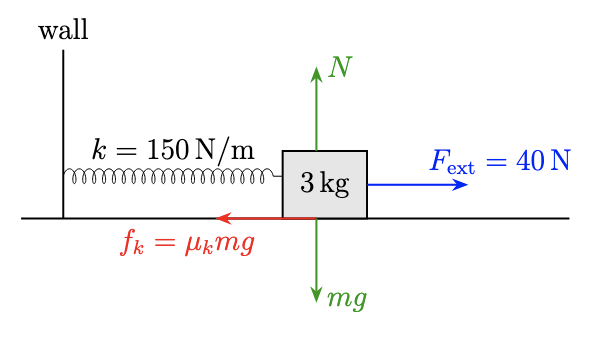
A block is attached to a wall by a spring with spring constant and is placed on a horizontal surface with a coefficient of kinetic friction Initially, the block is at the spring’s equilibrium position. An external force of is applied to pull the block away from the wall. Assume that as the block is pulled, the spring stretches by an amount . The friction force, which opposes the motion, is given by (a) Derive an expression for the net force acting on the block as a function of the displacement from equilibrium. (b) Evaluate the net acceleration of the block when the spring is stretched by .
Solution:
Step 1: Forces acting on the block
-
The external force, (to the right).
-
The restoring force of the spring (Hooke’s Law):
For , this force acts to the left.
-
The kinetic friction force opposes the motion. Since the block is pulled to the right, friction acts to the left, with magnitude:
Step 2: Net force as a function of
Take right as positive. The net force is the applied force minus the leftward spring force magnitude and minus the leftward friction force:
Step 3: Net acceleration at
Use , , , and . At :
So the net force is:
Then the acceleration is:
-
The net force as a function of displacement is:
-
When , the acceleration is approximately to the right.