


Achievable logoAchievable logo
AP Physics 1
Sign in
Sign up
Purchase
Textbook
Practice exams
Support
How it works
Exam catalog
Mountain with a flag at the peak
Textbook
Introduction
1. Decoding the exam
2. Vectors and their analysis
3. Kinematics
4. Laws of motion
4.1 Introduction to force and laws of motion
4.2 Free body diagrams and equilibrium
4.3 Friction and spring forces
4.4 Circular motion
5. Work, energy, and power
6. Linear momentum and collisions
7. Torque and rotational mechanics
8. Oscillations
9. Fluids
Wrapping up
Achievable logoAchievable logo
4.2 Free body diagrams and equilibrium
Achievable AP Physics 1
4. Laws of motion
Our AP Physics 1 course is currently in development and is a work-in-progress.

Free body diagrams and equilibrium

12 min read
Font
Discuss
Share
Feedback

This subchapter explains how to construct and use free-body diagrams (FBDs) to analyze forces and apply Newton’s laws of motion to solve problems.

In this section, we focus on:

  • Constructing free-body diagrams to visualize forces acting on an object.
  • Resolving forces into their horizontal and vertical components.
  • Applying the equilibrium conditions for static systems (∑Fx​=0, ∑Fy​=0, ∑τ=0).
  • Analyzing dynamic equilibrium (objects moving at constant velocity with zero net force) as well as situations with acceleration.

In this subchapter, we do not introduce friction. Our focus is on ideal force conditions, tensions, and multiple-body configurations.

Introduction to free-body diagrams

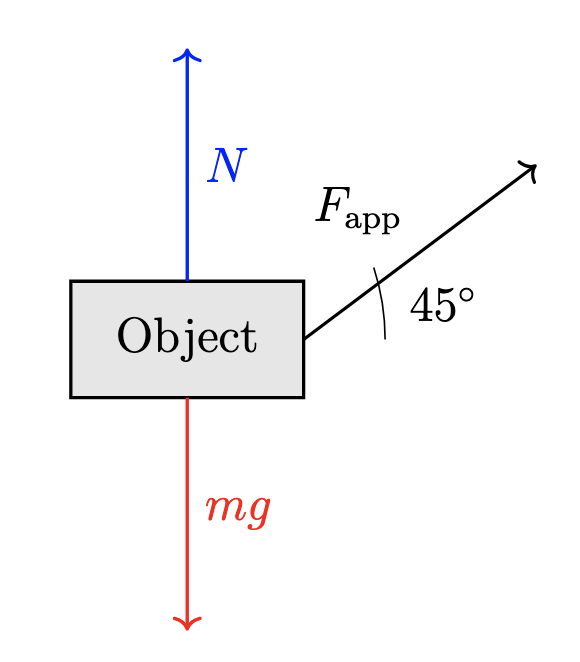
A free-body diagram is a simplified sketch that shows all the forces acting on a single, isolated object. You use it to translate a physical situation into equations for motion or equilibrium.

The typical steps in drawing an FBD are:

  1. Isolate the object: Imagine the object removed from its environment.
  2. Identify all forces: List every force acting on the object. Common forces include:
    • Weight, mg, acting downward.
    • Normal force, N, acting perpendicular to the supporting surface.
    • Applied forces, Fapp​, from pushes or pulls.
    • Tension, T, in strings or ropes.
  3. Choose a coordinate system: Pick axes that simplify the math (for example, one axis along an inclined surface).
  4. Resolve forces into components: For forces not aligned with your axes, break them into components along the chosen directions.
  5. Label and draw: Draw an arrow for each force, showing its direction and labeling its magnitude (or an unknown symbol).
A specimen free body diagram

Resolving forces into components

When a force acts at an angle, it’s usually easier to work with its components along your coordinate axes (often horizontal and vertical). Those components are what you plug into Newton’s second law in each direction.

Steps to resolve a force

Suppose a force F acts on an object at an angle θ from the horizontal. We can resolve F into:

  • A horizontal component, Fx​=Fcosθ,
  • A vertical component, Fy​=Fsinθ.

Once you have Fx​ and Fy​, you can write separate equations for the x- and y-directions.

Example: Resolving an applied force

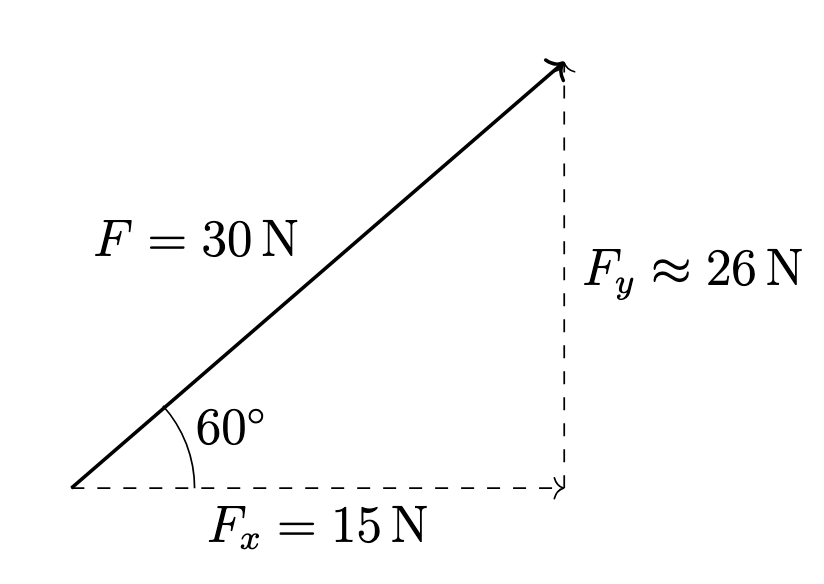
Consider a force F=30N applied at an angle θ=60∘ above the horizontal. The components are:

Fx​=30cos60∘,Fy​=30sin60∘.

Since cos60∘=0.5 and sin60∘≈0.866, we get:

Fx​=30×0.5=15N,Fy​=30×0.866≈25.98N.

You’d then use Fx​ to analyze motion in the horizontal direction and Fy​ to analyze motion in the vertical direction.

Resolving an applied force into components

Static equilibrium

An object is in static equilibrium when it is at rest and both the net force and the net torque on it are zero. In equation form:

∑Fx​=0,∑Fy​=0,∑τ=0.

These conditions let you solve for unknown forces (like tensions or normal forces) in a system.

Object on a horizontal surface

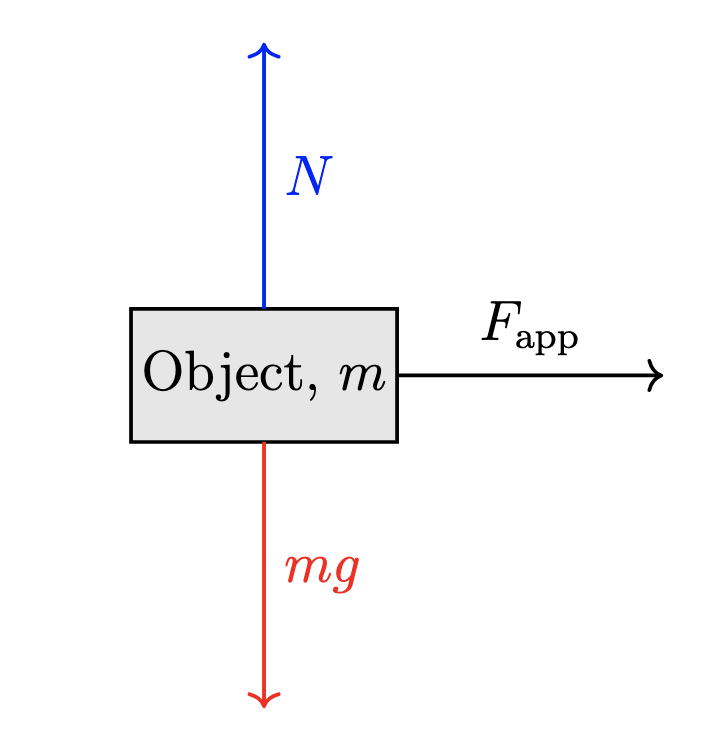
Consider an object of mass m resting on a horizontal surface with an applied force that has both horizontal and vertical components. In equilibrium:

  • Vertical forces: N+Fy​=mg.
  • Horizontal forces: Any horizontal applied force must be balanced by an opposing force.
FBD of the object on the horizontal surface

Suspended object with two strings

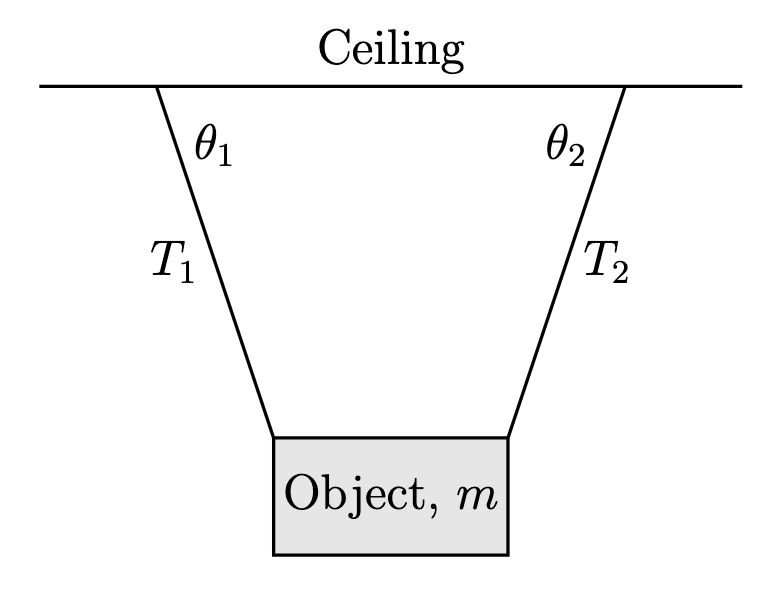
An object of mass m is suspended from the ceiling by two strings. The left string makes an angle θ1​ with the vertical, and the right string makes an angle θ2​ with the vertical. In static equilibrium, the forces satisfy:

  • Vertical balance: T1​cosθ1​+T2​cosθ2​=mg.
  • Horizontal balance: T1​sinθ1​=T2​sinθ2​.

From the horizontal equation,

T1​=T2​sinθ1​sinθ2​​.

Substitute this expression into the vertical balance equation to solve for the tensions.

FBD of an object suspended by two strings

Dynamic equilibrium

Dynamic equilibrium occurs when an object moves at a constant velocity (possibly non-zero), so the net force on it is zero:

∑Fx​=0and∑Fy​=0.

Constant velocity means the acceleration is zero, so the force balance looks the same as in static equilibrium.

Constant velocity motion

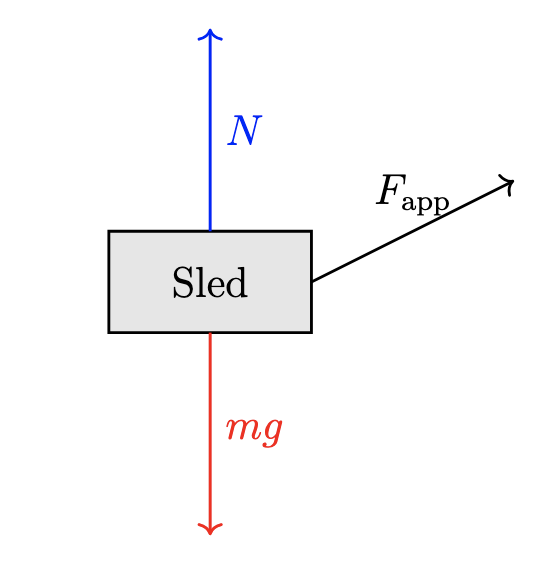
Consider a sled moving across frictionless ice at a constant velocity while being pulled by a rope at an angle. Even though the sled is moving, the net force is zero.

Sled in constant velocity motion

Since the sled moves at constant velocity, the net force in all directions is zero:

Fnet​=0⟹a=0.

Accelerated motion

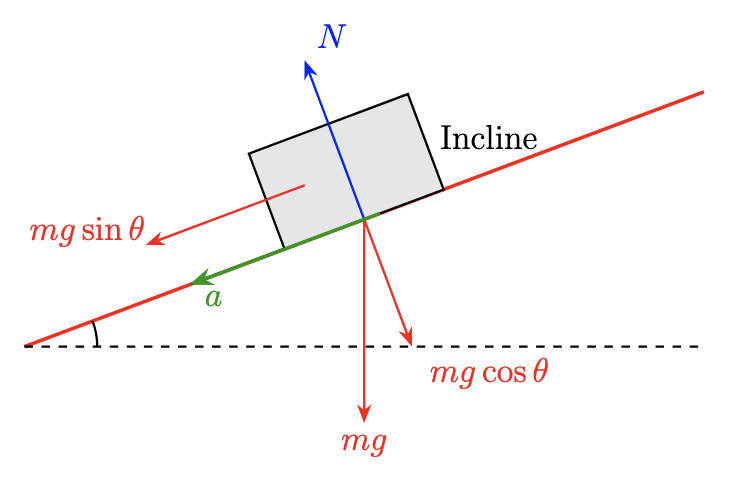
When a box rests on a frictionless inclined plane, its weight can be resolved into two components:

  • A component perpendicular to the plane (balanced by the normal force)
  • A component parallel to the plane (which causes acceleration down the plane if nothing counters it)

Free-body diagram of a box on an inclined plane

Free-body diagram of a box on an inclined plane

Consider a box of mass m on a frictionless incline that makes an angle θ with the horizontal. The weight of the box is mg, acting vertically downward. We resolve this weight into:

  • A component perpendicular to the incline: mgcosθ,
  • A component parallel to the incline: mgsinθ.

Since the plane is frictionless, the only unbalanced force causing the box to accelerate is the parallel component.

Equilibrium in the perpendicular direction

For the box to remain in contact with the plane (that is, not accelerate through the surface), the normal force N must balance the perpendicular component of the weight:

N=mgcosθ.

Acceleration along the incline

In the absence of friction, the net force acting along the plane is:

F∥​=mgsinθ.

Using Newton’s second law along the incline:

mgsinθ=ma,

which simplifies to:

a=gsinθ.

Example problem 1

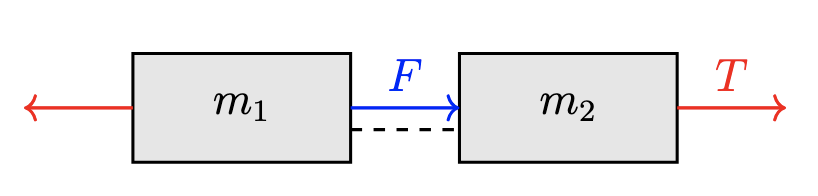
Consider two blocks of masses m1​ and m2​ on a frictionless horizontal surface connected by a light string. A force F is applied to m1​, causing both blocks to accelerate together.

(a) Draw the free-body diagram for each block. (b) Derive the acceleration of the system and the tension in the string.

Solution:

(spoiler)

For Block 1 (mass m1​): The forces acting are the applied force F to the right and the tension T to the left.

Newton’s second law gives:

F−T=m1​a.

For Block 2 (mass m2​): The only horizontal force is the tension T pulling it to the right:

T=m2​a.

Combine the equations: Substitute T=m2​a into the first equation:

F−m2​a=m1​a⇒F=(m1​+m2​)a.

Thus, the acceleration is:

a=m1​+m2​F​.

And the tension is:

T=m2​⋅m1​+m2​F​.

Free body diagram of the m1, m2 system

Example Problem 2

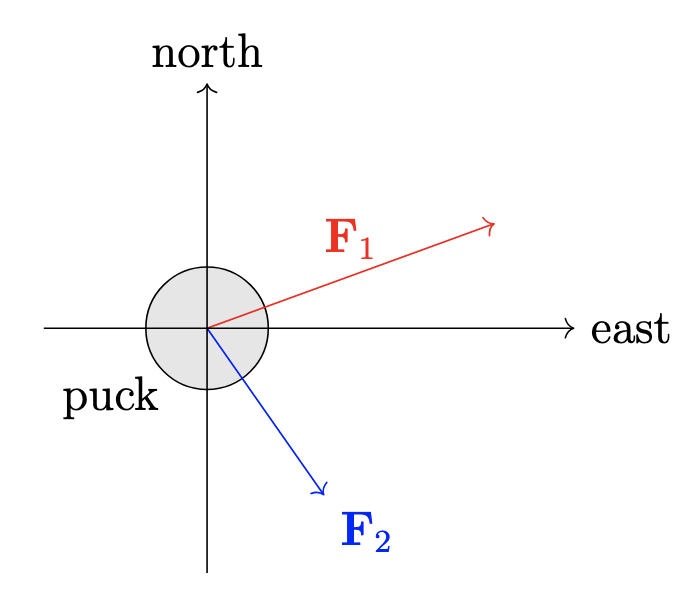
A 1.50 kg puck glides on perfectly frictionless ice. It is simultaneously pulled by two massless ropes:

  • Rope 1 exerts a force of magnitude F1​=8.0 N at an angle of 20∘ north of east.
  • Rope 2 exerts a force of magnitude F2​=5.0 N at an angle of 55∘ south of east.
  1. Draw a complete free-body diagram of the puck, labeling F1​ and F2​.
  2. Decompose each force into its components Fx​ (eastward) and Fy​ (northward). Write your results in terms of sines and cosines, then compute numerical values.
  3. Using Newton’s second law, determine the puck’s acceleration a. Give both the magnitude a=∣a∣ and the direction ϕ, measured as “degrees north of east.”
  4. Suppose a third rope is tied to the puck so that it remains at rest (net acceleration zero). What must be the magnitude and direction of the third force F3​ to hold it in equilibrium?

Solution:

(spoiler)
  1. Free-body diagram.
Free body diagram of the puck with F1 and F2
  1. Resolve into components.

    F1​=F1x​i^+F1y​j^​,F1x​=F1​cos20∘,F1y​=F1​sin20∘,

    F2​=F2x​i^+F2y​j^​,F2x​=F2​cos55∘,F2y​=−F2​sin55∘.

    Numerically:

    • F1x​=8.0cos20∘≈7.52N
    • F1y​=8.0sin20∘≈2.74N
    • F2x​=5.0cos55∘≈2.87N
    • F2y​=−5.0sin55∘≈−4.10N
  2. Net force and acceleration.

    Fnet,x​=F1x​+F2x​=7.52+2.87=10.39 N,

    Fnet,y​=F1y​+F2y​=2.74−4.10=−1.36 N.

    With m=1.50kg,

    ax​=mFnet,x​​=1.5010.39​≈6.93 m/s2,

    ay​=mFnet,y​​=1.50−1.36​≈−0.91 m/s2.

    Then

    a=ax2​+ay2​​≈6.932+(−0.91)2​≈6.98 m/s2,

    ϕ=arctan(ax​ay​​)≈arctan(−0.91/6.93)≈−7.45∘(or 7.45∘ south of east).

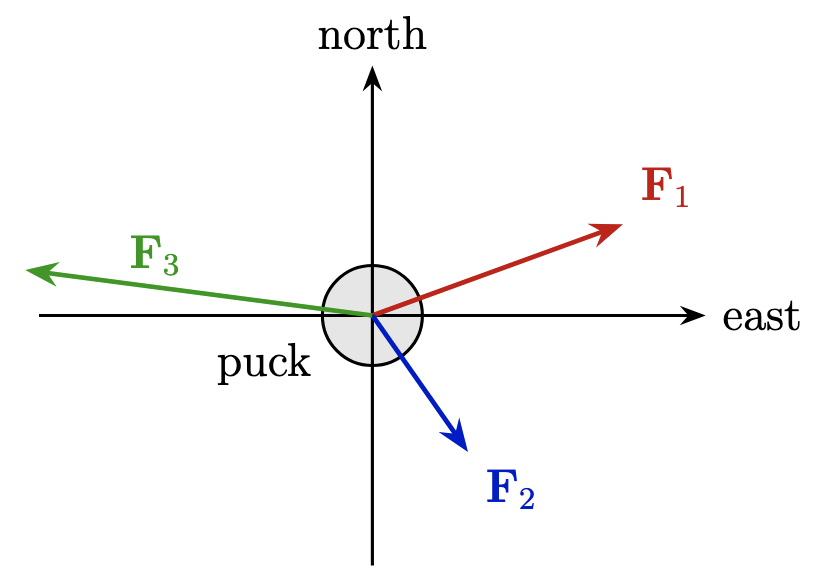
  3. Third force for equilibrium.

    F3​=−(F1​+F2​),

    so

    F3x​=−10.39 N,F3y​=+1.36 N.

    Magnitude and direction:

    F3​=(−10.39)2+(1.36)2​≈10.48 N,

    θ3​=arctan(10.391.36​)≈7.45∘(north of west).

Puck with all three forces acting on it

Introduction to free-body diagrams

  • Visual tool: shows all forces on a single, isolated object
  • Steps:
    • Isolate object, identify all forces (weight, normal, applied, tension)
    • Choose coordinate system, resolve forces into components
    • Draw and label all force vectors

Resolving forces into components

  • For force F at angle θ:
    • Horizontal: Fx​=Fcosθ
    • Vertical: Fy​=Fsinθ
  • Use components to write Newton’s laws in x and y directions

Static equilibrium

  • Conditions: ∑Fx​=0, ∑Fy​=0, ∑τ=0
  • Object at rest: net force and net torque are zero
    • Horizontal surface: N+Fy​=mg (vertical), horizontal forces must balance
    • Two-string suspension:
      • Vertical: T1​cosθ1​+T2​cosθ2​=mg
      • Horizontal: T1​sinθ1​=T2​sinθ2​
      • T1​=T2​sinθ1​sinθ2​​

Dynamic equilibrium

  • Object moves at constant velocity: ∑Fx​=0, ∑Fy​=0
  • Net force zero implies a=0 (no acceleration)
  • Example: sled on frictionless ice, pulled at constant velocity

Accelerated motion on an incline

  • Box on frictionless incline:
    • Resolve weight: mgcosθ (perpendicular), mgsinθ (parallel)
    • Normal force: N=mgcosθ
    • Net force down incline: F∥​=mgsinθ
    • Acceleration: a=gsinθ

Multiple-body systems (example: two blocks with string)

  • For m1​ (pulled by F): F−T=m1​a
  • For m2​: T=m2​a
  • System acceleration: a=m1​+m2​F​
  • String tension: T=m2​⋅m1​+m2​F​

Vector addition and equilibrium (example: puck with two ropes)

  • Resolve each force into x and y components using sines and cosines
  • Net force: sum x and y components
  • Acceleration: ax​=Fnet,x​/m, ay​=Fnet,y​/m
  • Magnitude: a=ax2​+ay2​​; direction: arctan(ay​/ax​)
  • For equilibrium: third force must exactly cancel net force (equal magnitude, opposite direction)

Key strategies

  • Always start with a clear free-body diagram
  • Resolve all forces into components along chosen axes
  • Apply equilibrium or Newton’s laws to relate forces and accelerations
  • Solve algebraically for unknowns

Sign up for free to take 7 quiz questions on this topic

Previous
Next  | 4.3 Friction and spring forces
All rights reserved ©2016 - 2026 Achievable, Inc.

Free body diagrams and equilibrium

This subchapter explains how to construct and use free-body diagrams (FBDs) to analyze forces and apply Newton’s laws of motion to solve problems.

In this section, we focus on:

  • Constructing free-body diagrams to visualize forces acting on an object.
  • Resolving forces into their horizontal and vertical components.
  • Applying the equilibrium conditions for static systems (∑Fx​=0, ∑Fy​=0, ∑τ=0).
  • Analyzing dynamic equilibrium (objects moving at constant velocity with zero net force) as well as situations with acceleration.

In this subchapter, we do not introduce friction. Our focus is on ideal force conditions, tensions, and multiple-body configurations.

Introduction to free-body diagrams

A free-body diagram is a simplified sketch that shows all the forces acting on a single, isolated object. You use it to translate a physical situation into equations for motion or equilibrium.

The typical steps in drawing an FBD are:

  1. Isolate the object: Imagine the object removed from its environment.
  2. Identify all forces: List every force acting on the object. Common forces include:
    • Weight, mg, acting downward.
    • Normal force, N, acting perpendicular to the supporting surface.
    • Applied forces, Fapp​, from pushes or pulls.
    • Tension, T, in strings or ropes.
  3. Choose a coordinate system: Pick axes that simplify the math (for example, one axis along an inclined surface).
  4. Resolve forces into components: For forces not aligned with your axes, break them into components along the chosen directions.
  5. Label and draw: Draw an arrow for each force, showing its direction and labeling its magnitude (or an unknown symbol).

Resolving forces into components

When a force acts at an angle, it’s usually easier to work with its components along your coordinate axes (often horizontal and vertical). Those components are what you plug into Newton’s second law in each direction.

Steps to resolve a force

Suppose a force F acts on an object at an angle θ from the horizontal. We can resolve F into:

  • A horizontal component, Fx​=Fcosθ,
  • A vertical component, Fy​=Fsinθ.

Once you have Fx​ and Fy​, you can write separate equations for the x- and y-directions.

Example: Resolving an applied force

Consider a force F=30N applied at an angle θ=60∘ above the horizontal. The components are:

Fx​=30cos60∘,Fy​=30sin60∘.

Since cos60∘=0.5 and sin60∘≈0.866, we get:

Fx​=30×0.5=15N,Fy​=30×0.866≈25.98N.

You’d then use Fx​ to analyze motion in the horizontal direction and Fy​ to analyze motion in the vertical direction.

Static equilibrium

An object is in static equilibrium when it is at rest and both the net force and the net torque on it are zero. In equation form:

∑Fx​=0,∑Fy​=0,∑τ=0.

These conditions let you solve for unknown forces (like tensions or normal forces) in a system.

Object on a horizontal surface

Consider an object of mass m resting on a horizontal surface with an applied force that has both horizontal and vertical components. In equilibrium:

  • Vertical forces: N+Fy​=mg.
  • Horizontal forces: Any horizontal applied force must be balanced by an opposing force.

Suspended object with two strings

An object of mass m is suspended from the ceiling by two strings. The left string makes an angle θ1​ with the vertical, and the right string makes an angle θ2​ with the vertical. In static equilibrium, the forces satisfy:

  • Vertical balance: T1​cosθ1​+T2​cosθ2​=mg.
  • Horizontal balance: T1​sinθ1​=T2​sinθ2​.

From the horizontal equation,

T1​=T2​sinθ1​sinθ2​​.

Substitute this expression into the vertical balance equation to solve for the tensions.

Dynamic equilibrium

Dynamic equilibrium occurs when an object moves at a constant velocity (possibly non-zero), so the net force on it is zero:

∑Fx​=0and∑Fy​=0.

Constant velocity means the acceleration is zero, so the force balance looks the same as in static equilibrium.

Constant velocity motion

Consider a sled moving across frictionless ice at a constant velocity while being pulled by a rope at an angle. Even though the sled is moving, the net force is zero.

Since the sled moves at constant velocity, the net force in all directions is zero:

Fnet​=0⟹a=0.

Accelerated motion

When a box rests on a frictionless inclined plane, its weight can be resolved into two components:

  • A component perpendicular to the plane (balanced by the normal force)
  • A component parallel to the plane (which causes acceleration down the plane if nothing counters it)

Free-body diagram of a box on an inclined plane

Consider a box of mass m on a frictionless incline that makes an angle θ with the horizontal. The weight of the box is mg, acting vertically downward. We resolve this weight into:

  • A component perpendicular to the incline: mgcosθ,
  • A component parallel to the incline: mgsinθ.

Since the plane is frictionless, the only unbalanced force causing the box to accelerate is the parallel component.

Equilibrium in the perpendicular direction

For the box to remain in contact with the plane (that is, not accelerate through the surface), the normal force N must balance the perpendicular component of the weight:

N=mgcosθ.

Acceleration along the incline

In the absence of friction, the net force acting along the plane is:

F∥​=mgsinθ.

Using Newton’s second law along the incline:

mgsinθ=ma,

which simplifies to:

a=gsinθ.

Example problem 1

Consider two blocks of masses m1​ and m2​ on a frictionless horizontal surface connected by a light string. A force F is applied to m1​, causing both blocks to accelerate together.

(a) Draw the free-body diagram for each block. (b) Derive the acceleration of the system and the tension in the string.

Solution:

(spoiler)

For Block 1 (mass m1​): The forces acting are the applied force F to the right and the tension T to the left.

Newton’s second law gives:

F−T=m1​a.

For Block 2 (mass m2​): The only horizontal force is the tension T pulling it to the right:

T=m2​a.

Combine the equations: Substitute T=m2​a into the first equation:

F−m2​a=m1​a⇒F=(m1​+m2​)a.

Thus, the acceleration is:

a=m1​+m2​F​.

And the tension is:

T=m2​⋅m1​+m2​F​.

Example Problem 2

A 1.50 kg puck glides on perfectly frictionless ice. It is simultaneously pulled by two massless ropes:

  • Rope 1 exerts a force of magnitude F1​=8.0 N at an angle of 20∘ north of east.
  • Rope 2 exerts a force of magnitude F2​=5.0 N at an angle of 55∘ south of east.
  1. Draw a complete free-body diagram of the puck, labeling F1​ and F2​.
  2. Decompose each force into its components Fx​ (eastward) and Fy​ (northward). Write your results in terms of sines and cosines, then compute numerical values.
  3. Using Newton’s second law, determine the puck’s acceleration a. Give both the magnitude a=∣a∣ and the direction ϕ, measured as “degrees north of east.”
  4. Suppose a third rope is tied to the puck so that it remains at rest (net acceleration zero). What must be the magnitude and direction of the third force F3​ to hold it in equilibrium?

Solution:

(spoiler)
  1. Free-body diagram.
  1. Resolve into components.

    F1​=F1x​i^+F1y​j^​,F1x​=F1​cos20∘,F1y​=F1​sin20∘,

    F2​=F2x​i^+F2y​j^​,F2x​=F2​cos55∘,F2y​=−F2​sin55∘.

    Numerically:

    • F1x​=8.0cos20∘≈7.52N
    • F1y​=8.0sin20∘≈2.74N
    • F2x​=5.0cos55∘≈2.87N
    • F2y​=−5.0sin55∘≈−4.10N
  2. Net force and acceleration.

    Fnet,x​=F1x​+F2x​=7.52+2.87=10.39 N,

    Fnet,y​=F1y​+F2y​=2.74−4.10=−1.36 N.

    With m=1.50kg,

    ax​=mFnet,x​​=1.5010.39​≈6.93 m/s2,

    ay​=mFnet,y​​=1.50−1.36​≈−0.91 m/s2.

    Then

    a=ax2​+ay2​​≈6.932+(−0.91)2​≈6.98 m/s2,

    ϕ=arctan(ax​ay​​)≈arctan(−0.91/6.93)≈−7.45∘(or 7.45∘ south of east).

  3. Third force for equilibrium.

    F3​=−(F1​+F2​),

    so

    F3x​=−10.39 N,F3y​=+1.36 N.

    Magnitude and direction:

    F3​=(−10.39)2+(1.36)2​≈10.48 N,

    θ3​=arctan(10.391.36​)≈7.45∘(north of west).

Key points

Introduction to free-body diagrams

  • Visual tool: shows all forces on a single, isolated object
  • Steps:
    • Isolate object, identify all forces (weight, normal, applied, tension)
    • Choose coordinate system, resolve forces into components
    • Draw and label all force vectors

Resolving forces into components

  • For force F at angle θ:
    • Horizontal: Fx​=Fcosθ
    • Vertical: Fy​=Fsinθ
  • Use components to write Newton’s laws in x and y directions

Static equilibrium

  • Conditions: ∑Fx​=0, ∑Fy​=0, ∑τ=0
  • Object at rest: net force and net torque are zero
    • Horizontal surface: N+Fy​=mg (vertical), horizontal forces must balance
    • Two-string suspension:
      • Vertical: T1​cosθ1​+T2​cosθ2​=mg
      • Horizontal: T1​sinθ1​=T2​sinθ2​
      • T1​=T2​sinθ1​sinθ2​​

Dynamic equilibrium

  • Object moves at constant velocity: ∑Fx​=0, ∑Fy​=0
  • Net force zero implies a=0 (no acceleration)
  • Example: sled on frictionless ice, pulled at constant velocity

Accelerated motion on an incline

  • Box on frictionless incline:
    • Resolve weight: mgcosθ (perpendicular), mgsinθ (parallel)
    • Normal force: N=mgcosθ
    • Net force down incline: F∥​=mgsinθ
    • Acceleration: a=gsinθ

Multiple-body systems (example: two blocks with string)

  • For m1​ (pulled by F): F−T=m1​a
  • For m2​: T=m2​a
  • System acceleration: a=m1​+m2​F​
  • String tension: T=m2​⋅m1​+m2​F​

Vector addition and equilibrium (example: puck with two ropes)

  • Resolve each force into x and y components using sines and cosines
  • Net force: sum x and y components
  • Acceleration: ax​=Fnet,x​/m, ay​=Fnet,y​/m
  • Magnitude: a=ax2​+ay2​​; direction: arctan(ay​/ax​)
  • For equilibrium: third force must exactly cancel net force (equal magnitude, opposite direction)

Key strategies

  • Always start with a clear free-body diagram
  • Resolve all forces into components along chosen axes
  • Apply equilibrium or Newton’s laws to relate forces and accelerations
  • Solve algebraically for unknowns

More from Laws of motion

  • Introduction to force and laws of motion
  • Friction and spring forces
  • Circular motion