


Achievable logoAchievable logo
AP Physics 1
Sign in
Sign up
Purchase
Textbook
Practice exams
Support
How it works
Exam catalog
Mountain with a flag at the peak
Textbook
Introduction
1. Decoding the exam
2. Vectors and their analysis
3. Kinematics
4. Laws of motion
4.1 Introduction to force and laws of motion
4.2 Free body diagrams and equilibrium
4.3 Friction and spring forces
4.4 Circular motion
5. Work, energy, and power
6. Linear momentum and collisions
7. Torque and rotational mechanics
8. Oscillations
9. Fluids
Wrapping up
Achievable logoAchievable logo
4.4 Circular motion
Achievable AP Physics 1
4. Laws of motion
Our AP Physics 1 course is currently in development and is a work-in-progress.

Circular motion

9 min read
Font
Discuss
Share
Feedback

This subchapter takes a close look at circular motion. You’ll learn the core ideas and formulas for:

  • Newton’s law of Universal Gravitation, the fundamental concepts and key formulas.
  • Concepts of uniform circular motion, centripetal acceleration and force, the relationship between angular speed and linear speed, and the period of motion.

Newton’s law of universal gravitation

Newton’s Law of Universal Gravitation says that any two point masses attract each other. The force is:

  • proportional to the product of their masses
  • inversely proportional to the square of the distance between their centers

Mathematically:

F=Gr2m1​m2​​,

where

  • F is the magnitude of the gravitational force between two masses,
  • m1​ and m2​ are the masses of the two objects,
  • r is the distance between the centers of the two masses, and
  • G is the gravitational constant, approximately 6.67×10⁻¹¹N⋅m2/kg2.

Explanation

Newton connected everyday falling motion to orbital motion: the same interaction that pulls an apple downward can also keep the Moon in orbit. Kepler’s work had already described planetary motion from observations, and Newton proposed gravity as the underlying cause.

Later, when we study circular orbital motion, you’ll see a step-by-step derivation that links gravitational force to the requirements for circular motion.

Gravitational field and acceleration

The gravitational field strength, g, at a distance r from the center of a mass M is defined as force per unit mass. Starting from g=mF​ and using Newton’s law of gravitation gives:

g=mF​=Gr2M​.

For Earth, if we take r≈RE​ (Earth’s radius, approximately 6.37×10⁶m), then:

g≈GRE2​ME​​≈9.8m/s2.

Fundamentals of circular motion

Uniform circular motion

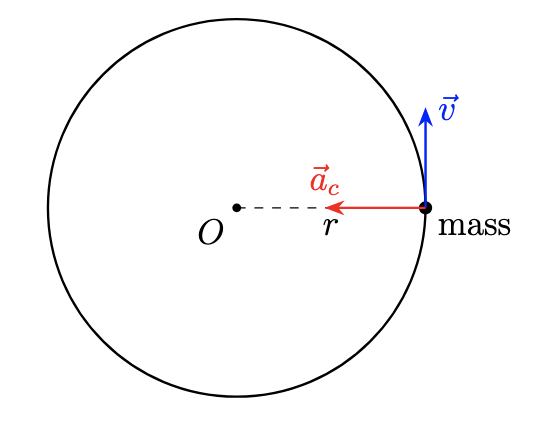
In uniform circular motion, an object travels around a circle at constant speed v. Even though the speed stays the same, the velocity changes because its direction changes continuously. A changing velocity means the object is accelerating.

That acceleration points toward the center of the circle and is called centripetal acceleration.

Centripetal acceleration

For an object moving at constant speedv in a circle of radius r, the centripetal acceleration ac​ is:

ac​=rv2​.

Key idea: the acceleration is radially inward at every point on the path. It comes from the continuous change in the direction of the velocity vector.

Centripetal acceleration during circular motion

Derivation of centripetal acceleration

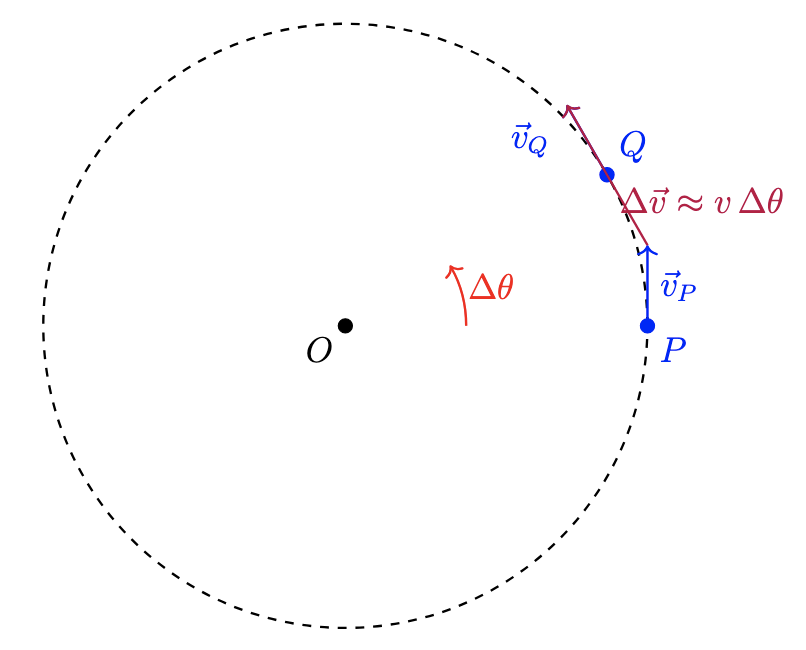
Suppose an object moves from point P to Q on the circle in a time interval Δt. During that time, its velocity changes direction by an angle Δθ (in radians). If the speed stays constant, the magnitude of the change in velocity is approximately:

Δv≈vΔθ.

Now connect the angle change to the distance traveled. The arc length is Δs=vΔt, and for a circle Δθ=Δs/r, so:

Δθ=rvΔt​.

Acceleration is change in velocity per unit time:

ac​≈ΔtΔv​≈ΔtvΔθ​=Δtv⋅(vΔt/r)​=rv2​.

Derivation of centripetal acceleration in uniform circular motion

Centripetal force

Newton’s Second Law says the net force on an object equals mass times acceleration. For uniform circular motion, the net inward force required to produce the centripetal acceleration is:

Fc​=mac​=mrv2​.

This net inward force is called the centripetal force. It’s not a new kind of force; it’s the name we give to whatever combination of real forces points toward the center (tension, gravity, friction, the normal force, or a combination).

Example scenario: Mass on a string in circular motion

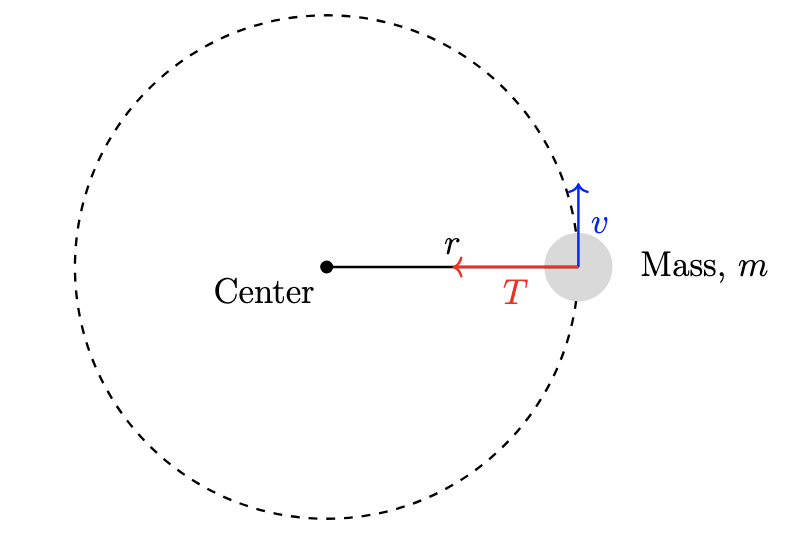
Consider a massm attached to a string of length r being swung in a horizontal circle. The tension T in the string points toward the center, so it provides the centripetal force:

T=mrv2​.

Mass swung in a horizontal circle

Angular velocity and time period

Angular velocity

Angular velocity ω measures how quickly the object sweeps out angle (in radians) per second. It relates to linear speed v by:

v=ωr.

So, for the same ω, a larger radius means a larger linear speed.

Time period

The time period T is the time for one complete revolution. One revolution covers a distance equal to the circumference, 2πr, so:

T=v2πr​.

Substitute v=ωr to write the period in terms of angular velocity:

T=ω2π​.

Applications

Banked curves (frictionless)

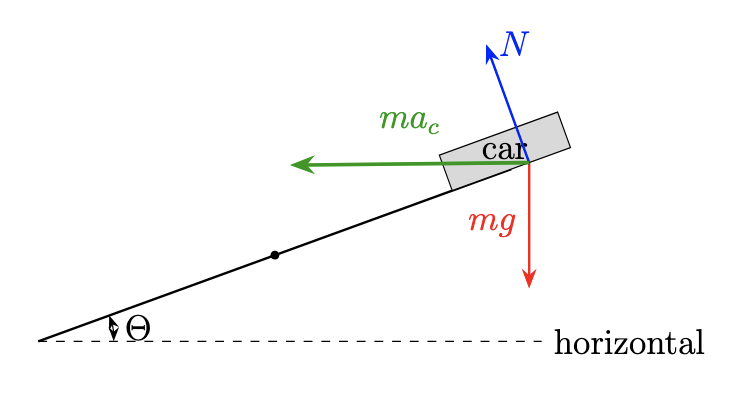
On a frictionless banked curve, the normal force is tilted. Its horizontal component points toward the center of the circular path and supplies the centripetal force. For a curve banked at an angle θb​ with radius r, the ideal speed v is:

v=rgtanθb​​.

This relationship is used in road and track design when you want the banking to reduce reliance on friction.

Banking of roads
Banking of roads

Conical pendulum

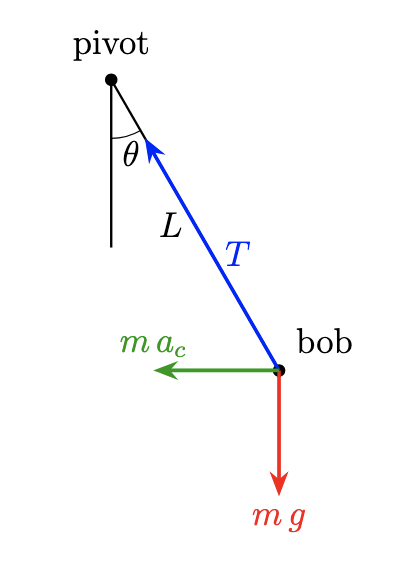
In a conical pendulum, a mass m hangs from a string of length L and moves in a horizontal circle at constant speed. The string makes an angle θ with the vertical.

The tension T has:

  • a vertical component that balances the weight
  • a horizontal component that provides the centripetal force

That gives:

Tcosθ=mgandTsinθ=mrv2​,

where the radius of the horizontal circle is r=Lsinθ. Combining these relationships leads to:

v=gLtanθ​sinθ.

This model is used to analyze conical pendulums and other rotating systems where tension provides the inward force.

Free body diagram of conical pendulum

Example Problem 1

A 2kg object is attached to a 1.5m string and swung in a horizontal circle at a constant speed of 6m/s. Calculate the centripetal force acting on the object.

Solution:

(spoiler)

Using the formula:

Fc​=mrv2​,

substitute:

Fc​=2kg×1.5m62​=2×1.536​=2×24=48N.

Thus, the centripetal force is 48N.

Example Problem 2

A conical pendulum consists of a 1kg mass attached to a 2m long string. The string makes an angle of 30∘ with the vertical as the mass moves in a horizontal circle. Calculate the period T of the motion.

Solution:

(spoiler)

First, determine the horizontal radius of the circular motion:

r=Lsinθ=2m×sin(30∘)=2m×0.5=1m.

The vertical component of the tension balances the weight:

Tcosθ=mg.

We use the relation for centripetal acceleration:

ac​=rv2​,

and the centripetal force provided by the horizontal component of the tension:

Tsinθ=mrv2​.

Dividing the second equation by the first gives:

tanθ=rgv2​.

Solve for v2:

v2=rgtanθ.

Substitute r=1m, g=10m/s2 (for simplicity), and tan(30∘)≈0.577:

v2=1×10×0.577=5.77,v≈2.4m/s.

The period T is the circumference divided by speed:

T=v2πr​=2.42π×1​≈2.46.28​≈2.62s.

Example Problem 3

A frictionless banked curve has a radius r=50m and is banked at an angle θb​=25∘. Determine the ideal speed for a car to navigate the curve without relying on friction.

Solution:

(spoiler)

For a frictionless banked curve, the ideal speed is given by:

v=rgtanθb​​.

Using g=10m/s2, r=50m, and tan(25∘)≈0.4663:

v=50×10×0.4663​≈233.15​≈15.27m/s.

Newton’s Law of Universal Gravitation\

  • Gravitational force: F=Gr2m1​m2​​
    • Proportional to product of masses, inversely proportional to square of distance
  • G (gravitational constant): 6.67×10⁻¹¹N⋅m2/kg2
  • Explains both falling objects and orbital motion

Gravitational Field and Acceleration\

  • Gravitational field strength: g=Gr2M​
  • On Earth’s surface: g≈9.8m/s2

Fundamentals of Circular Motion\

  • Uniform circular motion: constant speed, changing velocity direction
  • Centripetal acceleration: ac​=rv2​
    • Always directed toward center of circle

Centripetal Force\

  • Centripetal force: Fc​=mrv2​
  • Not a new force; provided by tension, gravity, friction, etc.
    • Example: Tension in string for mass in circular motion, T=mrv2​

Angular Velocity and Time Period\

  • Angular velocity: ω (radians/sec), relates to linear speed: v=ωr
  • Period of motion: T=v2πr​=ω2π​

Applications\

  • Banked Curves (Frictionless)
    • Ideal speed: v=rgtanθb​​
    • Used in road/track design to minimize friction reliance
  • Conical Pendulum
    • Vertical: Tcosθ=mg
    • Horizontal (centripetal): Tsinθ=mrv2​
    • Radius: r=Lsinθ
    • Speed: v=gLtanθ​sinθ

Key Example Problem Formulas\

  • Centripetal force: Fc​=mrv2​
  • Conical pendulum period: T=v2πr​
  • Banked curve speed: v=rgtanθb​​

Sign up for free to take 10 quiz questions on this topic

Previous
Next  | 5.1 Work done and power
All rights reserved ©2016 - 2026 Achievable, Inc.

Circular motion

This subchapter takes a close look at circular motion. You’ll learn the core ideas and formulas for:

  • Newton’s law of Universal Gravitation, the fundamental concepts and key formulas.
  • Concepts of uniform circular motion, centripetal acceleration and force, the relationship between angular speed and linear speed, and the period of motion.

Newton’s law of universal gravitation

Newton’s Law of Universal Gravitation says that any two point masses attract each other. The force is:

  • proportional to the product of their masses
  • inversely proportional to the square of the distance between their centers

Mathematically:

F=Gr2m1​m2​​,

where

  • F is the magnitude of the gravitational force between two masses,
  • m1​ and m2​ are the masses of the two objects,
  • r is the distance between the centers of the two masses, and
  • G is the gravitational constant, approximately 6.67×10⁻¹¹N⋅m2/kg2.

Explanation

Newton connected everyday falling motion to orbital motion: the same interaction that pulls an apple downward can also keep the Moon in orbit. Kepler’s work had already described planetary motion from observations, and Newton proposed gravity as the underlying cause.

Later, when we study circular orbital motion, you’ll see a step-by-step derivation that links gravitational force to the requirements for circular motion.

Gravitational field and acceleration

The gravitational field strength, g, at a distance r from the center of a mass M is defined as force per unit mass. Starting from g=mF​ and using Newton’s law of gravitation gives:

g=mF​=Gr2M​.

For Earth, if we take r≈RE​ (Earth’s radius, approximately 6.37×10⁶m), then:

g≈GRE2​ME​​≈9.8m/s2.

Fundamentals of circular motion

Uniform circular motion

In uniform circular motion, an object travels around a circle at constant speed v. Even though the speed stays the same, the velocity changes because its direction changes continuously. A changing velocity means the object is accelerating.

That acceleration points toward the center of the circle and is called centripetal acceleration.

Centripetal acceleration

For an object moving at constant speedv in a circle of radius r, the centripetal acceleration ac​ is:

ac​=rv2​.

Key idea: the acceleration is radially inward at every point on the path. It comes from the continuous change in the direction of the velocity vector.

Derivation of centripetal acceleration

Suppose an object moves from point P to Q on the circle in a time interval Δt. During that time, its velocity changes direction by an angle Δθ (in radians). If the speed stays constant, the magnitude of the change in velocity is approximately:

Δv≈vΔθ.

Now connect the angle change to the distance traveled. The arc length is Δs=vΔt, and for a circle Δθ=Δs/r, so:

Δθ=rvΔt​.

Acceleration is change in velocity per unit time:

ac​≈ΔtΔv​≈ΔtvΔθ​=Δtv⋅(vΔt/r)​=rv2​.

Centripetal force

Newton’s Second Law says the net force on an object equals mass times acceleration. For uniform circular motion, the net inward force required to produce the centripetal acceleration is:

Fc​=mac​=mrv2​.

This net inward force is called the centripetal force. It’s not a new kind of force; it’s the name we give to whatever combination of real forces points toward the center (tension, gravity, friction, the normal force, or a combination).

Example scenario: Mass on a string in circular motion

Consider a massm attached to a string of length r being swung in a horizontal circle. The tension T in the string points toward the center, so it provides the centripetal force:

T=mrv2​.

Angular velocity and time period

Angular velocity

Angular velocity ω measures how quickly the object sweeps out angle (in radians) per second. It relates to linear speed v by:

v=ωr.

So, for the same ω, a larger radius means a larger linear speed.

Time period

The time period T is the time for one complete revolution. One revolution covers a distance equal to the circumference, 2πr, so:

T=v2πr​.

Substitute v=ωr to write the period in terms of angular velocity:

T=ω2π​.

Applications

Banked curves (frictionless)

On a frictionless banked curve, the normal force is tilted. Its horizontal component points toward the center of the circular path and supplies the centripetal force. For a curve banked at an angle θb​ with radius r, the ideal speed v is:

v=rgtanθb​​.

This relationship is used in road and track design when you want the banking to reduce reliance on friction.

Conical pendulum

In a conical pendulum, a mass m hangs from a string of length L and moves in a horizontal circle at constant speed. The string makes an angle θ with the vertical.

The tension T has:

  • a vertical component that balances the weight
  • a horizontal component that provides the centripetal force

That gives:

Tcosθ=mgandTsinθ=mrv2​,

where the radius of the horizontal circle is r=Lsinθ. Combining these relationships leads to:

v=gLtanθ​sinθ.

This model is used to analyze conical pendulums and other rotating systems where tension provides the inward force.

Example Problem 1

A 2kg object is attached to a 1.5m string and swung in a horizontal circle at a constant speed of 6m/s. Calculate the centripetal force acting on the object.

Solution:

(spoiler)

Using the formula:

Fc​=mrv2​,

substitute:

Fc​=2kg×1.5m62​=2×1.536​=2×24=48N.

Thus, the centripetal force is 48N.

Example Problem 2

A conical pendulum consists of a 1kg mass attached to a 2m long string. The string makes an angle of 30∘ with the vertical as the mass moves in a horizontal circle. Calculate the period T of the motion.

Solution:

(spoiler)

First, determine the horizontal radius of the circular motion:

r=Lsinθ=2m×sin(30∘)=2m×0.5=1m.

The vertical component of the tension balances the weight:

Tcosθ=mg.

We use the relation for centripetal acceleration:

ac​=rv2​,

and the centripetal force provided by the horizontal component of the tension:

Tsinθ=mrv2​.

Dividing the second equation by the first gives:

tanθ=rgv2​.

Solve for v2:

v2=rgtanθ.

Substitute r=1m, g=10m/s2 (for simplicity), and tan(30∘)≈0.577:

v2=1×10×0.577=5.77,v≈2.4m/s.

The period T is the circumference divided by speed:

T=v2πr​=2.42π×1​≈2.46.28​≈2.62s.

Example Problem 3

A frictionless banked curve has a radius r=50m and is banked at an angle θb​=25∘. Determine the ideal speed for a car to navigate the curve without relying on friction.

Solution:

(spoiler)

For a frictionless banked curve, the ideal speed is given by:

v=rgtanθb​​.

Using g=10m/s2, r=50m, and tan(25∘)≈0.4663:

v=50×10×0.4663​≈233.15​≈15.27m/s.

Key points

Newton’s Law of Universal Gravitation\

  • Gravitational force: F=Gr2m1​m2​​
    • Proportional to product of masses, inversely proportional to square of distance
  • G (gravitational constant): 6.67×10⁻¹¹N⋅m2/kg2
  • Explains both falling objects and orbital motion

Gravitational Field and Acceleration\

  • Gravitational field strength: g=Gr2M​
  • On Earth’s surface: g≈9.8m/s2

Fundamentals of Circular Motion\

  • Uniform circular motion: constant speed, changing velocity direction
  • Centripetal acceleration: ac​=rv2​
    • Always directed toward center of circle

Centripetal Force\

  • Centripetal force: Fc​=mrv2​
  • Not a new force; provided by tension, gravity, friction, etc.
    • Example: Tension in string for mass in circular motion, T=mrv2​

Angular Velocity and Time Period\

  • Angular velocity: ω (radians/sec), relates to linear speed: v=ωr
  • Period of motion: T=v2πr​=ω2π​

Applications\

  • Banked Curves (Frictionless)
    • Ideal speed: v=rgtanθb​​
    • Used in road/track design to minimize friction reliance
  • Conical Pendulum
    • Vertical: Tcosθ=mg
    • Horizontal (centripetal): Tsinθ=mrv2​
    • Radius: r=Lsinθ
    • Speed: v=gLtanθ​sinθ

Key Example Problem Formulas\

  • Centripetal force: Fc​=mrv2​
  • Conical pendulum period: T=v2πr​
  • Banked curve speed: v=rgtanθb​​

More from Laws of motion

  • Introduction to force and laws of motion
  • Free body diagrams and equilibrium
  • Friction and spring forces