


Achievable logoAchievable logo
AP Physics 1
Sign in
Sign up
Purchase
Textbook
Practice exams
Support
How it works
Exam catalog
Mountain with a flag at the peak
Textbook
Introduction
1. Decoding the exam
2. Vectors and their analysis
3. Kinematics
4. Laws of motion
5. Work, energy, and power
5.1 Work done and power
5.2 Kinetic and potential energy
6. Linear momentum and collisions
7. Torque and rotational mechanics
8. Oscillations
9. Fluids
Wrapping up
Achievable logoAchievable logo
5.1 Work done and power
Achievable AP Physics 1
5. Work, energy, and power
Our AP Physics 1 course is currently in development and is a work-in-progress.

Work done and power

8 min read
Font
Discuss
Share
Feedback

In this subchapter, you’ll build the core ideas behind work, energy, and power. Here’s what we’ll cover:

  • Definition of work
  • Work done by common forces
  • Work and kinetic energy conversion
  • Power

Definition of work

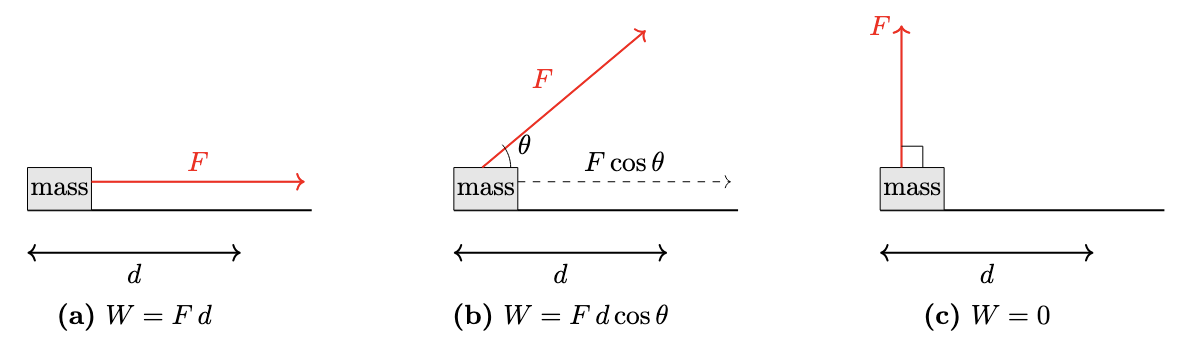
When a constant force F acts on a particle and produces a displacement Δr, the work W done by the force is

W=F⋅Δr=FΔrcosθ,

where θ is the angle between F and the displacement vector Δr.

A useful way to read this is: only the component of the force along the displacement contributes to work.

  • If θ<90∘, then W>0 (force has a component along displacement).
  • If θ>90∘, then W<0 (force opposes displacement).
  • If θ=90∘, then W=0 (force is perpendicular to displacement).
Work done in different cases

Work by a variable force

If the force changes with position, you can’t use a single constant value of F. Instead, you add up the work done over many tiny displacements.

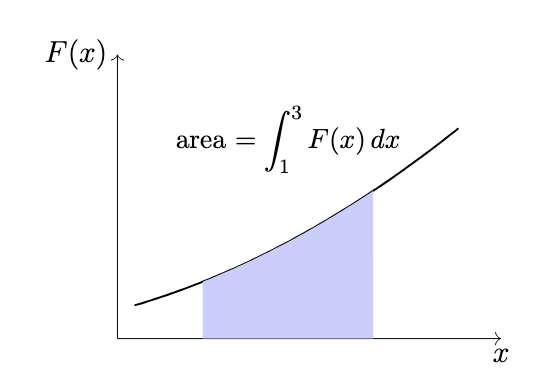
For a force F(x) varying along the x-axis from x=a to x=b, the work is

W=∫ab​F(x)dx.

Geometrically, this integral is the area under the F vs. x graph from a to b.

Work done by variable force

Work-kinetic energy theorem

Work is closely tied to changes in speed. For a particle of mass m subject to a net force Fnet​ that changes its speed from v1​ to v2​, the net work done equals the change in kinetic energy:

Wnet​=∫r1​r2​​Fnet​⋅dr=21​mv22​−21​mv12​.

This is the work-energy theorem.

Work by common forces

Here are a few work results you’ll use often.

  • Gravity: A mass m moves vertically by Δy:

    Wg​=−mgΔy.

    This sign convention matches the idea that gravity does negative work when an object moves upward (Δy>0) and positive work when it moves downward (Δy<0).

  • Spring: Hooke’s law F=−kx yields

    Ws​=∫xi​xf​​(−kx)dx=−21​k(xf2​−xi2​).

  • Normal and Tension: If displacement is along the surface or direction of the string, these can do work; otherwise zero.

Definition of power

Power tells you how quickly work is done.

For work W over time Δt,

P=ΔtW​.

Instantaneous power delivered by a force F acting on a particle moving with velocity v is

P=dtdW​=F⋅v.

Example Problem 1

A block of mass 2kg is pulled along a horizontal surface by a constant force F=10N at an angle 30∘ above the horizontal for a distance 5m. Compute:
(a) The work done by F.
(b) The work done by gravity and the normal force.
(c) The power if the block moves at constant speed 2m/s.

Solution:

(spoiler)
  1. The displacement is horizontal, so only the horizontal component of the force does work.

    Horizontal component Fx​=Fcos30∘=10×23​​=53​N, so

    WF​=Fx​d=(53​)(5)=253​J.

  2. Gravity and the normal force are vertical while the motion is horizontal, so each is perpendicular to the displacement:

    ⇒Wg​=WN​=0.

  3. With constant speed, the instantaneous power from the pulling force is

    P=F⋅v=Fx​v=(53​)(2)=103​W.

Example Problem 2

A car of mass 1000kg accelerates from 20m/s to 30m/s on level ground in 5s. What is the average power output of the engine (neglect friction)?

Solution:

(spoiler)

The engine’s work goes into changing kinetic energy:

ΔK=21​m(v22​−v12​)=21​(1000)(302−202)=250,000J,

so the average power is

Pavg​=ΔtΔK​=5250,000​=50,000W.

Example Problem 3

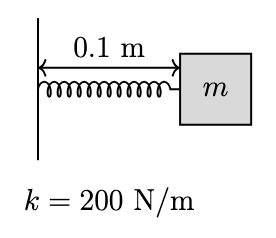
A 3kg mass attached to a spring (k=200N/m) is stretched 0.1m and released. How much work is done by the spring as it returns to equilibrium?

Solution:

(spoiler)

Use the spring‐work formula:

W=21​kx2.

Substitute k=200N/m and x=0.1m:

W=21​×200×(0.1)2=1.0J.

Hence, the spring does 1.0J of work returning the mass to equilibrium.

Spring mass system according to the question

Example Problem 4

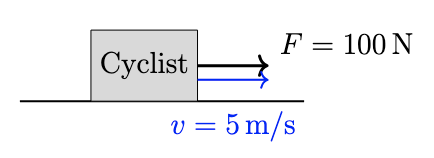
A bicyclist applies a constant 100N horizontally to move at 5m/s. What power must the cyclist develop?

Solution:

(spoiler)

Because force and velocity point in the same direction,

P=F⋅v=Fv=100×5=500W.

Power developed by cyclist

Example Problem 5

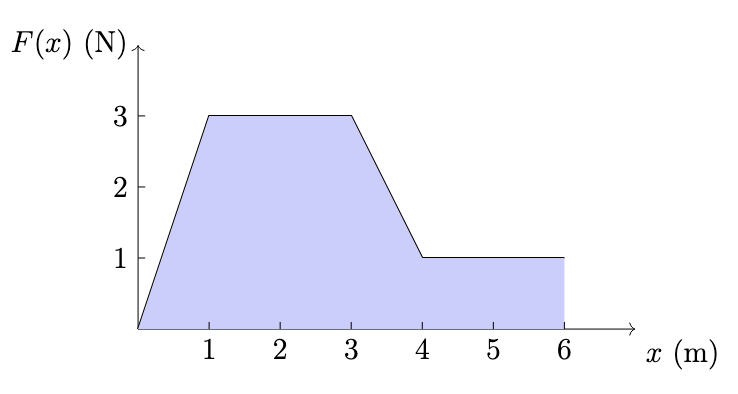
An object is acted upon by a variable force F(x) whose dependence on the displacement x is shown below. Calculate the work done by this force as the object moves from x=0 to x=6m.

Work done by the given variable force

Solution:

(spoiler)

Because work is the area under the F-vs.-x graph, divide the shaded region into four simple shapes:

  1. Triangle (0 to 1 m, height 3 N): W1​=21​(1)(3)=1.5J.
  2. Rectangle (1 to 3 m at 3 N): W2​=2×3=6J.
  3. Trapezoid (3 to 4 m, from 3 N to 1 N): W3​=23+1​×1=2J.
  4. Rectangle (4 to 6 m at 1 N): W4​=2×1=2J.

Total:

W=W1​+W2​+W3​+W4​=1.5+6+2+2=11.5J.

Definition of Work

  • Work: W=F⋅Δr=FΔrcosθ
  • Only force component along displacement does work
  • Sign of work:
    • θ<90∘: W>0 (along displacement)
    • θ>90∘: W<0 (opposes displacement)
    • θ=90∘: W=0 (perpendicular)

Work by a Variable Force

  • For variable force: W=∫ab​F(x)dx
  • Work equals area under F vs. x graph

Work-Kinetic Energy Theorem

  • Net work equals change in kinetic energy: Wnet​=ΔK
    • ΔK=21​mv22​−21​mv12​
  • Applies to net force acting over displacement

Work by Common Forces

  • Gravity: Wg​=−mgΔy
    • Negative when moving up, positive when moving down
  • Spring (Hooke’s law): Ws​=−21​k(xf2​−xi2​)
  • Normal and tension: Do work only if displacement has a component along their direction; otherwise zero

Definition of Power

  • Average power: P=ΔtW​
  • Instantaneous power: P=F⋅v
  • Measures rate of doing work

Key Example Takeaways

  • Only force component parallel to displacement does work
  • Work by gravity and normal force is zero if displacement is perpendicular
  • For springs, use W=21​kx2 for work from stretched/compressed position to equilibrium
  • Power from constant force and velocity: P=Fv (if same direction)
  • For variable force, sum work by finding area under F vs. x graph

Core Toolkit Summary

  • Work: W=F⋅Δr
  • Variable force: integrate or use area under curve
  • Work-kinetic energy theorem: Wnet​=ΔK
  • Power: P=ΔtW​ and P=F⋅v

Sign up for free to take 5 quiz questions on this topic

Previous
Next  | 5.2 Kinetic and potential energy
All rights reserved ©2016 - 2026 Achievable, Inc.

Work done and power

In this subchapter, you’ll build the core ideas behind work, energy, and power. Here’s what we’ll cover:

  • Definition of work
  • Work done by common forces
  • Work and kinetic energy conversion
  • Power

Definition of work

When a constant force F acts on a particle and produces a displacement Δr, the work W done by the force is

W=F⋅Δr=FΔrcosθ,

where θ is the angle between F and the displacement vector Δr.

A useful way to read this is: only the component of the force along the displacement contributes to work.

  • If θ<90∘, then W>0 (force has a component along displacement).
  • If θ>90∘, then W<0 (force opposes displacement).
  • If θ=90∘, then W=0 (force is perpendicular to displacement).

Work by a variable force

If the force changes with position, you can’t use a single constant value of F. Instead, you add up the work done over many tiny displacements.

For a force F(x) varying along the x-axis from x=a to x=b, the work is

W=∫ab​F(x)dx.

Geometrically, this integral is the area under the F vs. x graph from a to b.

Work-kinetic energy theorem

Work is closely tied to changes in speed. For a particle of mass m subject to a net force Fnet​ that changes its speed from v1​ to v2​, the net work done equals the change in kinetic energy:

Wnet​=∫r1​r2​​Fnet​⋅dr=21​mv22​−21​mv12​.

This is the work-energy theorem.

Work by common forces

Here are a few work results you’ll use often.

  • Gravity: A mass m moves vertically by Δy:

    Wg​=−mgΔy.

    This sign convention matches the idea that gravity does negative work when an object moves upward (Δy>0) and positive work when it moves downward (Δy<0).

  • Spring: Hooke’s law F=−kx yields

    Ws​=∫xi​xf​​(−kx)dx=−21​k(xf2​−xi2​).

  • Normal and Tension: If displacement is along the surface or direction of the string, these can do work; otherwise zero.

Definition of power

Power tells you how quickly work is done.

For work W over time Δt,

P=ΔtW​.

Instantaneous power delivered by a force F acting on a particle moving with velocity v is

P=dtdW​=F⋅v.

Example Problem 1

A block of mass 2kg is pulled along a horizontal surface by a constant force F=10N at an angle 30∘ above the horizontal for a distance 5m. Compute:
(a) The work done by F.
(b) The work done by gravity and the normal force.
(c) The power if the block moves at constant speed 2m/s.

Solution:

(spoiler)
  1. The displacement is horizontal, so only the horizontal component of the force does work.

    Horizontal component Fx​=Fcos30∘=10×23​​=53​N, so

    WF​=Fx​d=(53​)(5)=253​J.

  2. Gravity and the normal force are vertical while the motion is horizontal, so each is perpendicular to the displacement:

    ⇒Wg​=WN​=0.

  3. With constant speed, the instantaneous power from the pulling force is

    P=F⋅v=Fx​v=(53​)(2)=103​W.

Example Problem 2

A car of mass 1000kg accelerates from 20m/s to 30m/s on level ground in 5s. What is the average power output of the engine (neglect friction)?

Solution:

(spoiler)

The engine’s work goes into changing kinetic energy:

ΔK=21​m(v22​−v12​)=21​(1000)(302−202)=250,000J,

so the average power is

Pavg​=ΔtΔK​=5250,000​=50,000W.

Example Problem 3

A 3kg mass attached to a spring (k=200N/m) is stretched 0.1m and released. How much work is done by the spring as it returns to equilibrium?

Solution:

(spoiler)

Use the spring‐work formula:

W=21​kx2.

Substitute k=200N/m and x=0.1m:

W=21​×200×(0.1)2=1.0J.

Hence, the spring does 1.0J of work returning the mass to equilibrium.

Example Problem 4

A bicyclist applies a constant 100N horizontally to move at 5m/s. What power must the cyclist develop?

Solution:

(spoiler)

Because force and velocity point in the same direction,

P=F⋅v=Fv=100×5=500W.

Example Problem 5

An object is acted upon by a variable force F(x) whose dependence on the displacement x is shown below. Calculate the work done by this force as the object moves from x=0 to x=6m.

Solution:

(spoiler)

Because work is the area under the F-vs.-x graph, divide the shaded region into four simple shapes:

  1. Triangle (0 to 1 m, height 3 N): W1​=21​(1)(3)=1.5J.
  2. Rectangle (1 to 3 m at 3 N): W2​=2×3=6J.
  3. Trapezoid (3 to 4 m, from 3 N to 1 N): W3​=23+1​×1=2J.
  4. Rectangle (4 to 6 m at 1 N): W4​=2×1=2J.

Total:

W=W1​+W2​+W3​+W4​=1.5+6+2+2=11.5J.

Key points

Definition of Work

  • Work: W=F⋅Δr=FΔrcosθ
  • Only force component along displacement does work
  • Sign of work:
    • θ<90∘: W>0 (along displacement)
    • θ>90∘: W<0 (opposes displacement)
    • θ=90∘: W=0 (perpendicular)

Work by a Variable Force

  • For variable force: W=∫ab​F(x)dx
  • Work equals area under F vs. x graph

Work-Kinetic Energy Theorem

  • Net work equals change in kinetic energy: Wnet​=ΔK
    • ΔK=21​mv22​−21​mv12​
  • Applies to net force acting over displacement

Work by Common Forces

  • Gravity: Wg​=−mgΔy
    • Negative when moving up, positive when moving down
  • Spring (Hooke’s law): Ws​=−21​k(xf2​−xi2​)
  • Normal and tension: Do work only if displacement has a component along their direction; otherwise zero

Definition of Power

  • Average power: P=ΔtW​
  • Instantaneous power: P=F⋅v
  • Measures rate of doing work

Key Example Takeaways

  • Only force component parallel to displacement does work
  • Work by gravity and normal force is zero if displacement is perpendicular
  • For springs, use W=21​kx2 for work from stretched/compressed position to equilibrium
  • Power from constant force and velocity: P=Fv (if same direction)
  • For variable force, sum work by finding area under F vs. x graph

Core Toolkit Summary

  • Work: W=F⋅Δr
  • Variable force: integrate or use area under curve
  • Work-kinetic energy theorem: Wnet​=ΔK
  • Power: P=ΔtW​ and P=F⋅v

More from Work, energy, and power

  • Kinetic and potential energy