



Kinetic and potential energy
In this subchapter we cover:
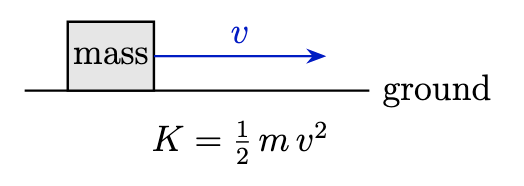
Kinetic energy
Kinetic energy is the energy an object has because it’s moving. For an object of mass moving with speed ,
One way to justify this formula is to connect energy to work. The net force does work to speed the object up from rest to speed , and that work becomes kinetic energy:
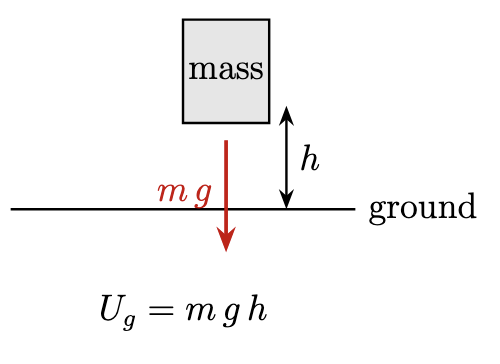
Gravitational potential energy
Gravitational potential energy is energy stored because of height in a gravitational field. If a mass is at height above a chosen reference level, then
This equals the work required to lift the mass slowly from the reference level up to height against gravity.
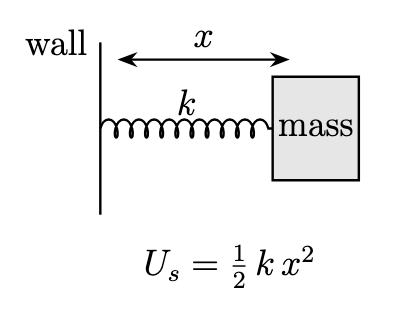
Elastic (spring) potential energy
A spring stores energy when it’s stretched or compressed. For a spring with constant displaced by an amount from its equilibrium length, the elastic potential energy is
Conservation of mechanical energy
When only conservative forces act (such as gravity and ideal spring forces), the total mechanical energy
stays constant. In equation form,
This means energy can shift between kinetic and potential forms, but the total remains the same.
Example problem 1
A mass is released from rest at height above the ground. Neglecting air resistance, find its speed just before it hits the ground.
Solution:
Use energy conservation with gravitational potential energy:
Example problem 2
A block of mass is released from rest when a spring of constant is compressed by . Find its speed when the spring returns to equilibrium.
Solution:
Apply mechanical energy conservation between the initial compressed state and the instant the spring reaches equilibrium ():
Example problem 3
A kg block starts from rest at the top of a frictionless incline of height m. At the bottom it compresses a spring of constant N/m. (a) Find the maximum compression of the spring. (b) What is the block’s speed as it passes through the spring’s equilibrium position?
Solution:
-
Energy conservation: Initially , J, .
At maximum compression the block momentarily stops, so , , and . Thus
-
Speed at equilibrium of spring: At the spring’s natural length (), the spring potential energy is zero, so the energy is entirely kinetic:
Example Problem 4
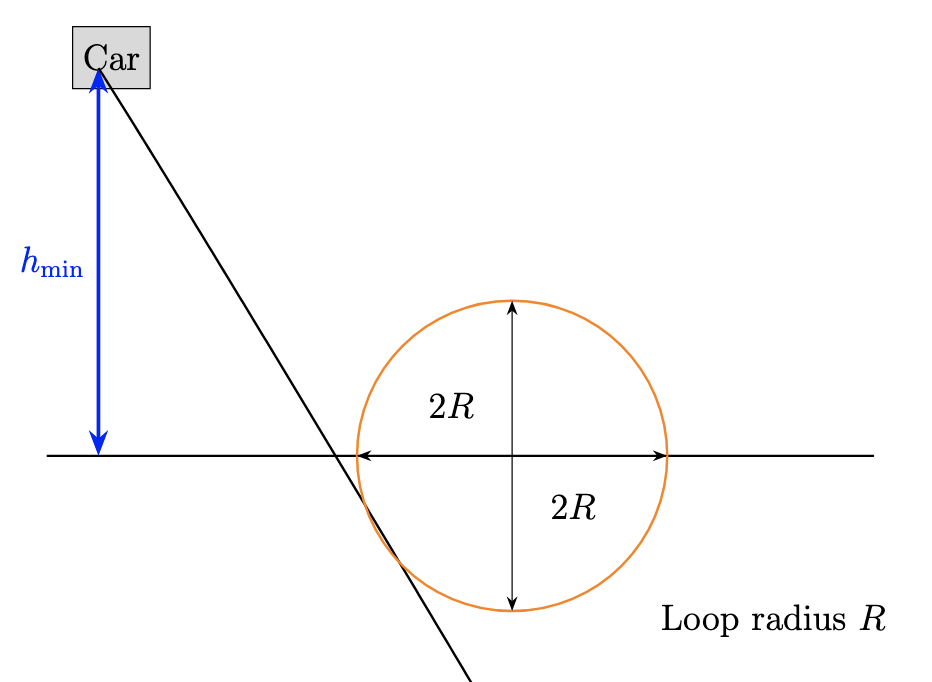
A roller‐coaster car of mass kg starts from rest at height above the bottom of a frictionless track that includes a vertical circular loop of radius m. Determine the minimum height so that the car remains in contact with the track at the top of the loop.
Solution:
-
Condition for contact at the top: At the top, the minimum-speed condition occurs when the normal force is zero, so gravity alone provides the needed centripetal acceleration:
-
Energy conservation from start to top: Take the bottom of the loop as the reference level for gravitational potential energy. The top of the loop is at height :
Substitute :
-
Solve for :
Thus the car must start from at least m above the bottom of the loop to stay in contact at the top.
Example Problem 5
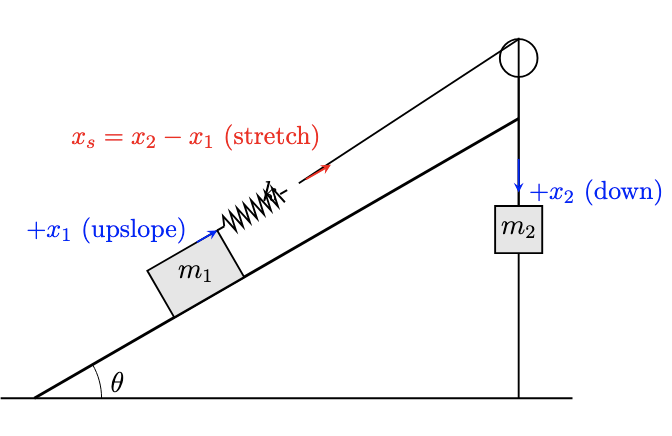
A block of mass rests on a rough incline at angle . The coefficient of kinetic friction between the block and plane is (assume static friction is large enough to prevent initial slipping downward). The block is attached to one end of a light spring of constant . The other end of the spring is tied to a light, inextensible string that passes over a small frictionless pulley at the top of the incline and supports a hanging block of mass . Initially, the spring is unstretched and the system is released from rest.
(a) Immediately after release, indicate the direction of the initial acceleration of each block and explain briefly why the spring stretches rather than compresses in this configuration.
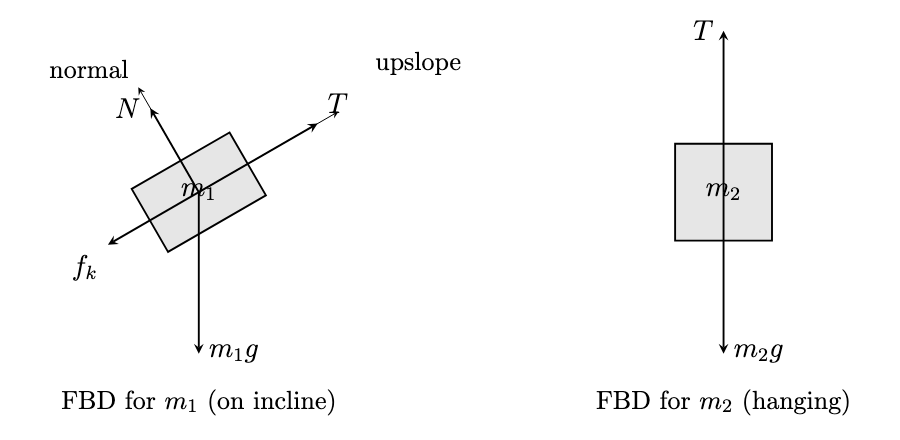
(b) (i) Draw and label a free-body diagram for while it is moving upslope. (ii) Draw and label a free-body diagram for while it is moving downward. (c) Using , write the equations of motion for (along the incline) and for (vertical). (d) From release (spring unstretched, at rest) to a general instant with speeds , use work-energy to relate , , , and .
Solution:
(a) Initial directions and spring behavior. Let be the displacement of up the incline (positive upslope), the displacement of downward (positive downward), and the spring extension (positive when stretched). At release the spring is unstretched, so it exerts no force.
The hanging block has weight downward. Along the incline, the component of ’s weight is downslope. If moves upslope, kinetic friction also acts downslope with magnitude .
With the given values, initially exceeds the resisting effect on , so accelerates downward and accelerates upslope.
The spring sits between the block and the rope. Right after release, the rope end is pulled upslope by , while the block end doesn’t move as quickly. That relative motion increases the spring’s length, so the spring stretches (not compresses) and builds tension that pulls . (b) Free-body diagrams.
Constraint (geometry). Because the spring is between the block and the rope,
(positive when the rope-end advances upslope relative to the block-end). The spring tension is .
Equations of motion. Take upslope as for and downward as for :
When the hanging block’s acceleration is momentarily zero, :
(d) Work-energy relation. From release (spring unstretched; ) to a general state with speeds :
This scalar energy balance is valid at all times. At any instant where both speeds vanish, only the potential-energy terms remain.