



Systems, momentum and impulse
In this subchapter, you’ll work with these core ideas:
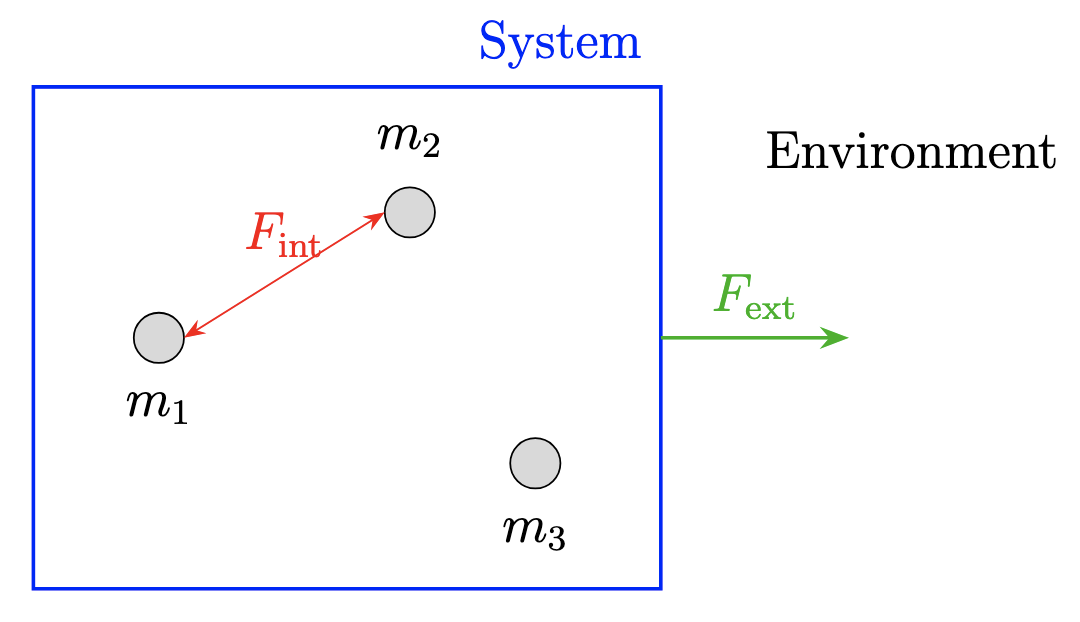
What is a system? A system in physics is the collection of objects or particles you choose to analyze together.
- We imagine a boundary around the system.
- Everything outside that boundary is the environment.
Forces then fall into two categories:
- Internal forces act between objects inside the boundary. Internal forces can change how parts of the system move relative to each other, but they can’t change the motion of the system as a whole.
- External forces are exerted by the environment on the system. External forces determine the system’s overall motion.
Isolated vs. non-isolated:
- An isolated system has no net external force. Its total momentum and the motion of its centre of mass remain unchanged.
- A non-isolated system has a net external force, so its centre of mass accelerates.
Centre of mass: The centre of mass (CM) of a system is the unique point where you can treat the system’s mass as if it were concentrated, as far as translational motion is concerned. The CM moves as if all external forces acted at that point.
Equation of motion of the CM: If you add up all external forces on a system, the centre of mass accelerates according to
So, for translational motion, the system behaves like a single particle of mass acted on by the net external force.
Example problem 1
Three particles of masses kg, kg and kg lie on the -axis at , , and m. Find the centre of mass.
Solution:
Example problem 2
Two point masses, at and at , lie on the -axis. Calculate the position of their CM.
Solution.
- Compute total mass:
- Compute weighted sum of positions:
- Divide to find CM:
Example problem 3
A thin rod of length has linear density distributed along its length from to . Show that its centre of mass is at = .
Solution.
- Total mass:
- First moment:
- Centre of mass:
Note: This question is for illustration purpose and is not expected to be a part of AP Physics 1 scope.
Example problem 4
Three masses form a right triangle at , , and with masses , , and . Determine the CM coordinates .
Solution.
-
Total mass: .
-
-coordinate:
- -coordinate:
.
Linear momentum
Linear momentum measures “mass in motion.” For a particle of mass moving with velocity ,
For a system, the total momentum is the sum of the momenta of its parts:
Impulse-momentum theorem
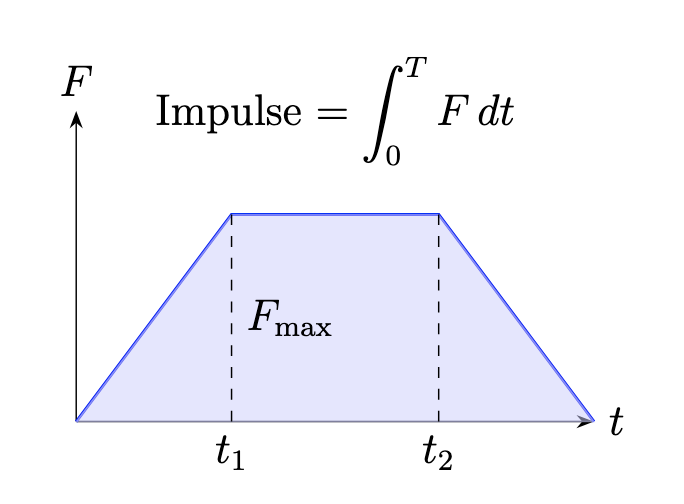
When an external force acts over a time interval , it delivers an impulse. For a constant force,
and that impulse changes the object’s momentum:
Example problem 5 A 2.0 kg puck sliding at 3.0 m/s receives a constant force of 5.0 N in the direction of motion for 0.4 s. Find its final speed.
Solution:
Example problem 6 A 0.5 kg toy car moving at 2.0 m/s collides with a spring bumper that exerts an average force of 4.0 N over 0.10 s. Determine the change in the car’s speed and its final velocity.
Solution: