


Achievable logoAchievable logo
AP Physics 1
Sign in
Sign up
Purchase
Textbook
Practice exams
Support
How it works
Exam catalog
Mountain with a flag at the peak
Textbook
Introduction
1. Decoding the exam
2. Vectors and their analysis
3. Kinematics
4. Laws of motion
5. Work, energy, and power
6. Linear momentum and collisions
6.1 Systems, momentum and impulse
6.2 Conservation of momentum and collisions
7. Torque and rotational mechanics
8. Oscillations
9. Fluids
Wrapping up
Achievable logoAchievable logo
6.2 Conservation of momentum and collisions
Achievable AP Physics 1
6. Linear momentum and collisions
Our AP Physics 1 course is currently in development and is a work-in-progress.

Conservation of momentum and collisions

14 min read
Font
Discuss
Share
Feedback

This subchapter builds on the previous one and focuses on three core ideas:

  • Conservation of momentum
  • Elastic collisions
  • Inelastic collisions

Conservation of momentum

Momentum is conserved when you choose a system with no net external force (an isolated system). In that case, the system’s total linear momentum stays constant over time.

Consider N particles with masses mi​ and velocities vi​. The total momentum is

P=i=1∑N​mi​vi​.

Apply Newton’s second law to each particle:

mi​dtdvi​​=Fi,int​+Fi,ext​.

Now sum over all particles. The internal forces Fi,int​ cancel in pairs because of Newton’s third law (action-reaction). That leaves only the external forces:

dtdP​=i=1∑N​Fi,ext​=Fext,net​.

So if the net external force is zero, Fext,net​=0, then

dtdP​=0⟹Pinitial​=Pfinal​.

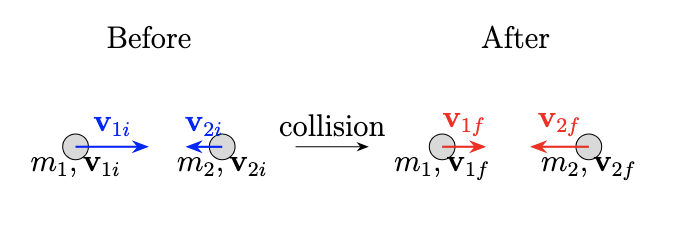
Conservation of momentum before and after collision

Key Point:

m1​v1i​+m2​v2i​=m1​v1f​+m2​v2f​.

Elastic collisions

An elastic collision conserves:

  • total momentum
  • total kinetic energy

In one dimension, those conservation laws are

m1​v1i​+m2​v2i​=m1​v1f​+m2​v2f​,

21​m1​v1i2​+21​m2​v2i2​=21​m1​v1f2​+21​m2​v2f2​.

Solving these simultaneously gives the standard final-velocity formulas:

v1f​=m1​+m2​m1​−m2​​v1i​−m1​+m2​2m2​​v2i​,v2f​=m1​+m2​2m1​​v1i​−m1​+m2​m2​−m1​​v2i​.

Example problem 1

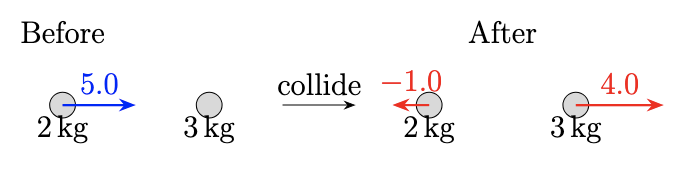
A 2.0 kg puck moving at 5.0 m/s collides elastically with a 3.0 kg puck at rest. Find their final speeds. Solution:

(spoiler)

m1​=2.0,v1i​=5.0,m2​=3.0,v2i​=0.

Apply the elastic-collision formulas:

v1f​=2+32−3​(5.0)+52⋅3​(0)=−51​5.0=−1.0m/s,

v2f​=52⋅2​(5.0)+53−2​(0)=54​5.0=4.0m/s.

Elastic collision between the two pucks

Inelastic collisions

In an inelastic collision, momentum is conserved but kinetic energy decreases (some of it becomes thermal energy, sound, deformation, etc.).

In a perfectly inelastic collision, the objects stick together and move with a common final velocity vf​:

m1​v1i​+m2​v2i​=(m1​+m2​)vf​⟹vf​=m1​+m2​m1​v1i​+m2​v2i​​.

The kinetic energy lost (difference between initial and final kinetic energy) is

ΔK=21​m1​v1i2​+21​m2​v2i2​−21​(m1​+m2​)vf2​.

Example problem 2

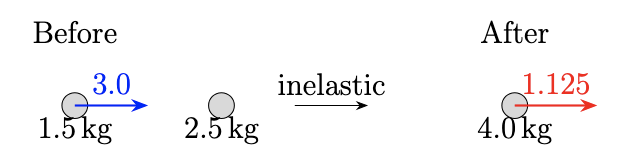
A 1.5 kg cart moving at 3.0 m/s collides and sticks to a 2.5 kg cart at rest. Find their common speed and the kinetic energy lost. Solution.

(spoiler)

m1​=1.5,v1i​=3.0,m2​=2.5,v2i​=0.

Common speed:

vf​=1.5+2.51.5⋅3.0+2.5⋅0​=4.04.5​=1.125m/s.

Initial KE:

Ki​=21​(1.5)(3.0)2+0=6.75J.

Final KE:

Kf​=21​(4.0)(1.125)2=2.531J.

KE lost:

ΔK=6.75−2.531=4.219J.

Inelastic collision between two carts

Example problem 3

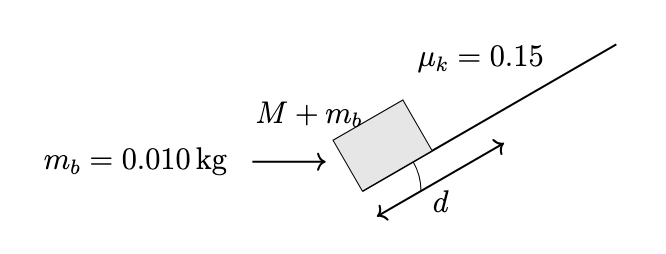
A bullet of mass mb​=0.010kg is fired horizontally at speed vb​=300m/s into a stationary block of mass M=1.50kg at the base of a rough incline of angle θ=30∘. The coefficient of kinetic friction between the block (with embedded bullet) and the incline is μk​=0.15. After the inelastic collision, the combined mass slides up the incline and comes to rest. Determine the distance d it travels up the incline.

Inelastic collision between the bullet and the block
Solution:

(spoiler)
  1. Inelastic collision → speed just after impact. Conserve momentum of bullet + block:

    mb​vb​+M⋅0=(M+mb​)vc​⟹vc​=M+mb​mb​vb​​=1.5100.010×300​≈1.987m/s.

  2. Energy loss in collision. Initial KE of bullet:

    Ki​=21​mb​vb2​=21​(0.010)(300)2=450J.

    KE of combined mass just after collision:

    Kc​=21​(M+mb​)vc2​=21​(1.510)(1.987)2≈2.985J.

    KE dissipated:

    ΔK=Ki​−Kc​≈450−2.985=447.015J.

  3. Work against gravity and friction up the incline. The kinetic energy just after the collision is used to do work against gravity and friction until the mass comes to rest:

    Kc​=Wg​+Wf​,

    where

    Wg​=(M+mb​)gdsinθ,Wf​=μk​(M+mb​)gcosθd.

    Thus

    21​(M+mb​)vc2​=(M+mb​)gd(sinθ+μk​cosθ).

    Cancel (M+mb​) and solve for d:

    d=g(sinθ+μk​cosθ)21​vc2​​=9.8(0.5+0.15⋅0.866)(1.987)2/2​≈0.320m.

Answer: d≈0.320m up the incline.

Example problem 4

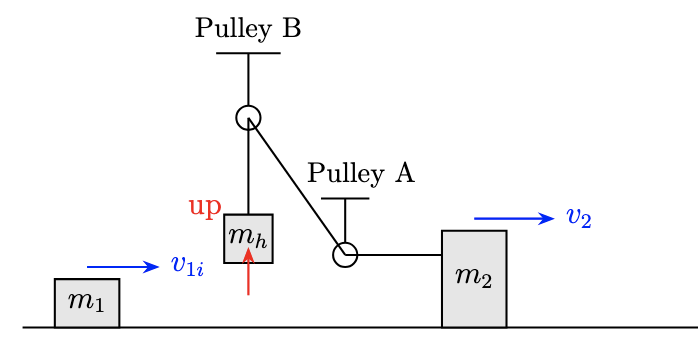
A cart of mass m1​ moves on a frictionless horizontal track with speed v1i​ and collides elastically with a stationary cart of mass m2​. Cart m2​ is attached to a light, inextensible string that runs horizontally to a fixed pulley A (mounted at the same height as the string attachment point on m2​), then up to a higher fixed pulley B, and finally straight down to a hanging mass mh​ (which hangs above the track). Assume both pulleys are frictionless and the string is massless; the pulleys only redirect the string and provide no mechanical advantage. Assume the collision occurs so quickly that the string and mh​ do not affect the collision itself. After the collision, the string is taut; as m2​ moves to the right, mh​ moves upward.

Carts colliding and mass moving up as per given scenario

Given for numerical evaluation (use SI units): m1​=1.2, m2​=1.8, mh​=0.5, v1i​=2.5, g=9.8. Answer the following:

(a) Using conservation of momentum and kinetic energy for an elastic head-on collision, determine v1f​ and v2f​, the velocities of m1​ and m2​ immediately after the collision.

(b) Immediately after the collision, is the speed of the hanging mass equal to the speed of cart m2​? Justify briefly, and write an expression for the total kinetic energy of the moving pair (m2​ and mh​) just after the collision.

(c) As the system evolves, mh​ rises and the pair comes momentarily to rest. Using energy, derive an expression for the maximum rise hmax​ of mh​ in terms of m2​, mh​, v2f​, and g.

(d) Calculate numerical values for v1f​, v2f​, and hmax​ using the given data.

(e) Describe the subsequent motion of m1​ after the collision and explain why. Solutions:

(spoiler)

(a) Post-collision speeds v1f​,v2f​.

During the brief collision, the hanging mass and string have no effect, so the system is only m1​+m2​. We apply conservation of linear momentum and conservation of kinetic energy.

Momentum conservation:

m1​v1i​+m2​(0)=m1​v1f​+m2​v2f​.

Kinetic energy conservation (elastic collision):

21​m1​v1i2​=21​m1​v1f2​+21​m2​v2f2​.

From momentum:

m1​v1i​=m1​v1f​+m2​v2f​.

Divide the energy equation by 21​:

m1​v1i2​=m1​v1f2​+m2​v2f2​.

These two simultaneous equations can be solved algebraically. A useful result of solving them is the relative velocity relation for elastic collisions:

v1i​−0=−(v1f​−v2f​),

or equivalently

v1i​=v2f​−v1f​.

Now solve with m1​=1.2, m2​=1.8, v1i​=2.5:

v1f​=m1​+m2​m1​−m2​​v1i​=−0.50 m/s,

v2f​=m1​+m2​2m1​​v1i​=2.0 m/s.

v1f​=−0.50 m/s,v2f​=+2.0 m/s​

(b) Speed matching and total KE just after the collision.

Justification. The string is massless and inextensible; the pulleys are ideal and only redirect the string. There is no mechanical advantage, so the instantaneous speed of the string is the same everywhere. Therefore, immediately after the collision the hanging mass speed equals the cart’s speed on the string:

vh​=v2f​.

Total KE of the moving pair:

Kafter​=21​m2​v2f2​+21​mh​v2f2​=21​(m2​+mh​)v2f2​.

(c) Maximum risehmax​ of mh​ (energy).

From just after the collision to the top of the rise, the pair’s kinetic energy converts into the gravitational potential of mh​ (both come momentarily to rest at the top):

21​(m2​+mh​)v2f2​=mh​ghmax​⟹hmax​=2mh​g(m2​+mh​)v2f2​​​.

Note: This result relies on vh​=v2f​ because pulleys only change direction.

(d) Numerical results.

Using m1​=1.2, m2​=1.8, mh​=0.5, v1i​=2.5, g=9.8:

v1f​=−0.50 m/s,v2f​=+2.0 m/s,

hmax​=2(0.5)(9.8)(1.8+0.5)(2.0)2​=9.82.3⋅4​≈0.94 m.

hmax​≈0.94 m.​

(e) Motion of m1​ after the collision.

After the instantaneous, elastic collision, m1​ has velocity −0.50 m/s (to the left). The track is frictionless and no horizontal forces act on m1​ thereafter. By Newton’s first law, m1​ continues with constant velocity to the left and plays no further role in the string-pulley-mass motion.

Example problem 5

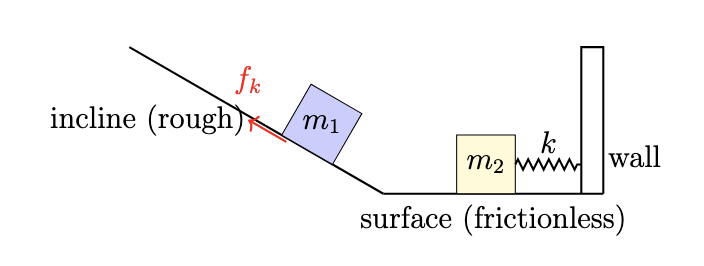
A block m1​=1.0kg starts from rest at the top of a rough incline of angle θ=30∘ and height h=2.0m. The coefficient of kinetic friction is μk​=0.20. At the bottom, it collides inelastically and sticks to a second block m2​=1.5kg initially at rest on a horizontal surface attached to a spring of constant k=200N/m. Find the maximum spring compression xmax​.

Block on incline, colliding with spring
Solution:

(spoiler)

(a) Speed at bottom of incline: Work-energy (including friction):

m1​gh−fk​d=21​m1​v12​,fk​=μk​m1​gcosθ,d=sinθh​.

Compute:

fk​=0.20×1.0×9.8×cos30∘≈1.695N,d=0.52.0​=4.0m.

So

m1​gh−fk​d=(1.0)(9.8)(2.0)−(1.695)(4.0)=19.6−6.78=12.82J,

v1​=1.02×12.82​​≈5.065m/s.

(b) Inelastic collision: m1​ sticks to m2​, so

m1​v1​+m2​⋅0=(m1​+m2​)vc​⟹vc​=2.51.0⋅5.065​≈2.026m/s.

(c) Spring compression: The combined mass stops after compressing the spring:

21​(m1​+m2​)vc2​=21​kxmax2​⟹xmax​=vc​km1​+m2​​​=2.0262002.5​​≈2.026×0.1118≈0.227m.

Conservation of momentum

  • Momentum conserved in isolated systems (no net external force)
  • Total momentum: P=∑i=1N​mi​vi​
  • Key equation: m1​v1i​+m2​v2i​=m1​v1f​+m2​v2f​

Elastic collisions

  • Both momentum and kinetic energy conserved
  • Conservation laws (1D):
    • m1​v1i​+m2​v2i​=m1​v1f​+m2​v2f​
    • 21​m1​v1i2​+21​m2​v2i2​=21​m1​v1f2​+21​m2​v2f2​
  • Final velocities:
    • v1f​=m1​+m2​m1​−m2​​v1i​+m1​+m2​2m2​​v2i​
    • v2f​=m1​+m2​2m1​​v1i​+m1​+m2​m2​−m1​​v2i​

Inelastic collisions

  • Momentum conserved, kinetic energy not conserved
  • Perfectly inelastic: objects stick together, common velocity vf​
    • vf​=m1​+m2​m1​v1i​+m2​v2i​​
  • Kinetic energy lost: ΔK=21​m1​v1i2​+21​m2​v2i2​−21​(m1​+m2​)vf2​

Multi-step collision and energy problems

  • For collisions followed by motion (e.g., up an incline or compressing a spring):
    • Use momentum conservation for collision phase
    • Use energy conservation (including work by friction or gravity) for subsequent motion
  • Example: block and bullet problem
    • Post-collision speed: vc​=M+mb​mb​vb​​
    • Distance up incline: d=g(sinθ+μk​cosθ)21​vc2​​

Compound systems with pulleys and strings

  • Immediately after collision, connected objects (via massless, inextensible string and ideal pulleys) have equal speed
  • Total kinetic energy: K=21​(m2​+mh​)v2f2​
  • Maximum rise of hanging mass: hmax​=2mh​g(m2​+mh​)v2f2​​
  • Isolated object after collision (on frictionless track) continues at constant velocity

Incline-collision-spring sequence

  • Speed at bottom of incline: use work-energy, account for friction
  • Inelastic collision: combine masses, find common speed
  • Maximum spring compression: xmax​=vc​km1​+m2​​​

General strategies for collision problems

  • Clearly define the system and direction
  • Write momentum conservation equations for before and after collision
  • Decide if kinetic energy is also conserved (elastic vs. inelastic)
  • Use energy principles for post-collision motion if needed

Sign up for free to take 6 quiz questions on this topic

Previous
Next  | 7.1 Rotational kinematics
All rights reserved ©2016 - 2026 Achievable, Inc.

Conservation of momentum and collisions

This subchapter builds on the previous one and focuses on three core ideas:

  • Conservation of momentum
  • Elastic collisions
  • Inelastic collisions

Conservation of momentum

Momentum is conserved when you choose a system with no net external force (an isolated system). In that case, the system’s total linear momentum stays constant over time.

Consider N particles with masses mi​ and velocities vi​. The total momentum is

P=i=1∑N​mi​vi​.

Apply Newton’s second law to each particle:

mi​dtdvi​​=Fi,int​+Fi,ext​.

Now sum over all particles. The internal forces Fi,int​ cancel in pairs because of Newton’s third law (action-reaction). That leaves only the external forces:

dtdP​=i=1∑N​Fi,ext​=Fext,net​.

So if the net external force is zero, Fext,net​=0, then

dtdP​=0⟹Pinitial​=Pfinal​.

Key Point:

m1​v1i​+m2​v2i​=m1​v1f​+m2​v2f​.

Elastic collisions

An elastic collision conserves:

  • total momentum
  • total kinetic energy

In one dimension, those conservation laws are

m1​v1i​+m2​v2i​=m1​v1f​+m2​v2f​,

21​m1​v1i2​+21​m2​v2i2​=21​m1​v1f2​+21​m2​v2f2​.

Solving these simultaneously gives the standard final-velocity formulas:

v1f​=m1​+m2​m1​−m2​​v1i​−m1​+m2​2m2​​v2i​,v2f​=m1​+m2​2m1​​v1i​−m1​+m2​m2​−m1​​v2i​.

Example problem 1

A 2.0 kg puck moving at 5.0 m/s collides elastically with a 3.0 kg puck at rest. Find their final speeds. Solution:

(spoiler)

m1​=2.0,v1i​=5.0,m2​=3.0,v2i​=0.

Apply the elastic-collision formulas:

v1f​=2+32−3​(5.0)+52⋅3​(0)=−51​5.0=−1.0m/s,

v2f​=52⋅2​(5.0)+53−2​(0)=54​5.0=4.0m/s.

Inelastic collisions

In an inelastic collision, momentum is conserved but kinetic energy decreases (some of it becomes thermal energy, sound, deformation, etc.).

In a perfectly inelastic collision, the objects stick together and move with a common final velocity vf​:

m1​v1i​+m2​v2i​=(m1​+m2​)vf​⟹vf​=m1​+m2​m1​v1i​+m2​v2i​​.

The kinetic energy lost (difference between initial and final kinetic energy) is

ΔK=21​m1​v1i2​+21​m2​v2i2​−21​(m1​+m2​)vf2​.

Example problem 2

A 1.5 kg cart moving at 3.0 m/s collides and sticks to a 2.5 kg cart at rest. Find their common speed and the kinetic energy lost. Solution.

(spoiler)

m1​=1.5,v1i​=3.0,m2​=2.5,v2i​=0.

Common speed:

vf​=1.5+2.51.5⋅3.0+2.5⋅0​=4.04.5​=1.125m/s.

Initial KE:

Ki​=21​(1.5)(3.0)2+0=6.75J.

Final KE:

Kf​=21​(4.0)(1.125)2=2.531J.

KE lost:

ΔK=6.75−2.531=4.219J.

Example problem 3

A bullet of mass mb​=0.010kg is fired horizontally at speed vb​=300m/s into a stationary block of mass M=1.50kg at the base of a rough incline of angle θ=30∘. The coefficient of kinetic friction between the block (with embedded bullet) and the incline is μk​=0.15. After the inelastic collision, the combined mass slides up the incline and comes to rest. Determine the distance d it travels up the incline.

Solution:

(spoiler)
  1. Inelastic collision → speed just after impact. Conserve momentum of bullet + block:

    mb​vb​+M⋅0=(M+mb​)vc​⟹vc​=M+mb​mb​vb​​=1.5100.010×300​≈1.987m/s.

  2. Energy loss in collision. Initial KE of bullet:

    Ki​=21​mb​vb2​=21​(0.010)(300)2=450J.

    KE of combined mass just after collision:

    Kc​=21​(M+mb​)vc2​=21​(1.510)(1.987)2≈2.985J.

    KE dissipated:

    ΔK=Ki​−Kc​≈450−2.985=447.015J.

  3. Work against gravity and friction up the incline. The kinetic energy just after the collision is used to do work against gravity and friction until the mass comes to rest:

    Kc​=Wg​+Wf​,

    where

    Wg​=(M+mb​)gdsinθ,Wf​=μk​(M+mb​)gcosθd.

    Thus

    21​(M+mb​)vc2​=(M+mb​)gd(sinθ+μk​cosθ).

    Cancel (M+mb​) and solve for d:

    d=g(sinθ+μk​cosθ)21​vc2​​=9.8(0.5+0.15⋅0.866)(1.987)2/2​≈0.320m.

Answer: d≈0.320m up the incline.

Example problem 4

A cart of mass m1​ moves on a frictionless horizontal track with speed v1i​ and collides elastically with a stationary cart of mass m2​. Cart m2​ is attached to a light, inextensible string that runs horizontally to a fixed pulley A (mounted at the same height as the string attachment point on m2​), then up to a higher fixed pulley B, and finally straight down to a hanging mass mh​ (which hangs above the track). Assume both pulleys are frictionless and the string is massless; the pulleys only redirect the string and provide no mechanical advantage. Assume the collision occurs so quickly that the string and mh​ do not affect the collision itself. After the collision, the string is taut; as m2​ moves to the right, mh​ moves upward.

Given for numerical evaluation (use SI units): m1​=1.2, m2​=1.8, mh​=0.5, v1i​=2.5, g=9.8. Answer the following:

(a) Using conservation of momentum and kinetic energy for an elastic head-on collision, determine v1f​ and v2f​, the velocities of m1​ and m2​ immediately after the collision.

(b) Immediately after the collision, is the speed of the hanging mass equal to the speed of cart m2​? Justify briefly, and write an expression for the total kinetic energy of the moving pair (m2​ and mh​) just after the collision.

(c) As the system evolves, mh​ rises and the pair comes momentarily to rest. Using energy, derive an expression for the maximum rise hmax​ of mh​ in terms of m2​, mh​, v2f​, and g.

(d) Calculate numerical values for v1f​, v2f​, and hmax​ using the given data.

(e) Describe the subsequent motion of m1​ after the collision and explain why. Solutions:

(spoiler)

(a) Post-collision speeds v1f​,v2f​.

During the brief collision, the hanging mass and string have no effect, so the system is only m1​+m2​. We apply conservation of linear momentum and conservation of kinetic energy.

Momentum conservation:

m1​v1i​+m2​(0)=m1​v1f​+m2​v2f​.

Kinetic energy conservation (elastic collision):

21​m1​v1i2​=21​m1​v1f2​+21​m2​v2f2​.

From momentum:

m1​v1i​=m1​v1f​+m2​v2f​.

Divide the energy equation by 21​:

m1​v1i2​=m1​v1f2​+m2​v2f2​.

These two simultaneous equations can be solved algebraically. A useful result of solving them is the relative velocity relation for elastic collisions:

v1i​−0=−(v1f​−v2f​),

or equivalently

v1i​=v2f​−v1f​.

Now solve with m1​=1.2, m2​=1.8, v1i​=2.5:

v1f​=m1​+m2​m1​−m2​​v1i​=−0.50 m/s,

v2f​=m1​+m2​2m1​​v1i​=2.0 m/s.

v1f​=−0.50 m/s,v2f​=+2.0 m/s​

(b) Speed matching and total KE just after the collision.

Justification. The string is massless and inextensible; the pulleys are ideal and only redirect the string. There is no mechanical advantage, so the instantaneous speed of the string is the same everywhere. Therefore, immediately after the collision the hanging mass speed equals the cart’s speed on the string:

vh​=v2f​.

Total KE of the moving pair:

Kafter​=21​m2​v2f2​+21​mh​v2f2​=21​(m2​+mh​)v2f2​.

(c) Maximum risehmax​ of mh​ (energy).

From just after the collision to the top of the rise, the pair’s kinetic energy converts into the gravitational potential of mh​ (both come momentarily to rest at the top):

21​(m2​+mh​)v2f2​=mh​ghmax​⟹hmax​=2mh​g(m2​+mh​)v2f2​​​.

Note: This result relies on vh​=v2f​ because pulleys only change direction.

(d) Numerical results.

Using m1​=1.2, m2​=1.8, mh​=0.5, v1i​=2.5, g=9.8:

v1f​=−0.50 m/s,v2f​=+2.0 m/s,

hmax​=2(0.5)(9.8)(1.8+0.5)(2.0)2​=9.82.3⋅4​≈0.94 m.

hmax​≈0.94 m.​

(e) Motion of m1​ after the collision.

After the instantaneous, elastic collision, m1​ has velocity −0.50 m/s (to the left). The track is frictionless and no horizontal forces act on m1​ thereafter. By Newton’s first law, m1​ continues with constant velocity to the left and plays no further role in the string-pulley-mass motion.

Example problem 5

A block m1​=1.0kg starts from rest at the top of a rough incline of angle θ=30∘ and height h=2.0m. The coefficient of kinetic friction is μk​=0.20. At the bottom, it collides inelastically and sticks to a second block m2​=1.5kg initially at rest on a horizontal surface attached to a spring of constant k=200N/m. Find the maximum spring compression xmax​.

Solution:

(spoiler)

(a) Speed at bottom of incline: Work-energy (including friction):

m1​gh−fk​d=21​m1​v12​,fk​=μk​m1​gcosθ,d=sinθh​.

Compute:

fk​=0.20×1.0×9.8×cos30∘≈1.695N,d=0.52.0​=4.0m.

So

m1​gh−fk​d=(1.0)(9.8)(2.0)−(1.695)(4.0)=19.6−6.78=12.82J,

v1​=1.02×12.82​​≈5.065m/s.

(b) Inelastic collision: m1​ sticks to m2​, so

m1​v1​+m2​⋅0=(m1​+m2​)vc​⟹vc​=2.51.0⋅5.065​≈2.026m/s.

(c) Spring compression: The combined mass stops after compressing the spring:

21​(m1​+m2​)vc2​=21​kxmax2​⟹xmax​=vc​km1​+m2​​​=2.0262002.5​​≈2.026×0.1118≈0.227m.

Key points

Conservation of momentum

  • Momentum conserved in isolated systems (no net external force)
  • Total momentum: P=∑i=1N​mi​vi​
  • Key equation: m1​v1i​+m2​v2i​=m1​v1f​+m2​v2f​

Elastic collisions

  • Both momentum and kinetic energy conserved
  • Conservation laws (1D):
    • m1​v1i​+m2​v2i​=m1​v1f​+m2​v2f​
    • 21​m1​v1i2​+21​m2​v2i2​=21​m1​v1f2​+21​m2​v2f2​
  • Final velocities:
    • v1f​=m1​+m2​m1​−m2​​v1i​+m1​+m2​2m2​​v2i​
    • v2f​=m1​+m2​2m1​​v1i​+m1​+m2​m2​−m1​​v2i​

Inelastic collisions

  • Momentum conserved, kinetic energy not conserved
  • Perfectly inelastic: objects stick together, common velocity vf​
    • vf​=m1​+m2​m1​v1i​+m2​v2i​​
  • Kinetic energy lost: ΔK=21​m1​v1i2​+21​m2​v2i2​−21​(m1​+m2​)vf2​

Multi-step collision and energy problems

  • For collisions followed by motion (e.g., up an incline or compressing a spring):
    • Use momentum conservation for collision phase
    • Use energy conservation (including work by friction or gravity) for subsequent motion
  • Example: block and bullet problem
    • Post-collision speed: vc​=M+mb​mb​vb​​
    • Distance up incline: d=g(sinθ+μk​cosθ)21​vc2​​

Compound systems with pulleys and strings

  • Immediately after collision, connected objects (via massless, inextensible string and ideal pulleys) have equal speed
  • Total kinetic energy: K=21​(m2​+mh​)v2f2​
  • Maximum rise of hanging mass: hmax​=2mh​g(m2​+mh​)v2f2​​
  • Isolated object after collision (on frictionless track) continues at constant velocity

Incline-collision-spring sequence

  • Speed at bottom of incline: use work-energy, account for friction
  • Inelastic collision: combine masses, find common speed
  • Maximum spring compression: xmax​=vc​km1​+m2​​​

General strategies for collision problems

  • Clearly define the system and direction
  • Write momentum conservation equations for before and after collision
  • Decide if kinetic energy is also conserved (elastic vs. inelastic)
  • Use energy principles for post-collision motion if needed

More from Linear momentum and collisions

  • Systems, momentum and impulse