


Achievable logoAchievable logo
AP Physics 1
Sign in
Sign up
Purchase
Textbook
Practice exams
Support
How it works
Exam catalog
Mountain with a flag at the peak
Textbook
Introduction
1. Decoding the exam
2. Vectors and their analysis
3. Kinematics
3.1 Introduction and basic concepts
3.2 Graphical analysis of motion
3.3 Equations of motion and free fall
3.4 Motion in two dimensions
4. Laws of motion
5. Work, energy, and power
6. Linear momentum and collisions
7. Torque and rotational mechanics
8. Oscillations
9. Fluids
Wrapping up
Achievable logoAchievable logo
3.4 Motion in two dimensions
Achievable AP Physics 1
3. Kinematics
Our AP Physics 1 course is currently in development and is a work-in-progress.

Motion in two dimensions

12 min read
Font
Discuss
Share
Feedback

In this sub-chapter, we study motion in two dimensions. We’ll focus on:

  • Horizontal and vertical equations of motion
  • Trajectory formulas
  • Relative motion

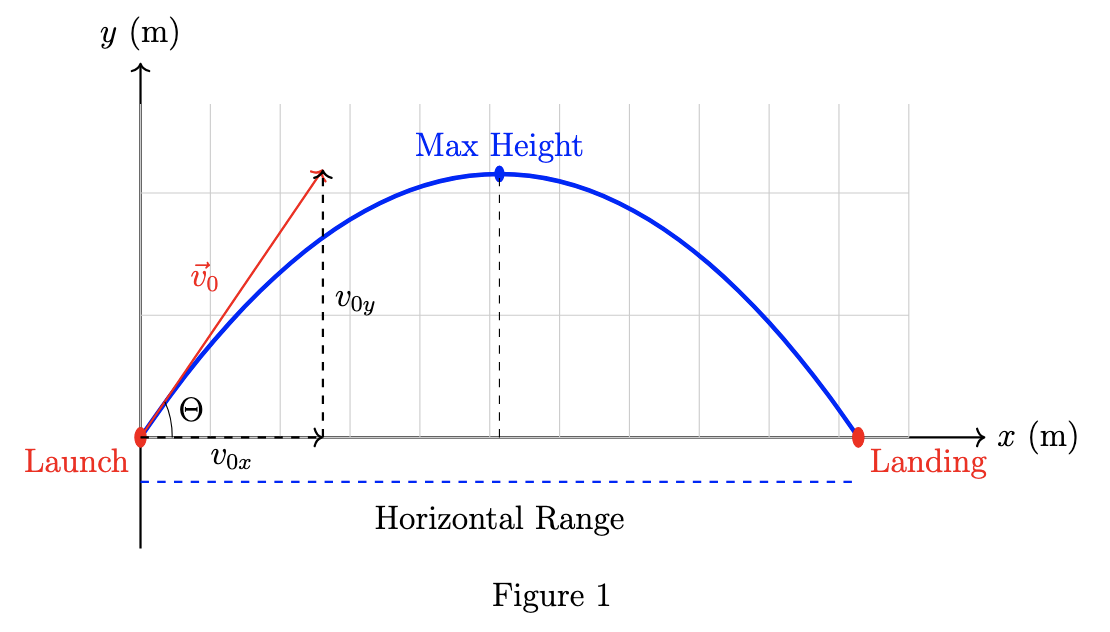
Decomposition of motion

A projectile launched with initial speed v0​ at an angle θ above the horizontal has the velocity components:

v0x​=v0​cosθ,v0y​=v0​sinθ.

The key idea is that the motion splits into two independent one-dimensional motions:

Decomposition of motion
  • Horizontal: No acceleration (ax​=0), so the horizontal velocity stays constant. The horizontal position is:

x=v0x​t.

  • Vertical: Constant acceleration due to gravity (ay​=−g), so the vertical position is:

y=y0​+v0y​t−21​gt2.

Derivation of trajectory formulas

Here are the standard projectile-motion results, derived directly from the horizontal and vertical kinematics equations.

Time of flight (for launch from ground level)

Assume the projectile is launched from ground level (y0​=0) and lands back at ground level (y=0). The vertical displacement equation becomes:

0=v0y​t−21​gt2.

Factor out t:

t(v0y​−21​gt)=0.

The solution t=0 corresponds to the launch instant, so we use the non-trivial solution:

v0y​−21​gt=0⟹t=g2v0y​​=g2v0​sinθ​.

Thus, the time of flight is:

T=g2v0​sinθ​.

Maximum height

At maximum height, the vertical velocity is zero. Using vy​=v0y​−gt:

0=v0y​−gtup​.

So the time to reach the top is:

tup​=gv0y​​=gv0​sinθ​.

Now substitute tup​ into the vertical displacement equation (with y0​=0):

H=v0y​tup​−21​gtup2​=v0​sinθ(gv0​sinθ​)−21​g(gv0​sinθ​)2.

Simplifying gives:

H=gv02​sin2θ​−21​gv02​sin2θ​=2gv02​sin2θ​.

Horizontal range

The horizontal range is the horizontal displacement after time T:

R=v0x​T=v0​cosθ(g2v0​sinθ​)=g2v02​sinθcosθ​.

Using sin2θ=2sinθcosθ:

R=gv02​sin2θ​.

In the practice problems below, the goal is to rely on the basic horizontal and vertical motion equations and use them to derive what you need, rather than depending only on memorized formulas. Example Problem 1

A projectile is launched from the ground with an initial speed of 15m/s at an angle of 40∘. Determine:

  1. The time of flight.
  2. The maximum height reached.
  3. The horizontal range.

Solution:

(spoiler)
  • Time of flight: Start with the vertical displacement equation:

    y=v0y​t−21​gt2.

    Since the projectile starts and lands at ground level, y0​=0 and the final y=0, so:

    0=(15sin40∘)t−21​(9.8)t2.

    Factor out t and ignore the trivial solution t=0:

    (15sin40∘)−21​(9.8)t=0.

    Solve for t:

    t=9.82(15sin40∘)​.

    Using sin40∘≈0.643:

    T≈9.82(15×0.643)​≈9.819.29​≈1.97s.

  • Maximum height: At the top of the trajectory, vy​=0. Using:

    vy​=v0y​−gt,

    we get:

    tup​=9.815sin40∘​≈9.815×0.643​≈9.89.645​≈0.98s.

    Substitute into the vertical displacement equation:

    H=(15sin40∘)(0.98)−21​(9.8)(0.98)2.

    Evaluate:

    H≈9.645×0.98−4.9×0.96≈9.45−4.70≈4.75m.

  • Horizontal range: Horizontal motion has constant velocity, so:

    x=v0x​t,

    where v0x​=15cos40∘. Using cos40∘≈0.766:

    v0x​≈15×0.766≈11.49m/s.

    Then:

    R=11.49×1.97≈22.62m.

Example problem 2

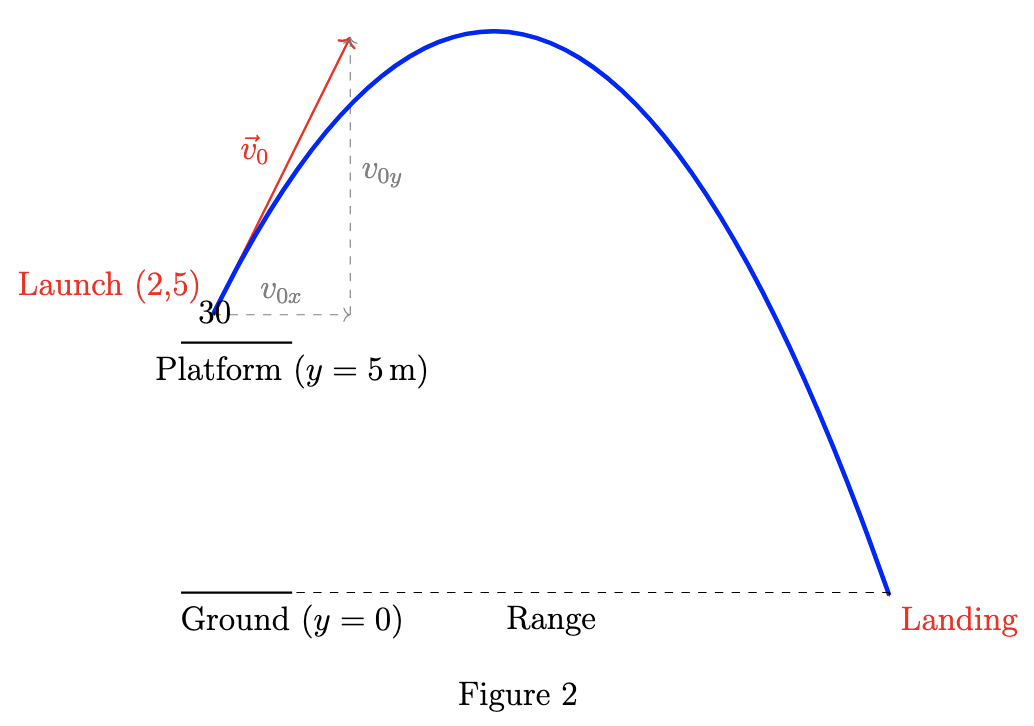
A ball is thrown from the top of a 5m high platform with an initial speed of 20m/s at an angle of 30∘ above the horizontal. Determine:

  1. The time until the ball hits the ground.
  2. The horizontal distance from the platform where the ball lands.

Solution:

(spoiler)
Graphing the given two dimensional motion scenario
  • Decompose the initial velocity:

    v0x​=20cos30∘≈20(0.866)=17.32m/s,

    v0y​=20sin30∘=20(0.5)=10m/s.

  • Vertical motion: Use:

    y=y0​+v0y​t−21​gt2,

    with y0​=5m and final y=0:

    0=5+10t−4.9t2.

    Rearrange into standard quadratic form:

    4.9t2−10t−5=0.

    Apply the quadratic formula:

    t=2(4.9)10±102−4(4.9)(−5)​​.

    Simplify:

    t=9.810±100+98​​=9.810±198​​.

    Take the positive root (time must be positive):

    t≈9.810+14.07​≈9.824.07​≈2.46s.

  • Horizontal motion: Now use x=v0x​t:

    x=v0x​t≈17.32m/s×2.46s≈42.59m.

Example problem 3

A projectile is launched from the ground with an initial speed of 18m/s at an angle of 60∘. When the projectile is at half its maximum height, determine the angle of its velocity vector with respect to the horizontal.

Solution:

(spoiler)
  • Determine maximum height: Start by decomposing the initial velocity:

    v0x​=18cos60∘=18(0.5)=9m/s,v0y​=18sin60∘≈18(0.866)=15.59m/s.

    Then compute the maximum height:

    H=2g(v0y​)2​=19.6(15.59)2​≈19.6243.1​≈12.41m.

    Half of the maximum height is about 6.205m.

  • Find the time at half-height: Use:

    y=v0y​t−21​gt2.

    Set y=6.205m:

    6.205=15.59t−4.9t2.

    Solve this quadratic for t and use the smaller positive solution (the projectile is on the way up), say t≈0.8s.

  • Determine velocity components at t≈0.8s: Horizontal velocity stays constant:

    vx​=v0x​=9m/s.

    Vertical velocity is:

    vy​=v0y​−gt≈15.59−9.8(0.8)≈15.59−7.84≈7.75m/s.

  • Compute the angle: Use the velocity components:

    tanϕ=vx​vy​​≈97.75​≈0.8611,

    ϕ≈arctan(0.8611)≈40∘.

Relative motion

Relative motion describes how an object’s velocity depends on the observer’s frame of reference.

If object A has velocity vA​ relative to the ground, and object B has velocity vB​ relative to the ground, then the velocity of A relative to B is:

vA/B​=vA​−vB​.

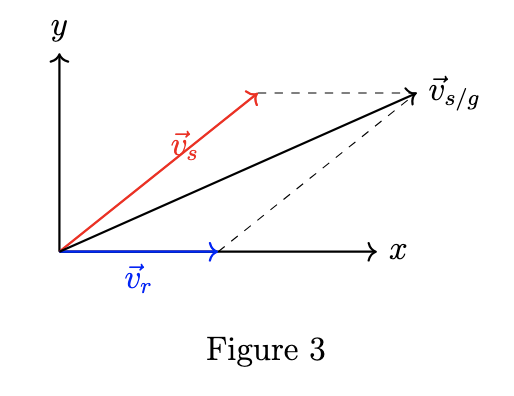
A common example is a swimmer crossing a river. The swimmer’s velocity relative to the ground is the vector sum of:

  • vs​, the swimmer’s velocity relative to the water
  • vr​, the river current (water relative to the ground)

So:

vs/g​=vs​+vr​.

This is the main idea to keep in mind: the swimmer’s path relative to the ground depends on both the swimmer’s motion through the water and the water’s motion relative to the ground.

Vector representation of swimmer's velocity and river flow

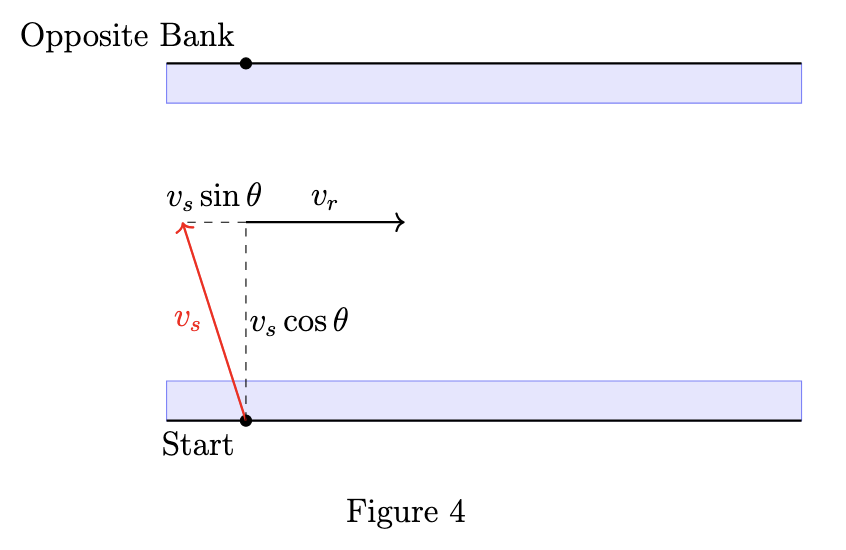
Case 1: Swimmer aiming to reach the opposite bank

To land directly opposite the starting point, the swimmer must aim upstream so that the upstream component of the swimming velocity cancels the river current.

Let:

  • vs​ be the swimmer’s speed relative to the water.
  • vr​ be the speed of the river.
  • θ be the angle upstream (measured from the line perpendicular to the bank).

For no downstream drift, the upstream component must match the river current:

vs​sinθ=vr​⟹θ=arcsin(vs​vr​​).

The effective speed across the river is the component perpendicular to the bank:

vs,⊥​=vs​cosθ.

For a river of width w, the crossing time is:

t=vs,⊥​w​=vs​cosθw​.

Swimmer reaching the opposite bank

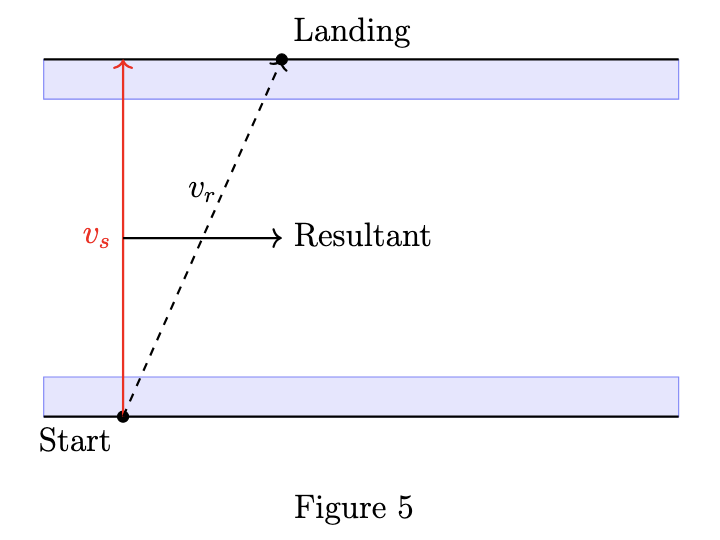
Case 2: Swimmer swimming straight across

If the swimmer points straight across (perpendicular to the banks), then the swimmer’s velocity relative to the water is entirely across the river:

vs,⊥​=vs​.

The river current still carries the swimmer downstream. The downstream displacement is:

d=vr​t,

where the crossing time is:

t=vs​w​.

Swimmer swimming straight across

Example problem 4

A swimmer can swim at 2.0m/s in still water and needs to cross a river that is 10m wide. The river current is 0.8m/s. At what angle (measured from the perpendicular to the bank) must the swimmer aim to land directly opposite the starting point? Also, determine the time to cross the river.

Solution:

(spoiler)
  • To cancel the river current:

vs​sinθ=0.8⟹sinθ=2.00.8​=0.4,

θ=arcsin(0.4)≈23.6∘.

  • The effective speed across the river is:

vs,⊥​=vs​cosθ≈2.0cos(23.6∘)≈2.0×0.917≈1.83m/s.

  • Time to cross:

t=1.83m/s10m​≈5.46s.

Example problem 5

Using the same swimmer (swimming at 2.0m/s) and a river current of 0.8m/s, if the swimmer heads straight across (perpendicular to the banks), how far downstream will he be carried?

Solution:

(spoiler)
  • Time to cross:

t=2.0m/s10m​=5.0s.

  • Downstream drift:

d=vr​t=0.8m/s×5.0s=4.0m.

Decomposition of motion\

  • Projectile motion splits into independent horizontal and vertical components
    • Horizontal: constant velocity, x=v0x​t
    • Vertical: constant acceleration, y=y0​+v0y​t−21​gt2
  • Initial velocity components: v0x​=v0​cosθ, v0y​=v0​sinθ

Trajectory formulas\

  • Time of flight (from ground): T=g2v0​sinθ​
  • Maximum height: H=2gv02​sin2θ​
  • Horizontal range: R=gv02​sin2θ​
  • Derive all formulas from basic kinematics, not memorization

Example problem strategies\

  • Always decompose initial velocity into x and y components
  • Use vertical motion to solve for time (quadratic if y0​=0)
  • Use horizontal velocity and time to find range/displacement
  • For velocity at a point, calculate vx​ (constant) and vy​ (changes with t), then use tanϕ=vy​/vx​

Relative motion\

  • Relative velocity: vA/B​=vA​−vB​
  • Swimmer in river:
    • Effective velocity relative to ground: vs/g​=vs​+vr​
    • To land directly opposite: vs​sinθ=vr​, θ=arcsin(vs​vr​​)
    • Crossing speed: vs,⊥​=vs​cosθ, crossing time t=vs​cosθw​
    • If heading straight across: downstream drift d=vr​t, t=vs​w​

Key problem-solving tips\

  • Do not memorize projectile formulas - derive from basic equations
  • Always resolve motion into perpendicular components
  • Use vector addition for relative motion scenarios

Sign up for free to take 7 quiz questions on this topic

Previous
Next  | 4.1 Introduction to force and laws of motion
All rights reserved ©2016 - 2026 Achievable, Inc.

Motion in two dimensions

In this sub-chapter, we study motion in two dimensions. We’ll focus on:

  • Horizontal and vertical equations of motion
  • Trajectory formulas
  • Relative motion

Decomposition of motion

A projectile launched with initial speed v0​ at an angle θ above the horizontal has the velocity components:

v0x​=v0​cosθ,v0y​=v0​sinθ.

The key idea is that the motion splits into two independent one-dimensional motions:

  • Horizontal: No acceleration (ax​=0), so the horizontal velocity stays constant. The horizontal position is:

x=v0x​t.

  • Vertical: Constant acceleration due to gravity (ay​=−g), so the vertical position is:

y=y0​+v0y​t−21​gt2.

Derivation of trajectory formulas

Here are the standard projectile-motion results, derived directly from the horizontal and vertical kinematics equations.

Time of flight (for launch from ground level)

Assume the projectile is launched from ground level (y0​=0) and lands back at ground level (y=0). The vertical displacement equation becomes:

0=v0y​t−21​gt2.

Factor out t:

t(v0y​−21​gt)=0.

The solution t=0 corresponds to the launch instant, so we use the non-trivial solution:

v0y​−21​gt=0⟹t=g2v0y​​=g2v0​sinθ​.

Thus, the time of flight is:

T=g2v0​sinθ​.

Maximum height

At maximum height, the vertical velocity is zero. Using vy​=v0y​−gt:

0=v0y​−gtup​.

So the time to reach the top is:

tup​=gv0y​​=gv0​sinθ​.

Now substitute tup​ into the vertical displacement equation (with y0​=0):

H=v0y​tup​−21​gtup2​=v0​sinθ(gv0​sinθ​)−21​g(gv0​sinθ​)2.

Simplifying gives:

H=gv02​sin2θ​−21​gv02​sin2θ​=2gv02​sin2θ​.

Horizontal range

The horizontal range is the horizontal displacement after time T:

R=v0x​T=v0​cosθ(g2v0​sinθ​)=g2v02​sinθcosθ​.

Using sin2θ=2sinθcosθ:

R=gv02​sin2θ​.

In the practice problems below, the goal is to rely on the basic horizontal and vertical motion equations and use them to derive what you need, rather than depending only on memorized formulas. Example Problem 1

A projectile is launched from the ground with an initial speed of 15m/s at an angle of 40∘. Determine:

  1. The time of flight.
  2. The maximum height reached.
  3. The horizontal range.

Solution:

(spoiler)
  • Time of flight: Start with the vertical displacement equation:

    y=v0y​t−21​gt2.

    Since the projectile starts and lands at ground level, y0​=0 and the final y=0, so:

    0=(15sin40∘)t−21​(9.8)t2.

    Factor out t and ignore the trivial solution t=0:

    (15sin40∘)−21​(9.8)t=0.

    Solve for t:

    t=9.82(15sin40∘)​.

    Using sin40∘≈0.643:

    T≈9.82(15×0.643)​≈9.819.29​≈1.97s.

  • Maximum height: At the top of the trajectory, vy​=0. Using:

    vy​=v0y​−gt,

    we get:

    tup​=9.815sin40∘​≈9.815×0.643​≈9.89.645​≈0.98s.

    Substitute into the vertical displacement equation:

    H=(15sin40∘)(0.98)−21​(9.8)(0.98)2.

    Evaluate:

    H≈9.645×0.98−4.9×0.96≈9.45−4.70≈4.75m.

  • Horizontal range: Horizontal motion has constant velocity, so:

    x=v0x​t,

    where v0x​=15cos40∘. Using cos40∘≈0.766:

    v0x​≈15×0.766≈11.49m/s.

    Then:

    R=11.49×1.97≈22.62m.

Example problem 2

A ball is thrown from the top of a 5m high platform with an initial speed of 20m/s at an angle of 30∘ above the horizontal. Determine:

  1. The time until the ball hits the ground.
  2. The horizontal distance from the platform where the ball lands.

Solution:

(spoiler)
  • Decompose the initial velocity:

    v0x​=20cos30∘≈20(0.866)=17.32m/s,

    v0y​=20sin30∘=20(0.5)=10m/s.

  • Vertical motion: Use:

    y=y0​+v0y​t−21​gt2,

    with y0​=5m and final y=0:

    0=5+10t−4.9t2.

    Rearrange into standard quadratic form:

    4.9t2−10t−5=0.

    Apply the quadratic formula:

    t=2(4.9)10±102−4(4.9)(−5)​​.

    Simplify:

    t=9.810±100+98​​=9.810±198​​.

    Take the positive root (time must be positive):

    t≈9.810+14.07​≈9.824.07​≈2.46s.

  • Horizontal motion: Now use x=v0x​t:

    x=v0x​t≈17.32m/s×2.46s≈42.59m.

Example problem 3

A projectile is launched from the ground with an initial speed of 18m/s at an angle of 60∘. When the projectile is at half its maximum height, determine the angle of its velocity vector with respect to the horizontal.

Solution:

(spoiler)
  • Determine maximum height: Start by decomposing the initial velocity:

    v0x​=18cos60∘=18(0.5)=9m/s,v0y​=18sin60∘≈18(0.866)=15.59m/s.

    Then compute the maximum height:

    H=2g(v0y​)2​=19.6(15.59)2​≈19.6243.1​≈12.41m.

    Half of the maximum height is about 6.205m.

  • Find the time at half-height: Use:

    y=v0y​t−21​gt2.

    Set y=6.205m:

    6.205=15.59t−4.9t2.

    Solve this quadratic for t and use the smaller positive solution (the projectile is on the way up), say t≈0.8s.

  • Determine velocity components at t≈0.8s: Horizontal velocity stays constant:

    vx​=v0x​=9m/s.

    Vertical velocity is:

    vy​=v0y​−gt≈15.59−9.8(0.8)≈15.59−7.84≈7.75m/s.

  • Compute the angle: Use the velocity components:

    tanϕ=vx​vy​​≈97.75​≈0.8611,

    ϕ≈arctan(0.8611)≈40∘.

Relative motion

Relative motion describes how an object’s velocity depends on the observer’s frame of reference.

If object A has velocity vA​ relative to the ground, and object B has velocity vB​ relative to the ground, then the velocity of A relative to B is:

vA/B​=vA​−vB​.

A common example is a swimmer crossing a river. The swimmer’s velocity relative to the ground is the vector sum of:

  • vs​, the swimmer’s velocity relative to the water
  • vr​, the river current (water relative to the ground)

So:

vs/g​=vs​+vr​.

This is the main idea to keep in mind: the swimmer’s path relative to the ground depends on both the swimmer’s motion through the water and the water’s motion relative to the ground.

Case 1: Swimmer aiming to reach the opposite bank

To land directly opposite the starting point, the swimmer must aim upstream so that the upstream component of the swimming velocity cancels the river current.

Let:

  • vs​ be the swimmer’s speed relative to the water.
  • vr​ be the speed of the river.
  • θ be the angle upstream (measured from the line perpendicular to the bank).

For no downstream drift, the upstream component must match the river current:

vs​sinθ=vr​⟹θ=arcsin(vs​vr​​).

The effective speed across the river is the component perpendicular to the bank:

vs,⊥​=vs​cosθ.

For a river of width w, the crossing time is:

t=vs,⊥​w​=vs​cosθw​.

Case 2: Swimmer swimming straight across

If the swimmer points straight across (perpendicular to the banks), then the swimmer’s velocity relative to the water is entirely across the river:

vs,⊥​=vs​.

The river current still carries the swimmer downstream. The downstream displacement is:

d=vr​t,

where the crossing time is:

t=vs​w​.

Example problem 4

A swimmer can swim at 2.0m/s in still water and needs to cross a river that is 10m wide. The river current is 0.8m/s. At what angle (measured from the perpendicular to the bank) must the swimmer aim to land directly opposite the starting point? Also, determine the time to cross the river.

Solution:

(spoiler)
  • To cancel the river current:

vs​sinθ=0.8⟹sinθ=2.00.8​=0.4,

θ=arcsin(0.4)≈23.6∘.

  • The effective speed across the river is:

vs,⊥​=vs​cosθ≈2.0cos(23.6∘)≈2.0×0.917≈1.83m/s.

  • Time to cross:

t=1.83m/s10m​≈5.46s.

Example problem 5

Using the same swimmer (swimming at 2.0m/s) and a river current of 0.8m/s, if the swimmer heads straight across (perpendicular to the banks), how far downstream will he be carried?

Solution:

(spoiler)
  • Time to cross:

t=2.0m/s10m​=5.0s.

  • Downstream drift:

d=vr​t=0.8m/s×5.0s=4.0m.

Key points

Decomposition of motion\

  • Projectile motion splits into independent horizontal and vertical components
    • Horizontal: constant velocity, x=v0x​t
    • Vertical: constant acceleration, y=y0​+v0y​t−21​gt2
  • Initial velocity components: v0x​=v0​cosθ, v0y​=v0​sinθ

Trajectory formulas\

  • Time of flight (from ground): T=g2v0​sinθ​
  • Maximum height: H=2gv02​sin2θ​
  • Horizontal range: R=gv02​sin2θ​
  • Derive all formulas from basic kinematics, not memorization

Example problem strategies\

  • Always decompose initial velocity into x and y components
  • Use vertical motion to solve for time (quadratic if y0​=0)
  • Use horizontal velocity and time to find range/displacement
  • For velocity at a point, calculate vx​ (constant) and vy​ (changes with t), then use tanϕ=vy​/vx​

Relative motion\

  • Relative velocity: vA/B​=vA​−vB​
  • Swimmer in river:
    • Effective velocity relative to ground: vs/g​=vs​+vr​
    • To land directly opposite: vs​sinθ=vr​, θ=arcsin(vs​vr​​)
    • Crossing speed: vs,⊥​=vs​cosθ, crossing time t=vs​cosθw​
    • If heading straight across: downstream drift d=vr​t, t=vs​w​

Key problem-solving tips\

  • Do not memorize projectile formulas - derive from basic equations
  • Always resolve motion into perpendicular components
  • Use vector addition for relative motion scenarios

More from Kinematics

  • Introduction and basic concepts
  • Graphical analysis of motion
  • Equations of motion and free fall