


Achievable logoAchievable logo
AP Physics 1
Sign in
Sign up
Purchase
Textbook
Practice exams
Support
How it works
Exam catalog
Mountain with a flag at the peak
Textbook
Introduction
1. Decoding the exam
2. Vectors and their analysis
3. Kinematics
3.1 Introduction and basic concepts
3.2 Graphical analysis of motion
3.3 Equations of motion and free fall
3.4 Motion in two dimensions
4. Laws of motion
5. Work, energy, and power
6. Linear momentum and collisions
7. Torque and rotational mechanics
8. Oscillations
9. Fluids
Wrapping up
Achievable logoAchievable logo
3.3 Equations of motion and free fall
Achievable AP Physics 1
3. Kinematics
Our AP Physics 1 course is currently in development and is a work-in-progress.

Equations of motion and free fall

12 min read
Font
Discuss
Share
Feedback

In this sub-chapter we discuss:

  • Three constant-acceleration equations
  • Graphical derivations
  • Algebraic derivations
  • Connection to kinematic graphs
  • Free fall scenarios

First equation of motion

When acceleration is constant, the average acceleration equals the change in velocity divided by the elapsed time:

a=tv−v0​​,

where

  • v0​ is the initial velocity,
  • v is the final velocity, and
  • t is the elapsed time.

Solve this equation for v by multiplying both sides by t and then adding v0​:

v=v0​+at.

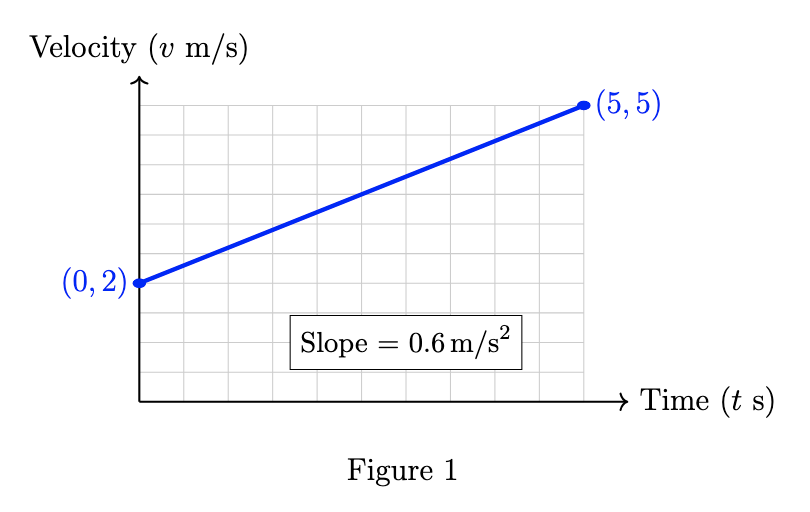
Below is a velocity-time graph for constant acceleration. The straight line shows that velocity changes linearly with time, and the slope of the line equals the acceleration.

Velocity-time graph for const. acceleration

Second equation of motion

For constant acceleration, the average velocity over a time interval is the mean of the initial and final velocities:

vavg​=2v0​+v​

Displacement over time t is average velocity times time:

Δs=vavg​⋅t

Now substitute v=v0​+at into the average-velocity formula:

vavg​=2v0​+(v0​+at)​=v0​+21​at.

Substitute this into the displacement equation:

Δs=(v0​+21​at)t=v0​t+21​at2.

Since Δs=s−s0​, the position at time t is:

s=s0​+v0​t+21​at2.

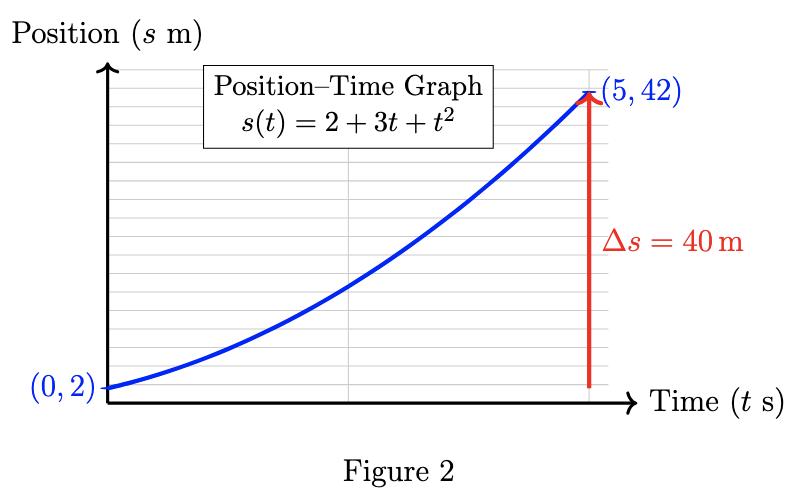
Below is a position-time graph for constant acceleration. The curve is parabolic because of the quadratic term 21​at2. The vertical difference between any two points on the curve gives the displacement between those times.

Position-time graph for const. acceleration

Third equation of motion

Sometimes you want a relationship that doesn’t include time. To eliminate t, start with:

v=v0​+at.

and the displacement equation:

Δs=v0​t+21​at2.

Solve the velocity equation for t:

t=av−v0​​.

Substitute this into the displacement equation:

Δs=v0​(av−v0​​)+21​a(av−v0​​)2.

Simplifying gives:

v2=v02​+2aΔs,

or equivalently,

v2=v02​+2a(s−s0​).

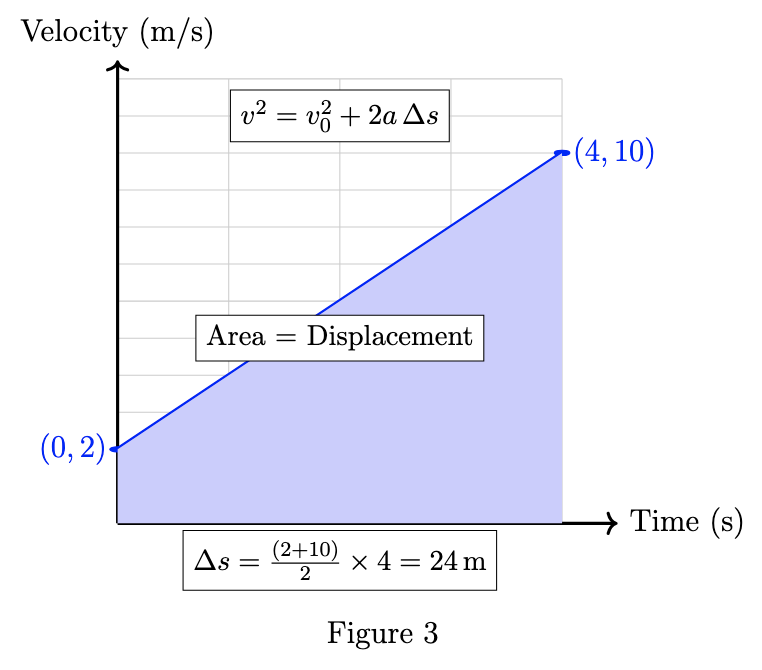
Even though the derivation above is algebraic, a velocity-time graph helps with interpretation: displacement is the area under the velocity-time curve, and this equation links that displacement to the change from v0​ to v.

Area under the velocity-time graph

Example problem 1

A car starts from rest and accelerates uniformly at 2m/s2 for a time t1​. Then it decelerates uniformly at 3m/s2 until coming to a stop. If the total time of the trip is 10s, determine:

(a) The time t1​spent accelerating.
(b) The maximum speed reached by the car.
(c) The total displacement during the trip.

Solution:

(spoiler)

(a) Lett2​=10−t1​ be the deceleration time.

During acceleration, the final speed is vmax​=2t1​.

During deceleration, the car slows from vmax​ to 0 with deceleration 3m/s2, so:

vmax​=3t2​=3(10−t1​).

Set the two expressions for vmax​ equal:

2t1​=3(10−t1​)⇒2t1​=30−3t1​⇒5t1​=30⇒t1​=6s.

Thus, t2​=4s.

(b) Maximum speed is:

vmax​=2t1​=2(6)=12m/s.

(c) Displacement during acceleration:

s1​=21​(2)t12​=t12​=36m.

Displacement during deceleration (using vmax​=3t2​):

s2​=vmax​t2​−21​(3)t22​=12⋅4−21​⋅3⋅16=48−24=24m.

Total displacement:

s=s1​+s2​=36+24=60m.

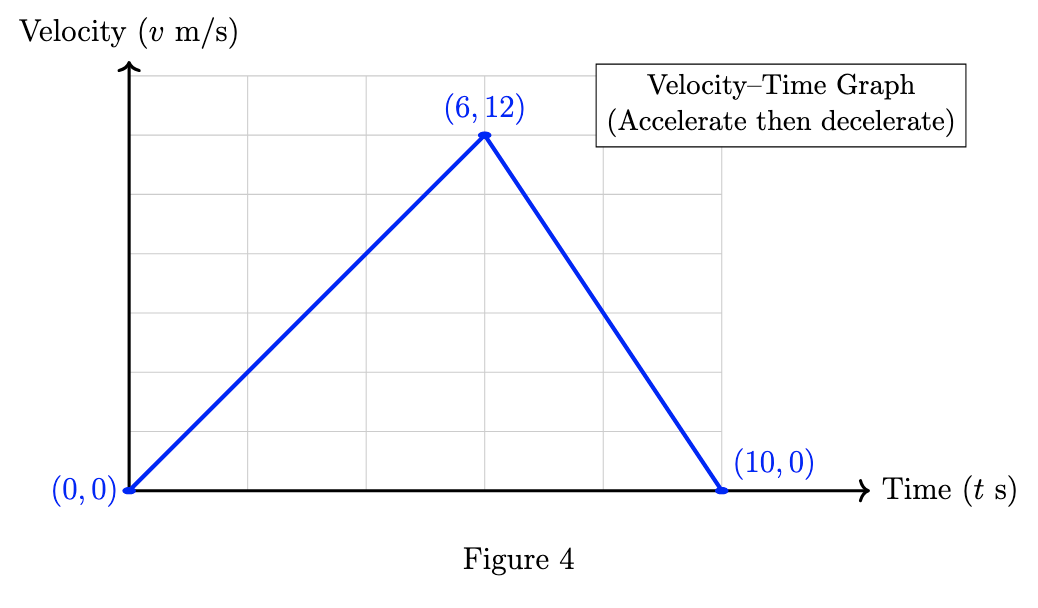
The area under the graph will also give a total displacement of 60 m.

Velocity-time graph as per the question

Example problem 2

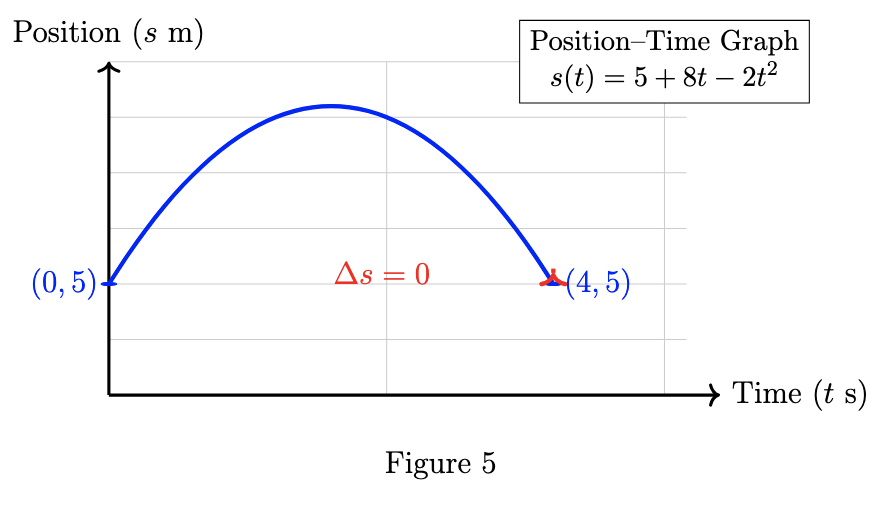
An object’s position is described by:

s(t)=5+8t−2t2,t∈[0,4].

Determine:

(a) The velocity at t=3s.
(b) The displacement betweent=0 s and t=4s.
(c) The average velocity over this interval.

Solution:

(spoiler)

Write the position function in the standard form:

s(t)=s0​+v0​t+21​at2.

Comparing, we have s0​=5, v0​=8, and 21​a=−2 so that a=−4m/s2.

  • Velocity at t=3: Using v=v0​+at:

    v(3)=8+(−4)(3)=8−12=−4m/s.

    The negative sign indicates that the object is moving in the opposite direction to the defined positive direction.

  • Displacement:

    Δs=s(4)−s(0).

    Calculate:

    s(0)=5,s(4)=5+8⋅4−2⋅16=5+32−32=5m.

    So, Δs=5−5=0m; the object returns to its starting position.

  • Average velocity: Since the net displacement is 0, the average velocity is:

    vavg​=40​=0m/s.

Position-time graph for the given scenario

Example problem 3

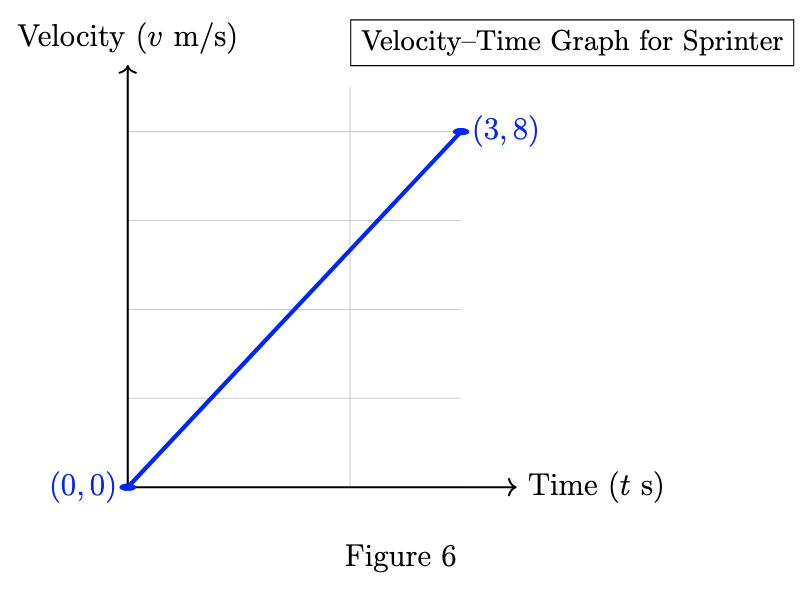
A sprinter starts from rest and accelerates uniformly during the first 3 seconds of a race. If the sprinter covers 12 m during this time, determine his final speed at 3 s. (Assume constant acceleration.)

Solution:

(spoiler)
  • Since the sprinter starts from rest, s0​=0 and v0​=0.

  • The displacement for constant acceleration is given by:

s=21​at2.

Given s=12 m and t=3 s:

12=21​a(32)⇒12=29​a⇒a=924​≈2.67m/s2.

  • The final speed is then:

v=v0​+at=0+2.67×3≈8.0m/s.

Velocity-time graph for the sprinter

Free fall

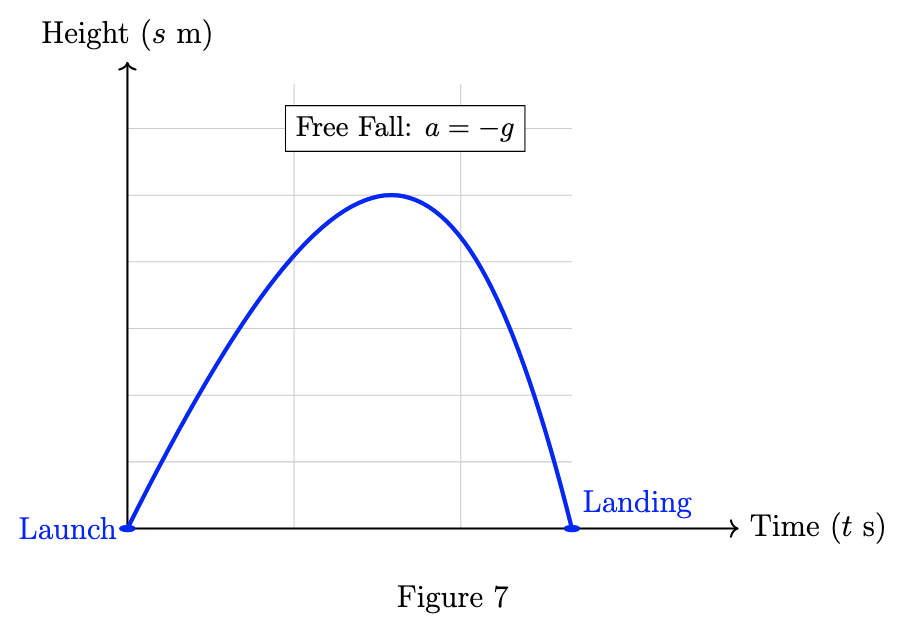
Free fall is a special case of constant acceleration where the only force acting is gravity. If we take upward as positive, then the acceleration is negative:

a=−g(with g≈9.8m/s2).

Substitute a=−g into the kinematic equations:

vsv2​=v0​−gt,=s0​+v0​t−21​gt2,=v02​−2g(s−s0​).​

These equations let you analyze free-fall motion using the same constant-acceleration tools, with the sign coming from your choice of positive direction.

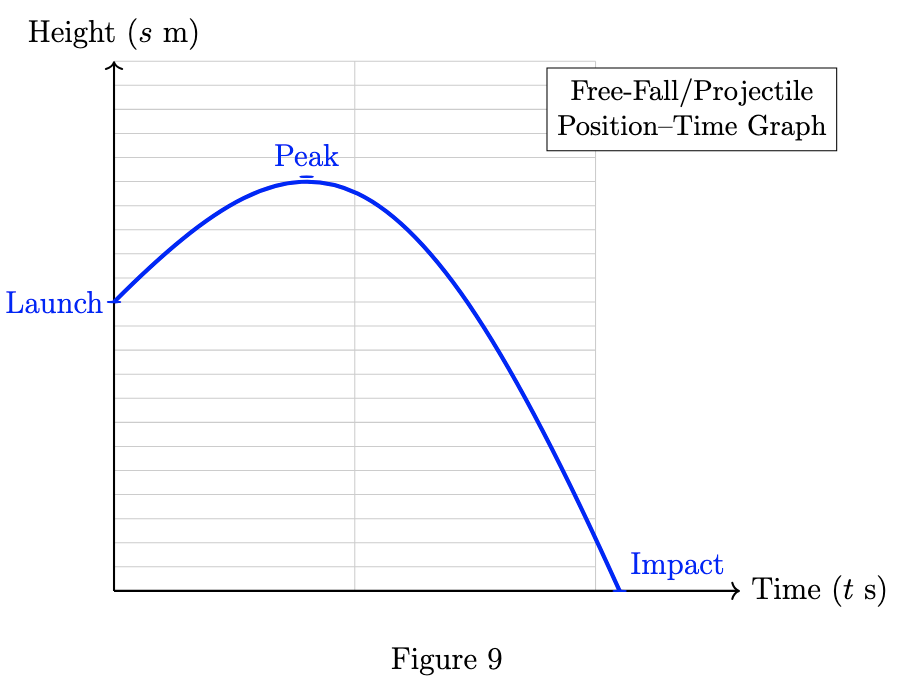
Position-time graph for an object thrown upwards

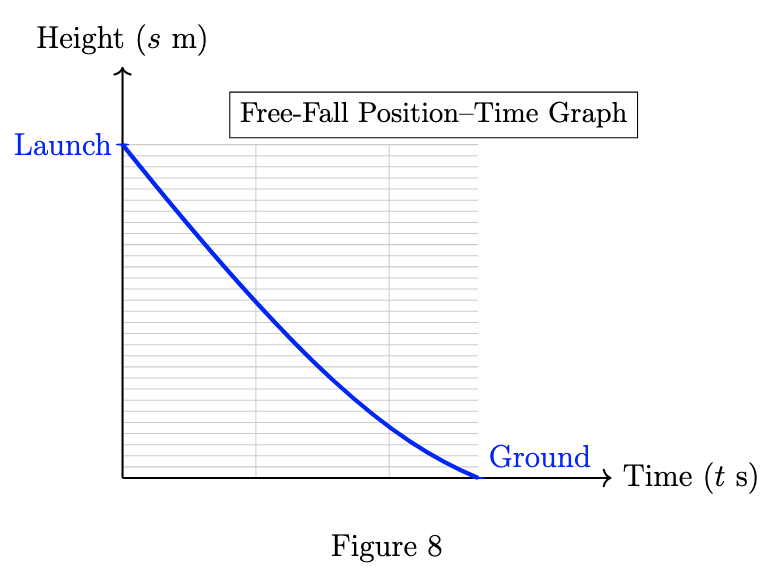
Example problem 4 A ball is dropped from the top of a 45 m high building. Assuming g=9.8m/s2 (take g≈10m/s2for simplicity if desired), determine:

(a) The time taken for the ball to hit the ground.
(b) The speed of the ball just before impact.

Solution:

(spoiler)

(a) In free fall from rest, the displacement is given by:

s=s0​−21​gt2.

Assuming s0​=45 m and s=0 (ground level),

0=45−21​(9.8)t2⇒21​(9.8)t2=45.

Solving for t:

t2=9.845×2​≈9.890​≈9.18⇒t≈3.03s.

(b) The final speed is given by:

v=gt≈9.8×3.03≈29.7m/s.

Thus, the ball takes approximately 3.03 s to fall and hits the ground at about 29.7 m/s.

Position-time graph for the given free fall scenario

Example problem 5 A ball is thrown upward with an initial speed of 20m/s from the top of a 30m building. Determine:

(a) The maximum height reached above the building.
(b) The total time of flight until the ball hits the ground.

Solution:

(spoiler)

(a) For upward motion under gravity, use the equation:

v=v0​−gt.

At the maximum height, v=0, so:

0=20−9.8tup​⇒tup​≈9.820​≈2.04s.

The additional height gained above the building is given by:

Δs=v0​tup​−21​gtup2​≈20(2.04)−0.5(9.8)(2.04)2.

Calculating approximately:

Δs≈40.8−20.4≈20.4m.

Thus, the maximum height above the ground is 30+20.4≈50.4m.

(b) The total time of flight can be found by considering the entire motion from the top of the building to the ground. Use the equation:

0=30+20t−21​9.8t2.

Rewriting:

4.9t2−20t−30=0.

Solve this quadratic using the quadratic formula:

t=2⋅4.920±202+4⋅4.9⋅30​​.

Calculate the discriminant:

Δ=400+588=988,

so,

t=9.820+988​​≈9.820+31.4​≈9.851.4​≈5.25s.

Thus, the total time of flight is approximately 5.25 s.

Position-time graph for the given scenario

Three constant-acceleration equations

  • First: v=v0​+at
  • Second: s=s0​+v0​t+21​at2
  • Third: v2=v02​+2a(s−s0​)

Graphical and algebraic derivations

  • Velocity-time graph: slope = acceleration, area under curve = displacement
  • Position-time graph: parabolic curve for constant a (due to t2 term)
  • Algebraic manipulation connects equations and eliminates variables as needed

Connection to kinematic graphs

  • Slope of v-t graph = acceleration
  • Area under v-t graph = displacement
  • s-t graph shape: parabola for constant acceleration

Free fall scenarios

  • Special case: a=−g (downward), g≈9.8m/s2
  • Kinematic equations with a=−g:
    • v=v0​−gt
    • s=s0​+v0​t−21​gt2
    • v2=v02​−2g(s−s0​)
  • Sign convention: upward positive, downward negative

Example problem 1 (car accelerates and decelerates)

  • Time accelerating: t1​=6s, decelerating: t2​=4s
  • Maximum speed: 12m/s
  • Total displacement: 60m

Example problem 2 (object with quadratic position function)

  • Velocity at t=3s: −4m/s (moving opposite to positive direction)
  • Displacement t=0 to t=4s: 0m (returns to start)
  • Average velocity: 0m/s

Example problem 3 (sprinter from rest)

  • Acceleration: a≈2.67m/s2
  • Final speed at t=3s: 8.0m/s

Example problem 4 (ball dropped from building)

  • Time to hit ground: ≈3.03s
  • Speed just before impact: ≈29.7m/s

Example problem 5 (ball thrown upward from building)

  • Maximum height above ground: ≈50.4m
  • Total time of flight: ≈5.25s

Problem-solving strategy

  • Choose the kinematic equation that matches knowns and unknowns
  • For free fall, keep sign convention consistent (up positive, a=−g)

Sign up for free to take 8 quiz questions on this topic

Previous
Next  | 3.4 Motion in two dimensions
All rights reserved ©2016 - 2026 Achievable, Inc.

Equations of motion and free fall

In this sub-chapter we discuss:

  • Three constant-acceleration equations
  • Graphical derivations
  • Algebraic derivations
  • Connection to kinematic graphs
  • Free fall scenarios

First equation of motion

When acceleration is constant, the average acceleration equals the change in velocity divided by the elapsed time:

a=tv−v0​​,

where

  • v0​ is the initial velocity,
  • v is the final velocity, and
  • t is the elapsed time.

Solve this equation for v by multiplying both sides by t and then adding v0​:

v=v0​+at.

Below is a velocity-time graph for constant acceleration. The straight line shows that velocity changes linearly with time, and the slope of the line equals the acceleration.

Second equation of motion

For constant acceleration, the average velocity over a time interval is the mean of the initial and final velocities:

vavg​=2v0​+v​

Displacement over time t is average velocity times time:

Δs=vavg​⋅t

Now substitute v=v0​+at into the average-velocity formula:

vavg​=2v0​+(v0​+at)​=v0​+21​at.

Substitute this into the displacement equation:

Δs=(v0​+21​at)t=v0​t+21​at2.

Since Δs=s−s0​, the position at time t is:

s=s0​+v0​t+21​at2.

Below is a position-time graph for constant acceleration. The curve is parabolic because of the quadratic term 21​at2. The vertical difference between any two points on the curve gives the displacement between those times.

Third equation of motion

Sometimes you want a relationship that doesn’t include time. To eliminate t, start with:

v=v0​+at.

and the displacement equation:

Δs=v0​t+21​at2.

Solve the velocity equation for t:

t=av−v0​​.

Substitute this into the displacement equation:

Δs=v0​(av−v0​​)+21​a(av−v0​​)2.

Simplifying gives:

v2=v02​+2aΔs,

or equivalently,

v2=v02​+2a(s−s0​).

Even though the derivation above is algebraic, a velocity-time graph helps with interpretation: displacement is the area under the velocity-time curve, and this equation links that displacement to the change from v0​ to v.

Example problem 1

A car starts from rest and accelerates uniformly at 2m/s2 for a time t1​. Then it decelerates uniformly at 3m/s2 until coming to a stop. If the total time of the trip is 10s, determine:

(a) The time t1​spent accelerating.
(b) The maximum speed reached by the car.
(c) The total displacement during the trip.

Solution:

(spoiler)

(a) Lett2​=10−t1​ be the deceleration time.

During acceleration, the final speed is vmax​=2t1​.

During deceleration, the car slows from vmax​ to 0 with deceleration 3m/s2, so:

vmax​=3t2​=3(10−t1​).

Set the two expressions for vmax​ equal:

2t1​=3(10−t1​)⇒2t1​=30−3t1​⇒5t1​=30⇒t1​=6s.

Thus, t2​=4s.

(b) Maximum speed is:

vmax​=2t1​=2(6)=12m/s.

(c) Displacement during acceleration:

s1​=21​(2)t12​=t12​=36m.

Displacement during deceleration (using vmax​=3t2​):

s2​=vmax​t2​−21​(3)t22​=12⋅4−21​⋅3⋅16=48−24=24m.

Total displacement:

s=s1​+s2​=36+24=60m.

The area under the graph will also give a total displacement of 60 m.

Example problem 2

An object’s position is described by:

s(t)=5+8t−2t2,t∈[0,4].

Determine:

(a) The velocity at t=3s.
(b) The displacement betweent=0 s and t=4s.
(c) The average velocity over this interval.

Solution:

(spoiler)

Write the position function in the standard form:

s(t)=s0​+v0​t+21​at2.

Comparing, we have s0​=5, v0​=8, and 21​a=−2 so that a=−4m/s2.

  • Velocity at t=3: Using v=v0​+at:

    v(3)=8+(−4)(3)=8−12=−4m/s.

    The negative sign indicates that the object is moving in the opposite direction to the defined positive direction.

  • Displacement:

    Δs=s(4)−s(0).

    Calculate:

    s(0)=5,s(4)=5+8⋅4−2⋅16=5+32−32=5m.

    So, Δs=5−5=0m; the object returns to its starting position.

  • Average velocity: Since the net displacement is 0, the average velocity is:

    vavg​=40​=0m/s.

Example problem 3

A sprinter starts from rest and accelerates uniformly during the first 3 seconds of a race. If the sprinter covers 12 m during this time, determine his final speed at 3 s. (Assume constant acceleration.)

Solution:

(spoiler)
  • Since the sprinter starts from rest, s0​=0 and v0​=0.

  • The displacement for constant acceleration is given by:

s=21​at2.

Given s=12 m and t=3 s:

12=21​a(32)⇒12=29​a⇒a=924​≈2.67m/s2.

  • The final speed is then:

v=v0​+at=0+2.67×3≈8.0m/s.

Free fall

Free fall is a special case of constant acceleration where the only force acting is gravity. If we take upward as positive, then the acceleration is negative:

a=−g(with g≈9.8m/s2).

Substitute a=−g into the kinematic equations:

vsv2​=v0​−gt,=s0​+v0​t−21​gt2,=v02​−2g(s−s0​).​

These equations let you analyze free-fall motion using the same constant-acceleration tools, with the sign coming from your choice of positive direction.

Example problem 4 A ball is dropped from the top of a 45 m high building. Assuming g=9.8m/s2 (take g≈10m/s2for simplicity if desired), determine:

(a) The time taken for the ball to hit the ground.
(b) The speed of the ball just before impact.

Solution:

(spoiler)

(a) In free fall from rest, the displacement is given by:

s=s0​−21​gt2.

Assuming s0​=45 m and s=0 (ground level),

0=45−21​(9.8)t2⇒21​(9.8)t2=45.

Solving for t:

t2=9.845×2​≈9.890​≈9.18⇒t≈3.03s.

(b) The final speed is given by:

v=gt≈9.8×3.03≈29.7m/s.

Thus, the ball takes approximately 3.03 s to fall and hits the ground at about 29.7 m/s.

Example problem 5 A ball is thrown upward with an initial speed of 20m/s from the top of a 30m building. Determine:

(a) The maximum height reached above the building.
(b) The total time of flight until the ball hits the ground.

Solution:

(spoiler)

(a) For upward motion under gravity, use the equation:

v=v0​−gt.

At the maximum height, v=0, so:

0=20−9.8tup​⇒tup​≈9.820​≈2.04s.

The additional height gained above the building is given by:

Δs=v0​tup​−21​gtup2​≈20(2.04)−0.5(9.8)(2.04)2.

Calculating approximately:

Δs≈40.8−20.4≈20.4m.

Thus, the maximum height above the ground is 30+20.4≈50.4m.

(b) The total time of flight can be found by considering the entire motion from the top of the building to the ground. Use the equation:

0=30+20t−21​9.8t2.

Rewriting:

4.9t2−20t−30=0.

Solve this quadratic using the quadratic formula:

t=2⋅4.920±202+4⋅4.9⋅30​​.

Calculate the discriminant:

Δ=400+588=988,

so,

t=9.820+988​​≈9.820+31.4​≈9.851.4​≈5.25s.

Thus, the total time of flight is approximately 5.25 s.

Key points

Three constant-acceleration equations

  • First: v=v0​+at
  • Second: s=s0​+v0​t+21​at2
  • Third: v2=v02​+2a(s−s0​)

Graphical and algebraic derivations

  • Velocity-time graph: slope = acceleration, area under curve = displacement
  • Position-time graph: parabolic curve for constant a (due to t2 term)
  • Algebraic manipulation connects equations and eliminates variables as needed

Connection to kinematic graphs

  • Slope of v-t graph = acceleration
  • Area under v-t graph = displacement
  • s-t graph shape: parabola for constant acceleration

Free fall scenarios

  • Special case: a=−g (downward), g≈9.8m/s2
  • Kinematic equations with a=−g:
    • v=v0​−gt
    • s=s0​+v0​t−21​gt2
    • v2=v02​−2g(s−s0​)
  • Sign convention: upward positive, downward negative

Example problem 1 (car accelerates and decelerates)

  • Time accelerating: t1​=6s, decelerating: t2​=4s
  • Maximum speed: 12m/s
  • Total displacement: 60m

Example problem 2 (object with quadratic position function)

  • Velocity at t=3s: −4m/s (moving opposite to positive direction)
  • Displacement t=0 to t=4s: 0m (returns to start)
  • Average velocity: 0m/s

Example problem 3 (sprinter from rest)

  • Acceleration: a≈2.67m/s2
  • Final speed at t=3s: 8.0m/s

Example problem 4 (ball dropped from building)

  • Time to hit ground: ≈3.03s
  • Speed just before impact: ≈29.7m/s

Example problem 5 (ball thrown upward from building)

  • Maximum height above ground: ≈50.4m
  • Total time of flight: ≈5.25s

Problem-solving strategy

  • Choose the kinematic equation that matches knowns and unknowns
  • For free fall, keep sign convention consistent (up positive, a=−g)

More from Kinematics

  • Introduction and basic concepts
  • Graphical analysis of motion
  • Motion in two dimensions