



Cross section method
We’ve seen that integrals compute area by adding up infinitely thin rectangles over an interval. Each rectangle has width and height given by either the function value or the distance between two curves.
That same “add up thin slices” idea works for 3D solids. Instead of rectangles, a solid is sliced into infinitely thin cross sections - flat 2D slices perpendicular to an axis (usually the - or -axis). In these problems, the cross sections are usually familiar shapes such as squares, rectangles, triangles (equilateral, isosceles, or right), semicircles, and quarter circles. If you can write the area of a typical cross section as a function of position, then integrating that area over an interval gives the volume.
To see what solids with certain cross sections look like, visit this GeoGebra application.
Example 1: squares
Use the formula for the area of a square
Here, is the distance between the curves. That distance becomes the side length of the square at a given (or at a given , depending on the slicing direction).
The region bounded by , and forms the base of a solid. Find the volume of the solid where the cross sections are:
a) Squares perpendicular to the -axis.
b) Squares perpendicular to the-axis.
Solutions
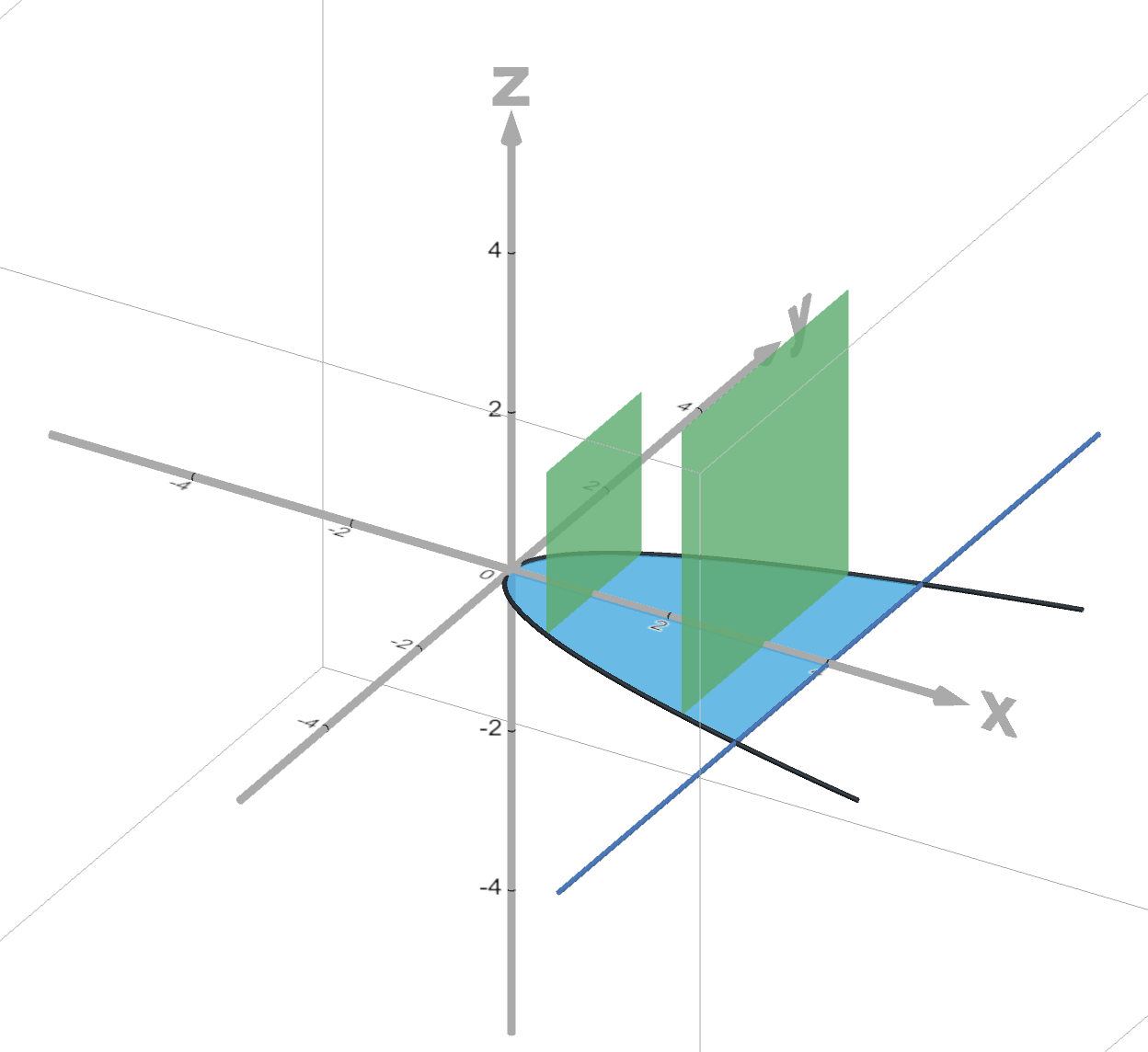
a) Squares perpendicular to the -axis
Here’s a visual of the curve with two sample cross-sectional slices. When you set up these problems, it helps to sketch the region in the -plane and draw one or two representative slices. The sketch doesn’t need to be 3D - what matters is that you can identify the side length .
is the distance between the curves and :
The area of each cross section is
The interval to integrate over is from to , so the volume of the solid is
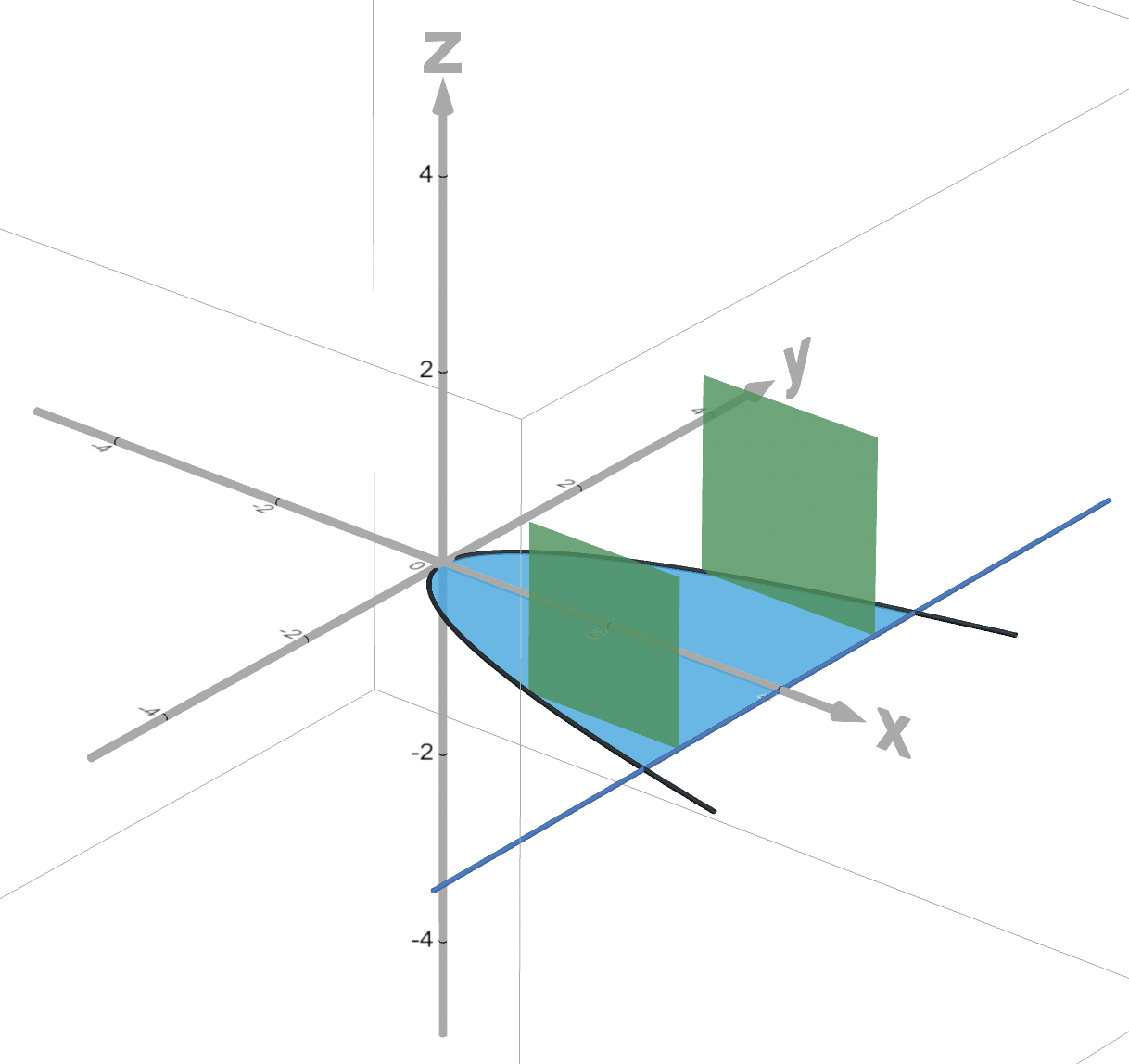
b) Squares perpendicular to the -axis
Here’s a visual of two slices perpendicular to the -axis.
Since the slices are perpendicular to the -axis, the area function depends on . Rewrite the curve in terms of :
The side length is the horizontal distance from the left boundary to the right boundary :
The area of each cross section is
The curve meets at and , so the interval is . The volume is
Example 2: rectangles
Use
Here, is given in the problem, and is the distance between the curves.
The region bounded by and forms the base of a solid. Find the volume when the cross sections are:
a) Rectangles perpendicular to the -axis with height .
b) Rectangles perpendicular to the-axis with height times the length of the base.
Solutions
a) Perpendicular to the -axis with height 1.5
, the length of the base, is the distance between the curves (top minus bottom):
The height is a constant , so the area of each cross section is
The curves intersect at and , so the interval is . The volume is
b) Perpendicular to the -axis with height 2 times the length of the base
When slicing perpendicular to the -axis, rewrite the curves as and . The base length is (right minus left), the height is , and the curves intersect at , giving .
Example 3: equilateral triangles
Use the area formula
The region bounded by and the lines , and forms the base of a solid. Find the volume of the solid if cross sections perpendicular to the -axis are equilateral triangles.
Solution
Slices perpendicular to the -axis depend on . Each triangle’s side length is the horizontal distance from the left boundary to the right boundary :
The area of each cross section is
The interval is from to , so the volume is
Example 4: isosceles right triangles
There are two possibilities here:
- Hypotenuse as the base
- Leg as the base
Case 1: Hypotenuse as base
Here, the distance between the curves is the hypotenuse of a triangle. Each leg has length , so the area of each cross section is
The region bounded by the line , the -axis, and the -axis forms the base of a solid. Find the volume if the cross sections perpendicular to the -axis are isosceles right triangles whose hypotenuses lie along the base of the region.
Solution
Slices perpendicular to the -axis depend on . The hypotenuse length is the horizontal distance from (the -axis) to :
So the area of each cross section is
The interval is from to , so the volume is
Case 2: Leg as base
Here, the distance between the curves is a leg of the isosceles right triangle. The other leg is also , so the area formula is
The region bounded by the line , the -axis, and the -axis forms the base of a solid. Find the volume if the cross sections perpendicular to the -axis are isosceles right triangles whose legs lie along the base of the region.
Solution
is the vertical distance from the top boundary (the -axis) to the bottom boundary :
So the area of each cross section is
The interval is from to , so the volume is
Example 5: semi-circles
The area of a semicircle is . Here, the radius is half the distance between the curves, so
The region bounded by the curves and and the -axis forms the base of a solid. Find its volume if the cross sections are semi-circles perpendicular to the -axis. Use a calculator to evaluate after setting up the integral.
Solution
, the distance between the curves, is top minus bottom:
So the area of each cross section is
Graphing the two functions on Desmos shows that they intersect at . The interval is from to , so the volume is
Example 6: quarter circles
The area of a quarter circle is . This time, the radius is the full distance between the curves, meaning . Then
The region bounded by the curves and and the -axis forms the base of a solid. Find its volume if the cross sections are quarter circles perpendicular to the -axis.
Solution
Since the slices are perpendicular to the -axis, rewrite the curves in terms of :
The equation has no closed-form solution, so use a calculator to find the intersection at (same point as Example 5). The left boundary of the base changes at this intersection: below it, the left edge is the line ; above it, the left edge becomes the curve . This is why the integral must be split into two pieces.
From up to the intersection point , the radius is the distance from to the -axis (right minus left):
So the area of each cross section is
The volume for that portion is
From to , the radius is the distance from to the -axis:
So the area of each cross section is
The volume for that portion is
The total volume of the solid is