


Achievable logoAchievable logo
AP Calculus AB
Sign in
Sign up
Purchase
Textbook
Practice exams
Support
How it works
Exam catalog
Mountain with a flag at the peak
Textbook
Introduction
1. Limits
2. Derivative basics
3. Advanced differentiation
4. Contextual uses
5. Analytical uses
5.1 Important theorems
5.2 1st derivative test
5.3 2nd derivative test
5.4 Graphs & curve sketching
5.5 Optimization
6. Integration
7. Differential equations
8. Applications of integrals
9. Testing details tag
Wrapping up
Achievable logoAchievable logo
5.1 Important theorems
Achievable AP Calculus AB
5. Analytical uses
Our AP Calculus AB course is currently in development and is a work-in-progress.

Important theorems

8 min read
Font
Discuss
Share
Feedback

What you’ll learn:

3 more big theorems in calculus

  1. Mean value theorem (MVT): instantaneous rate = average rate somewhere on the interval
  2. Rolle’s theorem: special case of the MVT
  3. Extreme value theorem: finding absolute max and min on closed interval

In addition to the Intermediate value theorem (from section 1.6 on Continuity), there are two other main existence theorems in calculus: the Mean value theorem (with Rolle’s theorem as a special case) and the Extreme value theorem.

Mean value theorem

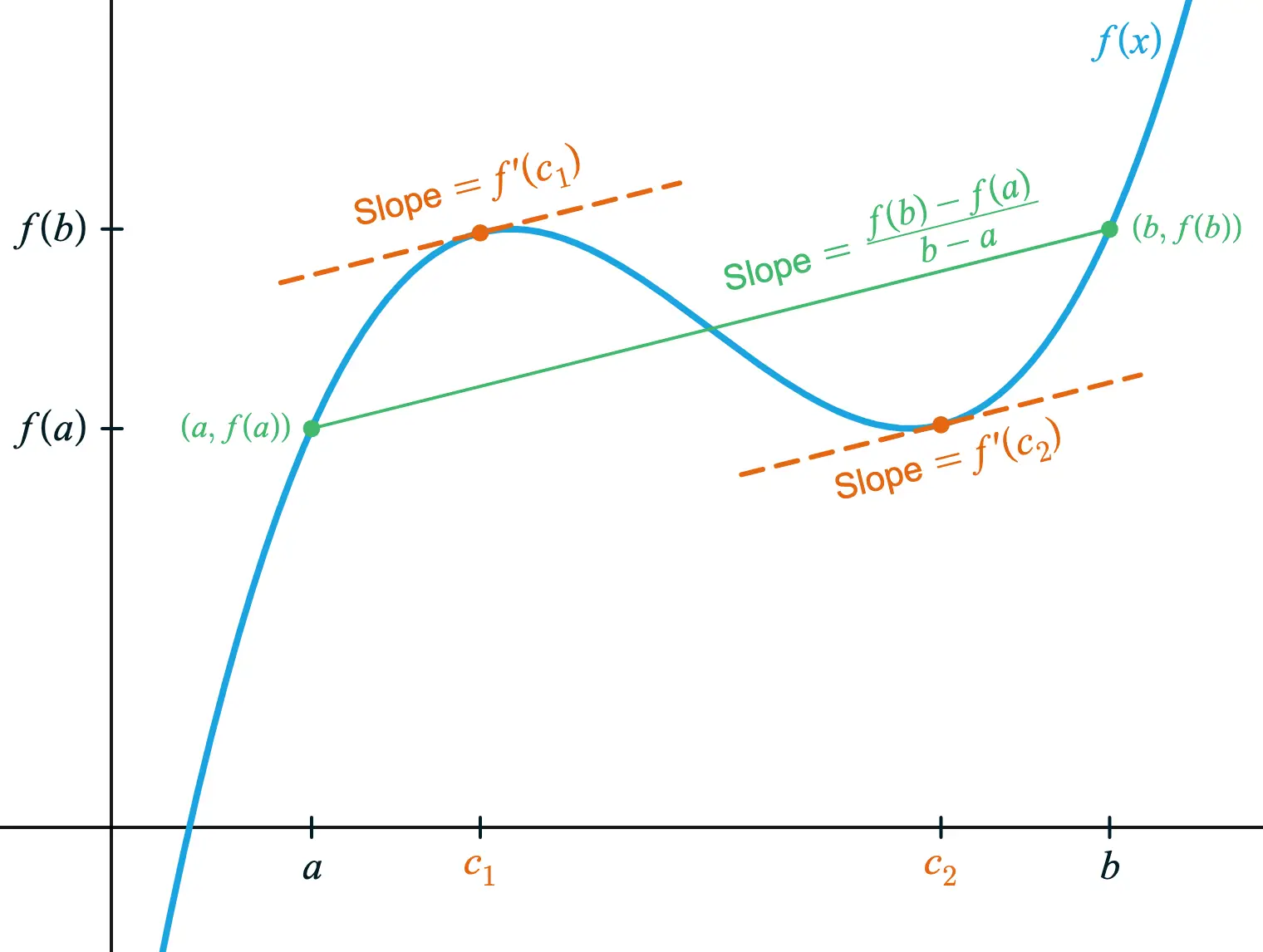
Mean value theorem:

If a function f(x) satisfies these 2 conditions:

  1. Continuity: f(x) is continuous on the closed interval [a,b]
  2. Differentiability: f(x) is differentiable on the open interval (a,b)

Then there exists at least one point c in (a,b) such that

f′(c)=b−af(b)−f(a)​

Here’s the idea in plain language: if f is continuous on [a,b] and differentiable on (a,b), then somewhere between a and b the instantaneous rate of change (the derivative) matches the average rate of change over the whole interval.

Examples

  1. Determine if the Mean value theorem can be applied to f(x) on the interval given and if so, find the values of c that satisfy the theorem.

a) f(x)=x2,[1,4]
b)f(x)=x3−3x2+2x,[0,3]
c)f(x)=1−x2​,[−1,0]

Solutions

a) f(x)=x2,[1,4]

f(x) is a polynomial, so it’s continuous and differentiable everywhere. The MVT applies.

The average rate of change over [1,4] is:

4−1f(4)−f(1)​

=316−1​

=5

The derivative of f(x) is

f′(x)=2x

Set the derivative equal to the average rate of change:

2c=5

c=25​

So c=25​ is the point where the instantaneous rate of change equals the average rate of change.

b) f(x)=x3−3x2+2x,[0,3]

(spoiler)

f(x) is a polynomial, so it’s continuous and differentiable everywhere. The MVT applies.

The average rate of change over [0,3] is:

3−0f(3)−f(0)​

=36−0​

=2

The derivative of f(x) is

f′(x)=3x2−6x+2

Set the derivative equal to the average rate of change:

3c2−6c+2=2

3c2−6c=0

3c(c−2)=0

c=0,2

Because c must be in the open interval (0,3), we eliminate c=0. So c=2​ is the only value that satisfies the MVT.

c) f(x)=1−x2​,[−1,0]

(spoiler)

f(x) is the top half of the unit circle. It is continuous on the interval [−1,0] even though at the endpoint x=−1, it doesn’t have a two-sided limit.

This is still fine, because continuity on a closed interval [a,b] only requires:

  • continuity from the right at the left endpoint: x→a+lim​f(x)=f(a)
  • continuity from the left at the right endpoint: x→b−lim​f(x)=f(b)

Also, while the derivative does not exist at the endpoint x=−1, the MVT only requires differentiability on the open interval (−1,0). Since f(x) is differentiable on (−1,0), the MVT applies.

The average rate of change over [−1,0] is

0−(−1)f(0)−f(−1)​

=11−0​

=1

The derivative of f(x) is

f′(x)=−1−x2​x​

Set the derivative equal to the average rate of change:

−1−c2​c​=1

−c=1−c2​

c2=1−c2

2c2=1

c=±22​​

Because we squared both sides, we may have introduced an extraneous solution. Checking both values in the original equation shows that c=−22​​​ is the only solution that satisfies the MVT.

  1. A car drives 100 miles between 9 AM and 11 AM on a long stretch of road with a posted speed limit of 35 mph. Has the driver broken the speed limit laws at any point?

Solution

(spoiler)

The average speed is distance divided by time:

2 hours100 miles​=50 mph

If the car’s position is a continuous and differentiable function of time (a reasonable model for real driving), then the MVT guarantees that at some point the car’s instantaneous speed was 50 mph. Since 50>35, the driver must have exceeded the speed limit at some point.

Rolle’s theorem

Rolle’s theorem is a special case of the Mean value theorem where the function starts and ends at the same value, meaning f(a)=f(b). In that situation, Rolle’s theorem guarantees at least one point in the interval where the tangent line is horizontal (so the derivative is 0).

Rolle’s theorem:

If a function f(x) satisfies these 3 conditions:

  1. Continuity: f(x) is continuous on the closed interval [a,b]
  2. Differentiability: f(x) is differentiable on the open interval (a,b)
  3. f(a)=f(b)

Then there exists at least one point c in (a,b) such that

f′(c)=0

Examples

Determine if Rolle’s theorem can be applied to f(x) on the closed interval given and if so, find the values of c that satisfy the theorem.

a) f(x)=x2−5x+1,[0,5]
b)f(x)=x−3x2+9​,[−1,6]
c)f(x)=∣x∣,[−2,2]

Solutions

a) f(x)=x2−5x+1,[0,5]

f(x) is a polynomial, so it’s continuous and differentiable everywhere.

Also,

f(0)=1andf(5)=25−25+1=1,

so f(0)=f(5). Rolle’s theorem applies.

The derivative is

f′(x)=2x−5.

Set f′(c)=0:

2c−5=0

c=25​

So c=25​. This matches the graph: there is a horizontal tangent at x=25​.

b) f(x)=x−3x2+9​,[−1,6]

(spoiler)

f(x) is a rational function and is discontinuous at x=3, which lies in the interval [−1,6]. Since the continuity condition fails, Rolle’s theorem cannot be applied. A horizontal tangent might still exist, but the theorem does not guarantee one.

c) f(x)=∣x∣,[−2,2]

(spoiler)

f(x) is continuous on [−2,2], but it is not differentiable at x=0, which is inside the interval. Since differentiability on (a,b) fails, Rolle’s theorem does not apply. In fact, there is no point where the tangent line is horizontal.

Extreme value theorem

The extreme value theorem guarantees that a continuous function has both a highest value and a lowest value on a closed interval. These absolute extrema can occur at interior points or at the endpoints.

Extreme value theorem

If f(x) is continuous on a closed interval [a,b], then it must attain both an absolute maximum and an absolute minimum value on that interval.

  • These extrema occur at either critical points (where f′(x)=0 or is undefined) or at the endpoints (a and b) of the interval.

To use the extreme value theorem to find the absolute maximum and minimum on an interval:

  1. Verify continuity on the interval. If there are any breaks, jumps, or asymptotes, the EVT is not applicable.

  2. Find critical points: Solve f′(x)=0 or determine where it is undefined within [a,b].

  3. Evaluate function values: Compute f(x) at the critical points and at the endpoints - f(a) and f(b).

  4. Compare function values: the largest function value is the absolute maximum and the smallest is the absolute minimum on that interval.

Examples

  1. Find the absolute extrema of f(x)=x2−4x+3 on [0,5].

Solution

(spoiler)

1. Verify continuity

f(x) is a polynomial, so it’s continuous.

2. Find critical points

f′(x)=2x−4

Solve f′(x)=0:

2x−4=0

x=2

3. Evaluate function values

At the critical point x=2,

f(2)=22−4(2)+3=−1

At the endpoints,

f(0)=02−4(0)+3=3

f(5)=52−4(5)+3=8

4. Compare function values

The absolute maximum is 8, which occurs at x=5.

The absolute minimum is −1, which occurs at x=2.

  1. Find the absolute extrema of

f(x)=x+1x​

on [0,3].

Solution

(spoiler)

1. Verify continuity

This rational function has a vertical asymptote at x=−1, but −1 is not in [0,3]. So f is continuous on the given interval.

2. Find critical points

f′(x)=(x+1)2(x+1)(1)−(x)(1)​

=(x+1)21​

Since f′(x)>0 for all x in [0,3], there are no critical points in the interval.

3. Evaluate function values

With no critical points, only evaluate the endpoints:

f(0)=0+10​

=0

f(3)=3+13​

=43​

4. Compare function values.

The absolute minimum is 0 at x=0.

The absolute maximum is 43​ at x=3.

Mean value theorem (MVT)

  • Applies if f(x) is continuous on [a,b] and differentiable on (a,b)
  • Guarantees ∃c∈(a,b) such that f′(c)=b−af(b)−f(a)​
  • Instantaneous rate equals average rate at some point

MVT examples

  • Check continuity and differentiability before applying MVT
  • Solve f′(c)=b−af(b)−f(a)​ for c in (a,b)
  • Real-world: If average speed exceeds speed limit, MVT guarantees speed limit was broken at some instant

Rolle’s theorem

  • Special case of MVT: f(a)=f(b)
  • Requires continuity on [a,b], differentiability on (a,b), and f(a)=f(b)
  • Guarantees ∃c∈(a,b) such that f′(c)=0
    • At least one horizontal tangent in (a,b)

Rolle’s theorem examples

  • Must check all three conditions (continuity, differentiability, f(a)=f(b))
  • If any condition fails, theorem does not apply
  • Find c by solving f′(c)=0 in (a,b)

Extreme value theorem (EVT)

  • If f(x) is continuous on [a,b], f attains absolute maximum and minimum on [a,b]
  • Extrema occur at:
    • Critical points (f′(x)=0 or undefined in [a,b])
    • Endpoints a and b
  • Procedure:
    • Verify continuity on [a,b]
    • Find all critical points in [a,b]
    • Evaluate f(x) at critical points and endpoints
    • Largest value = absolute max; smallest = absolute min

EVT examples

  • For polynomials: always continuous, so EVT applies
  • For rational functions: check for discontinuities in [a,b]
  • If no critical points, compare only endpoint values

Sign up for free to take 6 quiz questions on this topic

All rights reserved ©2016 - 2026 Achievable, Inc.

Important theorems

What you’ll learn:

3 more big theorems in calculus

  1. Mean value theorem (MVT): instantaneous rate = average rate somewhere on the interval
  2. Rolle’s theorem: special case of the MVT
  3. Extreme value theorem: finding absolute max and min on closed interval

In addition to the Intermediate value theorem (from section 1.6 on Continuity), there are two other main existence theorems in calculus: the Mean value theorem (with Rolle’s theorem as a special case) and the Extreme value theorem.

Mean value theorem

Mean value theorem:

If a function f(x) satisfies these 2 conditions:

  1. Continuity: f(x) is continuous on the closed interval [a,b]
  2. Differentiability: f(x) is differentiable on the open interval (a,b)

Then there exists at least one point c in (a,b) such that

f′(c)=b−af(b)−f(a)​

Here’s the idea in plain language: if f is continuous on [a,b] and differentiable on (a,b), then somewhere between a and b the instantaneous rate of change (the derivative) matches the average rate of change over the whole interval.

Examples

  1. Determine if the Mean value theorem can be applied to f(x) on the interval given and if so, find the values of c that satisfy the theorem.

a) f(x)=x2,[1,4]
b)f(x)=x3−3x2+2x,[0,3]
c)f(x)=1−x2​,[−1,0]

Solutions

a) f(x)=x2,[1,4]

f(x) is a polynomial, so it’s continuous and differentiable everywhere. The MVT applies.

The average rate of change over [1,4] is:

4−1f(4)−f(1)​

=316−1​

=5

The derivative of f(x) is

f′(x)=2x

Set the derivative equal to the average rate of change:

2c=5

c=25​

So c=25​ is the point where the instantaneous rate of change equals the average rate of change.

b) f(x)=x3−3x2+2x,[0,3]

(spoiler)

f(x) is a polynomial, so it’s continuous and differentiable everywhere. The MVT applies.

The average rate of change over [0,3] is:

3−0f(3)−f(0)​

=36−0​

=2

The derivative of f(x) is

f′(x)=3x2−6x+2

Set the derivative equal to the average rate of change:

3c2−6c+2=2

3c2−6c=0

3c(c−2)=0

c=0,2

Because c must be in the open interval (0,3), we eliminate c=0. So c=2​ is the only value that satisfies the MVT.

c) f(x)=1−x2​,[−1,0]

(spoiler)

f(x) is the top half of the unit circle. It is continuous on the interval [−1,0] even though at the endpoint x=−1, it doesn’t have a two-sided limit.

This is still fine, because continuity on a closed interval [a,b] only requires:

  • continuity from the right at the left endpoint: x→a+lim​f(x)=f(a)
  • continuity from the left at the right endpoint: x→b−lim​f(x)=f(b)

Also, while the derivative does not exist at the endpoint x=−1, the MVT only requires differentiability on the open interval (−1,0). Since f(x) is differentiable on (−1,0), the MVT applies.

The average rate of change over [−1,0] is

0−(−1)f(0)−f(−1)​

=11−0​

=1

The derivative of f(x) is

f′(x)=−1−x2​x​

Set the derivative equal to the average rate of change:

−1−c2​c​=1

−c=1−c2​

c2=1−c2

2c2=1

c=±22​​

Because we squared both sides, we may have introduced an extraneous solution. Checking both values in the original equation shows that c=−22​​​ is the only solution that satisfies the MVT.

  1. A car drives 100 miles between 9 AM and 11 AM on a long stretch of road with a posted speed limit of 35 mph. Has the driver broken the speed limit laws at any point?

Solution

(spoiler)

The average speed is distance divided by time:

2 hours100 miles​=50 mph

If the car’s position is a continuous and differentiable function of time (a reasonable model for real driving), then the MVT guarantees that at some point the car’s instantaneous speed was 50 mph. Since 50>35, the driver must have exceeded the speed limit at some point.

Rolle’s theorem

Rolle’s theorem is a special case of the Mean value theorem where the function starts and ends at the same value, meaning f(a)=f(b). In that situation, Rolle’s theorem guarantees at least one point in the interval where the tangent line is horizontal (so the derivative is 0).

Rolle’s theorem:

If a function f(x) satisfies these 3 conditions:

  1. Continuity: f(x) is continuous on the closed interval [a,b]
  2. Differentiability: f(x) is differentiable on the open interval (a,b)
  3. f(a)=f(b)

Then there exists at least one point c in (a,b) such that

f′(c)=0

Examples

Determine if Rolle’s theorem can be applied to f(x) on the closed interval given and if so, find the values of c that satisfy the theorem.

a) f(x)=x2−5x+1,[0,5]
b)f(x)=x−3x2+9​,[−1,6]
c)f(x)=∣x∣,[−2,2]

Solutions

a) f(x)=x2−5x+1,[0,5]

f(x) is a polynomial, so it’s continuous and differentiable everywhere.

Also,

f(0)=1andf(5)=25−25+1=1,

so f(0)=f(5). Rolle’s theorem applies.

The derivative is

f′(x)=2x−5.

Set f′(c)=0:

2c−5=0

c=25​

So c=25​. This matches the graph: there is a horizontal tangent at x=25​.

b) f(x)=x−3x2+9​,[−1,6]

(spoiler)

f(x) is a rational function and is discontinuous at x=3, which lies in the interval [−1,6]. Since the continuity condition fails, Rolle’s theorem cannot be applied. A horizontal tangent might still exist, but the theorem does not guarantee one.

c) f(x)=∣x∣,[−2,2]

(spoiler)

f(x) is continuous on [−2,2], but it is not differentiable at x=0, which is inside the interval. Since differentiability on (a,b) fails, Rolle’s theorem does not apply. In fact, there is no point where the tangent line is horizontal.

Extreme value theorem

The extreme value theorem guarantees that a continuous function has both a highest value and a lowest value on a closed interval. These absolute extrema can occur at interior points or at the endpoints.

Extreme value theorem

If f(x) is continuous on a closed interval [a,b], then it must attain both an absolute maximum and an absolute minimum value on that interval.

  • These extrema occur at either critical points (where f′(x)=0 or is undefined) or at the endpoints (a and b) of the interval.

To use the extreme value theorem to find the absolute maximum and minimum on an interval:

  1. Verify continuity on the interval. If there are any breaks, jumps, or asymptotes, the EVT is not applicable.

  2. Find critical points: Solve f′(x)=0 or determine where it is undefined within [a,b].

  3. Evaluate function values: Compute f(x) at the critical points and at the endpoints - f(a) and f(b).

  4. Compare function values: the largest function value is the absolute maximum and the smallest is the absolute minimum on that interval.

Examples

  1. Find the absolute extrema of f(x)=x2−4x+3 on [0,5].

Solution

(spoiler)

1. Verify continuity

f(x) is a polynomial, so it’s continuous.

2. Find critical points

f′(x)=2x−4

Solve f′(x)=0:

2x−4=0

x=2

3. Evaluate function values

At the critical point x=2,

f(2)=22−4(2)+3=−1

At the endpoints,

f(0)=02−4(0)+3=3

f(5)=52−4(5)+3=8

4. Compare function values

The absolute maximum is 8, which occurs at x=5.

The absolute minimum is −1, which occurs at x=2.

  1. Find the absolute extrema of

f(x)=x+1x​

on [0,3].

Solution

(spoiler)

1. Verify continuity

This rational function has a vertical asymptote at x=−1, but −1 is not in [0,3]. So f is continuous on the given interval.

2. Find critical points

f′(x)=(x+1)2(x+1)(1)−(x)(1)​

=(x+1)21​

Since f′(x)>0 for all x in [0,3], there are no critical points in the interval.

3. Evaluate function values

With no critical points, only evaluate the endpoints:

f(0)=0+10​

=0

f(3)=3+13​

=43​

4. Compare function values.

The absolute minimum is 0 at x=0.

The absolute maximum is 43​ at x=3.

Key points

Mean value theorem (MVT)

  • Applies if f(x) is continuous on [a,b] and differentiable on (a,b)
  • Guarantees ∃c∈(a,b) such that f′(c)=b−af(b)−f(a)​
  • Instantaneous rate equals average rate at some point

MVT examples

  • Check continuity and differentiability before applying MVT
  • Solve f′(c)=b−af(b)−f(a)​ for c in (a,b)
  • Real-world: If average speed exceeds speed limit, MVT guarantees speed limit was broken at some instant

Rolle’s theorem

  • Special case of MVT: f(a)=f(b)
  • Requires continuity on [a,b], differentiability on (a,b), and f(a)=f(b)
  • Guarantees ∃c∈(a,b) such that f′(c)=0
    • At least one horizontal tangent in (a,b)

Rolle’s theorem examples

  • Must check all three conditions (continuity, differentiability, f(a)=f(b))
  • If any condition fails, theorem does not apply
  • Find c by solving f′(c)=0 in (a,b)

Extreme value theorem (EVT)

  • If f(x) is continuous on [a,b], f attains absolute maximum and minimum on [a,b]
  • Extrema occur at:
    • Critical points (f′(x)=0 or undefined in [a,b])
    • Endpoints a and b
  • Procedure:
    • Verify continuity on [a,b]
    • Find all critical points in [a,b]
    • Evaluate f(x) at critical points and endpoints
    • Largest value = absolute max; smallest = absolute min

EVT examples

  • For polynomials: always continuous, so EVT applies
  • For rational functions: check for discontinuities in [a,b]
  • If no critical points, compare only endpoint values