


Achievable logoAchievable logo
AP Calculus AB
Sign in
Sign up
Purchase
Textbook
Practice exams
Support
How it works
Exam catalog
Mountain with a flag at the peak
Textbook
Introduction
1. Limits
2. Derivative basics
3. Advanced differentiation
4. Contextual uses
5. Analytical uses
5.1 Important theorems
5.2 1st derivative test
5.3 2nd derivative test
5.3.1 Concavity
5.3.2 Inflection points
5.4 Graphs & curve sketching
5.5 Optimization
6. Integration
7. Differential equations
8. Applications of integrals
9. Testing details tag
10. test
Wrapping up
Achievable logoAchievable logo
5.3.2 Inflection points
Achievable AP Calculus AB
5. Analytical uses
5.3. 2nd derivative test
Our AP Calculus AB course is currently in development and is a work-in-progress.

Inflection points

6 min read
Font
Discuss
Share
Feedback

What you’ll learn:

  • How to find points of inflection/inflection points
  • Determine intervals of concavity based on the sign of the 2nd derivative

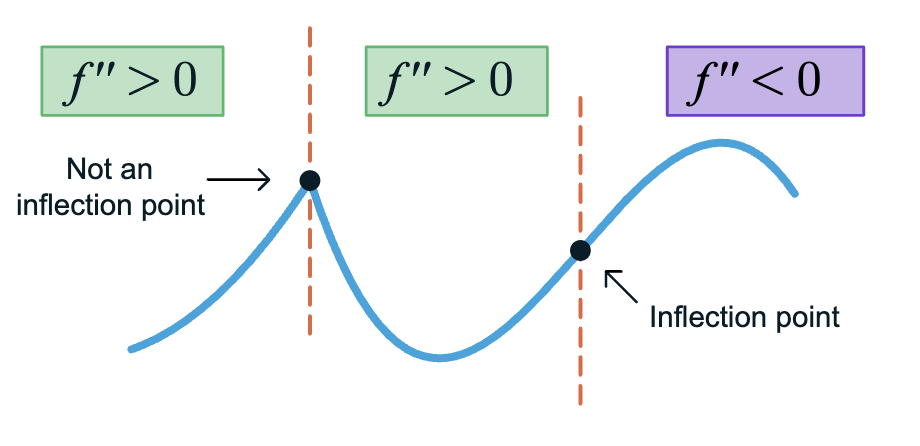
An inflection point (or point of inflection) occurs when the graph of a function changes concavity, from concave up to concave down or vice versa.

Inflection point
Inflection point

A potential point of inflection happens where the 2nd derivative f′′(x)=0 or is undefined. But the sign of f′′(x) must change around the potential point for it to be an inflection point. Similar to how we test for local extrema using the sign changes of f′(x), a sign diagram or chart for f′′(x) must be used to confirm the point of inflection.

To find points of inflection:

  1. Find where f′′(x)=0 or undefined. These potential inflection points must also be in the domain of the original function.
  2. Make a sign chart/diagram for f′′(x) to check whether the sign changes across those points.
  3. If the sign changes over a point, then it’s an inflection point.

Examples

1. Find the points of inflection and determine the concavity of

f(x)=e−x2

Solution

The domain of f(x) is all real numbers.

The 1st derivative is

f′(x)=−2xe−x2

The 2nd derivative is

f′′(x)=−2e−x2+4x2e−x2

=e−x2(4x2−2)

Set f′′(x)=0:

e−x2(4x2−2)=0

Since e−x2>0 for all x, it never equals 0. So we solve:

4x2−2=0

x2=21​

x=±22​​

Now set up a sign chart for f′′(x). Since e−x2>0, the sign of f′′(x) depends only on 4x2−2.

Interval Test point x Sign of f′′(x)
(−∞,−22​​) −1 +
(−22​​,22​​) 0 −
(22​​,∞) 1 +

Inflection points:

Since the sign of f′′(x) changes as the graph passes x=−22​​ as well as x=22​​, both are inflection points.

Concavity:

  • f(x) is concave up on (∞,−22​​)
  • Concave down on (−22​​,22​​)
  • Concave up on (22​​,∞)

2. Find the points of inflection and determine the concavity of

g(x)=x2−1​

Solution

(spoiler)

For the domain of g(x), the expression under the square root must be non-negative.

x2−1≥0

(x+1)(x−1)≥0

Use a number line and separate it at the x-intercepts of x=−1 and x=1 to find that the expression is ≥0 when x≤−1 or x≥1.

Next, the 1st derivative is

g′(x)=21​(x2−1)−1/2(2x)

=(x2−1)1/2x​

The 2nd derivative is

g′′(x)=x2−1(x2−1)1/2−x⋅x2−1​x​​

=x2−1x2−1​x2−1−x2​​

=−(x2−1)3/21​

g′′(x) is undefined when x=1 and −1. However, g(x) doesn’t exist in between −1 and 1. Since we can’t check for a change in concavity, those aren’t inflection points.

The denominator is always positive, so g′′(x)<0 for all x in the domain of g(x). Therefore g(x) is always concave down where it exists.

3. Find the points of inflection and determine the concavity of

f(x)=ln(x2−x+1)

Solution

(spoiler)

The domain is where the log argument (x2−x+1)>0. Checking the discriminant, x2−x+1 has no roots and is always above the x-axis, so the domain of f(x) is all real numbers.

The 1st derivative is

f′(x)=x2−x+12x−1​

The 2nd derivative is

f′′(x)=(x2−x+1)2(x2−x+1)(2)−(2x−1)(2x−1)​

=(x2−x+1)22x2−2x+2−(4x2−4x+1)​

=(x2−x+1)2−2x2+2x+1​

Since the denominator is always positive, f′′(x) is never undefined. Solving f′′(x)=0 for potential inflection points,

−2x2+2x+1=0

Using the quadratic formula,

x=21±3​​

Now set up a sign chart for f′′(x). Since (x2−x+1)2>0, the sign of f′′(x) depends only on −2x2+2x+1.

Interval Test point x Sign of f′′(x)
(−∞,21−3​​) −1 −
(21−3​​,21+3​​) 0 +
(21+3​​,∞) 2 −

Inflection points:

Since the sign of f′′(x) changes as the graph passes x=21−3​​ as well as x=21+3​​, both are inflection points.

Concavity:

  • f(x) is concave down on (−∞,21−3​​)
  • Concave up on (21−3​​,21+3​​)
  • Concave down on (21+3​​,∞)

4. A function f has 1st derivative

f′(x)=x2−4x−5

Find the points of inflection and determine the concavity of f(x).

Solution

(spoiler)

The 1st derivative is the given polynomial. The domain is all real numbers because only polynomials have derivatives that are also polynomials. The 2nd derivative is

f′′(x)=2x−4

f′′(x)=0 when x=2, which is the potential inflection point.

Interval Test point x Sign of f′′(x)
(−∞,2) 0 −
(2,∞) 3 +

Inflection points:

x=2 is an inflection point since the sign of g′′(x) changes.

Concavity:

  • f(x) is concave down on (−∞,2)
  • Concave up on (2,∞)

Sign up for free to take 5 quiz questions on this topic

All rights reserved ©2016 - 2026 Achievable, Inc.