


Achievable logoAchievable logo
AMC
Sign in
Sign up
Purchase
Textbook
Practice exams
Support
How it works
Exam catalog
Mountain with a flag at the peak
Textbook
Introduction
1. Algebra
2. Geometry
3. Number theory
4. Counting and probability
5. Intermediate topics (AMC 10/12)
6. Advanced topics (AMC 12)
7. General approaches
8. Practical strategies
8.1 Backsolve
8.2 Estimate
8.3 Eliminate
Wrapping up
Achievable logoAchievable logo
8.2 Estimate
Achievable AMC
8. Practical strategies

Estimate

6 min read
Font
Discuss
Share
Feedback

This chapter applies to all AMC 8/10/12 test takers.

This strategy (along with the other two in this unit) is best treated as a backup plan. Almost no AMC problems are meant to be solved by estimation alone. Still, estimation and related shortcuts can help you reach the correct answer when an exact solution feels out of reach or when you’re short on time.

AMC problems are also written with the expectation that test takers will use basic logic to eliminate impossible choices. For example, if a problem asks for the area of a shape inside another shape, the answer choices will rarely include values that are equal to or larger than the area of the outer shape - those can be eliminated immediately. Beyond these obvious checks, you can often use slightly more careful estimation to narrow the choices further.

Because calculators aren’t allowed, comparing answer choices that involve radicals, π, or fractions can feel awkward. This is where number sense matters. One helpful fact is that AMC answer choices are always listed in increasing order, even when they’re written in different forms. So it often helps to convert each choice into a rough decimal estimate so you can compare everything on the same scale.

Common approximations

Memorize these constants and commonly used rough estimates. You should also be able to determine the decimal values of common fractions.

2​=1.3

3​=1.7

5​=2.2

π=3.14

e=2.7

ln(2)=0.7

log10​(2)=0.3

Estimation vs. elimination

Estimation and elimination are related, but they’re not the same tool.

  • Estimation means you approximate the value you’re looking for and place it in a reasonable range on the number line. Once you have a plausible range, you guess among the choices that fall in (or near) that range.

  • Elimination means you cross out choices because they violate a specific requirement of the problem, not because they’re “too far” from an estimate. For example, you might eliminate all odd numbers for an arithmetic reason, or eliminate all choices that aren’t perfect cubes for a geometry reason.

Examples

For these AMC questions, try estimating without doing a full exact solution. Your goal is to get a rough value (or range), then compare it to the answer choices.

Example: The question below is from 2025 AMC 8

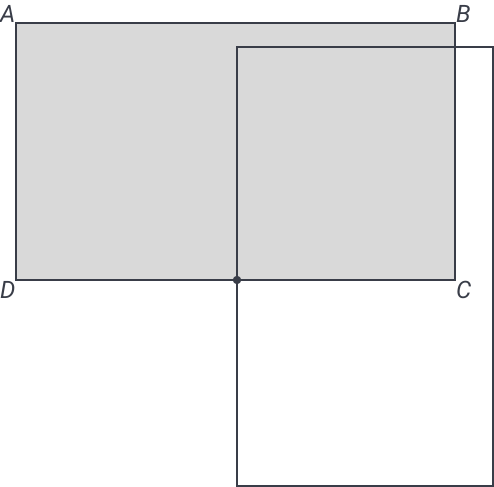
In the figure below, ABCD is a rectangle with sides of length AB=5 inches and AD = 3 inches. Rectangle ABCD is rotated 90∘ clockwise around the midpoint of side DC to give a second rectangle. What is the total area, in square inches, covered by the two overlapping rectangles?

ABCD rectangle

A. 21
B. 22.25
C. 23
D. 23.75
E. 25

(spoiler)

Answer: D. 23.75

Although this question is relatively simple to solve directly, you can also estimate it quickly.

  • The area of one rectangle is 5×3=15.
  • The total covered area is the area of one rectangle plus the part of the rotated rectangle that sticks out beyond the overlap.
  • From the diagram, that “extra” part looks a little more than half of the rectangle’s area (the unshaded region is about half the rectangle plus a thin sliver).

So the total should be a little more than 15+7.5=22.5. That eliminates A and B immediately, leaving C and D as the most reasonable choices.

Example: The question below is from 2019 AMC 10B

The figure below shows a square and four equilateral triangles, with each triangle having a side lying on a side of the square, such that each triangle has side length 2 and the third vertices of the triangles meet at the center of the square. The region inside the square but outside the triangles is shaded. What is the area of the shaded region?

Square and four equilateral triangles A. 4
B. 12−43​
C. 33​
D. 43​
E. 16−43​

(spoiler)

Answer: B. 12−43​

Start with a size estimate.

  • The square’s side length must be slightly less than 4, so the square’s area is less than 16.
  • From the picture, the shaded region looks a bit less than half of the square.

That suggests the shaded area is less than 8, and plausibly somewhere around 5 to 7.

  • Choice A is 4, which looks too small.
  • Choice E is greater than 8, which looks too large.

So B, C, and D are the only reasonable candidates by estimation. You can still solve the problem exactly, but this kind of estimate is useful when time is tight or when you want a quick reasonableness check on an exact computation.

Common themes

  • If an expression involves the multiplication of large integers, just round to the nearest easy integer to make the multiplication simple. AMC questions love to include the number of the year. For example, the number 2026 will be included in AMC 2026 questions. Just simplify this to 2000 when estimating.
  • Memorize all of the common approximations in this chapter, as well as the decimal value of common fractions.
  • When fractions are multiplied by each other many times, remember that the result is not linear; exponential functions involving fractions shrink rapidly, which can make some answer choices obviously incorrect.
  • Approximating ratios is also a valid option. For example, 4.9 to 9.1 is almost the same as 5 to 9.
  • Estimating square roots is also a valid shortcut. For example, 2507​ is almost 2500​=50.
  • For AMC 10/12, if your estimation allows you to guess between 3 or fewer choices, then it is beneficial to make your guess. If your estimation just leaves 4 or all of the answer choices remaining, it is more beneficial to earn the 1.5 points by keeping the answer blank. For AMC 8, it is always beneficial to guess because there is no marginal point benefit from leaving an answer blank.

Estimation as a Backup Strategy\

  • Used when exact solution is difficult or time is short
  • Helps eliminate impossible or unreasonable answer choices
  • AMC answer choices always listed in increasing order

Common Approximations\

  • 2​≈1.3, 3​≈1.7, 5​≈2.2
  • π≈3.14, e≈2.7
  • ln(2)≈0.7, log10​(2)≈0.3
  • Know decimal values of common fractions

Estimation vs. Elimination\

  • Estimation: approximate value, narrow choices to a plausible range
  • Elimination: remove choices violating problem requirements (e.g., parity, geometric constraints)

Example Strategies\

  • Estimate areas or values to quickly rule out unreasonable options
  • Convert all answer choices to decimals for easy comparison
  • Use diagrams and rough calculations to judge plausibility

Common Themes\

  • Round large numbers for easier computation (e.g., 2026 to 2000)
  • Memorize and use common approximations and fraction values
  • Recognize that repeated multiplication of fractions shrinks values rapidly (exponential decay)
  • Approximate ratios and square roots for quick comparison
  • AMC 10/12: Guess if estimation narrows to 3 or fewer choices; otherwise, leave blank
  • AMC 8: Always guess, as there is no penalty for wrong answers

Sign up for free to take 6 quiz questions on this topic

Previous
Next  | 8.3 Eliminate
All rights reserved ©2016 - 2026 Achievable, Inc.

Estimate

This chapter applies to all AMC 8/10/12 test takers.

This strategy (along with the other two in this unit) is best treated as a backup plan. Almost no AMC problems are meant to be solved by estimation alone. Still, estimation and related shortcuts can help you reach the correct answer when an exact solution feels out of reach or when you’re short on time.

AMC problems are also written with the expectation that test takers will use basic logic to eliminate impossible choices. For example, if a problem asks for the area of a shape inside another shape, the answer choices will rarely include values that are equal to or larger than the area of the outer shape - those can be eliminated immediately. Beyond these obvious checks, you can often use slightly more careful estimation to narrow the choices further.

Because calculators aren’t allowed, comparing answer choices that involve radicals, π, or fractions can feel awkward. This is where number sense matters. One helpful fact is that AMC answer choices are always listed in increasing order, even when they’re written in different forms. So it often helps to convert each choice into a rough decimal estimate so you can compare everything on the same scale.

Common approximations

Memorize these constants and commonly used rough estimates. You should also be able to determine the decimal values of common fractions.

2​=1.3

3​=1.7

5​=2.2

π=3.14

e=2.7

ln(2)=0.7

log10​(2)=0.3

Estimation vs. elimination

Estimation and elimination are related, but they’re not the same tool.

  • Estimation means you approximate the value you’re looking for and place it in a reasonable range on the number line. Once you have a plausible range, you guess among the choices that fall in (or near) that range.

  • Elimination means you cross out choices because they violate a specific requirement of the problem, not because they’re “too far” from an estimate. For example, you might eliminate all odd numbers for an arithmetic reason, or eliminate all choices that aren’t perfect cubes for a geometry reason.

Examples

For these AMC questions, try estimating without doing a full exact solution. Your goal is to get a rough value (or range), then compare it to the answer choices.

Example: The question below is from 2025 AMC 8

In the figure below, ABCD is a rectangle with sides of length AB=5 inches and AD = 3 inches. Rectangle ABCD is rotated 90∘ clockwise around the midpoint of side DC to give a second rectangle. What is the total area, in square inches, covered by the two overlapping rectangles?

ABCD rectangle

A. 21
B. 22.25
C. 23
D. 23.75
E. 25

(spoiler)

Answer: D. 23.75

Although this question is relatively simple to solve directly, you can also estimate it quickly.

  • The area of one rectangle is 5×3=15.
  • The total covered area is the area of one rectangle plus the part of the rotated rectangle that sticks out beyond the overlap.
  • From the diagram, that “extra” part looks a little more than half of the rectangle’s area (the unshaded region is about half the rectangle plus a thin sliver).

So the total should be a little more than 15+7.5=22.5. That eliminates A and B immediately, leaving C and D as the most reasonable choices.

Example: The question below is from 2019 AMC 10B

The figure below shows a square and four equilateral triangles, with each triangle having a side lying on a side of the square, such that each triangle has side length 2 and the third vertices of the triangles meet at the center of the square. The region inside the square but outside the triangles is shaded. What is the area of the shaded region?

Square and four equilateral triangles A. 4
B. 12−43​
C. 33​
D. 43​
E. 16−43​

(spoiler)

Answer: B. 12−43​

Start with a size estimate.

  • The square’s side length must be slightly less than 4, so the square’s area is less than 16.
  • From the picture, the shaded region looks a bit less than half of the square.

That suggests the shaded area is less than 8, and plausibly somewhere around 5 to 7.

  • Choice A is 4, which looks too small.
  • Choice E is greater than 8, which looks too large.

So B, C, and D are the only reasonable candidates by estimation. You can still solve the problem exactly, but this kind of estimate is useful when time is tight or when you want a quick reasonableness check on an exact computation.

Common themes

  • If an expression involves the multiplication of large integers, just round to the nearest easy integer to make the multiplication simple. AMC questions love to include the number of the year. For example, the number 2026 will be included in AMC 2026 questions. Just simplify this to 2000 when estimating.
  • Memorize all of the common approximations in this chapter, as well as the decimal value of common fractions.
  • When fractions are multiplied by each other many times, remember that the result is not linear; exponential functions involving fractions shrink rapidly, which can make some answer choices obviously incorrect.
  • Approximating ratios is also a valid option. For example, 4.9 to 9.1 is almost the same as 5 to 9.
  • Estimating square roots is also a valid shortcut. For example, 2507​ is almost 2500​=50.
  • For AMC 10/12, if your estimation allows you to guess between 3 or fewer choices, then it is beneficial to make your guess. If your estimation just leaves 4 or all of the answer choices remaining, it is more beneficial to earn the 1.5 points by keeping the answer blank. For AMC 8, it is always beneficial to guess because there is no marginal point benefit from leaving an answer blank.
Key points

Estimation as a Backup Strategy\

  • Used when exact solution is difficult or time is short
  • Helps eliminate impossible or unreasonable answer choices
  • AMC answer choices always listed in increasing order

Common Approximations\

  • 2​≈1.3, 3​≈1.7, 5​≈2.2
  • π≈3.14, e≈2.7
  • ln(2)≈0.7, log10​(2)≈0.3
  • Know decimal values of common fractions

Estimation vs. Elimination\

  • Estimation: approximate value, narrow choices to a plausible range
  • Elimination: remove choices violating problem requirements (e.g., parity, geometric constraints)

Example Strategies\

  • Estimate areas or values to quickly rule out unreasonable options
  • Convert all answer choices to decimals for easy comparison
  • Use diagrams and rough calculations to judge plausibility

Common Themes\

  • Round large numbers for easier computation (e.g., 2026 to 2000)
  • Memorize and use common approximations and fraction values
  • Recognize that repeated multiplication of fractions shrinks values rapidly (exponential decay)
  • Approximate ratios and square roots for quick comparison
  • AMC 10/12: Guess if estimation narrows to 3 or fewer choices; otherwise, leave blank
  • AMC 8: Always guess, as there is no penalty for wrong answers

More from Practical strategies

  • Backsolve
  • Eliminate