



Translating Functions
Introduction
Translations are part of a larger category of function changes known as transformations. Transformations include changes to the shape of a function, such as the narrowing or widening of a parabola. Since such transformations occur rarely, if ever, on the SAT, we will confine ourselves to translations in this lesson.
Approach Question
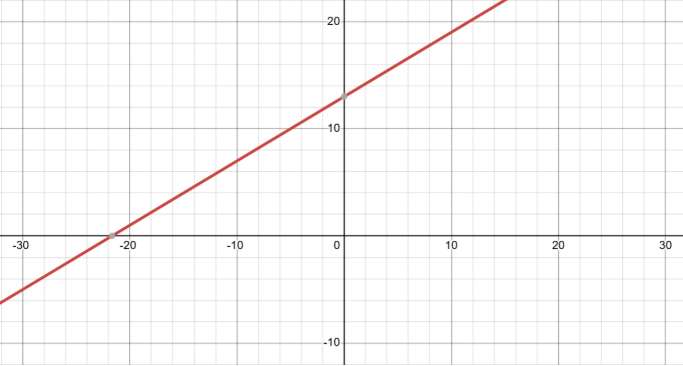
The graph of is shown. Which of the following equations defines function f?
A.
B.
C.
D.
Explanation
The following table summarizes the four types of translation you will see on the SAT.
| Algebraic change | Change in graph | Type of function in which it is found | Frequency |
| Add a positive value k to the end of the function | Moves up k units | All (linear, quadratic, exponential, etc.) | Common |
| Add a negative value k to the end of the function | Moves down k units | All (linear, quadratic, exponential, etc.) | Common |
| Add a positive value k to x (inside the parentheses) | Moves to the left k units | Quadratic, exponential | Rare |
| Add a negative k to x (inside the parentheses) | Moves to the right k units | Quadratic, exponential | Rare |
Of the above translations, the left/right movement often seems counterintuitive to students. If you simply remember that the right/left shift is “backward” (positive moves left, negative moves right), you will not go wrong.
Now to the Approach question. The initial information reveals that has been added to the end of the function. We are, therefore, in the first category listed in the table, and the graph has been shifted up 20 units. But take careful note: the change has already happened! We are not called upon to take the graph provided and move it up 20 units; we are instead told to assume that our effect is the “after” picture in this “before and after” situation. The prior graph, therefore, must have been 20 units down from the one we’re given.
With linear equations, we can most easily track translations by means of the -intercept. So we can subtract from the -intercept of to get . Using slope-intercept form, we know the correct answer must be one of the two with in the place of .
We now must distinguish between a slope of and a slope of . We could use the intercepts in the graph to determine slope, but this is a little tricky because the -intercept appears not to be an integer. Instead, let’s reason from our understanding of slope. A slope of less than , such as , means the graph is moving to the right more than it is moving up. Conversely, a slope of more than , like , means the graph is moving more upward than it is to the right. The latter graph would have a steeper slope than the former. In this case, if we observe the intercepts, we can see that the graph is moving up units but moving to the right move than . Put in the language of slope, the “run” is greater than the “rise”, which means the denominator is greater than the numerator. is the slope we want, and the answer is .
Topics for Cross-Reference
Variations
One example not included in this lesson is translation of a circle. Think of the circle equation: . Given its structure, how do you think a translation of a circle would take place? How would it be moved up and down? How left and right?
Flashcard Fodder
-
Because the horizontal translation is “backwards” from what we might expect, it may be worth making two flashcards–one that connects “plus” with “movement left” and one that connects “minus” with “movement right”.
-
We introduced it in the Quadratics lesson, but as a reminder (because it’s helpful in this lesson): the formula for the x-coordinate of the vertex from standard form is .
Sample Questions
Difficulty 1
The linear function is translated into the function . Which of the following changes has taken place in the translation?
A. The slope has increased.
B. The slope has decreased.
C. The y-intercept has increased.
D. The y-intercept has decreased.
The answer is The y-intercept has increased. This question goes back to slope-intercept form. Do you recall that, in , is the slope and is the -intercept? Look carefully at what changes, and what doesn’t, in the translation. In both cases, the , and therefore, the slope is because we have a term. But in the first equation, the , and therefore the -intercept, is , while in the second case it’s . The -intercept has increased by while the slope has remained constant.
Difficulty 2
The function is defined by . In the -plane, the graph of is the result of shifting the graph of to the right three units. Which of the following equations defines function ?
A.
B.
C.
D.
The answer is . Consult the main table from this lesson, if needed, to remind yourself of the difference between translating up and down and translating right and left. In the case of right or left (horizontal) translation, the added element must be placed inside the parentheses. If is a positive value, we will either have or . That narrows down the answer here to the choices with the placed inside the parentheses. But is it or ?
This is where the “backward” nature of horizontal translation comes in. Whereas a positive change to would normally be associated with “right” and a negative change with “left”, the opposite is true in the case of translation. If the graph is shifted to the right, we actually want the negative constant added to the . So in the parentheses marks the correct answer.
Difficulty 3
The function f is defined by . In the -plane, the graph of the function is the result of translating the graph of down 7 units. What is the value of ? (Note: this is a free-response question.)
The answer is 113. Although the initial function looks complicated, note that you don’t have to multiply it all out (thank goodness!) in order to translate it down 7 units. Simply add a at the end. This means the function is . We can plug in and we’ll find that
Difficulty 4
The function is defined by . For what value of does reach its minimum? (Note: this is a free-response question.)
The answer is -5.5. To answer this question, we need 1) the correct formula for the vertex of a parabola and 2) a careful substitution and solving process. We need #1 because the question asks for a “minimum”. As noted in the lesson on quadratics, the word “minimum” or “maximum” on a quadratic function question always points to the vertex. And the formula for the vertex’s -coordinate is . We can field that formula once we have the function in hand, but we don’t have the function until we plug in for all instances of in the function. Here we go:
Now that the function is simplified into standard form (), we can apply the formula. .
Difficulty 5
The graph of is translated up 3 units in the -coordinate plane. What is the -coordinate of the -intercept of the resulting graph? (Note: this is a free-response question.)
The answer is -13. Watch out for the trap on this question. We cannot simply add at the end of the given function, because translation of linear equations only works that way with slope-intercept form. So guess what comes next? A conversion from standard form to slope-intercept form, of course. Here are the steps:
Notice that, in the second step, we were careful to place the before the so slope-intercept form would be apparent. With slope-intercept form before us, we are now permitted to add to the -intercept form. Turning into in order to achieve a common denominator, we find that our new equation is .
Our last step is to find the -intercept. Remember the rule that for an intercept, the opposite variable is equal to . So we need to plug in for and solve for . The steps: