



Quadratics and Other Polynomials
Introduction
Quadratics are expressions whose largest exponent, or highest power, equals 2. A quadratic equation connects two expressions, one on either side of the equals sign, at least one of which has a term with a variable squared. A quadratic function is structured in the usual notation, with “f(x)” (or similar function notation) set equal to a quadratic. In ordinary circumstances, quadratic equations have two solutions; another way to say the same thing is that their graph, a parabola, has two x-intercepts. There are exceptions to this rule, exceptions we’ll cover in this module, but your normal expectation should follow the pattern that the number of solutions to an equation equals the highest exponent found in that equation. In the case of a quadratic, that’s 2!
Approach Question
A pirate ship fires a cannonball at a merchant ship but the cannonball misses high, sailing over the merchant ship and eventually splashing into the ocean. The flight of the cannonball can be modeled by the function , where is the time, in seconds, and is the height above the water at which the ball is found at time . After how many seconds does the cannonball attain its maximum height above the water?
A. 0.5 seconds
B. 2 seconds
C. 4 seconds
D. 5 seconds
Explanation
This kind of projectile question is a common way to test knowledge of quadratics through a word problem, and the SAT is no exception. Let’s start by reviewing the standard form of a quadratic (or parabola, speaking in graphing terms): , where , , and are coefficients. There will always be a negative sign on the “a” term in a projectile question, indicating an “upside down” parabola used to model where the flight begins, where it reaches its maximum, and where it hits the ground (or, in this case, the water).
Though seemingly complicated at first, this question is actually straightforward if you know two things: 1) that “maximum” corresponds to the vertex of the parabola (as does minimum in an upward-facing parabola) and 2) the formula for the -coordinate of the vertex: . Since this question is asking for the time, or value, we have only to apply the formula: . The answer is B: seconds.
But there are a few other important things to note as we study this question. Any quadratic equation in a real-life situation will reveal, in addition to the maximum (or minimum), two other points in the object’s flight: the starting point and the point at which the object hits the ground (or water). The starting point is the y-intercept, just as it is in a linear equation. Also, the y-intercept is transparent in a quadratic: it is simply the term. So answer choice here is a trap answer of sorts, since is a significant number in this situation. But it’s not the time at which the maximum is reached; rather, (feet) is the height above the water at which the cannonball began its journey out of the cannon.
Finding the “landing point” for the cannonball involves finding the other intercept, the x-intercept, and that process is more complicated. The first step is to determine whether the quadratic can be factored (see mini-lesson below). Once we have set the quadratic equal to zero (required to find the solution or -intercept), the best way to proceed is to multiply the equation by to get rid of the leading coefficient (). That yields . As you can see if you remember your factoring principles, this equation will not factor.
That leaves with the Swiss Army Knife of quadratics, useful in every situation: the quadratic formula. Does a song run through your head as you recite it? “The quadratic formula’s +/- the square root of , all over .” If you apply the formula in this case, you get something quite messy. (Want to try it? Check your answer below.) Thankfully, we are not asked for the time at which the cannonball hit the water!
(Spoiler: the quadratic formula, once simplified in this case, yields . Taking only the “plus” answer tells us that the cannonball hits the water between and seconds after being fired. Not an easy quantity to figure out without a calculator!)
And finally, though very importantly, you can actually skip all the above information if you graph the function in Desmos! Remember, if you do so, that you are not reading the graph for the -intercepts, for reasons explained above. You are looking for the vertex of the graph, which in this case is its very top, since the parabola faces downward. We do recommend solving the problem with Desmos, as it is likely the fastest way to do so. However, it can be dangerous to use Desmos without understanding the underlying principles and concepts, so we have provided explanations about every angle of this question, not just the Desmos approach.
Mini-Lesson: Factoring Quadratics
To understand what it takes to factor a quadratic with a leading coefficient of (so in the form ), it helps to review the opposite of factoring, that is, multiplying (or expanding) binomials such as and . Commonly known as “FOIL”–an abbreviation for “first, outer, inner, last,” expanding involves multiplying the two binomials in four steps so that each term in the first binomial gets multiplied by each term in the second. Expanding and yields , which, after combining like terms in the middle, simplifies to .
To factor a quadratic, we literally undo this process, like a movie playing in reverse. If given , we consider what two integers would multiply to make (the “last” portion of FOIL) and what two integers would add to make (the “outer” plus the “inner” portion of FOIL). (Note that the “first” part of FOIL doesn’t really come into play because the leading coefficient is , and that can only be if we’re using integer factors). Looking at as a multiple, we could use some combination of and or and . However, the multiple is really ; for a negative product, we need one negative integer and one positive integer.
We can’t decide among these options until we consider the middle term’s coefficient: . Knowing that this coefficient comes from adding two coefficients together, we establish that the negative coefficient must have a larger absolute value than the positive coefficient; that is, the negative coefficient must be larger if you don’t consider the negative. (Think of a tug of war between a negative and a positive number where the negative is winning.) So we could use and as a pair, or else and . But only the second of these pairs, when added together, produced . That’s our winner.
With this in mind, we can construct our two binomials to be multiplied together. The leading terms have coefficients of , so in that case it’s always . Plugging in and , we have , which can also be written in reverse since multiplication is commutative: .
Finally, we should consider different positive/negative sign combinations from the one we have above. Here are the other three possibilities:
Two positive signs: both factors must have positive signs
A negative sign, then a positive sign: both factors must have negative signs
A positive sign, then a negative sign: one factor must have a negative and the other a positive, with the positive “winning,” that is, having a larger absolute value.
Try factoring these three quadratic expressions:
or
or
or
Topics for Cross-Reference
Variations
On somewhat rare occasions, the SAT will present a quadratic expression or equation with a leading coefficient greater than . There are two different ways this can occur, each corresponding to its own solution strategy:
- Sometimes the expression can be turned into a “traditional” quadratic by factoring out the greatest common factor. For example: consider . It looks hard to factor, but if we divide out the GCF, we have , and the quadratic inside the parentheses now factors cleanly into . Always look out for the possibility of a GCF!
- If there is a leading coefficient and no GCF, there are ways to factor such a quadratic, but this situation is rare enough on the SAT that it’s not worth going into detail about those here (look up “slide and divide” online if you’re curious). In these situations, work out your quadratic formula muscles! This has the benefit of solidifying the formula in your mind. The other benefit is that the quadratic (again, in rare cases) may not be factorable into integer factors at all, so if you default directly to the quadratic formula, you avoid the frustration of trying to factor something that isn’t factorable! (You may also figure out that the quadratic isn’t factorable if you use the UnCLES method and look at the answers, discovering that some or all of them have square roots present. A sure sign that the quadratic formula is your ace in the hole!)
- In the case of either #1 or #2 above, you can always graph the quadratic with Desmos instead. Graphing with Desmos is often faster, sometimes even much faster, than traditional textbook approaches.
Flashcard Fodder
-
We’ve used it already in this lesson, but make sure to memorize the formula for the x-coordinate of the vertex from standard form: .
-
vertex form: although is your primary tool for finding the vertex, it’s important to recognize vertex form when it arises: , where are the coordinates of the vertex. Note there is a minus before the so you’ll need to switch the sign; if you have inside the parentheses, for instance, the x-coordinate is , not .
-
Two handy shortcuts if you are asked for the sum of the solutions or the product of the solutions to a quadratic. The sum is and the product is .
-
It’s important to memorize the quadratic formula more generally (get a song in your head to help!), but the part of the quadratic formula under the radical is helpful in determining the number of solutions to a quadratic equation. It’s called the discriminant and is . The rules are as follows:
- If the discriminant is less than zero, there are zero real solutions.
- If the discriminant is equal to zero, there is one real solution.
- If the discriminant is greater than zero, there are two real solutions.
-
The difference of squares is very helpful:
-
It’s also worth memorizing the two “perfect square quadratics”:
Sample Questions
Difficulty 1
Which of the following is equivalent to ?
A.
B.
C.
D.
The answer is . This problem presents the difference of squares (see “Flashcard Fodder”). We may expand these two binomials by multiplying the first terms (), the outer terms (), the inner terms (), and the last terms (). Adding these four terms together cancels the two middle terms ( and ), leaving just . However, it is more efficient to memorize the form of the difference of squares so that you know to square the first term, square the last term, and put a minus sign in between.
Difficulty 2
Which of the following is a solution to the equation ?
A. 5
B. 2
C. -3
D. -6
The answer is 2. We need to factor the expression on the left using the method shown in the mini-lesson. The two integer pairs of factors of six are 1) and ; 2) and . Next, we note the signs: with a negative for adding and a positive for multiplying, we must use two negative factors. That means we’re adding two negative numbers to make , so and won’t work. The factoring must be . We set each of these factors individually equal to zero and discover that since , could equal , and since , could also equal . Only the first of these options is provided in the answers. (The answer choice is a good trap for those who confuse the factor with the solution . Remember that if the factor is , the solution is actually positive .)
As an alternative solving solution, you could simply plug in the answers. If you can do this quickly, plugging in the answers (known as backsolving) can sometimes be the fastest approach. Plugging in the right answer, gives us . Since it is true that , this is the answer. Backsolving is also a great checking method; if you have any doubt that is the answer, and provided you have time to do so, we encourage you, with any equation question, to plug in your answer to make sure it works.
And finally, once again, feel free to use Desmos! If you graph the equation exactly as it is (you do not need to begin with as you do on a graphing calculator), you will see two vertical lines that represent the two solutions, and . If you prefer to enter the problem as , Desmos will give you a parabola whose -intercepts provide the solutions. Either way works!
Difficulty 3
Note: an extra question is provided at Difficulty 3, as quadratics represent one of the most frequent and wide-varying question types on the SAT.
- Darius has an older brother, Cyrus, who is 7 years older than he is. If the product of the brothers’ two ages is 78, how old is Darius?
A. 6
B. 7
C. 13
D. 14
The answer is 6. Why is this a quadratics question? Consider what happens if we apply a variable (let’s call it d for Darius) and relate Cyrus’ age to that variable. If Darius’ age is , then Cyrus’ age must be , and the product of their ages must be equivalent to . But when we distribute the through the parentheses, we get a squared term (), so we have a quadratic equation. Because we know the product is , our entire equation is . Subtracting from both sides yields .
What approach should we take at this point? We include a mini-lesson on factoring in this module because factoring quadratics is a very important skill for the SAT. Having said that, the final constant here () does not readily suggest what the two needed factors might be in this case. Why not just plug the equation into Desmos and read the -intercepts? If you do so, you’ll see that the factors are and . is a nonsense answer when talking about people’s ages, so must be the value we want.
This question, like all questions with real-life scenarios and numerical answer choices, can be solved by backsolving. If you take this choice, make sure you start in the middle when plugging in the answers. Let’s say we start with the choice suggesting that Darius is years old. That means Cyrus is , and the product of their ages is therefore . Since that product is too large, we can infer the answer must be because it’s the only answer smaller than !
Be careful here; although the correct answer does turn out to be , there would be another step had the question asked for the age of Cyrus rather than Darius. On that sort of question, would be a trap answer. Make sure to use the UnCLES method thoroughly!
- Given the quadratic function , which of the following represents the value of where the graph of the function is at its minimum?
A.
B.
C.
D.
The answer is . This question looks complicated at first. Fortunately, there are two relatively straightforward solutions. The first, as you might have guessed, is graphing with Desmos. If you choose that approach, it’s important to remember that, as you hover your cursor over the parabola’s vertex, it is the -coordinate you are looking for. The other complication is that Desmos is going to give you that value in decimal, not fraction form. It will show you the value of (approximately); it is your job to recognize which of the fractional answers agree with that decimal. But if you carefully consider the two answer choices with positive values, you will likely see that is too large to match a value less than . Only one answer remains.
The other answer is to use the formula given above under Flashcard Fodder for the -coordinate of a parabola’s vertex: . If you plug in (don’t forget the negative sign!) for and for , you’ll arrive at once the two negatives cancel each other out.
Difficulty 4
The graph of the given equations in the -plane intersects at the point . Which of the following could be the value of ?
A. -3
B. -2
C. 0
D. 3
The answer is -3. There are three ways to approach this problem. The textbook approach involves noticing that the right sides of both equations are set equal to , so they must also be equal to each other. We can therefore say that . Moving all the terms to the side with (remember: always set quadratics equal to zero!), we get . This factors to , meaning that must equal either or . We can plug both of these solutions back in and solve for , but let’s be smart with the help of the UnCLES method. Looking at the answers, we can see that is not an option for , so we can only use .
Alternatively, we can backsolve here, seeing which answer fits both equations. To be efficient, we should notice that and are both used twice as the value of , so we should pick one of those to start with. It’s always easier to plug in a positive than a negative, so let’s plug in for the first equation. That yields , so it looks like is the answer. To be safe, we can plug in for in the second equation as well, confirming our choice.
The third way is–you guessed it–Desmos! If you graph the two equations given, you will encounter a line intersecting a parabola at two points. Hover over each of those points to find the -coordinates of and . As already observed, only is given among the choices.
Difficulty 5
The equation above has no solution in the real number system. If is an integer, what is the smallest possible value of ? (Note: this is a free-response question.)
The answer is -23. This is a challenging problem and a great chance to explore the discriminant, as described under Definitions and Flashcard Fodder in this lesson (and included on the master SAT formula sheet). The discriminant can be applied straightforwardly when the values of , , and in are all provided. But what happens when one of the coefficients, in this case, is simply replaced by another unknown (in this case, )? We can still set up the discriminant; we just have to set it up fully as an inequality based on the knowledge that this equation has no solutions. That means the value of the discriminant must be negative. so:
At this point, we need to be careful. We can take the square root of both sides (using a calculator, we can see that the square root of is, unsurprisingly, a whole number: ), but with an inequality, this means we must change the direction of the inequality when considering the negative solution. So our answer becomes and . Since we’re looking for the smallest integer value, the answer must be (not -, which is actually outside of our accepted range). The trap answers of and refer to the solutions for this quadratic when or , not the value of itself.
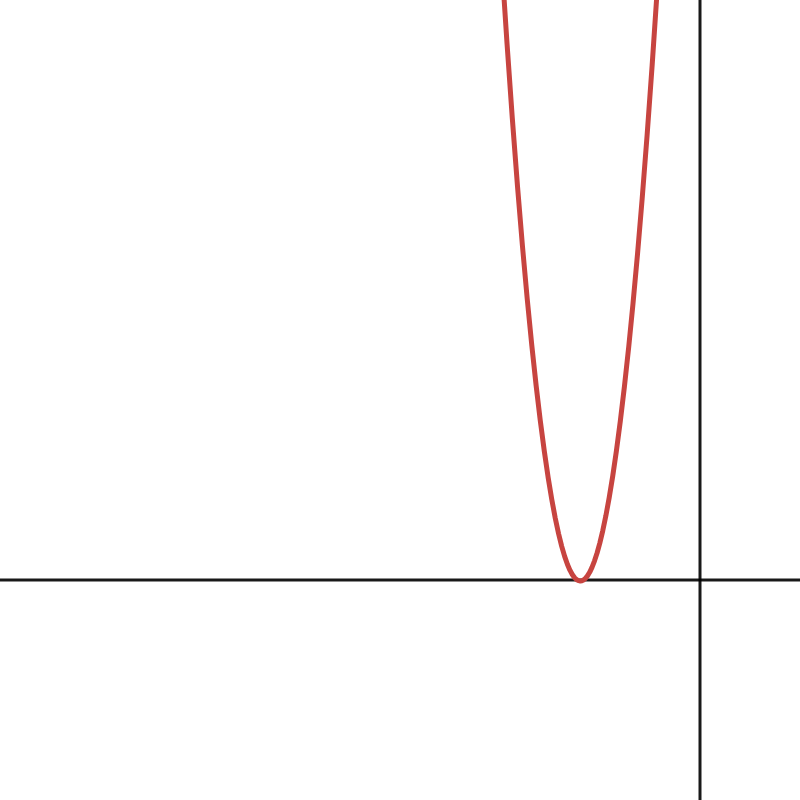
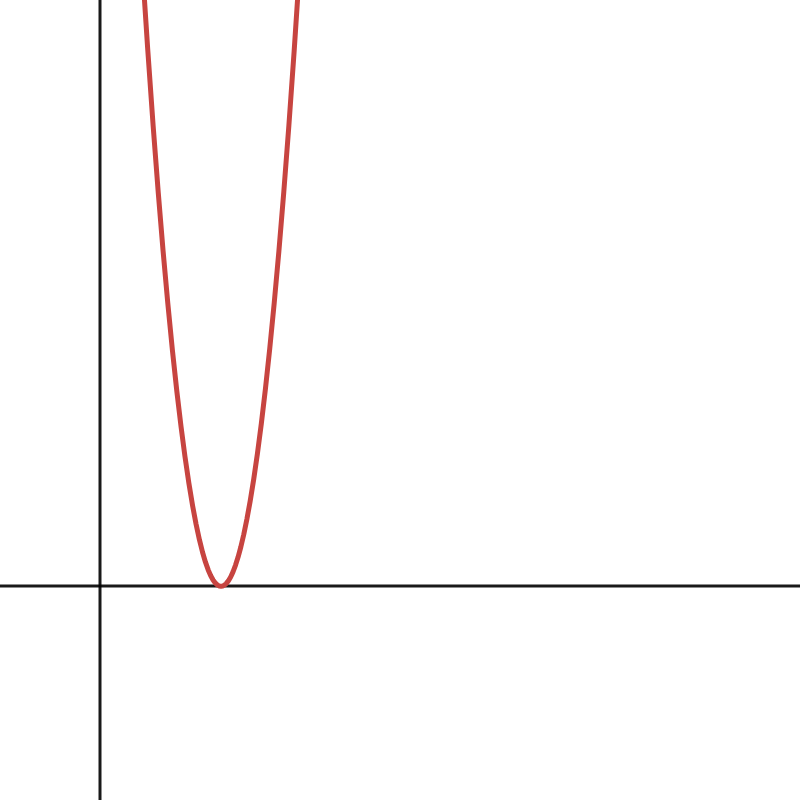
That’s a very tricky process. Is there an alternative? We’re glad you asked. Desmos! It may not appear that Desmos is a solving candidate in this case, since the unknown would appear to be hard to graph. But if you graph in Desmos, you’ll see that it offers you something called a slider to vary the value of . Moving the slider from left to right (and back, as necessary), reveals that the parabola touches the -axis when or . (See images below.)
Between those two values, you’ll see that the parabola does not touch the -axis, which means it has no solutions at all those values of . This is exactly what we discovered by using the discriminant: we want the smallest possible integer value between and .