



Circles
Introduction
Circle questions on the SAT may explore the concepts of area and circumference (both formulas included in the SAT reference on test day), but they also may include other concepts such as angle measure and arc measure. Among harder circle questions, one formula becomes crucial: the circle equation. This formula is not included in the SAT reference; make sure you know it and can apply it!
Approach Question
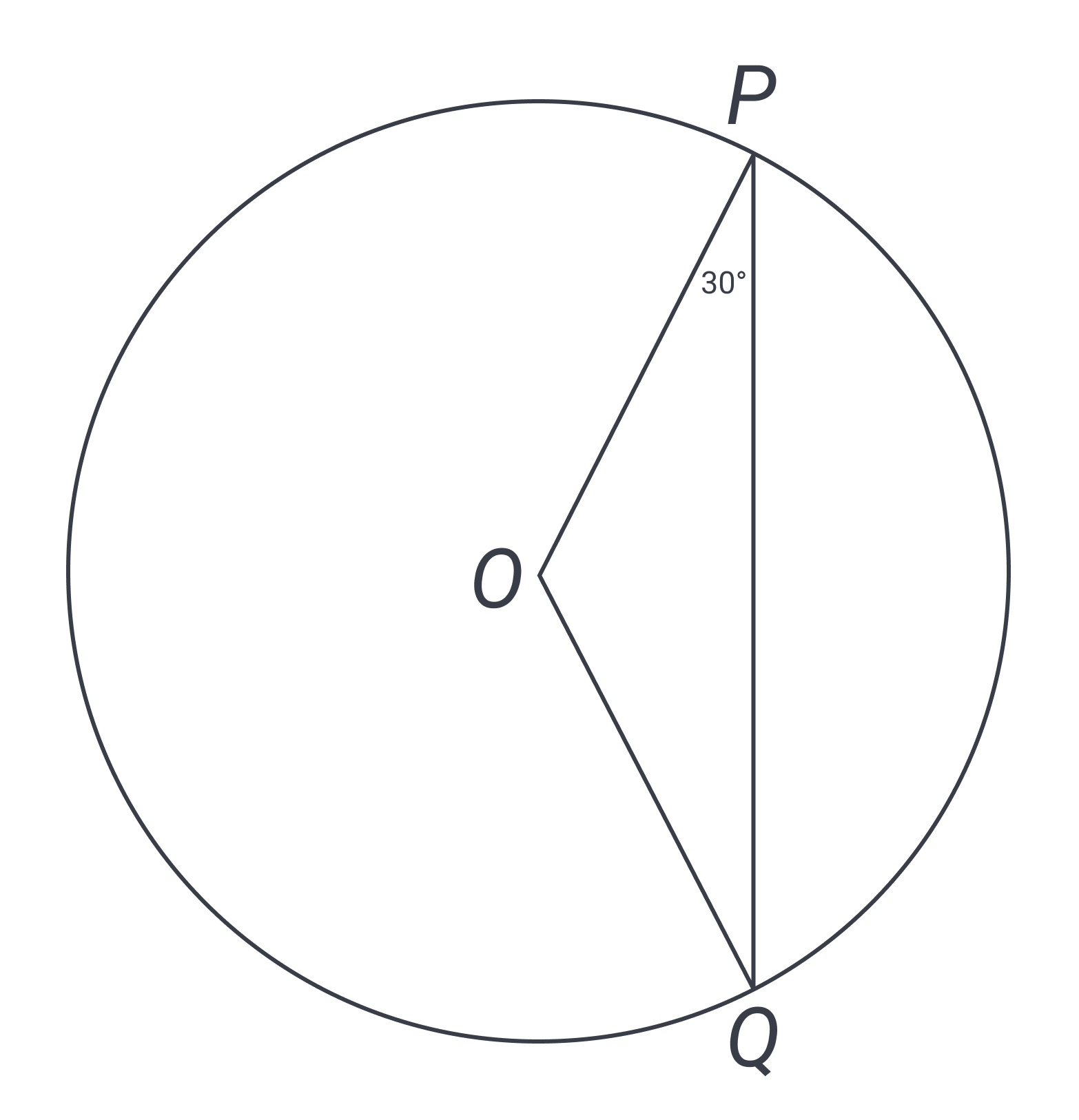
In a certain circle, is the center and is a triangle with points and on the circle. If the measure of angle , what is the measure of arc , in degrees?
A. 120
B. 90
C. 60
D. 30
Explanation
This question is typical of many SAT circle questions in that it includes the concept of angles along with elements of circle analysis. In pursuit of angle measure, we must also deal with a triangle contained within the circle. An important principle whenever you encounter overlapping shapes is to determine what the two shapes have in common. In this case, we must note that line segments and are both sides of the triangle and radii of the circle. As always with SAT geometry, it’s best to copy the figure so we can annotate it. The result looks something like this:
Your diagram need not look exactly like this (although the more you can draw it to scale, the better); the important recognition is that both and are radii of the circle. Why does this matter? All radii of a circle are, by definition, congruent; as a result, we have an isosceles triangle inside our circle. All isosceles triangles have not only two congruent sides but also two congruent angles. Knowing (from our Triangles lesson) that the congruent angles must be across from the congruent sides, we can conclude that angle is also in measure. Knowing that all triangles contain in interior measure, we can solve for angle by subtracting the other two angle measures from . Angle measures .
At this point, you might be wondering why any of this matters. Isn’t this a circle question, after all? Here’s how the angle determination helps. We are asked for the measure of an arc, which must be something less than if it does not encompass the entire circle. Typically, the way to find an arc is based on the principle that the measure of an arc is equal to the central angle that creates it. This means we have (perhaps unknowingly) already arrived at our answer: the measure of arc is the same as the measure of angle : 120°.
Topics for Cross-Reference
Variations
You will notice that instances of the circle equation always locate the circle on the -coordinate plane, with the coordinates of the circle’s center identified by the equation. On rare occasions, SAT circle equations will locate circles in the coordinate plane without the circle equation. You may be called on to plot a couple of points to understand the nature of the circles and any figures that might be included within them.
Flashcard Fodder
Circle formulas provided by the SAT on test day
Area of a circle =
Circumference of a circle =
Degrees in a circle =
Circle formulas NOT provided by the SAT on test day
The equation of a circle: ; is the center of the circle and is the radius.
The measure of a central angle of a circle is equal to the arc it intercepts.
The measure of an inscribed angle (an angle where the focal point of the angle is on the circle, not at the center) is one-half the measure of the arc it intercepts. (This is rare on the SAT, but not impossible.)
The arc length formula , where is the degree measure of the arc or central angle.
The sector area formula , where is the degree measure of the central angle.
Sample Questions
Difficulty 1
A circle has an area of units squared. What is its circumference?
A. units
B. units
C. units
D. units
The answer is C. Among other formulas, the SAT provides you with the circumference formula of and the area formula of . We need to use both in this case. First, we set the area formula equal to : . Cancel the pi on both sides and we get , so .
We now plug the radius of into the circumference formula: . Note that the SAT will virtually always leave pi in the answer choices. They know you don’t have a calculator and don’t expect you to calculate !
Difficulty 2
Circle has a diameter of centimeters. Circle has a radius of centimeters. What is the combined area of circles and , in ?
A.
B.
C.
D.
The answer is . The UnCLES method reminds us to read carefully, noting key terms. Did you notice that we are given the radius in one case but the diameter in the other? That discrepancy will be important; you may be aware that the radius is really the root of all circle calculations since it makes up part of the formulas for both circumference and area. So let’s convert Circle ’s diameter into a radius of (since the diameter is always twice the length of the radius).
Now that we have both radii, we can use the area formula () twice. Circle M has an area of , and Circle has an area of . Add them together and we have our answer.
Difficulty 3
A circle in the -plane has a diameter with endpoints and . An equation of the circle is . What is the length of this circle’s radius? (Note: this is a free-response question.)
The answer is 6. As noted in Flashcard Fodder, the circle equation tells two things about the circle: the coordinates of its center and the length of its radius. This problem calls on us to reverse engineer that process in order to find the radius. Are we given the coordinates of the circle’s center? No, but since we know where the diameter starts and ends, we can find the midpoint of the diameter, since the midpoint must be the center of the circle. As a reminder, a midpoint is simply the average between two points. We can average and to find the -coordinate of the center (no surprise there, the average is !); averaging and tells us the -coordinate (in this case, ).
We can plug these coordinates into the circle equation, but if you stay focused on what the question is asking, we really just need to know the distance from the center to one endpoint on the diameter. That distance (from to or from to ) is . So we have arrived at our answer! Keep in mind that we are only asked for , not ; while the equation would contain as the value of , the radius’ length of is what we’re asked for here.
Difficulty 4
Circle has a diameter of and Circle has a diameter of , where is a positive constant. The area of Circle is how many times the area of Circle ?
A. 21
B. 42
C. 441
D. 1764
The answer is 441. To understand this question, you should carefully consider the unit conversion notes laid out under Strategy Insight #3. To avoid falling for the trap answer (), in this case, you must realize that we are moving from a one-dimensional quantity (a diameter, half of which is a radius) to a two-dimensional quantity (area). To illustrate this movement, consider the formula for the area of a circle: . The “squared” is an important reminder that this is two-dimensional.
What this means is that you can divide by to get , demonstrating that the ratio of the two diameters (and therefore of the two radii) is . But you must take the next step and square that ratio to . If it’s true that a circle with twice the radius has four times the diameter, it follows that a circle with times the radius has times the diameter.
If you still feel uncertain, you can confirm the answer by calculating the areas of both circles independently in terms of a. The area of the larger circle would be , while the area of the smaller circle would be . If you divide the former by the latter, the terms and the ’s cancel; . This is another way of proving the answer.
Difficulty 5
A circle in the xy-plane has equation . The circle is shifted to the left three units and down two units, then the radius of the circle is doubled. What is the equation of the circle after all of these transformations?
A.
B.
C.
D.
The answer is . The movement and expansion of a graph, such as our circle here, is known as a transformation. Let’s take the transformations in this question one at a time. To move a graph three units to the left is more complicated than may first appear. It helps to think about the nature of the circle equation, and how this equation is telling us that the x-coordinate of the circle’s center is . Moving the whole circle three units to the left moves the -coordinate of the center to . This means that the new equation must begin with . This rules out one of the answer choices, the one that simply starts with (this could be a trap answer if you simply subtracted inside the parentheses, thinking that is what is meant by “3 units to the left”).
Moving the circle 2 units down follows the same process. The y-coordinate of the center is current zero (notice there is nothing to represent in this equation, so must be zero). We need to change the equation so that the center, , is now . As with the -coordinate, this means we need a plus, not a minus, sign before the . (If you’re not sure why this is, consider the subtraction symbols in the circle equation, as shown in Flashcard Fodder). We need in the parentheses. Another answer is eliminated.
To determine whether the right side of the equation should be or , we consider our last transformation: the doubling of the radius. What was the original radius? We know that the right side of the equation is ; if , then the original radius is . In the new circle, that doubles to , but we must square that value again to complete the equation. is the right value for the equation’s right side. (Note: could be a tempting aspect of a trap answer if you think you must simply double the .)
Finally, you could also solve this problem by graphing on Desmos. The best way to do so would be to graph the original circle and all of the answer choices as well, then determine by observation which of the answer choices’ graphs moves the circle the correct distances to the left and down and then doubles the circle’s radius. For those who feel confident working with Desmos, this could well be a much faster approach.