




Angles
Introduction
Angles questions on the SAT commonly ask about angles inside shapes: triangles and quadrilaterals especially, but occasionally larger polygons. They also sometimes feature angles in relationship to lines, such as finding measures of angles on a straight line or those between parallel lines. In these cases, the supplementary relationship (angle measures adding up to 180°) is very common. Identifying congruent angles, that is, angles equal in measure. often plays an important role in solving as well.
Approach Question
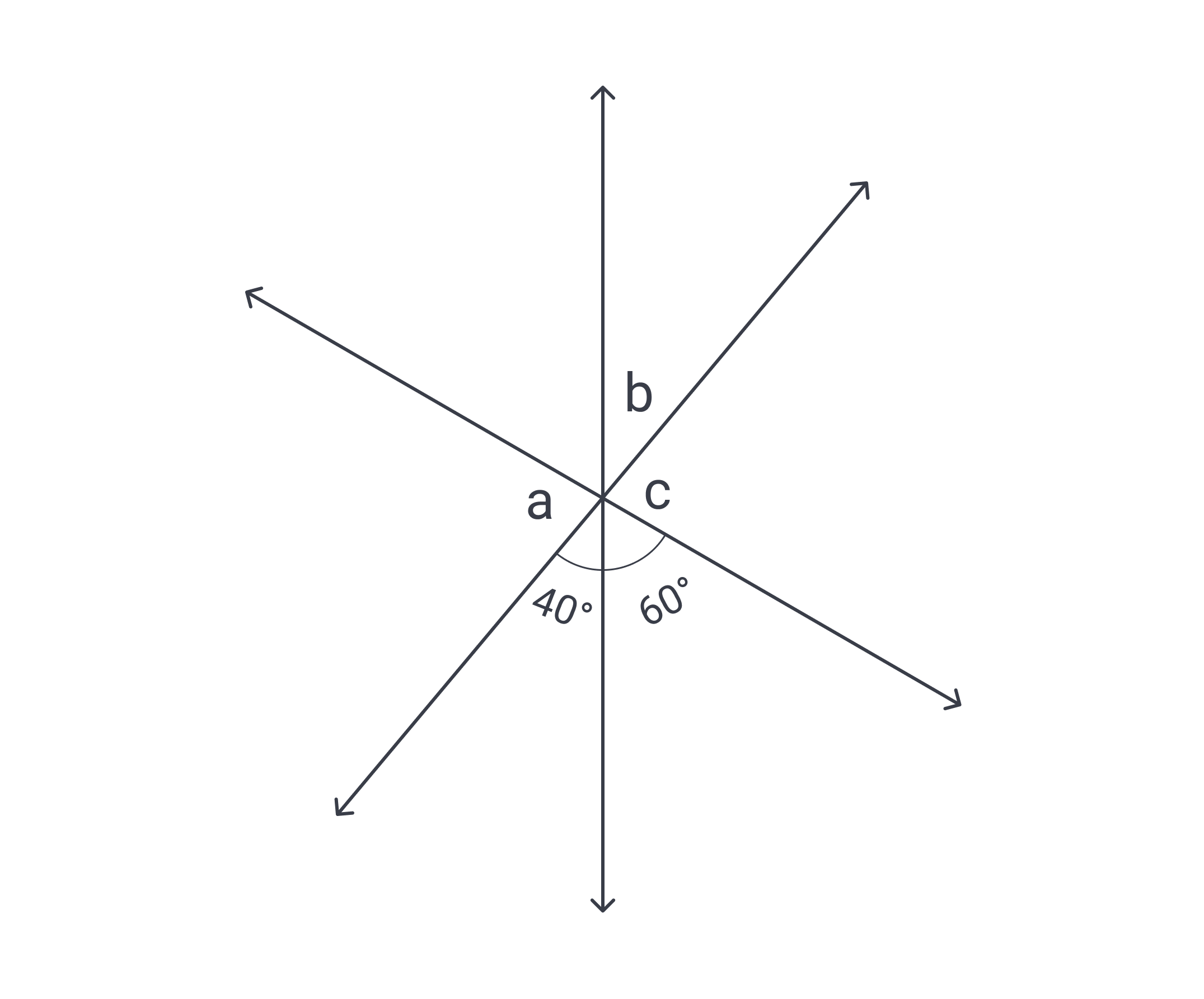
In the figure, three lines intersect at the same point, creating the angles shown. What is the measure of angle ? A. 40°
B. 60°
C. 80°
D. 90°
Explanation
Angles questions will draw on several different properties of angles; we will cover the most frequent of these properties in this lesson. In this case, two theorems in particular are needed. First, we need to know that angles making up a straight angle (the angle along a straight line) are supplementary, that is, they add up to . This is true no matter how many angles combine to make the straight angle. In this figure, the angles measuring and combine with angle c to make up a straight angle, so the three of those angles must add up to . If we subtract the two numbered angles from , remains, so that must be the measure of angle . The answer is 80°.
Another (less direct) way to answer the question is to note that angle a must be for the same reason as angle : it makes up a straight angle along with angles of and . From here, we use a second important theorem: the vertical angles theorem, which tells us that two opposite angles created by the intersection of two lines must be congruent (“congruent” means equal). To find vertical angles, we look for two intersecting lines and seek the angles “across from” each other. We can see in this figure that two lines create angles and and that angles and are opposite each other. This means that the measure of angle is equal to the measure of angle , so angle is also . This is, of course, not the fastest way to do the problem, but having multiple ways to arrive at the answer can add to both your accuracy and your confidence.
Topics for Cross-Reference
Variations
Radian measure is a way of talking about angles using radians instead of degrees as the units. As noted below, in a unit circle (with radius 1), 180° is equal to pi radians. Although this concept overlaps with our lesson on circles, we will introduce it here and include a practice question to give you some experience with the concept.
Flashcard Fodder
The triangle angle sum theorem, showing that the angles within a triangle measure , is used repeatedly in this lesson. Nothing is more helpful for SAT angle problems than this theorem!
-
Quadrilaterals (polygons with four sides) have of interior angle measure.
-
Beyond four sides, polygon angle measure continues a pattern: from for three sides to for four sides, we can continue adding per added side: so a pentagon has , a hexagon , etc. If you prefer, however, memorize the following formula for the total degrees in a polygon:
Total degree measure = , where is the number of sides
-
If you want to use the formula above but find out the measure of each of the angles in the regular polygon, simply divide by n as the number of sides. So that formula is:
Degree measure of each angle =
-
As shown in the Approach Question to today’s lesson, vertical angles (angles immediately across from each other and created by the same two lines) are congruent.
-
radians = degrees. This means that to convert from radians to degrees, we multiply by , while to change from degrees to radians, we multiply by . (The concept of radians comes from the trigonometry of the unit circle, but the SAT doesn’t typically ask about the unit circle apart from angles in radian measure.)
Sample Questions
Difficulty 1
One angle in a triangle measures . What is the sum of the measures of the other two angles in the triangle?
A. 35°
B. 70°
C. 125°
D. 155°
The answer is 125°. The measures of the interior angles in a triangle sum to degrees. The SAT, usually on lower-difficulty questions, will ask you to subtract existing angles from . There are degrees left for the two angles in the triangle not yet known, so the sum of their measure must be .
Difficulty 2
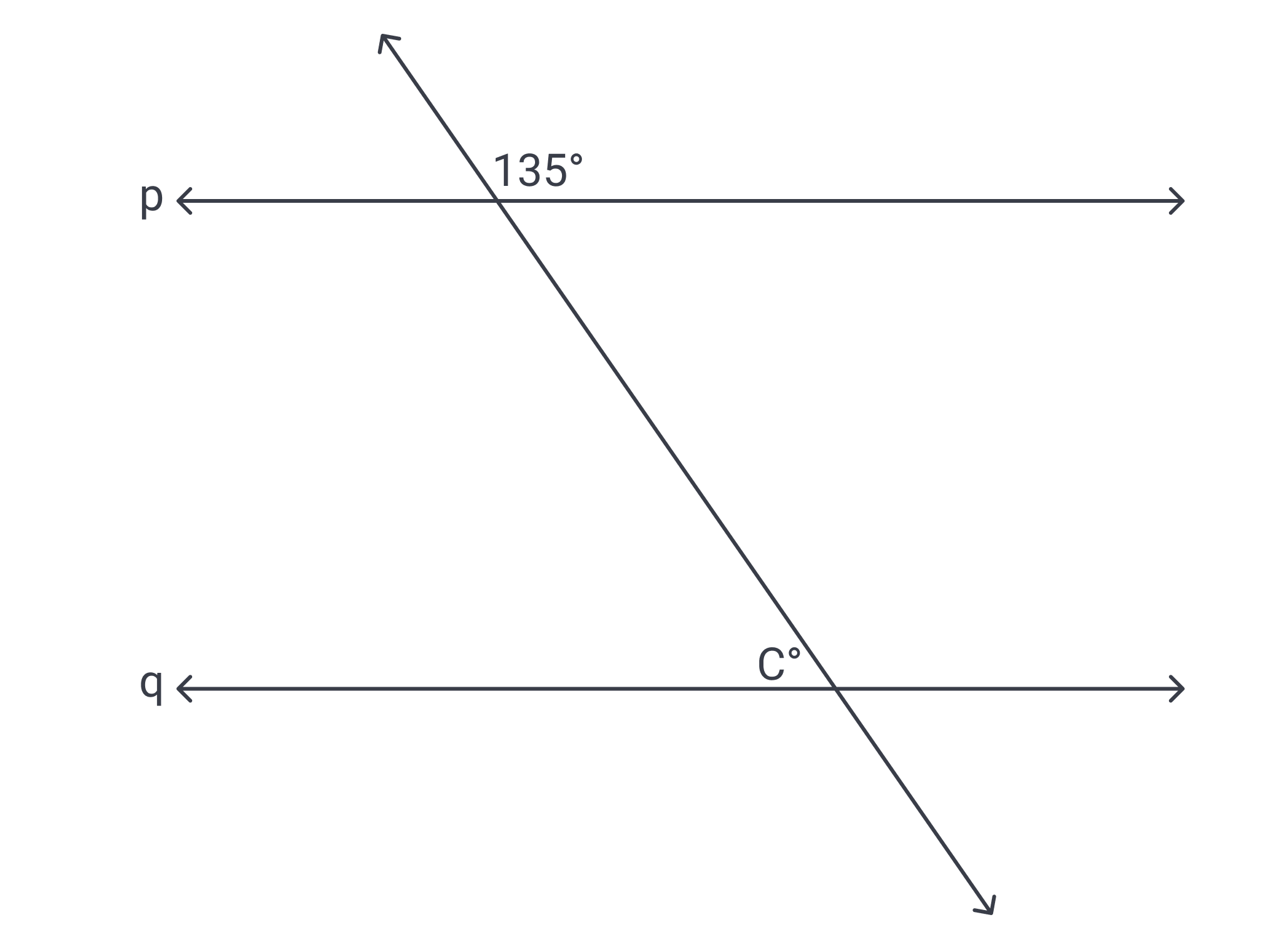
In the figure, line is parallel to line . What is the value of ? (Note: this is a free-response question.)
The answer is 45. If you skimmed the part of Strategy Insights that addresses parallel lines, take a more detailed look. The upshot of all theorems and properties regarding angles with parallel lines (when crossed by a transversal) is that all acute angles are congruent and all obtuse angles are congruent (this assumes the transversal is not perpendicular to the perpendicular lines). Even more relevant for this question is the third property listed in Strategy Insight #1: any obtuse angle plus any acute angle equals degrees. This gives us our answer right away, because is an obtuse angle and angle is an acute angle. So the measure of angle must be equal to .
Difficulty 3
Triangles and are similar, where corresponds to . If the measure of angle is and the measure of angle is , what is the measure of angle ?
A. 29°
B. 46°
C. 75°
D. 105°
The answer is 46°. Since similar triangles have congruent corresponding angles, we mostly need to note which pairs of angles are corresponding in this case. We could draw the triangles, but it’s quicker to simply note the corresponding angles based on the order in which the letters are listed in the problem:
Now, given these equalities, we can assign angle measures based on the information in the problem:
Since there are in a triangle, it must be true that .
Difficulty 4
The measure of angle is radians. If the measure of angle is radians, how much larger, in degrees, is angle than angle ?
A. 210°
B. 240°
C. 270°
D. 390°
The answer is 390°. Although it might at first appear that we need a common denominator in order to find the difference between the two angles, keep in mind that the fractions will disappear if we first convert each radian measure to degrees by multiplying by . Our results will look like this:
radians
radians
We now have a much simpler subtraction problem: .
In case you’re wondering about the common denominator approach, here it is:
Then, can be multiplied by ; the ’s will cancel and the calculator will yield our answer of .
Difficulty 5
What is the measure of each of the angles in a regular octagon?
A. 90°
B. 105°
C. 120°
D. 135°
The answer is 135°. There is a formula for this question, which we will use in a moment, but let’s consider how you might use geometric reasoning to answer this question if you didn’t know the formula. How could you draw diagonals inside a regular octagon to help you divide its angle into recognizable portions? If we keep all our diagonals either vertical or horizontal, we’ll recognize right angles and be able to infer the measures of the other angles. Consider this figure:
The dashed lines create several rectangles and triangles; knowing that a rectangle’s angles are all degrees allows us to locate a right angle making up part of each of the octagon’s interior angles. What is the measure of the other part? If all the interior angles are going to be equal, then the part added to in each angle must be the same. But that angle also constitutes, in the case of each of the four triangles, the two non-right angles. The non-right angles must always add up to , so in this case each smaller angle must be . So each interior angle of a regular octagon must measure .
We summarize the strategy above to help you see that there are ways to solve geometry questions using logic and sketching even when you don’t know the relevant formula. But, of course, the relevant formula is much faster in this case:
Angle measures in a regular polygon = , where is the number of sides.
Plug in for and, with a little calculation, you get .