



3D Figures, Surface Area, and Volume
Introduction
Three-dimensional figures involve a number of formulas and make you think about the figures’ characteristics in several ways. Whereas questions about two-dimensional figures like rectangles and circles ask about area and perimeter, 3-D figures involve questions about volume and surface area. At least one of these two quantities is present in nearly every SAT 3-D solids question.
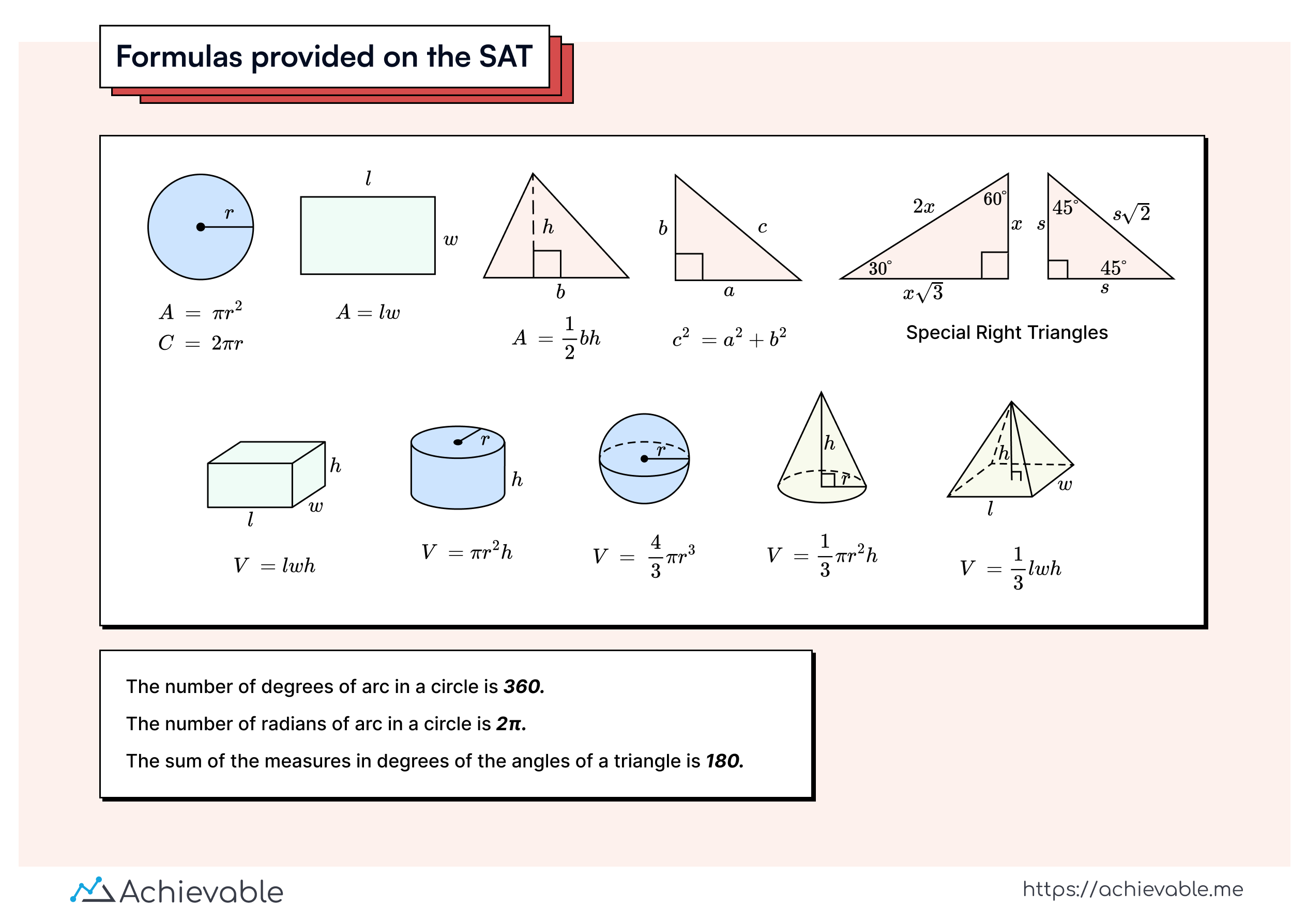
The normal geometry reminder to draw the figures applies here, perhaps even more so because 3-D figures can be harder to visualize than 2-D ones. But ultimately, SAT problems involving volume usually require using and manipulating the volume formula for the shape in question. Thankfully, several volume formulas are provided for you in the SAT reference box! We’ve provided it immediately below for your reference.
Approach Question
What is the volume of the largest possible cylinder that can be inscribed in a cube with a volume of ? The cylinder’s flat top and bottom touch the top and bottom faces of the cube.
A.
B.
C.
D.
Explanation
The largest possible cylinder in this case would touch all four side faces of the cube (in other words, all faces that are neither the top nor the bottom of the cube). This means that the diameter of the cylinder’s circular bases would be equal to the length of one of the cube’s edges. (If you haven’t yet attempted to draw this figure, do so now in order to visualize what this paragraph is describing.) Meanwhile, the height of the cylinder would also be limited by the length of the cube’s edge and equal to that length.
What is the length of one of the cube’s edges? We are speaking of a consistent edge length because we know that all the dimensions of a cube–length, width, and height–are the same. So we need a number that, when used for each of the three dimensions, multiplies to . Students often mistakenly think we need to divide by in this situation, but it’s actually the cube root of we need. (Consider that the volume formula for a cube is and imagine reversing that process.) The cube root of is . So both the diameter of the cylinder’s bases and its height are equal to cm.
We are almost ready to plug these numbers into the volume formula for the cylinder, which is . (Think about how this makes sense: should sound familiar as the circle’s area, and we need to multiply the area of that circular base times its height.) But we first need the radius, which must be half of the diameter, or cm in this case. Now we can plug in: (just as with circle, the SAT will typically leave pi in the answer choices rather than making you calculate it). The answer is .
Topics for Cross-Reference
Variations
The hardest problems with 3-D figures may require you to combine two figures (such as stacking two rectangular prisms on top of each other). Being able to draw these figures well can be important for visualizing such problems correctly. As you work through problems like this, don’t hesitate to draw the figures you’re working on!
Flashcard Fodder
3D formulas provided by the SAT on test day
Volume of a sphere =
Volume of a prism =
Volume of a cylinder = area of base x height =
Volume of a pyramid =
Volume of a cone =
3D formulas NOT provided by the SAT on test day
Volume of a cube = (this is a corollary of the prism volume formula, given that length, width, and height are all identical in a cube)
Surface area of a cube = x (if you think about how a cube is made up of six squares, you may not need to memorize this)
Density = mass/volume (see practice problem below)
Sample Questions
Difficulty 1
If a right rectangular prism has a length of , a width of , and a volume of , what is the height of the prism? (Note: this is a free-response question.)
The answer is 15. The SAT formula reference tells us that the volume of a rectangular prism is equal to . A more straightforward problem would provide all three of these values and ask you to find the volume; this question adds the slight wrinkle of providing the volume and asking you to calculate the height. This is best done by making the height the unknown variable in an equation:
Multiplying and dividing both sides by gives us the answer.
Difficulty 2
A spherical balloon has a volume of inches. What is the radius of the balloon?
A. 4 inches
B. 6 inches
C. 8 inches
D. 12 inches
The answer is 6 inches. As with the previous problem, we are given the volume; since this is a sphere and not a prism, though, this time we are asked for the radius. Students often get stuck here; it’s always a good idea to write out the formula to start. In this case, it’s . Now, let’s plug in for . Knowing that is a number, we have only one unknown variable left: . Further, we can cancel the on both sides by dividing by . That leaves us with .
We need to divide both sides by 4/3, recalling in the process that dividing by a fraction is the same thing as multiplying by its reciprocal. The left side of the equation is now . That value can be found with the calculator. An alternate approach is to plug the original equation into Desmos; the graphing calculator can solve one-variable equations for you. You simply need to be aware that you will read the answer at the x-intercept; Desmos will graph for you the entire line , not just one point.
Difficulty 3
A right circular cone has a height of and a base with a radius of . The cone has a volume of . What is the value of ? (Note: this is a free-response question.)
The answer is 294. This problem is complicated slightly by the inclusion of the unknown , but this is just another way of asking what number should accompany in our final calculation. The problem is straightforwardly about applying the cone formula given the SAT formula reference; that formula is . Plugging in for and for and (as usual) leaving as it is, we discover that the volume of this cone is . That means .
Difficulty 4
A right circular cylinder has a volume of cubic inches. If the length of the diameter of the cylinder’s base is inches, what is the exact height of the cylinder, in inches?
A.
B.
C.
D.
The answer is . To answer this question, we need to use the cylinder formula, being careful to plug in for and leaving h as the unknown. But what should we do for ? The radius is half the length of the diameter, so . We can now render the equation as follows and solve:
It may seem odd to end up with pi in the denominator, but remember that the original volume was given without a , so with on the other side of the formula from , at some point both sides have to be divided by .
Difficulty 5
A sample of iron in the shape of a cube has a density of grams per cubic centimeter. Each edge of the cube has a length of centimeters. What is the mass, in grams, of this sample of iron?
A. 4.096
B. 6.4
C. 10.0
D. 19.5
The answer is 4.096. Now and then, the SAT will assume you remember some algebraic formula necessary to solve a higher-difficulty problem. In the case of three-dimensional figures, the test will sometimes include density in the question, since density is a property of three-dimensional matter. Do you remember the formula for density? It’s , where is mass and is volume. It makes sense if you think about it: the more stuff (mass) there is, or the less space (volume) there is, the more dense something will be.
Now we can use the density formula to solve for something unknown; using the UnCLES method and keeping the question itself in mind, we note that mass is the unknown quantity. That means we must know the value of the density and the volume. The density is given to us, but not the volume; we have to calculate the volume from the edge length of . Since we know that the volume of a cube equals , we calculate a volume of . We are now ready to set up the equation:
Having progressed this far in the Achievable SAT course, you will now that unit conversion is sometimes a crucial factor in SAT math. But in this case, the units (grams and centimeters) stay consistent, we don’t have to do any conversions. We do, however, have to avoid the mistake of simply multiplying times , which yields one of the trap answers. If we manipulate the equation wrongly and end up dividing by a number instead of multiplying by a number, we have trap answers present for that as well.