



Right Triangle Trigonometry
Introduction
Right triangle trigonometry is one of the more consistent question types on the SAT; there is not a great degree of variation among these questions, and the acronym SOHCAHTOA is your relevant tool in virtually every case. (See “Flashcard Fodder” for more details on SOHCAHTOA.) The core skill of using SOHCAHTOA, plus a solid understanding of the tools for right triangles (Pythagorean triples, special right triangles, etc.) will equip you thoroughly for these questions.
Approach Question
Right triangle MNO is similar to triangle PQR. If tan M = 12/5, what is the value of cos Q?
A.
B.
C.
D.
Explanation
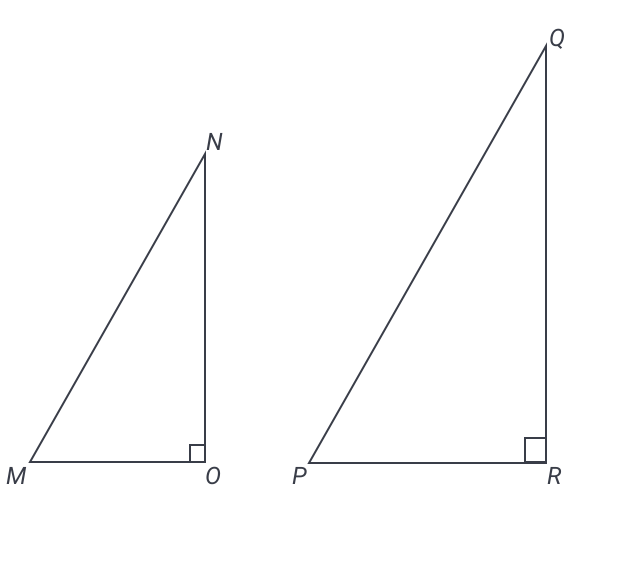
Draw, draw, draw! It is crucial to draw these figures so you can visualize them. (If, with practice, you find you see the figures in your head and answer more quickly, fine, but we heartily recommend you begin by drawing until you’re extremely comfortable.) Your drawing of the two similar triangles should look something like this:
A couple of things to note about making this diagram: 1) we have made triangle larger than triangle , but it’s just as possible that it’s the other way around. The key is to recognize the triangles as similar and therefore having all the same angles and proportions. 2) We haven’t yet labeled the sides in triangle , and that’s by design. Using SOHCAHTOA to understand the tangent information, you could label side as and side as , but there’s a possibility of misleading yourself in that process.
Here is a crucial point, also noted in our Strategy Insights for this lesson: trig ratios from SOHCAHTOA are just that: ratios. They are not fixed values. Sides and might well be and , respectively, but they could just as well be and or and . It doesn’t matter; the only thing that matters is the ratio. And because similar triangles have identical proportions among their corresponding sides, we can transfer that ratio directly to triangle . In fact, it makes more sense to label this triangle with and so we can think about the third side (as long as we continue to keep in mind that this is a ratio). So let’s label side as and side as , in keeping with SOHCAHTOA. What does that mean for the hypotenuse? You can use the Pythagorean theorem, but it’s even better if you remember your triples: is a common right triangle ratio. In ratio terms, the hypotenuse must be .
We’re now to use SOHCAHTOA once again to get our final answer. The middle part of the acronym, COH, reminds us that . (The side adjacent to the angle must be one of the legs of the triangle; the side considered “adjacent” cannot be the hypotenuse.) Being careful to orient ourselves from angle , not angle , we look at adjacent, then hypotenuse, getting a ratio of . The answer is C.
One note for wrong answer elimination: because a right triangle’s leg can never be longer than its hypotenuse, sine and cosine can never be larger than 1. If you are asked about sine or cosine, you can always eliminate an answer like .
Topics for Cross-Reference
Variations
It is theoretically possible that the SAT will include a right triangle trigonometry question that asks you to find one of the reciprocal trig ratios: cosecant, secant, or cotangent. There is no evidence in the SAT’s released practice materials that this is the case, but if you want to cover all your bases, memorize the following:
cosecant:
secant:
cotangent:
Flashcard Fodder
- SOHCAHTOA, which means that within a right triangle,
The sine of an angle =
The cosine of an angle =
The tangent of an angle =
-
The hypotenuse is the longest side, opposite the right angle.
-
The opposite is the leg facing the acute angle in question.
-
The adjacent is the leg next to the acute angle in question.
-
An important trigonometric identity that shows up on hard SAT questions: sine and cosine are complementary. What this means in formula terms is: and . In other words, if two angles add up to in measure, the sine of one equals the cosine of the other, and vice versa. This is always true, whether the angles are part of a “special” right triangle or not. For example, , and .
Sample Questions
Difficulty 1
In right triangle , the length of side ; side ; and side . What is the value of ?
A.
B.
C.
D.
The answer is . As always, draw the triangle. If you remember that the hypotenuse (longest side) of the triangle must be across from the right angle, that will help you draw the figure more quickly. Alternatively, you can note that side must be across from angle , and “across” is precisely what we are seeking to find sine (opposite/hypotenuse). Whether you reason this way or use the diagram, the opposite is and the hypotenuse must be . reduces to when you divide by two.
One final note: it’s always worth noting Pythagorean triples when they appear, and we have one here: is one of the less common triples, but a good one to know nevertheless!
Difficulty 2
In triangle , angle and angle . What is the value of ?
The answer is . The key to this question is recognizing the special right triangle implied by the angles given. Angle must be the right angle, so we know that angle is the smallest angle. This means (as shown in our lesson on triangles) that it must be across from the smallest side. As shown in the SAT reference list (though ideally also solidly memorized by you!), the smallest side is represented by the in the ratio. This means that the ratio of the opposite in this case (smallest side) to the adjacent (middle side) is . Since opposite/adjacent is what we need for tangent, we are close to our answer.
What remains to be done? The rules of algebra tell us that a radical (in this case, a square root) in the denominator is not considered simplified, so we need to rationalize the denominator by multiplying both top and bottom of the fraction by that denominator. That gives us the following:
x =
Difficulty 3
Triangle corresponds to triangle , where angle corresponds to angle and angles and are right angles. If , what is the value of ?
A.
B.
C.
D.
The answer is . This problem is simpler than it might first appear. Remember that the cosine (as well as the sine and the tangent) of an angle is always the same if the angle is the same measure. For example, the sine of is always , even if we’re talking about two different angles in two different triangles. So if two angles correspond, they must have all the same trigonometric ratios (sine, cosine, and tangent), because they have, by definition, the same measure. This means that the only question we need to answer here is, Do angles and correspond? According to the definition given at the beginning of the problem and the SAT’s consistent use of alphabetical order to denote corresponding angles, we know that they do. So the cosine of one angle must be the same as the others.
It’s worth briefly addressing the wrong answers here. The answer of could be a trap if you do the hard work of the Pythagorean theorem on your calculator. There is actually a very large Pythagorean triple at play here: the values , , and work in the Pythagorean theorem. So is a valid ratio for this triangle, but it is the sine, not the cosine.
The two answers in which the numerator is larger than the denominator can be ruled out based on the general rule that sine and cosine can never be greater than . This is because the leg of a triangle can never be larger than the hypotenuse. Of the three major trig ratios, only tangent can be greater than one, so these two answer choices are only possible if we are looking for tangent.
Difficulty 4
In triangle , and is a right angle. What is the value of ? (Note: this is a free-response question.)
The answer is . The key to understanding this problem is realizing that the two values in the sine ratio give you, effectively, two of the three parts needed for the Pythagorean theorem, and you can solve for them. Remember: trig ratios are ratios only; we do NOT know that two sides of the triangle are exactly and . But because we know they exist in a ratio of , we can “pretend” those are the actual values as we seek to calculate a different trig ratio in the same triangle.
If one of the legs, therefore, is for our purposes, and the hypotenuse is (remember that , so we know is the hypotenuse), we can use the Pythagorean theorem (, given in the SAT reference list) to solve for the third side. Doing so reveals that we actually have an unusual Pythagorean triple here: one in the ratio of .
How do we know the value of ? If the answer doesn’t present itself to you, take a moment to sketch a right triangle in which the right angle is angle . The sine of already given means that side must be , while we know that hypotenuse is . That leaves side which, by process of elimination, must be . So, from the point of view of angle , is the opposite. This means that .
Difficulty 5
In triangle , the sum of angles and is degrees. The value of is . What is the value of ?
A.
B.
C.
D.
The answer is . Even the hardest right triangle trig questions on the SAT can sometimes be solved simply if you know the important trig identity. If you weren’t sure what identity to apply in this case, go back and review the complementary relationship of sine and cosine described under Flashcard Fodder. It makes things surprisingly simple! Whenever the two acute angles in a right triangle, we know that the sine of one equals the cosine of the other, and vice versa. The right answer here must be identical to the sine already given!
The wrong answer choices largely come from other trigonometric ratios in this particular triangle. If you were to use the Pythagorean theorem to discover that the third side of this triangle has a length of , you would see that is the tangent of angle H. , meanwhile, it the sine of H. is the cotangent, in case you’re curious, but cotangent rarely to never pops up on the SAT. In any case, you don’t need to worry about any of these wrong answers if you simply apply the trig identity concerning the complementary relationship of sine and cosine.