



Properties of whole numbers
Factors
Factors tell you which smaller whole numbers multiply to make a larger number. Factors matter any time you simplify fractions, compare ratios, or break a number into primes. When you find factors, you’re uncovering the “parts” a number can be split into.
Factors come in pairs whose product equals the original number. Once you’ve checked all possible factors up to the square root, you’ve automatically found the larger factors as the matching partners.
Divisibility rules
Divisibility rules let you check whether one number divides another without doing long division. They’re based on digit patterns, so they’re fast and help reduce arithmetic mistakes.
Useful rules
- Divisible by 2: Last digit is
- Divisible by 3: Sum of digits divisible by
- Divisible by 4: Last two digits form a number divisible by
- Divisible by 5: Last digit is or
- Divisible by 6: Divisible by both and
- Divisible by 8: Last three digits form a number divisible by
- Divisible by 9: Sum of digits divisible by
- Divisible by 10: Last digit is
These rules are especially useful when you’re simplifying fractions or breaking numbers into prime factors.
Remainders
When a number doesn’t divide evenly, the amount left over is the remainder: remainder , because . So a number that leaves remainder when divided by is more than a multiple of .
Example: two conditions at once
A number of marbles splits evenly into bags of , but bagging them by leaves over. Could there be , , or marbles?
- All three are multiples of , so check the remainder when each is divided by .
- leaves ; leaves ; leaves .
Answer:
Using divisibility to find factors
Divisibility rules give you a systematic way to factor numbers: test small primes, divide, and keep going until what’s left is prime.
Example: find factors of
We start with small prime numbers. Because is even, it is divisible by .
- - this shows that and are a factor pair of .
- - dividing again by shows that .
At this point, is no longer divisible by , so we switch to the next smallest prime, .
This confirms that . Combining all the prime factors used gives the prime factorization:
To list all factors, find every pair that multiplies to : , , , , .
Answer: Factors:
Prime factorization shows the “building blocks” of a number, but it doesn’t automatically list every factor. To list all factors, you still have to combine the prime factors in all possible ways. That’s why a number with a short prime factorization can still have many total factors.
Factor trees
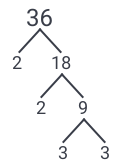
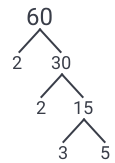
Factor trees give you a visual way to break a number into primes. Each branch splits a number into smaller factors until only prime numbers remain.
Example: factor tree for
Prime factorization:
Example: factor tree for
Prime factorization:
Common factors, GCF, and GCD
Common factors are factors shared by two or more numbers. The greatest common factor (GCF) is the largest shared factor, which is why it’s so useful for simplifying fractions and reducing ratios. The term greatest common divisor (GCD) means the same thing as GCF - “factor” and “divisor” are two names for a number that divides another number evenly.
A reliable method for finding the GCF or GCD:
- Write prime factorizations of each number.
- Identify the primes they have in common.
- Use the smallest exponent of each shared prime.
- Multiply these together.
Example: GCF of and
- Shared lowest powers:
Answer:
Multiples and the least common multiple (LCM)
Multiples “expand outward” from a number by repeated multiplication. The LCM is the smallest number that both values divide into evenly.
Factors and multiples work in opposite directions: the factors of are - they all divide in evenly and are . The multiples of are - they are built by multiplying out and are all . A factor divides in; a multiple is built out.
Example: LCM of and
- LCM uses highest powers:
Answer:
Even and odd numbers
Even and odd numbers describe parity, which shows up in patterns, divisibility, and algebra.
- Even: divisible by ; form
- Odd: not divisible by ; form
These definitions explain many common patterns. For example, adding two odd numbers always gives an even result, and multiplying an even number by any whole number always gives an even product.
Prime numbers
Prime numbers are the basic “atoms” of number theory. Every whole number greater than is either prime or composite.
Testing for primality
To test whether a number is prime, check divisibility using primes up to .
So checking primes up to is enough to confirm whether a number is prime.
Example: is prime?
- , so we only need to test primes up to : that’s , , and .
- is odd, so it’s not divisible by .
- Digit sum: , which is not divisible by .
- doesn’t end in or , so it’s not divisible by .
- No prime up to divides .
Answer: is prime
Sequences
A sequence is a list of numbers in a set order, and each number is a term. Write for the first term and for the term in position . A recursive rule says how to get the next term, , from the one before it.
To tell which you have, check the differences, then the ratios. In every difference is , so . In the differences change, but every ratio is , so .
To reach a far-off term without listing every one, count the steps: the th term is steps past the first.
Example: finding a later term
(a) An arithmetic sequence begins . What is the th term?
(b) A sequence begins . What is the th term?
- (a) , and the th term is steps past the first: .
- (b) Each term is the one before times , so the signs alternate: .
Answer: (a) ; (b)
Some rules use more than one earlier term, such as “each term is the sum of the two before it.” Apply the rule one term at a time and stop at the term the question asks for. A rule also runs backward: if each term is the sum of the three before it, then in the last term gives , so .
Example: a rule that uses two earlier terms
Each term after the first two is the sum of the two before it: . Find .
Answer: