


This browser is too old to run Achievable.

Update it, or open this page in a current version of Chrome, Safari, Firefox or Edge. On an iPhone or iPad, update iOS: every browser there runs on the version of Safari that comes with it.

Achievable logoAchievable logo
Health
Sign in
Sign up
Purchase
Textbook
Practice exams
Support
How it works
Resources
Exam catalog
Mountain with a flag at the peak
Textbook
1. General Insurance Concepts
2. Producer Roles and Receipt Types
3. Underwriting
4. Health Insurance Basics
5. Required Policy Provisions
6. Optional Policy Provisions
7. Medical Expense Insurance
8. Group Health Insurance
9. The Affordable Care Act (ACA)
10. Disability Income Insurance
11. Accidental Death and Dismemberment Insurance
12. Long Term Care Insurance
13. Dental Insurance
14. Section 125 Plans and Limited Policies
15. Federal Government Programs
16. Medigap and Medicaid
17. Health Insurance Taxation
Wrapping up
Achievable logoAchievable logo
6. Optional Policy Provisions
Achievable Health

Optional Policy Provisions

11 min read
Font
Discuss
Share
Feedback

Optional provisions, as the name suggests, may be included in or excluded from a policy at the insurer’s discretion. The 11 optional policy provisions are as follows:

Change of occupation

  • If the insured changes to a more hazardous job, benefits may be reduced: on a claim, the insurer pays only the benefits that the premium paid would have purchased at its rate for the more hazardous job. If the insured changes to a less hazardous job, premiums may be reduced: once it receives proof of the change, the insurer lowers the premium rate and returns the excess unearned premium.

Misstatement of age

  • Benefits will be adjusted to reflect what the premiums would have purchased if the insured’s correct age had been stated on the application.

Other insurance with the same insurer

  • If the insured has more than one policy of the same kind with the same insurer, coverage is limited either to a maximum amount the policy states, with any insurance over it void, or to the one policy the insured (or the beneficiary or estate) chooses. The insurer returns the premiums paid for the excess coverage or for the other policies.

Expense insurance with other insurers

  • Applies when the insured has expense-type policies (such as hospital or surgical coverage) with more than one company. An insurer that was not given written notice of the other coverage before the loss pays only its proportionate share of the loss, and returns the premium paid for the excess. Some states provide instead for an overinsurance (or coordination of benefits) provision, which reduces the insurer’s payment so that benefits from all valid coverage do not exceed the insured’s allowable expenses.

Income insurance with other insurers

  • Applies when the insured has coverage that pays a fixed benefit, such as disability income, with more than one company. An insurer that was not given written notice of the other coverage before the loss pays only its proportionate share of the benefits, and returns the premium paid for the excess.

Relation of earnings to insurance

  • Ensures disability income benefits do not exceed the insured’s actual earned income, reinforcing the principle of indemnity.

Unpaid premiums

  • Allows the insurer to deduct any premium due but unpaid from the amount of a claim. This often applies if a claim occurs during the grace period.

Cancellation

  • Allows the insurer to cancel the policy with proper notice and requires any unearned premium to be refunded to the policyowner.

Conformity with state statutes

  • Any policy provision that conflicts with state law is automatically amended to conform with the statutes of the state where the insured resides.

Illegal occupation

  • No coverage is provided if a claim arises from the insured committing a felony or engaging in an illegal occupation.

Intoxicants and narcotics

  • The insurer is not liable for a loss that results from the insured’s being intoxicated or under the influence of a narcotic, unless the narcotic was taken on a physician’s advice. The provision applies when the intoxication or the narcotic caused the loss, not merely because the insured was intoxicated when a loss occurred.
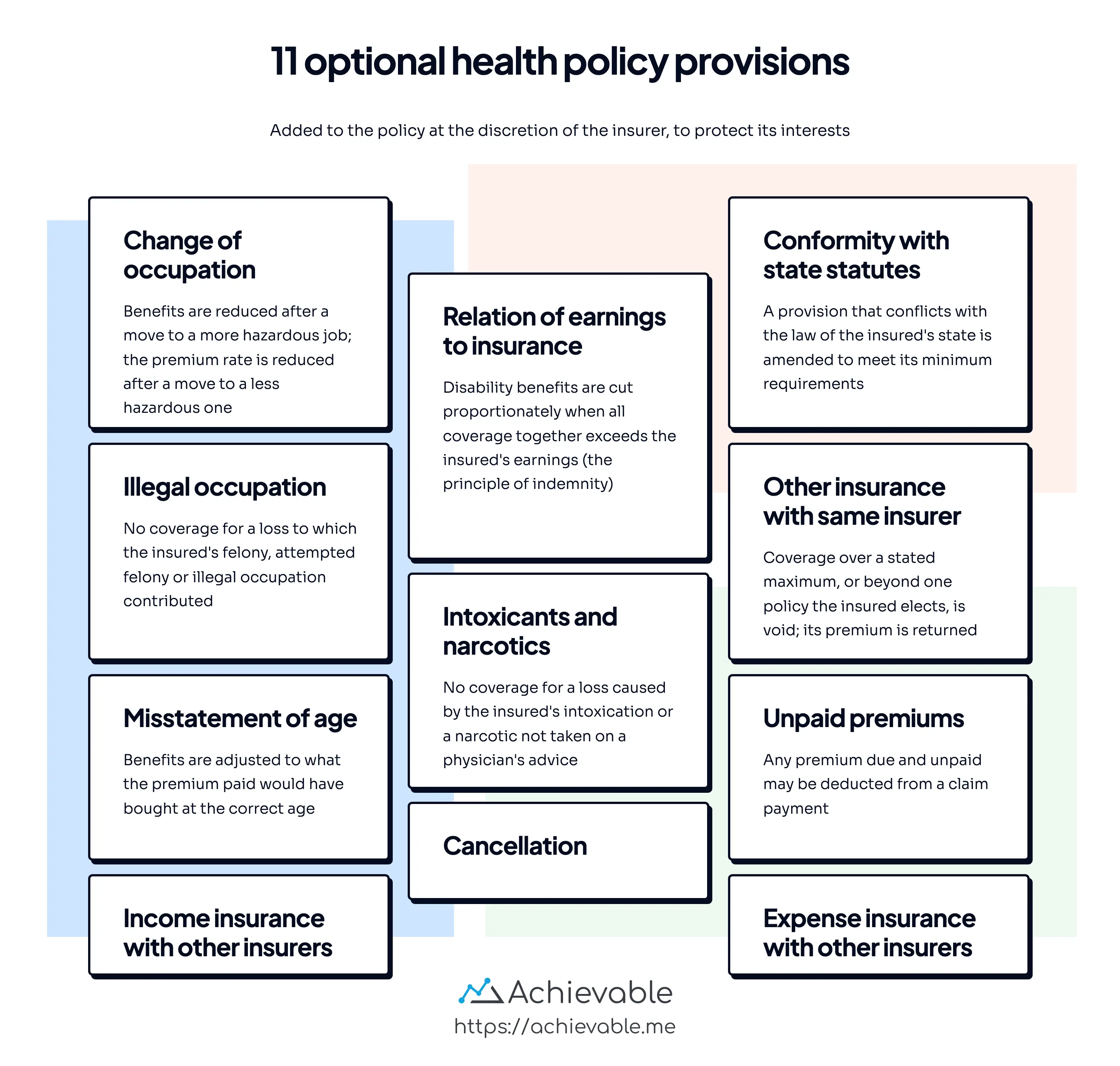
Eleven optional health policy provisions

Other general provisions

Free look (right to examine)

  • Under this provision, the insured may return the policy to the agent or the insurer within 10 days of delivery (30 days for LTC and Medigap policies) and receive a full refund of premiums paid.

Insuring clause

  • This provision is customarily found on the first page of the policy. It defines the benefits and policy periods and states the insurer’s promise to pay benefits if coverage is provided by the policy and all conditions are satisfied.

Consideration clause

  • This provision spells out the amount and frequency of premium payments and the representations made by the applicant, as well as the insurer’s obligation to pay the benefits.

Assignment of benefits provision

  • This provision defines how benefits may be paid in the event of a covered loss. In many health reimbursement policies, the beneficiary prefers that the insurer pay the doctor or hospital directly. If the provider will accept an assignment of benefits, the insurer will pay the provider directly in the name of the insured.

Waiver of premium

  • Disability income policies usually include this option, which exempts the insured from paying premiums if totally and permanently disabled. Other types of policies may also make this option available for an additional premium.

Lesson summary

In an insurance policy, optional provisions may be included or excluded at the discretion of the insurer.

Optional policy provisions:

  • Change of occupation: Benefits or premiums may be adjusted if the insured changes to a job with a different risk level.
  • Misstatement of age: Benefits are adjusted to what the correct age and premium would have purchased.
  • Other insurance with the same insurer: Prevents double recovery if the insured has more than one policy with the same company.
  • Expense insurance with other insurers: An insurer not told of other medical expense coverage pays only its proportionate share.
  • Income insurance with other insurers: An insurer not told of other fixed-benefit coverage, such as disability income, pays only its proportionate share.
  • Relation of earnings to insurance: Disability benefits cannot exceed the insured’s actual earned income.
  • Unpaid premiums: Any unpaid premium may be deducted from a claim payment.
  • Cancellation: Insurer may cancel with proper notice and must refund any unearned premium.
  • Conformity with state statutes: Policy automatically amends to meet state insurance laws.
  • Illegal occupation: No coverage for a loss to which the insured’s committing or attempting to commit a felony, or engaging in an illegal occupation, was a contributing cause.
  • Intoxicants and narcotics: No coverage for a loss caused by the insured’s being intoxicated or under the influence of a narcotic not taken on a physician’s advice.

Chapter vocabulary

Definitions
Cancellable Policy
A policy that may be terminated either by the insured or the insurance company by notification to the other party in accordance with the terms of the policy.
Cancellation
Short rate cancellation is utilized when an insured decides to cancel an insurance contract, and pro-rata is used when an insurer cancels the contract.
Coordination of Benefits (COB)
The method of determining which company pays as primary insurer and which company pays as secondary or excess insurer when a working couple or their dependents have a claim covered by more than one insurance contract.
Free-Look Period
A period of time during which the purchaser of an insurance policy or annuity can cancel the contract with no penalty. The number of days varies by product.
Guaranteed Renewable
The option of renewal to a specified age, or for a lifetime, vested solely in the insured. However, the insurance company has the right to increase the premiums applicable to an entire class of policyholders.
Insuring Clause
The policy provision, usually found on the first page, that defines the scope of coverage and contains the insurer’s promise to pay benefits if the covered loss occurs.
Noncancellable
A policy that an insurance company is not permitted to terminate or amend during its term (except for non-payment of a premium).
Optionally Renewable
Policies that are renewable at the option of the insurance company.
Other Insurance Clause
A provision found in many life and health insurance policies, stating the disposition of claims when any other insurance contract covers the same events as the policy in which the provision is contained.
Pro-rata Cancellation
When a policy is canceled midterm, unearned premiums must be refunded to the policy owner. A pro-rata refund is due if the insurer cancels.
Pro-rata (proportional) Reinsurance
Portion of the losses and premium reinsurer shares with the ceding entity.
Reduction of Benefits
Automatic reduction in coverage under certain specified conditions (i.e., after the insured has reached age 60).
Relation of Earnings to Insurance
A provision in the policy that permits the insurance company to reduce the monthly income disability benefits payable if the insured’s total income from benefits exceeds the greater of his/her current monthly earnings and his/her average monthly earnings during the 2 year period immediately preceding the disability.
Unearned Premium
Amount of premium for which payment has been made by the policyholder but coverage has not yet been provided.

Optional Policy Provisions

  • Change of occupation: adjust benefits/premiums for job risk changes
  • Misstatement of age: benefits reflect correct age/premium
  • Other insurance with same insurer: coverage over a stated maximum, or beyond one elected policy, is void; its premium is refunded
  • Expense insurance with other insurers: an insurer not told of the other coverage before the loss pays only its proportionate share (some states use an overinsurance/COB provision instead)
  • Income insurance with other insurers: an insurer not told of other fixed-benefit coverage (e.g., disability income) before the loss pays only its proportionate share
  • Relation of earnings to insurance: disability benefits limited to earned income
  • Unpaid premiums: insurer may deduct unpaid premiums from claims
  • Cancellation: insurer may cancel with notice, refund unearned premium
  • Conformity with state statutes: policy amends to meet state law
  • Illegal occupation: no coverage for a loss to which committing or attempting a felony, or engaging in an illegal occupation, was a contributing cause
  • Intoxicants and narcotics: no coverage for a loss caused by the insured’s intoxication or by a narcotic not taken on a physician’s advice

Other General Provisions

  • Free look (right to examine): 10–30 days to return policy for full refund
  • Insuring clause: defines benefits, policy period, insurer’s promise to pay
  • Consideration clause: outlines premium payments and applicant’s representations
  • Assignment of benefits: allows direct payment to providers if assigned
  • Waiver of premium: exempts premium if insured is totally/permanently disabled

Chapter Vocabulary

  • Cancellable policy: can be terminated by insurer or insured per policy terms
  • Cancellation: short rate (insured cancels), pro-rata (insurer cancels)
  • Coordination of Benefits (COB): determines primary/secondary insurer for overlapping coverage
  • Free-look period: time to cancel policy without penalty
  • Guaranteed renewable: insured can renew, insurer may raise class premiums
  • Insuring clause: defines coverage scope and insurer’s promise
  • Noncancellable: insurer cannot terminate/amend except for non-payment
  • Optionally renewable: insurer chooses whether to renew
  • Other insurance clause: addresses claims with overlapping coverage
  • Pro-rata cancellation: refund of unearned premium if insurer cancels
  • Pro-rata reinsurance: reinsurer shares losses/premiums proportionally
  • Reduction of benefits: automatic coverage reduction under certain conditions
  • Relation of earnings to insurance: benefits reduced when all coverage exceeds the greater of current or 2-year average earnings
  • Unearned premium: prepaid premium for unused coverage period

Sign up for free to take 25 quiz questions on this topic

Previous
Next  | 7.1 Classes of Coverage
All rights reserved ©2016 - 2026 Achievable, Inc.

Optional Policy Provisions

Optional provisions, as the name suggests, may be included in or excluded from a policy at the insurer’s discretion. The 11 optional policy provisions are as follows:

Change of occupation

  • If the insured changes to a more hazardous job, benefits may be reduced: on a claim, the insurer pays only the benefits that the premium paid would have purchased at its rate for the more hazardous job. If the insured changes to a less hazardous job, premiums may be reduced: once it receives proof of the change, the insurer lowers the premium rate and returns the excess unearned premium.

Misstatement of age

  • Benefits will be adjusted to reflect what the premiums would have purchased if the insured’s correct age had been stated on the application.

Other insurance with the same insurer

  • If the insured has more than one policy of the same kind with the same insurer, coverage is limited either to a maximum amount the policy states, with any insurance over it void, or to the one policy the insured (or the beneficiary or estate) chooses. The insurer returns the premiums paid for the excess coverage or for the other policies.

Expense insurance with other insurers

  • Applies when the insured has expense-type policies (such as hospital or surgical coverage) with more than one company. An insurer that was not given written notice of the other coverage before the loss pays only its proportionate share of the loss, and returns the premium paid for the excess. Some states provide instead for an overinsurance (or coordination of benefits) provision, which reduces the insurer’s payment so that benefits from all valid coverage do not exceed the insured’s allowable expenses.

Income insurance with other insurers

  • Applies when the insured has coverage that pays a fixed benefit, such as disability income, with more than one company. An insurer that was not given written notice of the other coverage before the loss pays only its proportionate share of the benefits, and returns the premium paid for the excess.

Relation of earnings to insurance

  • Ensures disability income benefits do not exceed the insured’s actual earned income, reinforcing the principle of indemnity.

Unpaid premiums

  • Allows the insurer to deduct any premium due but unpaid from the amount of a claim. This often applies if a claim occurs during the grace period.

Cancellation

  • Allows the insurer to cancel the policy with proper notice and requires any unearned premium to be refunded to the policyowner.

Conformity with state statutes

  • Any policy provision that conflicts with state law is automatically amended to conform with the statutes of the state where the insured resides.

Illegal occupation

  • No coverage is provided if a claim arises from the insured committing a felony or engaging in an illegal occupation.

Intoxicants and narcotics

  • The insurer is not liable for a loss that results from the insured’s being intoxicated or under the influence of a narcotic, unless the narcotic was taken on a physician’s advice. The provision applies when the intoxication or the narcotic caused the loss, not merely because the insured was intoxicated when a loss occurred.

Eleven optional health policy provisions

Other general provisions

Free look (right to examine)

  • Under this provision, the insured may return the policy to the agent or the insurer within 10 days of delivery (30 days for LTC and Medigap policies) and receive a full refund of premiums paid.

Insuring clause

  • This provision is customarily found on the first page of the policy. It defines the benefits and policy periods and states the insurer’s promise to pay benefits if coverage is provided by the policy and all conditions are satisfied.

Consideration clause

  • This provision spells out the amount and frequency of premium payments and the representations made by the applicant, as well as the insurer’s obligation to pay the benefits.

Assignment of benefits provision

  • This provision defines how benefits may be paid in the event of a covered loss. In many health reimbursement policies, the beneficiary prefers that the insurer pay the doctor or hospital directly. If the provider will accept an assignment of benefits, the insurer will pay the provider directly in the name of the insured.

Waiver of premium

  • Disability income policies usually include this option, which exempts the insured from paying premiums if totally and permanently disabled. Other types of policies may also make this option available for an additional premium.

Lesson summary

In an insurance policy, optional provisions may be included or excluded at the discretion of the insurer.

Optional policy provisions:

  • Change of occupation: Benefits or premiums may be adjusted if the insured changes to a job with a different risk level.
  • Misstatement of age: Benefits are adjusted to what the correct age and premium would have purchased.
  • Other insurance with the same insurer: Prevents double recovery if the insured has more than one policy with the same company.
  • Expense insurance with other insurers: An insurer not told of other medical expense coverage pays only its proportionate share.
  • Income insurance with other insurers: An insurer not told of other fixed-benefit coverage, such as disability income, pays only its proportionate share.
  • Relation of earnings to insurance: Disability benefits cannot exceed the insured’s actual earned income.
  • Unpaid premiums: Any unpaid premium may be deducted from a claim payment.
  • Cancellation: Insurer may cancel with proper notice and must refund any unearned premium.
  • Conformity with state statutes: Policy automatically amends to meet state insurance laws.
  • Illegal occupation: No coverage for a loss to which the insured’s committing or attempting to commit a felony, or engaging in an illegal occupation, was a contributing cause.
  • Intoxicants and narcotics: No coverage for a loss caused by the insured’s being intoxicated or under the influence of a narcotic not taken on a physician’s advice.

Chapter vocabulary

Definitions
Cancellable Policy
A policy that may be terminated either by the insured or the insurance company by notification to the other party in accordance with the terms of the policy.
Cancellation
Short rate cancellation is utilized when an insured decides to cancel an insurance contract, and pro-rata is used when an insurer cancels the contract.
Coordination of Benefits (COB)
The method of determining which company pays as primary insurer and which company pays as secondary or excess insurer when a working couple or their dependents have a claim covered by more than one insurance contract.
Free-Look Period
A period of time during which the purchaser of an insurance policy or annuity can cancel the contract with no penalty. The number of days varies by product.
Guaranteed Renewable
The option of renewal to a specified age, or for a lifetime, vested solely in the insured. However, the insurance company has the right to increase the premiums applicable to an entire class of policyholders.
Insuring Clause
The policy provision, usually found on the first page, that defines the scope of coverage and contains the insurer’s promise to pay benefits if the covered loss occurs.
Noncancellable
A policy that an insurance company is not permitted to terminate or amend during its term (except for non-payment of a premium).
Optionally Renewable
Policies that are renewable at the option of the insurance company.
Other Insurance Clause
A provision found in many life and health insurance policies, stating the disposition of claims when any other insurance contract covers the same events as the policy in which the provision is contained.
Pro-rata Cancellation
When a policy is canceled midterm, unearned premiums must be refunded to the policy owner. A pro-rata refund is due if the insurer cancels.
Pro-rata (proportional) Reinsurance
Portion of the losses and premium reinsurer shares with the ceding entity.
Reduction of Benefits
Automatic reduction in coverage under certain specified conditions (i.e., after the insured has reached age 60).
Relation of Earnings to Insurance
A provision in the policy that permits the insurance company to reduce the monthly income disability benefits payable if the insured’s total income from benefits exceeds the greater of his/her current monthly earnings and his/her average monthly earnings during the 2 year period immediately preceding the disability.
Unearned Premium
Amount of premium for which payment has been made by the policyholder but coverage has not yet been provided.
Key points

Optional Policy Provisions

  • Change of occupation: adjust benefits/premiums for job risk changes
  • Misstatement of age: benefits reflect correct age/premium
  • Other insurance with same insurer: coverage over a stated maximum, or beyond one elected policy, is void; its premium is refunded
  • Expense insurance with other insurers: an insurer not told of the other coverage before the loss pays only its proportionate share (some states use an overinsurance/COB provision instead)
  • Income insurance with other insurers: an insurer not told of other fixed-benefit coverage (e.g., disability income) before the loss pays only its proportionate share
  • Relation of earnings to insurance: disability benefits limited to earned income
  • Unpaid premiums: insurer may deduct unpaid premiums from claims
  • Cancellation: insurer may cancel with notice, refund unearned premium
  • Conformity with state statutes: policy amends to meet state law
  • Illegal occupation: no coverage for a loss to which committing or attempting a felony, or engaging in an illegal occupation, was a contributing cause
  • Intoxicants and narcotics: no coverage for a loss caused by the insured’s intoxication or by a narcotic not taken on a physician’s advice

Other General Provisions

  • Free look (right to examine): 10–30 days to return policy for full refund
  • Insuring clause: defines benefits, policy period, insurer’s promise to pay
  • Consideration clause: outlines premium payments and applicant’s representations
  • Assignment of benefits: allows direct payment to providers if assigned
  • Waiver of premium: exempts premium if insured is totally/permanently disabled

Chapter Vocabulary

  • Cancellable policy: can be terminated by insurer or insured per policy terms
  • Cancellation: short rate (insured cancels), pro-rata (insurer cancels)
  • Coordination of Benefits (COB): determines primary/secondary insurer for overlapping coverage
  • Free-look period: time to cancel policy without penalty
  • Guaranteed renewable: insured can renew, insurer may raise class premiums
  • Insuring clause: defines coverage scope and insurer’s promise
  • Noncancellable: insurer cannot terminate/amend except for non-payment
  • Optionally renewable: insurer chooses whether to renew
  • Other insurance clause: addresses claims with overlapping coverage
  • Pro-rata cancellation: refund of unearned premium if insurer cancels
  • Pro-rata reinsurance: reinsurer shares losses/premiums proportionally
  • Reduction of benefits: automatic coverage reduction under certain conditions
  • Relation of earnings to insurance: benefits reduced when all coverage exceeds the greater of current or 2-year average earnings
  • Unearned premium: prepaid premium for unused coverage period

Related readings

  • Producer Roles and Receipt Types
  • Underwriting
  • Health Insurance Basics
  • Required Policy Provisions
  • The Affordable Care Act (ACA)