



Classes of Coverage
Medical expense insurance is offered through commercial insurers and is commonly grouped into three basic classes of coverage:
- Basic medical expense
- Major medical
- Comprehensive
Basic medical expense insurance
The original (and still very common) form of health insurance is basic medical expense insurance. It’s also called first dollar coverage because it can pay a medical claim starting with the first dollar of covered expense, up to the policy’s maximum benefit.
Basic medical expense policies are typically divided into three types:
- Hospitalization room and board
- Miscellaneous expense
- Surgical expense
Hospitalization room and board
These policies provide benefits on a reimbursement basis, paying actual hospital expenses. They commonly cover care in a semi-private room, up to:
- a stated dollar maximum, and
- a maximum number of days
Miscellaneous expenses
These policies cover many of the additional charges associated with a hospital stay. Covered items can include operating room charges, physician’s fees, medicine, diagnostic lab tests, x-rays, and ambulance service charges.
The benefit amount is commonly expressed as either:
- a stated dollar amount, or
- a multiple of the hospitalization room and board benefit
Surgical expense
These policies pay surgical expenses for treatment received in a hospital or on an outpatient basis. Most basic medical plans base benefits on a schedule of operations, which lists how much will be reimbursed for each type of procedure.
Historically, an insured might own one, two, or all three of these basic coverages. Together, they were commonly called the base plan. These coverages are still available today, but their low maximum benefits are often inadequate for catastrophic events. To meet the need for higher limits, insurers developed major medical plans.
Major medical
As the name suggests, major medical provides coverage for major medical expenses. These policies typically have maximum benefits of several million dollars, and they cover a broad range of expenses.
Major medical plans are also characterized by:
- a deductible (the amount the insured must pay before the plan pays benefits), and
- co-insurance (the insured shares in the cost of covered treatment)
Deductibles can range from $50 to several thousand dollars, depending on the insured’s preference. In general, the higher the deductible, the lower the premium.
A deductible may apply on either:
- a calendar year basis, or
- a per medical occurrence basis
The calendar year basis is more common. Under this method, one deductible applies to any and all medical expenses incurred during that calendar year.
Many plans also offer a family deductible. For example, a plan might state that a $100 deductible applies to any one family member, but the total deductible for the entire family will not exceed $250, regardless of how many family members receive treatment.
Another cost-sharing feature is co-insurance. For covered expenses above the deductible, a major medical plan will generally pay 80%, leaving the policyowner responsible for the remaining 20%. To protect insureds from very large out-of-pocket costs, many plans include a stop-loss feature.
Stop-loss (also called “max out of pocket”) caps the amount of expenses subject to the co-insurance requirement. Once the insured’s out-of-pocket expenses reach the specified stop-loss amount, covered expenses above that cap are paid by the insurer at 100%.
Underwriting is also standard for major medical policies. Applicants may be required to provide health information, and coverage may be issued on a standard or adjusted basis depending on the insurer’s risk assessment.
Comprehensive major medical
As the industry evolved, the three policies that made up the traditional base plan - hospital, surgical, and regular medical expense - were often paired with a supplemental major medical policy to broaden coverage.
In that arrangement:
- The basic medical expense plan provided first-dollar coverage up to a specified limit, with no deductible.
- After the basic benefits were exhausted, the insured paid a corridor deductible.
- After the corridor deductible was satisfied, the supplemental major medical coverage began.
For example, if the base plan paid up to $50,000 and the corridor deductible was $1,000, the insured would pay the next $1,000 out of pocket before major medical benefits began.
Over time, these separate components were combined into a single policy called comprehensive major medical. This type of policy typically uses one overall deductible from the start, without a separate base layer or corridor deductible.
Service providers
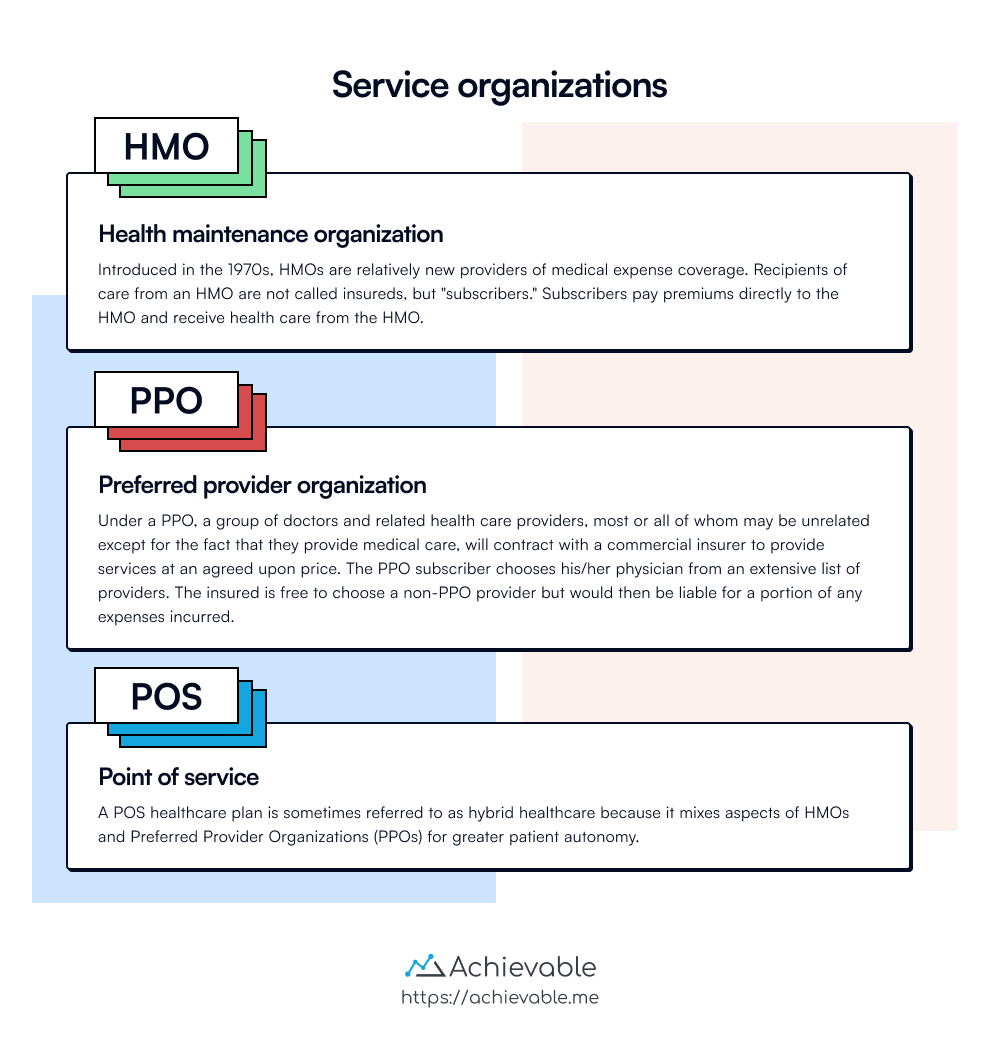
Introduced in the 1970s, Health Maintenance Organizations (HMOs) are relatively new providers of medical expense coverage. People who receive care through an HMO are not called “insureds,” but subscribers. Subscribers pay premiums directly to the HMO and receive health care from the HMO. HMO premiums represent a prepayment of services, and HMOs do not operate on a reimbursement basis.
A key emphasis of an HMO is preventive health care. As a result, an HMO may cover care that is not usually covered under commercial policies. A common example is an annual physical examination.
HMOs also attempt to curb medical costs by preventing illness or detecting it early. Examples include:
- immunizations for children
- prenatal care
- mammograms
- blood pressure tests
- cholesterol screening
Managing ongoing conditions (such as asthma, diabetes, or high blood pressure) can also help prevent medical crises and emergency hospitalization. This is another way preventive care can reduce costs.
HMO subscribers are generally required to obtain treatment from the HMO or from a provider approved by (contracted with) the HMO. This is a key distinguishing feature of an HMO.
To contract with an HMO, a provider negotiates a capitation arrangement. Capitation means the provider is paid a set fee per HMO subscriber served, regardless of how much treatment the subscriber requires. In exchange, the physician agrees to provide a specific range of medical services to a specific number of subscribers.
To ensure subscribers use HMO providers, the system typically requires that (except for emergencies) the subscriber first see a primary care provider, also called a gatekeeper. The gatekeeper either provides the needed care or refers the subscriber to a contracted specialist.
Preferred provider organizations (PPOs)
A common criticism of HMOs is that subscribers must obtain treatment directly from the HMO (or a contracted provider), which limits the subscriber’s control over physician selection. Preferred Provider Organizations (PPOs) were developed largely in response to this concern.
Under a PPO, a group of doctors and related health care providers - most or all of whom may be unrelated except for providing medical care - contracts with a commercial insurer to provide services at an agreed-upon price.
A PPO subscriber chooses a physician from an extensive list of providers. The insured may choose a non-PPO provider, but would then be responsible for a portion of the expenses incurred.
Point-of-service (POS) plans
A Point-of-Service (POS) plan is a type of managed healthcare arrangement that combines features of both HMOs and PPOs.
- Like an HMO, subscribers usually select a primary care physician who coordinates care and provides referrals to specialists.
- Like a PPO, POS plans allow subscribers to seek care from out-of-network providers, though doing so typically results in higher out-of-pocket costs.
POS plans are sometimes called “hybrid” healthcare arrangements because they blend the cost-control emphasis of HMOs with the flexibility of PPOs.
A firm that provides administrative services for employers and other associations with group insurance policies is a third-party administrator (TPA). The TPA acts as a liaison between the insurer and the employer in matters such as certifying eligibility and processing claims.
If claim costs are fairly predictable, an employer may consider self-funding a health care plan. With a self-funded plan, the employer (not an insurance company) provides the funds to pay claims and uses third-party administrators to facilitate the claims process.
Lesson summary
Medical expense insurance consists of several categories of coverage provided by commercial insurers:
- Basic medical expense
- Major medical
- Comprehensive major medical
Basic medical expense insurance (first dollar coverage) includes:
- Hospitalization room and board
- Miscellaneous expenses
- Surgical expenses
Hospitalization room and board policies reimburse hospital expenses for a semi-private room within specific limits. Miscellaneous expenses policies cover additional charges associated with a hospital stay, such as operating room charges or physician fees. Surgical expense policies pay surgical expenses for treatment received in hospitals or outpatient facilities based on a schedule of operations.
Major medical provides coverage for major medical expenses, requires a deductible and co-insurance, and may include a stop-loss provision. Comprehensive major medical combines coverage into a single policy that typically uses one overall deductible from the start.
Health Maintenance Organizations (HMOs) emphasize preventive health care, with subscribers receiving care through the HMO or contracted providers. Preferred Provider Organizations (PPOs) offer more flexibility in choosing providers at predetermined rates.