



Group Health Underwriting
Some of the rules in this chapter, such as pre-existing condition limitations and COBRA continuation, have been changed or modified by the Affordable Care Act (ACA). However, for exam purposes, these provisions are still tested in their original form. A separate chapter covers ACA-specific updates in detail. This chapter focuses on traditional group health underwriting topics that remain common on exams.
Group underwriting
Group health underwriting evaluates the risk of the group as a whole rather than the risk of each individual. Underwriters typically don’t require physical exams or individual applications. Instead, they review group-level information such as:
- Group size
- Average age
- Type of work
- Claims history
Because working populations are generally healthier than the overall population, group plans usually present lower morbidity risk. If the group qualifies, the insurer accepts or rejects the entire group (not individual members).
On each anniversary date, group underwriters review the previous year’s claims experience for the group. This experience is used, to an extent, to help determine the next year’s premium.
The variables used to calculate a group health premium are fundamentally the same as those used for an individual health policy. However, health insurance pricing is generally more complex than life insurance pricing. Key variables include:
- Interest
- Expenses
- Morbidity
- Claims experience
- Policy benefits
Similar to mortality tables (which show how many people are expected to die at each age), morbidity tables show how many people in a large group are expected to become ill or disabled at each age.
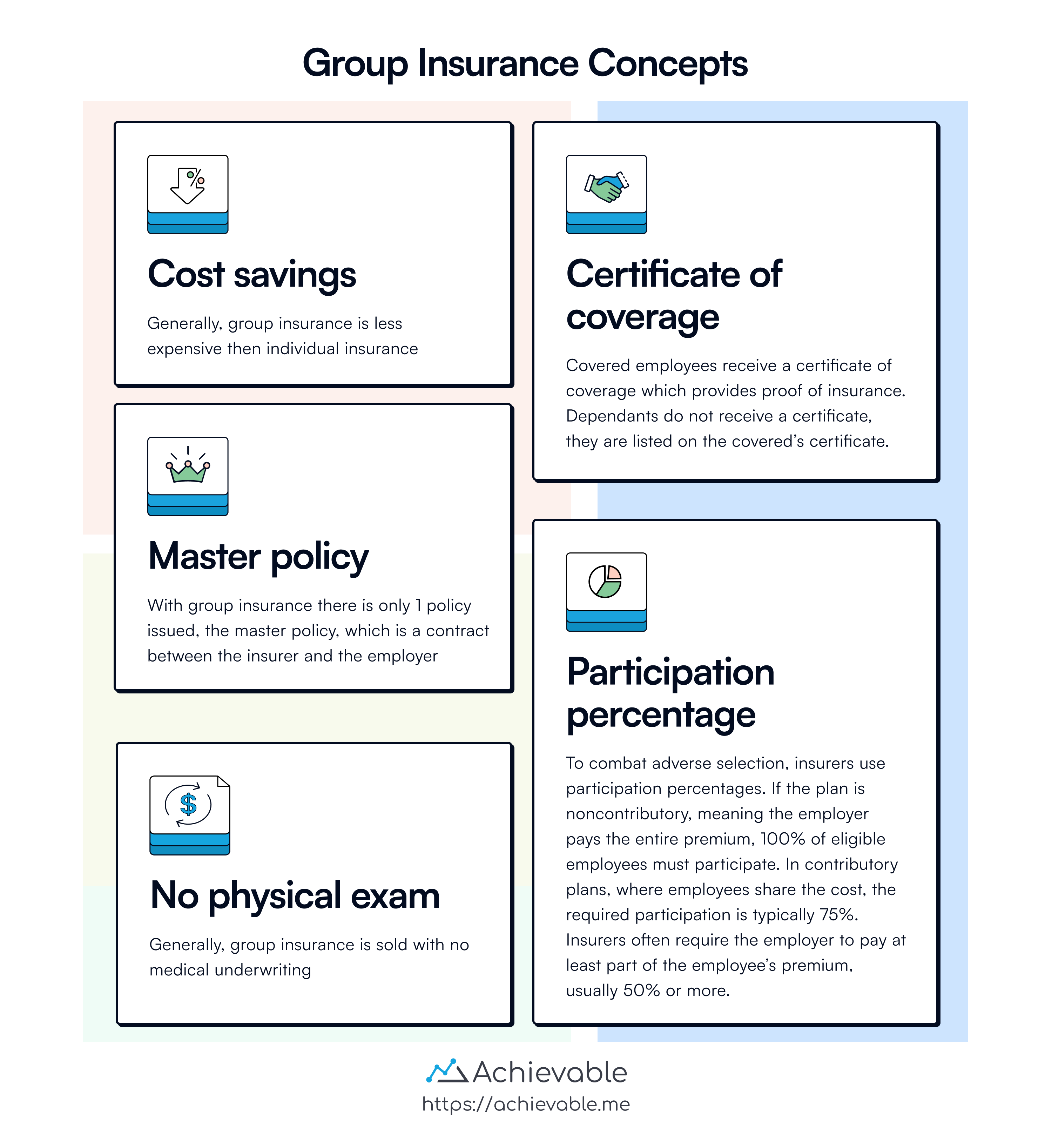
Insurers also impose requirements on group plans to reduce adverse selection and keep administrative costs low. One common requirement is minimum participation.
- Noncontributory plans (the employer pays the full premium) typically require 100% of eligible employees to enroll.
- Contributory plans (the employer and employees share the cost) typically require at least 75% participation.
Insurers often require the employer to pay part of the employee’s premium - commonly 50% or more - for the plan to qualify as contributory.
Employers are free to switch insurance carriers for group coverage or terminate coverage altogether. Statutory rules regulate the terms and conditions that must be followed when this occurs.
The employees must be notified that the policy is being discontinued.
If a group health plan is discontinued, the plan must provide a reasonable extension of benefits for anyone who is totally disabled on the date it ends. Under the NAIC’s Group Coverage Discontinuance and Replacement Model Regulation, the extension must last at least 12 months under major medical coverage. Under other hospital or medical expense coverage, the plan must provide either an extension of at least 90 days or an accrued-liability provision. Benefits during the extension may be limited to the disabling condition and remain subject to the plan’s usual benefit limits.
When one insurer replaces another:
- The prior insurer remains liable only to the extent of its accrued liabilities and extensions of benefits.
- The new insurer must cover all employees who were eligible to participate under the prior insurer.
- The new insurer must disregard any pre-existing conditions that would otherwise make a participant uninsurable.
Health insurance portability and accountability act (HIPAA)
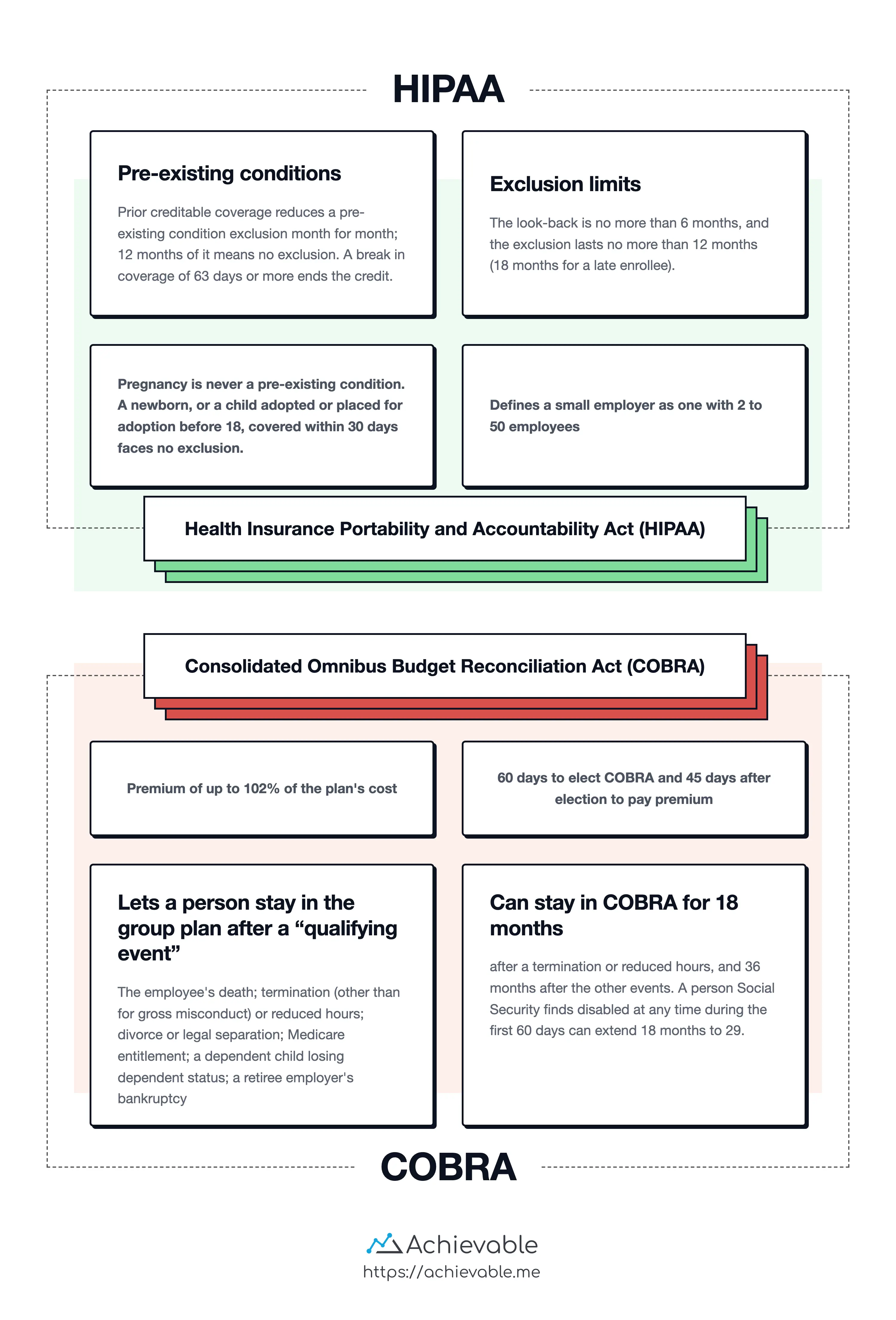
Under HIPAA, any insurer in the business of writing group health insurance must make the product available to small employer groups (2 to 50 employees) without regard to health status.
HIPAA also limits how pre-existing conditions can be handled:
- The look-back period for pre-existing conditions is limited to 6 months.
- The maximum probationary period is 12 months (pre-existing conditions will be covered 12 months after enrollment).
- If an individual enters a group plan within 63 days of leaving another group plan, the new insurer can’t impose a probationary period for pre-existing conditions.
Pregnancy is not a pre-existing condition, and newborn children must be covered from the moment of birth. Under a separate federal law, the Newborns’ and Mothers’ Health Protection Act, a group health plan that covers childbirth may not limit the hospital stay to less than the following, unless the attending provider, in consultation with the mother, decides on an earlier discharge:
- 48 hours after a vaginal delivery
- 96 hours after a caesarean birth
The newborn may be enrolled within 30 days without any pre-existing condition limitations.
A group health policy may include a conversion privilege, and some states’ laws require one. This allows members to convert their group coverage to an individual health insurance policy for 31 days after leaving a group plan due to a qualifying event.
The key value of this provision is that evidence of insurability isn’t required. This matters most when a person has health problems or pre-existing conditions at the time of the qualifying event.
Which events give the right to convert depends on the policy and the state’s law. Wyoming’s law is one example. A member who has been insured under the group for at least 3 months may convert when the member’s group coverage ends for any reason, unless it ended because the member did not pay a required contribution, or the discontinued group coverage was replaced by similar group coverage within 31 days. The privilege also extends to:
- The surviving spouse and children, when the member dies
- A spouse who stops being an eligible family member, as on divorce, and the children whose coverage ends at the same time
- A child who stops being an eligible dependent
Under HIPAA, employers must make full health care coverage available immediately (upon eligibility) to newly hired employees who were previously covered by a group policy for at least 12 months, with no break in coverage greater than 63 days. Coverage must be made available with no probationary, look back, or waiting periods.
Consolidated omnibus budget reconciliation act (COBRA)
COBRA is a federal law that requires employers with 20 or more employees to offer continuation of benefits under the employer’s group insurance plan after a qualifying event. Continuation coverage is available to former employees and their dependents at 102% of the required premium.
COBRA provides transitional health care coverage until the employee and dependents can obtain coverage elsewhere.
Generally, the maximum continuation period is 18 months. However, if the qualifying event was the employee’s death, divorce or legal separation, or entitlement to Medicare, or a dependent child losing dependent status (for example, by attaining age 26), the maximum continuation period is 36 months. Disability is not a qualifying event, but a qualified beneficiary whom Social Security finds to have been disabled at any time during the first 60 days of continuation coverage can extend the 18 months to 29 months.
After a qualifying event, the employee or dependent has 60 days to notify the group insurer or plan administrator of their election to stay in the group plan through COBRA.
In effect, former employees may use the 60 days as a period of “free coverage,” by electing COBRA and paying the premium only if a claim arises.
If the employee takes a new job (and enrolls in a new group plan), the new group coverage will most likely take effect before the COBRA transitional period expires. However, if COBRA is elected, the premium must be paid within 45 days.
HIPAA requires that every insurer who offers individual health insurance must offer at least two plans on a guaranteed issue basis to any individual who has elected and exhausted COBRA and is not eligible for coverage under any other group plan, Medicare, or Medicaid.
Other means of covering groups
Blanket disability insurance provides definite, ascertainable benefits to a changing, nameless group of people (the class). Anyone who enters the covered class is automatically covered, and coverage ends when they leave the class.
Example: A scout camp purchases a blanket disability policy that pays a flat dollar amount (for example, $5,000) to anyone who sustains an injury requiring medical care while attending the camp.
Franchise insurance is similar to the concept of METs (Multiple Employer Trusts), but with franchise insurance, each eligible participant is issued an individual policy. Premium levels are reduced somewhat from those of regular individual policies because of savings in underwriting expenses and plan administration costs.
Another form of group coverage similar to the MET is the Multiple Employer Welfare Association (MEWA), which is an alternative to true group insurance. MEWAs provide self-funded health care benefits to employees of several large employers. In recent years, the growth of MEWAs has slowed due to increased requirements governing legal reserves.
Lesson summary
- Group underwriting does not assess individuals but considers group data like size and claims history.
- Group premiums are determined by factors such as morbidity, claims experience, and policy benefits.
- Requirements like participation percentages reduce adverse selection in group plans.
Under the Health Insurance Portability and Accountability Act (HIPAA), insurers must offer group health insurance to small employers without regard to health status. HIPAA also limits pre-existing condition exclusions and bars treating pregnancy as a pre-existing condition.
- Qualifying events like termination or death enable conversion to an individual policy without requiring evidence of insurability.
- The Consolidated Omnibus Budget Reconciliation Act (COBRA) demands that employers provide continuation of benefits after qualifying events.
Alternative group coverage includes blanket disability insurance and franchise insurance, catering to nameless groups with specific benefits. Multiple Employer Welfare Associations (MEWA) offer self-funded benefits to employees of large companies.