



Benefits and Provisions
Disability income insurance helps solve the financial problem created by disability. This type of health insurance pays monthly income benefits if the insured becomes unable to work and earn a living because of sickness or injury.
There are logical restrictions on disability income insurance. To discourage malingering (faking an illness or disability to collect insurance benefits), insurers place strict controls on how much disability income a person can receive. In general, insurers limit disability income benefits to less than 100% of the insured’s gross income. Because benefits paid from a policy for which the insured pays the premium are not taxed, insuring your net earned (after-tax) income is usually sufficient. Policy limits seldom exceed 70% of gross income, since allowing more may violate the principle of indemnity.
Elimination period
The elimination period, also called the waiting period, is the amount of time that must pass after a disability begins before benefit payments start.
Conceptually, the elimination period is similar to a deductible in other policies. In both cases, the goal is to reduce the number of small claims (and therefore premiums) by requiring the insured to absorb relatively minor losses.
Benefit period
Disability income policies include a provision that states how long benefits will be paid. While many benefit periods are available, the most common arrangement is for benefits to be payable until the insured reaches age 65.
- Short-term policies typically provide benefits for up to 6 months, and sometimes as long as 1 year.
- Long-term policies generally provide benefits for 2 years, 5 years, to age 65, or even for life.
It’s common for an insured to have two disability income policies (short-term and long-term).
- The short-term disability policy typically has a 7-day waiting period before coverage begins and pays benefits for up to 13, 26, or 52 weeks.
- The long-term disability policy is designed to take over when short-term benefits end and to continue benefit payments for a specified number of years, to age 65, or for life.
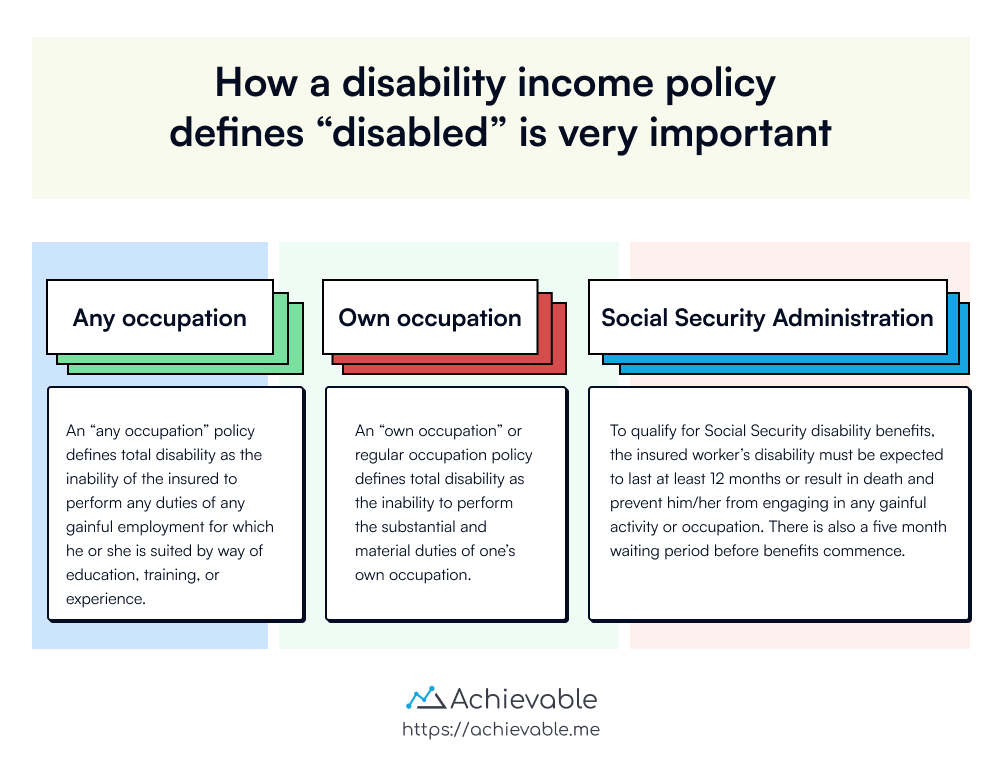
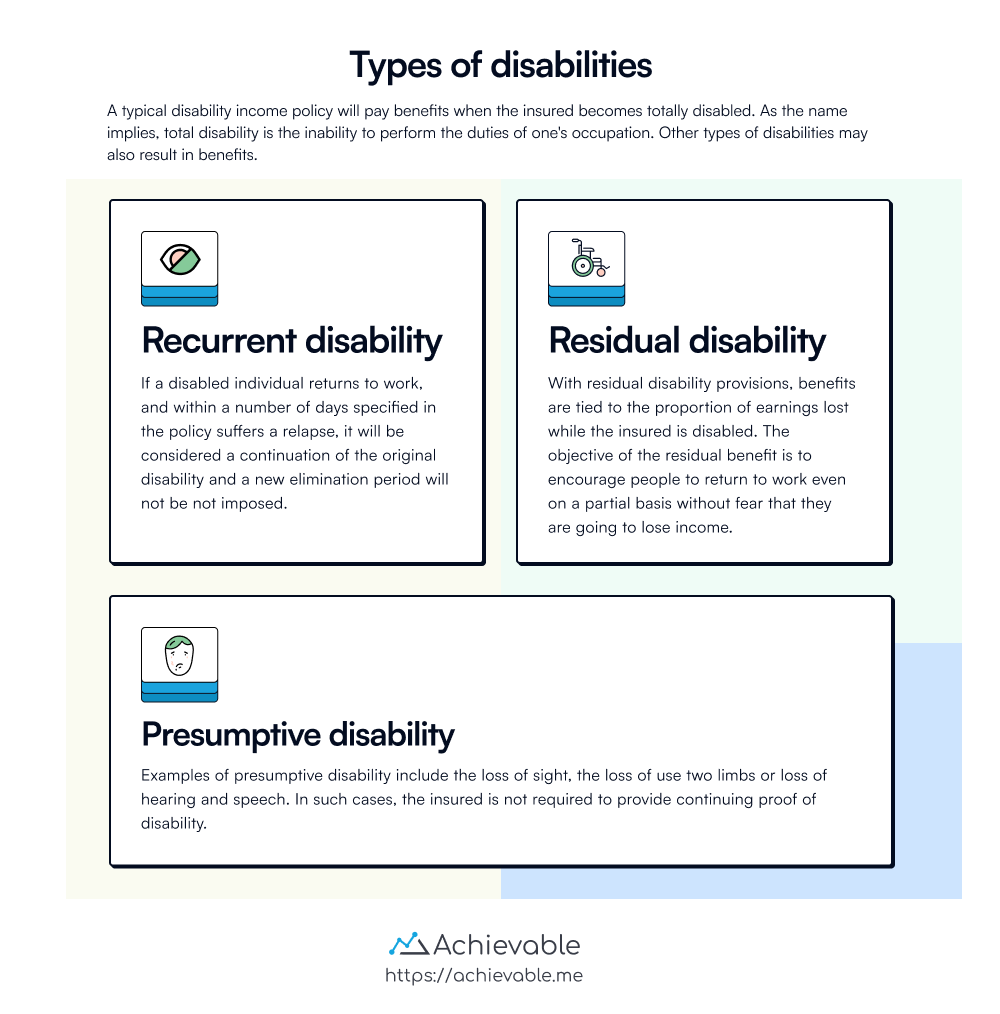
A typical disability income policy pays benefits when the insured becomes totally disabled. As the name implies, total disability is the inability to perform the duties of one’s occupation. Policies generally use one of two definitions of total disability. One is more restrictive than the other and, as a result, is usually less expensive. Because of this, the policy’s definition of disability is a key provision.
An “any occupation” policy defines total disability as the inability of the insured to perform the duties of any gainful employment for which he or she is suited by education, training, or experience. Under this definition, a person must be so disabled that they cannot engage in any employment they could reasonably be expected to perform.
The second, less restrictive definition is “own occupation.” An own occupation policy defines total disability as the inability to perform the duties of one’s own occupation.
For example, assume a dentist buys a policy and later loses a hand. The dentist will not be able to perform dentistry again, but could reasonably be expected to work in other occupations. With an own occupation policy, benefits would be payable. An any occupation policy would not provide benefits in this case.
Many policies combine these concepts. They may define total disability as the inability to perform one’s own job for the first 2 years after the sickness or injury begins, and then as the inability to perform any job for which you are reasonably suited by education, training, or experience after that.
Other definitions of disability
Partial disability
- Recovery from many disabilities includes a period of partial disability before full recovery. During this time, the person may be able to return to work on a limited basis.
- A policy with a partial disability provision pays reduced benefits during this period.
- Partial benefits are typically limited to a brief period to discourage malingering.
- Although partial disability often follows total disability, partial disability benefits may also be paid at the onset of the disability.
Residual disability
-
With residual disability provisions, benefits are tied to the proportion of earnings lost while the insured is disabled.
-
Unlike a partial disability provision (which focuses on limited hours), the residual benefit amount is based on the percentage of pre-disability income the insured is not receiving.
-
Example: If an insured returns to work full time but earns only 60% of pre-disability income, the policy might pay 40% of the total disability benefit (because earnings have decreased by 40%).
-
The objective of the residual benefit is to encourage people to return to work, even on a partial basis, without fear of losing income.
-
An important feature of residual benefits is that the policy owner can return to work in any occupation, even a low-paying job, without losing all disability income benefits.
Recurrent disability
- A disability may recur after the policy owner has seemingly recovered.
- If a disabled individual returns to work and, within 90 days, suffers a relapse, it is considered a continuation of the original disability and a new elimination period will not be imposed.
Presumptive disability
- In most cases, disability income benefits are payable only while the insured is under the care of a physician.
- It’s common for an insurer to require regular physician statements supporting the continuing disability.
- In some situations, the insured is presumed to be totally disabled based on the nature of the disability. Examples include loss of sight, loss of use of 2 limbs, or loss of hearing and speech.
- In these cases, the insured is not required to provide continuing proof of disability.
A disability income policy may distinguish between a confining and a non-confining disability.
- A confining policy requires confinement of the insured in a hospital or other facility to be entitled to income benefits.
- Most policies are non-confining. If the insured meets the policy’s definition of disabled, there is no confinement requirement.
Disability income policies may also vary in how they define an “accident.”
A policy with an accidental means clause covers accidents only if the cause was unintentional. This can be restrictive. For example, you are riding a bus that is pulling up to the curb but has not come to a complete stop. You choose to jump from the bus and break your leg. Because you intended to jump, a policy with an accidental means clause would not cover the injury. However, if you slipped and fell off the bus, the act leading to the injury would have been unintentional and you would be covered.
Most policies contain an accidental bodily injury clause, which is less restrictive. Any injury that results from an accident is covered, even if what led to the injury was intentional.
Lesson summary
Disability income insurance is designed to provide financial assistance if the insured becomes unable to work due to sickness or injury. Below are the key features and considerations of disability income insurance:
- Restrictions on disability income insurance:
- Benefits are typically limited to less than 100% of the insured’s gross income to deter malingering.
- Policy limits usually do not exceed 70% of gross income to adhere to the principle of indemnity.
- Elimination period:
- The waiting period before benefit payments begin after the onset of disability.
- Similar to a deductible, it aims to minimize claims and premiums by making the insured wait.
- Benefit period:
- Specifies the duration for which benefits will be paid.
- Most common benefit period lasts until the insured reaches age 65.
- Types of disability:
- Total disability: Inability to perform one’s occupation, with variations like “any occupation” or “own occupation.”
- Partial disability: Allows for reduced benefits during recovery.
- Residual disability: Benefits are tied to the earnings lost while disabled.
- Recurrent disability: Covers relapses of the original disability without imposing a new elimination period.
- Presumptive disability: Provides benefits without requiring ongoing proof of disability for certain conditions like loss of sight or limbs.