


Achievable logoAchievable logo
Casualty
Sign in
Sign up
Purchase
Textbook
Practice exams
Support
How it works
Exam catalog
Mountain with a flag at the peak
Textbook
1. General Insurance Concepts
1.1 Insurance Basics and Foundational Concepts
1.2 Managing Risks
1.3 Transferring Losses
1.4 Insurance Sources
1.5 Marketing Systems and Producer Authority
1.6 Insurance Contracts
1.7 Producer Roles and Receipt Types
2. Casualty Insurance Basics
3. Underwriting
4. Claims Settlement
5. Personal Auto Insurance (PAP)
6. Commercial General Liability (CGL)
7. Commercial Auto Insurance
8. Crime and Professional Liability
9. Business Owners Policy (BOP) & Workers Comp
Bonding
Achievable logoAchievable logo
1.6 Insurance Contracts
Achievable Casualty
1. General Insurance Concepts
Our Insurance Casualty course is now in "early access" - get 50% off for a limited time.

Insurance Contracts

8 min read
Font
Discuss
Share
Feedback

Essential elements of an insurance contract

An insurance contract is fundamentally based on the utmost good faith of all parties. The applicant relies on the insurer’s promise to pay. The insurer relies on the truthfulness of the statements the applicant makes on the application.

Insurance is also governed by the law of contract. For any contract to be valid and enforceable, four conditions must be met:

  1. There must be consideration by both parties.
  2. An offer must be made by one party and acceptance of that offer made by the other party.
  3. All parties to the contract must be legally capable of entering into a contract.
  4. The purpose of the contract must be legal.

Consideration

For a contract to be valid, each party must give something of value.

  • The insurer’s consideration is its promise to pay policy benefits if the insured suffers a covered loss (acceptance of the risk).
  • The applicant’s consideration is the premium.

Premiums are often calculated on an annualized basis, even when the insured pays in other modes (monthly, quarterly, semiannual). Statutory reserves are maintained to meet future claim obligations.

Offer and acceptance

The offer made by one party must be accepted by the other on an unconditional basis.

  • The applicant makes the offer by completing an application.
  • The insurer may accept the application as written, or it may make a counteroffer (for example, by proposing a rated policy).

A contract forms only when both parties agree to the final terms. If they don’t agree, there is no contract.

Legal capacity

Both parties must be legally capable of entering into a contract.

  • If the insurer is admitted or authorized in the state, it has legal capacity.
  • The applicant has legal capacity unless he/she is a minor, mentally incompetent, intoxicated, or under the influence of narcotics.

Certain individuals, such as enemy aliens or others restricted by law, may also lack capacity in specific jurisdictions.

Legal purpose

A valid contract must be for a legal purpose and not against public policy. A life insurance policy purchased with the intent to have the insured killed is an obvious example of an invalid contract.

For an insurance contract to be valid, there must be an insurable interest between the applicant/owner and the insured.

  • For life insurance, insurable interest must exist at policy inception.
  • For property and casualty insurance, it must exist at the time of loss.
Sidenote
Know this...

Consideration, Offer, Acceptance, Legal Purpose, and Competent Parties (Legal Capacity) are the five essential elements of an insurance contract. “Meeting of the minds” is a way to describe “Acceptance by both parties.”

A property and casualty insurance policy is comprised of four basic sections of coverage including:

  • Declarations

  • Insuring agreement

  • Conditions

  • Exclusions

Declarations

The declarations page provides information about the property or exposures being insured. Much of the information in the declarations section is taken directly from the application and include, but are not limited to:

  • Name and address of the named insured

  • A description of the type of property to be insured

  • The location of the property

  • The coverage limit provided

  • The amount of the annual premium

  • Amount of the deductible, if any

  • The policy period (inception and expiration dates)

  • The name of a mortgagee, if any

  • A company officer name, signature or stamp

Insuring clause

This section summarizes the coverage (the agreement) between the named insured and the insurer. More specifically, it identifies the parties to the contract and lists the perils covered by the policy.

Conditions

This section identifies the responsibilities of each party to the contract. If a named insured fails or refuses to comply with policy conditions, an insurer may deny a claim or refuse to renew coverage.

Most policy conditions are placed on the named insured. For example, if a risk is altered or increased (i.e. installing a swimming pool after the policy became effective), the insured is required to notify the insurer.

Exclusions

This section identifies the property and perils that are not covered. Exclusions allow or permit an insurer to protect itself from financial disaster by not providing coverage for catastrophic losses.

Insurance contracts are unique in that the applicant must purchase the policy as written, without any opportunity to modify or clarify the contract language. Over time, courts have used the Doctrine of Adhesion to interpret ambiguous contract terms or conditions in favor of the insured, since the insured had no chance to alter the contract at the time of application.
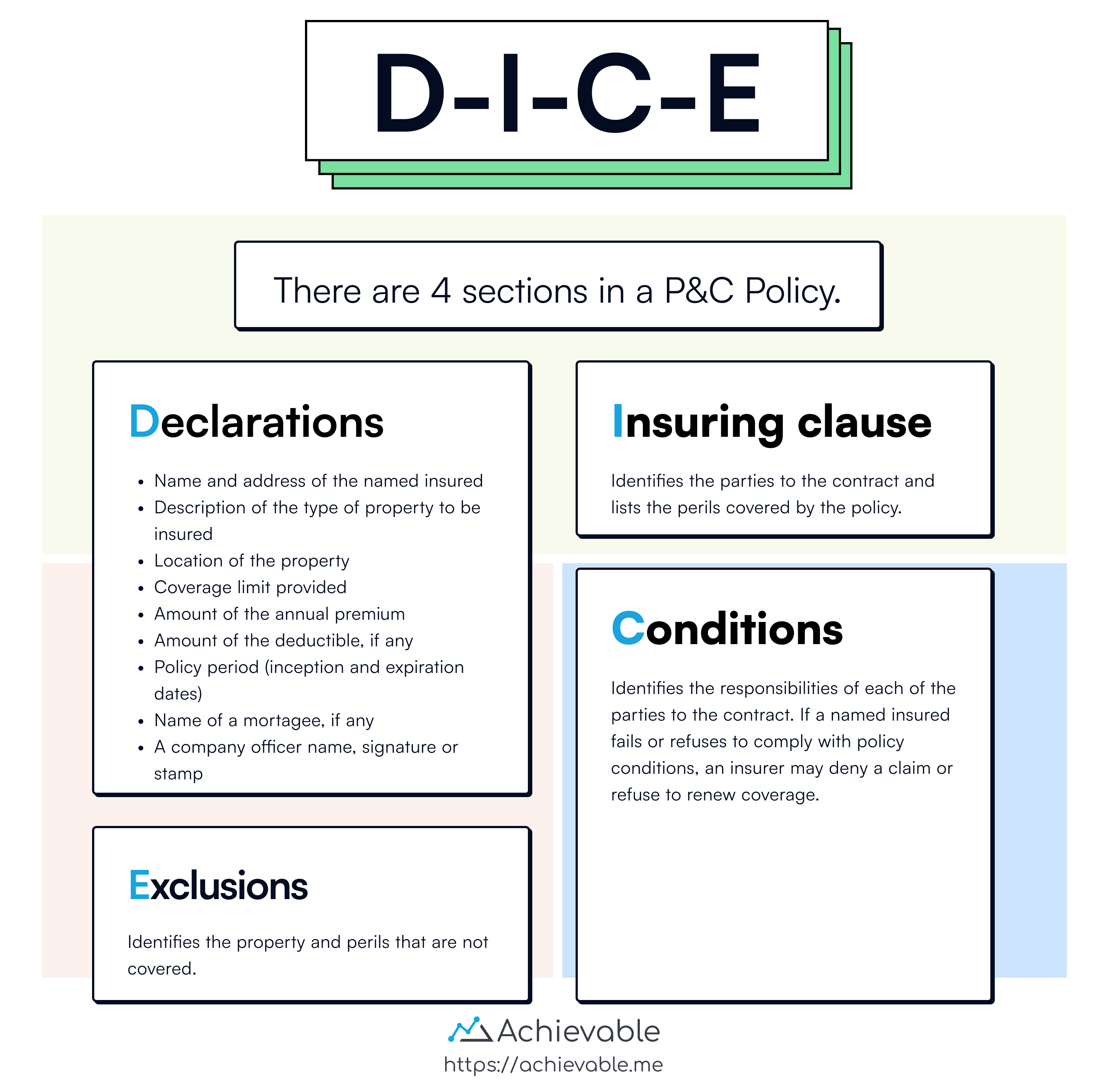
DICE four basic sections

Insurers go to great lengths to ensure that their contract language is clear and to avoid misunderstandings about the policy’s terms. Still, questions and conflicts do arise, and when they do, they often involve the concepts of warranties and representations.

A warranty is a statement or promise incorporated into the policy that must be true as stated or performed as promised. Under modern insurance law, a breach must be material to affect coverage.

Representations are statements made on the application that are substantially true to the best of the applicant’s knowledge.

If a statement is made on an application that the applicant knows is false, it is a misrepresentation and may constitute fraud. If the insurer can prove that the misrepresentation was made intentionally, it may void the contract and may be punishable as a Class 6 felony.

Lesson summary

An insurance contract is based on utmost good faith: the applicant relies on the insurer’s promise to pay, and the insurer relies on the truthfulness of the applicant’s statements.

To be valid and enforceable, a contract must include:

  • consideration by both parties
  • offer and acceptance
  • legal capacity of the parties
  • a legal purpose

Consideration is the exchange of promises:

  • The insurer promises benefits for covered losses.
  • The applicant pays the premium.

Offer and acceptance require an unconditional agreement. The applicant offers by completing an application, which the insurer can accept as written or change through a counteroffer.

Legal capacity means both parties must be able to enter into a contract. The contract’s purpose must also be legal and not against public policy. A valid insurance contract must establish an insurable interest.

  • Insurance contracts have unique features:

  • Applicants must accept policies as written without modification.

  • The Doctrine of Adhesion favors insured parties in case of ambiguous terms.

Insurers strive for clear contract language to prevent misunderstandings.

A property and casualty insurance policy consists of four parts:

  • Declarations: Information about the insured property
  • Insuring Clause: Summary of coverage and perils covered
  • Conditions: Responsibilities of each party
  • Exclusions: Identifies what is not covered

Warranties are promises that must be true as stated; representations are statements believed to be true to the best of the applicant’s knowledge.

Misrepresentations, if intentional, can void the contract and may constitute fraud.

Chapter vocabulary

Definitions
Acceptance
An agreement is reached when the offer (application) is accepted.
Adhesion
Insurance policies are contracts of adhesion because the terms are written by the insurer, and the insured simply “adheres.” For this reason, vague or ambiguous provisions are often interpreted by courts in favor of the insured.
Competent Party
Most entities in a contract are deemed competent except minors, those under the influence of alcohol or narcotics, and mentally incompetent individuals.
Concealment
Neither party may conceal facts that would have affected the creation of the contract.
Conditions
Requirements specified in the insurance contract that must be upheld by the insured to qualify for indemnification.
Consideration
The exchange of values on which a contract is based. In insurance, the consideration offered by the insured is the premium. The consideration offered by the insurer is the promise to pay in accordance with the terms of the contract.
Declarations
Policy statements regarding the applicant and property covered such as demographic and occupational information, property specifications and expected mileage per year.
Exclusions
Provisions in the policy that eliminate coverage for specified losses or causes of loss.
Insuring Clause
The provision of an insurance policy containing the insurance company’s promise. It established the obligation of the company to provide the insurance coverage as stated in the policy.
Legal Purpose
A contract/policy must be drawn for a legal purpose and not against public policy.
Misrepresentation
On the part of an insurer or its agent, falsely representing the terms, benefits, or privileges of a policy. On the part of an applicant, falsely representing the health or other condition of the proposed insured.
Offer
The terms of a contract proposed by one party to another. In insurance, submitting an application to the company is usually considered an offer.
Representations
On an application, facts that the applicant represents as true and accurate to the best of his/her knowledge and belief.
Rescission
The termination of an insurance contract by the insurer when material misrepresentation has occurred.
Utmost Good Faith
Acting in fairness and equity with a sincere belief that the act is not unlawful or harmful to others. The insurance contract requires that each party is entitled to rely on the representations of the other without attempts to conceal or deceive.
Warranty
A statement made on an application for insurance that is warranted to be true in all respects. If untrue in any respect, even though the untruth may not have been known to the person giving the warranty, the contract may be voided whether or not the untruth or inexactness is material to the risk. Statements on life and health insurance applications are, in the absence of any evidence of fraud, representations rather than warranties. (Contrast with Representations.)

Essential elements of an insurance contract

  • Based on utmost good faith (truthfulness, fairness)
  • Five essential elements:
    • Consideration (exchange of value)
    • Offer
    • Acceptance
    • Legal capacity (competent parties)
    • Legal purpose (not against public policy)
  • Insurable interest required for validity

Consideration

  • Insurer: promise to pay for covered losses
  • Applicant: payment of premium
  • Premiums often annualized; statutory reserves maintained

Offer and acceptance

  • Applicant submits application (offer)
  • Insurer accepts as written or issues counteroffer (e.g., rated policy)
  • Contract forms only with unconditional agreement

Legal capacity

  • Both parties must be legally able to contract
    • Insurer: must be authorized/admitted in state
    • Applicant: not a minor, mentally incompetent, intoxicated, or otherwise restricted

Legal purpose

  • Contract must be for lawful purpose
  • Insurable interest must exist:
    • Life insurance: at inception
    • Property/casualty: at time of loss

Property and casualty policy structure (DICE)

  • Declarations: insured info, property details, coverage limits, premiums, policy period
  • Insuring clause: summary of coverage, covered perils, parties to contract
  • Conditions: duties/responsibilities of each party, compliance required for claims
  • Exclusions: property/perils not covered, protects insurer from catastrophic losses

Doctrine of Adhesion

  • Policies are contracts of adhesion (take-it-or-leave-it)
  • Ambiguities interpreted in favor of insured

Warranties, representations, and misrepresentation

  • Warranty: must be strictly true/performed as promised; breach must be material
  • Representation: statements believed true to best knowledge of applicant
  • Misrepresentation: false statement; if intentional, can void contract and may be fraud

Key vocabulary

  • Acceptance: agreement reached when offer is accepted
  • Adhesion: contract written by insurer, insured must accept as is
  • Concealment: hiding material facts is prohibited
  • Conditions: requirements for indemnification
  • Declarations: policy/applicant/property info
  • Exclusions: losses not covered
  • Insuring clause: insurer’s promise to pay
  • Legal purpose: must not violate public policy
  • Offer: application submission
  • Rescission: contract termination for material misrepresentation
  • Utmost good faith: fairness and honesty required

Sign up for free to take 21 quiz questions on this topic

All rights reserved ©2016 - 2026 Achievable, Inc.

Insurance Contracts

Essential elements of an insurance contract

An insurance contract is fundamentally based on the utmost good faith of all parties. The applicant relies on the insurer’s promise to pay. The insurer relies on the truthfulness of the statements the applicant makes on the application.

Insurance is also governed by the law of contract. For any contract to be valid and enforceable, four conditions must be met:

  1. There must be consideration by both parties.
  2. An offer must be made by one party and acceptance of that offer made by the other party.
  3. All parties to the contract must be legally capable of entering into a contract.
  4. The purpose of the contract must be legal.

Consideration

For a contract to be valid, each party must give something of value.

  • The insurer’s consideration is its promise to pay policy benefits if the insured suffers a covered loss (acceptance of the risk).
  • The applicant’s consideration is the premium.

Premiums are often calculated on an annualized basis, even when the insured pays in other modes (monthly, quarterly, semiannual). Statutory reserves are maintained to meet future claim obligations.

Offer and acceptance

The offer made by one party must be accepted by the other on an unconditional basis.

  • The applicant makes the offer by completing an application.
  • The insurer may accept the application as written, or it may make a counteroffer (for example, by proposing a rated policy).

A contract forms only when both parties agree to the final terms. If they don’t agree, there is no contract.

Legal capacity

Both parties must be legally capable of entering into a contract.

  • If the insurer is admitted or authorized in the state, it has legal capacity.
  • The applicant has legal capacity unless he/she is a minor, mentally incompetent, intoxicated, or under the influence of narcotics.

Certain individuals, such as enemy aliens or others restricted by law, may also lack capacity in specific jurisdictions.

Legal purpose

A valid contract must be for a legal purpose and not against public policy. A life insurance policy purchased with the intent to have the insured killed is an obvious example of an invalid contract.

For an insurance contract to be valid, there must be an insurable interest between the applicant/owner and the insured.

  • For life insurance, insurable interest must exist at policy inception.
  • For property and casualty insurance, it must exist at the time of loss.
Sidenote
Know this...

Consideration, Offer, Acceptance, Legal Purpose, and Competent Parties (Legal Capacity) are the five essential elements of an insurance contract. “Meeting of the minds” is a way to describe “Acceptance by both parties.”

A property and casualty insurance policy is comprised of four basic sections of coverage including:

  • Declarations

  • Insuring agreement

  • Conditions

  • Exclusions

Declarations

The declarations page provides information about the property or exposures being insured. Much of the information in the declarations section is taken directly from the application and include, but are not limited to:

  • Name and address of the named insured

  • A description of the type of property to be insured

  • The location of the property

  • The coverage limit provided

  • The amount of the annual premium

  • Amount of the deductible, if any

  • The policy period (inception and expiration dates)

  • The name of a mortgagee, if any

  • A company officer name, signature or stamp

Insuring clause

This section summarizes the coverage (the agreement) between the named insured and the insurer. More specifically, it identifies the parties to the contract and lists the perils covered by the policy.

Conditions

This section identifies the responsibilities of each party to the contract. If a named insured fails or refuses to comply with policy conditions, an insurer may deny a claim or refuse to renew coverage.

Most policy conditions are placed on the named insured. For example, if a risk is altered or increased (i.e. installing a swimming pool after the policy became effective), the insured is required to notify the insurer.

Exclusions

This section identifies the property and perils that are not covered. Exclusions allow or permit an insurer to protect itself from financial disaster by not providing coverage for catastrophic losses.

Insurance contracts are unique in that the applicant must purchase the policy as written, without any opportunity to modify or clarify the contract language. Over time, courts have used the Doctrine of Adhesion to interpret ambiguous contract terms or conditions in favor of the insured, since the insured had no chance to alter the contract at the time of application.

DICE four basic sections

Insurers go to great lengths to ensure that their contract language is clear and to avoid misunderstandings about the policy’s terms. Still, questions and conflicts do arise, and when they do, they often involve the concepts of warranties and representations.

A warranty is a statement or promise incorporated into the policy that must be true as stated or performed as promised. Under modern insurance law, a breach must be material to affect coverage.

Representations are statements made on the application that are substantially true to the best of the applicant’s knowledge.

If a statement is made on an application that the applicant knows is false, it is a misrepresentation and may constitute fraud. If the insurer can prove that the misrepresentation was made intentionally, it may void the contract and may be punishable as a Class 6 felony.

Lesson summary

An insurance contract is based on utmost good faith: the applicant relies on the insurer’s promise to pay, and the insurer relies on the truthfulness of the applicant’s statements.

To be valid and enforceable, a contract must include:

  • consideration by both parties
  • offer and acceptance
  • legal capacity of the parties
  • a legal purpose

Consideration is the exchange of promises:

  • The insurer promises benefits for covered losses.
  • The applicant pays the premium.

Offer and acceptance require an unconditional agreement. The applicant offers by completing an application, which the insurer can accept as written or change through a counteroffer.

Legal capacity means both parties must be able to enter into a contract. The contract’s purpose must also be legal and not against public policy. A valid insurance contract must establish an insurable interest.

  • Insurance contracts have unique features:

  • Applicants must accept policies as written without modification.

  • The Doctrine of Adhesion favors insured parties in case of ambiguous terms.

Insurers strive for clear contract language to prevent misunderstandings.

A property and casualty insurance policy consists of four parts:

  • Declarations: Information about the insured property
  • Insuring Clause: Summary of coverage and perils covered
  • Conditions: Responsibilities of each party
  • Exclusions: Identifies what is not covered

Warranties are promises that must be true as stated; representations are statements believed to be true to the best of the applicant’s knowledge.

Misrepresentations, if intentional, can void the contract and may constitute fraud.

Chapter vocabulary

Definitions
Acceptance
An agreement is reached when the offer (application) is accepted.
Adhesion
Insurance policies are contracts of adhesion because the terms are written by the insurer, and the insured simply “adheres.” For this reason, vague or ambiguous provisions are often interpreted by courts in favor of the insured.
Competent Party
Most entities in a contract are deemed competent except minors, those under the influence of alcohol or narcotics, and mentally incompetent individuals.
Concealment
Neither party may conceal facts that would have affected the creation of the contract.
Conditions
Requirements specified in the insurance contract that must be upheld by the insured to qualify for indemnification.
Consideration
The exchange of values on which a contract is based. In insurance, the consideration offered by the insured is the premium. The consideration offered by the insurer is the promise to pay in accordance with the terms of the contract.
Declarations
Policy statements regarding the applicant and property covered such as demographic and occupational information, property specifications and expected mileage per year.
Exclusions
Provisions in the policy that eliminate coverage for specified losses or causes of loss.
Insuring Clause
The provision of an insurance policy containing the insurance company’s promise. It established the obligation of the company to provide the insurance coverage as stated in the policy.
Legal Purpose
A contract/policy must be drawn for a legal purpose and not against public policy.
Misrepresentation
On the part of an insurer or its agent, falsely representing the terms, benefits, or privileges of a policy. On the part of an applicant, falsely representing the health or other condition of the proposed insured.
Offer
The terms of a contract proposed by one party to another. In insurance, submitting an application to the company is usually considered an offer.
Representations
On an application, facts that the applicant represents as true and accurate to the best of his/her knowledge and belief.
Rescission
The termination of an insurance contract by the insurer when material misrepresentation has occurred.
Utmost Good Faith
Acting in fairness and equity with a sincere belief that the act is not unlawful or harmful to others. The insurance contract requires that each party is entitled to rely on the representations of the other without attempts to conceal or deceive.
Warranty
A statement made on an application for insurance that is warranted to be true in all respects. If untrue in any respect, even though the untruth may not have been known to the person giving the warranty, the contract may be voided whether or not the untruth or inexactness is material to the risk. Statements on life and health insurance applications are, in the absence of any evidence of fraud, representations rather than warranties. (Contrast with Representations.)
Key points

Essential elements of an insurance contract

  • Based on utmost good faith (truthfulness, fairness)
  • Five essential elements:
    • Consideration (exchange of value)
    • Offer
    • Acceptance
    • Legal capacity (competent parties)
    • Legal purpose (not against public policy)
  • Insurable interest required for validity

Consideration

  • Insurer: promise to pay for covered losses
  • Applicant: payment of premium
  • Premiums often annualized; statutory reserves maintained

Offer and acceptance

  • Applicant submits application (offer)
  • Insurer accepts as written or issues counteroffer (e.g., rated policy)
  • Contract forms only with unconditional agreement

Legal capacity

  • Both parties must be legally able to contract
    • Insurer: must be authorized/admitted in state
    • Applicant: not a minor, mentally incompetent, intoxicated, or otherwise restricted

Legal purpose

  • Contract must be for lawful purpose
  • Insurable interest must exist:
    • Life insurance: at inception
    • Property/casualty: at time of loss

Property and casualty policy structure (DICE)

  • Declarations: insured info, property details, coverage limits, premiums, policy period
  • Insuring clause: summary of coverage, covered perils, parties to contract
  • Conditions: duties/responsibilities of each party, compliance required for claims
  • Exclusions: property/perils not covered, protects insurer from catastrophic losses

Doctrine of Adhesion

  • Policies are contracts of adhesion (take-it-or-leave-it)
  • Ambiguities interpreted in favor of insured

Warranties, representations, and misrepresentation

  • Warranty: must be strictly true/performed as promised; breach must be material
  • Representation: statements believed true to best knowledge of applicant
  • Misrepresentation: false statement; if intentional, can void contract and may be fraud

Key vocabulary

  • Acceptance: agreement reached when offer is accepted
  • Adhesion: contract written by insurer, insured must accept as is
  • Concealment: hiding material facts is prohibited
  • Conditions: requirements for indemnification
  • Declarations: policy/applicant/property info
  • Exclusions: losses not covered
  • Insuring clause: insurer’s promise to pay
  • Legal purpose: must not violate public policy
  • Offer: application submission
  • Rescission: contract termination for material misrepresentation
  • Utmost good faith: fairness and honesty required