Update it, or open this page in a current version of Chrome, Safari, Firefox or Edge. On an iPhone or iPad, update iOS: every browser there runs on the version of Safari that comes with it.
3.1.4.3.3 Materials usage variances
Achievable CMA Part 1
3. Cost and variance measures
3.1. Management by exception and standard cost systems
3.1.4. Material cost variance
Our CMA Part 1 course is currently in development and is a work-in-progress.
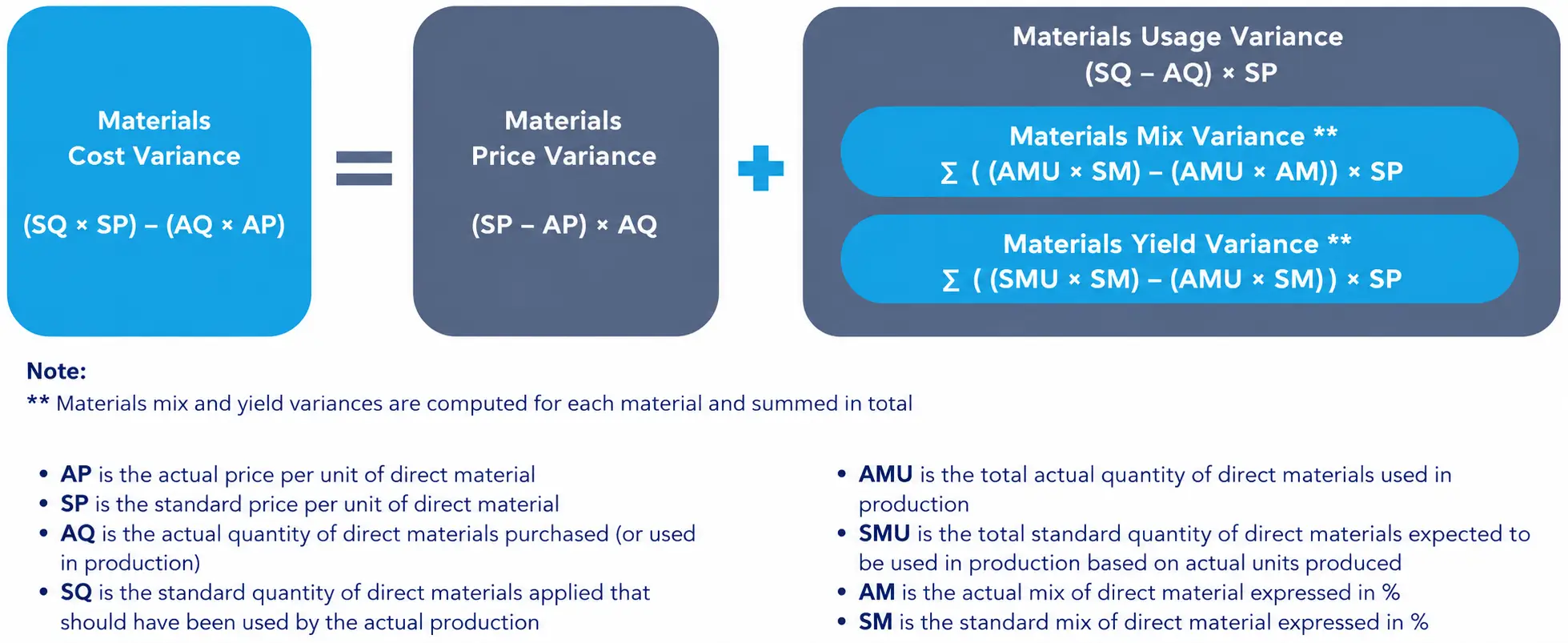
The materials usage variance relates to production efficiency as it relates to the use of materials. Here we compare the “standard cost of the standard quantity of materials based on actual units produced” versus the “standard costs for the actual quantity used in production”.
To understand it better:
Materials Usage Variance=Standard Quantity for Actual Production in Standard Prices−Actual Quantity in Standard Prices
It can also be expressed in terms of the formulas:
SP is the standard price per unit of direct material
AQ is the actual quantity of direct materials used in production
SQ is the standard quantity of direct materials applied that should have been used by the actual production
When applying inputs into the formula, a positive variance indicates a favorable variance, while a negative variance signifies an unfavorable variance. However, to avoid getting confused with the mathematical signs, it is essential to understand the reasons behind these variances to interpret them correctly.
For instance, if the standard quantity of materials allowed is greater than the actual quantity of materials used in production, this reflects production efficiency. Such a scenario is considered favorable for the company, as it indicates that less material was used than anticipated, leading to cost savings and improved operational performance.
The materials usage variance can be further analyzed through its two subcategories:
materials mix variance and
materials yield variance.
The mix variance evaluates the cost impact of deviations in the proportions of different materials used in production compared to the standard mix, while the yield variance measures the efficiency of overall material usage in terms of output generated. Together, these subcategories provide deeper insights into whether variances arise from changes in material composition or inefficiencies in material consumption.
Materials mix variance
This variance focuses on the composition of materials used in production when multiple types of materials are combined. It measures the cost impact of using a different proportion of materials than planned in the standard mix. In terms of calculation, we need to obtain the difference between the actual quantity produced in standard proportion versus the actual quantity produced in actual proportion, applying standard material prices. Expressed in formulas:
Materials Mix Variance=Standard Cost of Total Actual Material Usage in Standard Proportion−Standard Cost of Total Actual Material Usage in Actual Proportion
It can also be expressed in terms of other formulas:
Materials Mix Variance=((Total Actual Material Usage×Standard Mix)−(Total Actual Material Usage×Actual Mix))×Standard Price=((AMU×SM)−(AMU×AM))×SP=((AMU×SM)−AQ)×SP
Where:
SP is the standard price per unit of direct material
AMU is the total actual quantity of direct materials used in production
SM is the standard mix of direct material expressed in %
AM is the actual mix of direct material expressed in %
AQ is the actual quantity of materials used for that specific material (in units of that material)
It is good to note that (AMU × AM) is equal to AQ for that specific material and there is no need to perform computations for this part of the formula.
The formulas above are computed for each direct material used in production and added together to the total materials mix variance.
Materials yield variance
This variance evaluates the overall efficiency of materials usage in terms of output produced. It measures the cost impact of using more or less total material than expected to produce a given level of output. A favorable yield variance indicates efficient usage of materials, while an unfavorable variance suggests wastage or inefficiencies.
In terms of calculation, we need to obtain the difference between the standard materials usage in standard proportion versus the actual materials usage in standard proportion, applying standard material prices. Expressed in formulas:
Materials Yield Variance=Standard Cost of Total Standard Material Usage in Standard Proportion−Standard Cost of Total Actual Material Usage in Standard Proportion
It can also be expressed in terms of other formulas:
Materials Yield Variance=((Total Standard Material Usage×Standard Mix)−(Total Actual Material Usage×Standard Mix))×Standard Price=((SMU×SM)−(AMU×SM))×SP
Where:
SP is the standard price per unit of direct material
AMU is the total actual quantity of direct materials used in production
SMU is the total standard quantity of direct materials expected to be used in production based on actual units produced
SM is the standard mix of direct material expressed in %
The formulas above are computed for each direct material used in production and added together to the total materials yield variance.
Materials usage variances
Measures efficiency in material use: compares standard quantity (SQ) vs. actual quantity (AQ) at standard price (SP)
The materials usage variance relates to production efficiency as it relates to the use of materials. Here we compare the “standard cost of the standard quantity of materials based on actual units produced” versus the “standard costs for the actual quantity used in production”.
To understand it better:
Materials Usage Variance=Standard Quantity for Actual Production in Standard Prices−Actual Quantity in Standard Prices
It can also be expressed in terms of the formulas:
SP is the standard price per unit of direct material
AQ is the actual quantity of direct materials used in production
SQ is the standard quantity of direct materials applied that should have been used by the actual production
When applying inputs into the formula, a positive variance indicates a favorable variance, while a negative variance signifies an unfavorable variance. However, to avoid getting confused with the mathematical signs, it is essential to understand the reasons behind these variances to interpret them correctly.
For instance, if the standard quantity of materials allowed is greater than the actual quantity of materials used in production, this reflects production efficiency. Such a scenario is considered favorable for the company, as it indicates that less material was used than anticipated, leading to cost savings and improved operational performance.
The materials usage variance can be further analyzed through its two subcategories:
materials mix variance and
materials yield variance.
The mix variance evaluates the cost impact of deviations in the proportions of different materials used in production compared to the standard mix, while the yield variance measures the efficiency of overall material usage in terms of output generated. Together, these subcategories provide deeper insights into whether variances arise from changes in material composition or inefficiencies in material consumption.
Materials mix variance
This variance focuses on the composition of materials used in production when multiple types of materials are combined. It measures the cost impact of using a different proportion of materials than planned in the standard mix. In terms of calculation, we need to obtain the difference between the actual quantity produced in standard proportion versus the actual quantity produced in actual proportion, applying standard material prices. Expressed in formulas:
Materials Mix Variance=Standard Cost of Total Actual Material Usage in Standard Proportion−Standard Cost of Total Actual Material Usage in Actual Proportion
It can also be expressed in terms of other formulas:
Materials Mix Variance=((Total Actual Material Usage×Standard Mix)−(Total Actual Material Usage×Actual Mix))×Standard Price=((AMU×SM)−(AMU×AM))×SP=((AMU×SM)−AQ)×SP
Where:
SP is the standard price per unit of direct material
AMU is the total actual quantity of direct materials used in production
SM is the standard mix of direct material expressed in %
AM is the actual mix of direct material expressed in %
AQ is the actual quantity of materials used for that specific material (in units of that material)
It is good to note that (AMU × AM) is equal to AQ for that specific material and there is no need to perform computations for this part of the formula.
The formulas above are computed for each direct material used in production and added together to the total materials mix variance.
Materials yield variance
This variance evaluates the overall efficiency of materials usage in terms of output produced. It measures the cost impact of using more or less total material than expected to produce a given level of output. A favorable yield variance indicates efficient usage of materials, while an unfavorable variance suggests wastage or inefficiencies.
In terms of calculation, we need to obtain the difference between the standard materials usage in standard proportion versus the actual materials usage in standard proportion, applying standard material prices. Expressed in formulas:
Materials Yield Variance=Standard Cost of Total Standard Material Usage in Standard Proportion−Standard Cost of Total Actual Material Usage in Standard Proportion
It can also be expressed in terms of other formulas:
Materials Yield Variance=((Total Standard Material Usage×Standard Mix)−(Total Actual Material Usage×Standard Mix))×Standard Price=((SMU×SM)−(AMU×SM))×SP
Where:
SP is the standard price per unit of direct material
AMU is the total actual quantity of direct materials used in production
SMU is the total standard quantity of direct materials expected to be used in production based on actual units produced
SM is the standard mix of direct material expressed in %
The formulas above are computed for each direct material used in production and added together to the total materials yield variance.