


Achievable logoAchievable logo
CMA Part 1
Sign in
Sign up
Purchase
Textbook
Practice exams
Support
How it works
Exam catalog
Mountain with a flag at the peak
Textbook
1. External financial reporting decisions
2. Planning, budgeting, and forecasting
3. Performance management
4. Cost management
5. Internal control
6. Technology and analytics
Achievable logoAchievable logo
3.1.4.3.1 Overview of materials cost variance formula
Achievable CMA Part 1
3. Cost and variance measures
3.1. Management by exception and standard cost systems
3.1.4. Material cost variance
Our CMA Part 1 course is currently in development and is a work-in-progress.

Overview of materials cost variance formula

3 min read
Font
Discuss
Share
Feedback

Material cost variance is the total difference between the standard cost of materials and the actual cost incurred for materials.

The general formula for this is expressed below:

Material Cost Variance=(Standard Quantity×Standard Price)−(Actual Quantity×Actual Price)

It should be noted that the Standard Quantity used in this formula is not the same as the quantity in the master budget. Explained simply, this is the standard quantity of materials expected to be used based on actual production volume achieved. It will be explained further when we discuss the materials usage variances.

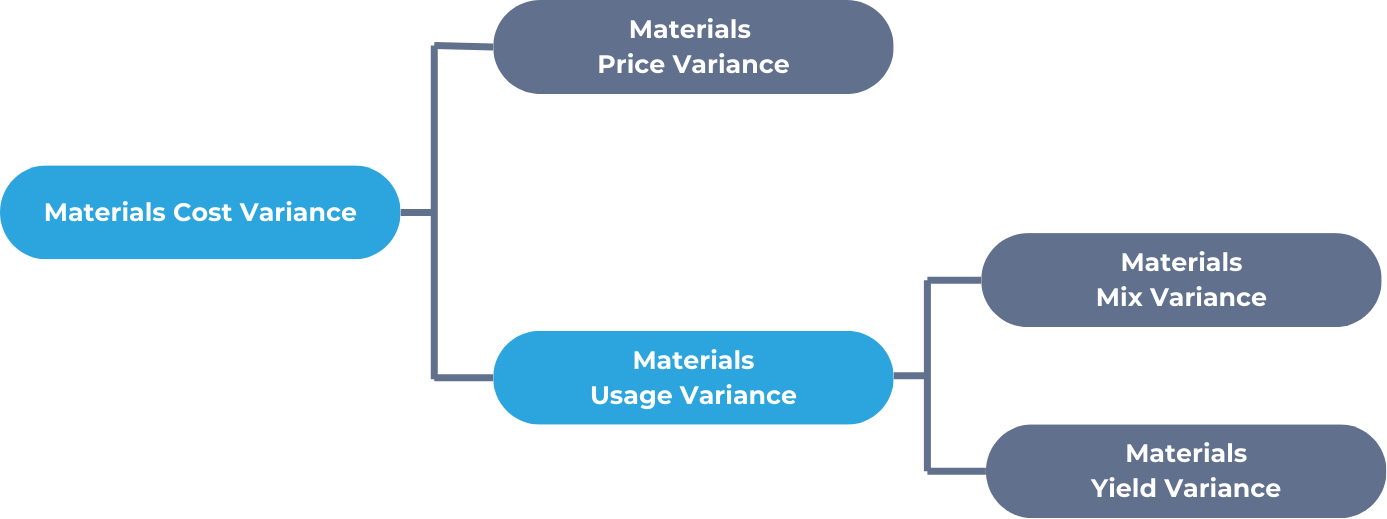
The materials cost variance is broken down into different variances in order to isolate the sources of the deviations from the standard costs and usage. The variance is coming mainly from two sources:

  1. differences between standard price versus actual price paid for materials (materials price variance); and
  2. the differences between the standard consumption versus the actual consumption (materials usage variance). The usage variance can be further broken down when there are more than one direct materials used in production as this also impacts total costs.
Breakdown of materials cost variance

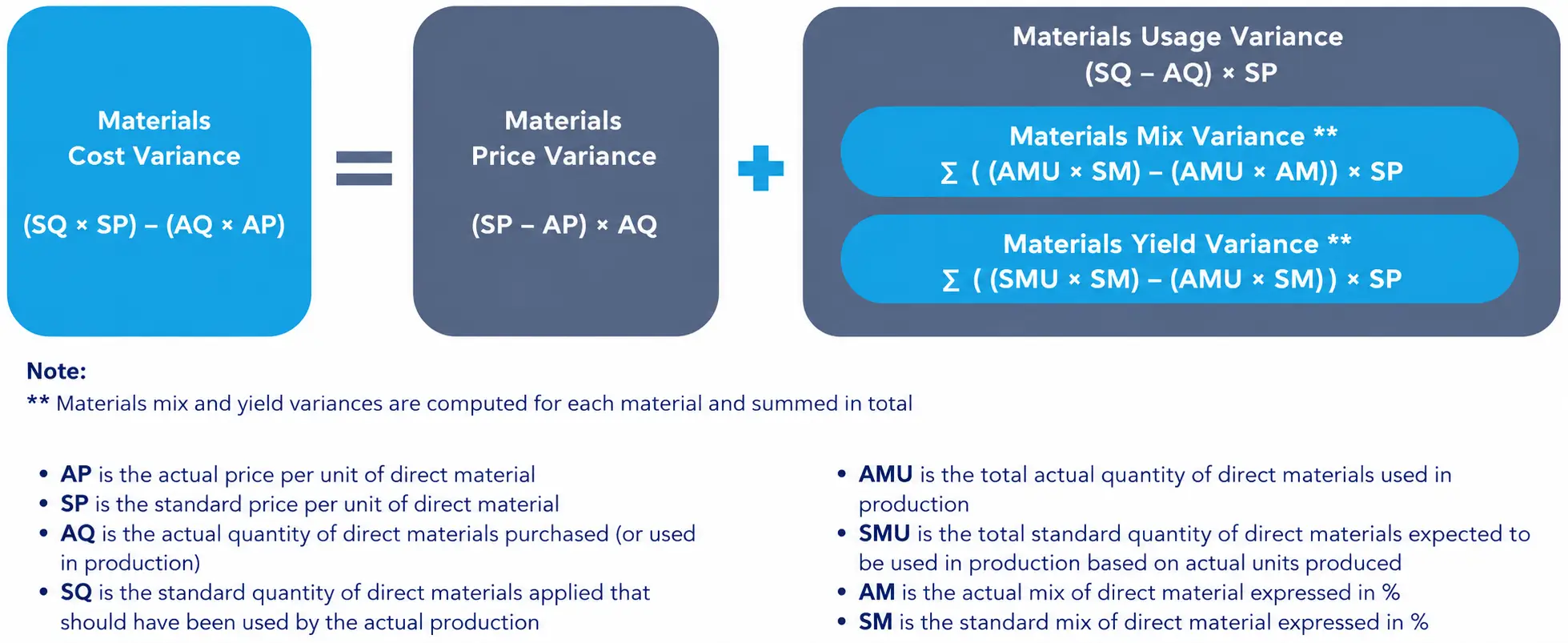
Overview of variance formula

When the quantity of materials used in production matches the quantity purchased, the total of all calculated variances should equal the overall materials cost variance. This provides a useful way to verify the accuracy of your calculations by comparing the sum of the individual variances to the total materials cost variance.

Formulas break direct materials cost variance into price, usage, mix, and yield variances.
Direct materials variances

Material Cost Variance

  • Difference between standard cost and actual cost of materials
  • Formula: (Standard Quantity × Standard Price) − (Actual Quantity × Actual Price)
  • Standard Quantity based on actual production volume, not master budget

Sources of Variance

  • Materials price variance: standard price vs. actual price paid
  • Materials usage variance: standard consumption vs. actual consumption
    • Can be further broken down if multiple direct materials used

Variance Formula Overview

  • When materials used = materials purchased, sum of individual variances equals total materials cost variance
  • Useful for verifying calculation accuracy

Sign up for free to take 7 quiz questions on this topic

Previous
Next  | 3.1.4.3.2 Materials price variance
All rights reserved ©2016 - 2026 Achievable, Inc.

Overview of materials cost variance formula

Material cost variance is the total difference between the standard cost of materials and the actual cost incurred for materials.

The general formula for this is expressed below:

Material Cost Variance=(Standard Quantity×Standard Price)−(Actual Quantity×Actual Price)

It should be noted that the Standard Quantity used in this formula is not the same as the quantity in the master budget. Explained simply, this is the standard quantity of materials expected to be used based on actual production volume achieved. It will be explained further when we discuss the materials usage variances.

The materials cost variance is broken down into different variances in order to isolate the sources of the deviations from the standard costs and usage. The variance is coming mainly from two sources:

  1. differences between standard price versus actual price paid for materials (materials price variance); and
  2. the differences between the standard consumption versus the actual consumption (materials usage variance). The usage variance can be further broken down when there are more than one direct materials used in production as this also impacts total costs.

Overview of variance formula

When the quantity of materials used in production matches the quantity purchased, the total of all calculated variances should equal the overall materials cost variance. This provides a useful way to verify the accuracy of your calculations by comparing the sum of the individual variances to the total materials cost variance.

Key points

Material Cost Variance

  • Difference between standard cost and actual cost of materials
  • Formula: (Standard Quantity × Standard Price) − (Actual Quantity × Actual Price)
  • Standard Quantity based on actual production volume, not master budget

Sources of Variance

  • Materials price variance: standard price vs. actual price paid
  • Materials usage variance: standard consumption vs. actual consumption
    • Can be further broken down if multiple direct materials used

Variance Formula Overview

  • When materials used = materials purchased, sum of individual variances equals total materials cost variance
  • Useful for verifying calculation accuracy

More from Material cost variance

  • Materials cost variance scenario: Multiple DMs
  • Materials cost variance scenario: One type of DM
  • Materials price variance
  • Materials usage variances