Update it, or open this page in a current version of Chrome, Safari, Firefox or Edge. On an iPhone or iPad, update iOS: every browser there runs on the version of Safari that comes with it.
3.1.4.4.3 Labor efficiency variances
Achievable CMA Part 1
3. Cost and variance measures
3.1. Management by exception and standard cost systems
3.1.4. Labor cost variance
Our CMA Part 1 course is currently in development and is a work-in-progress.
The labor efficiency variance arises from the difference between the actual working hours and the standard working hours applied to the actual production. This variance is typically the responsibility of operations or production managers, as it reflects how efficiently labor hours are utilized during production. This variance is influenced by internal factors such as workflow processes, workforce productivity, employee training, and equipment availability. Unfavorable variances may result from inefficiencies like idle time, untrained staff, or machine downtime, while favorable variances indicate effective resource utilization. Since the variance is driven by operational efficiencies and processes, it is within the control of production teams to address and improve performance.
In terms of formula:
Labor Efficiency Variance=Standard Cost of Standard Hours for Actual Production−Standard Cost of Actual Hours
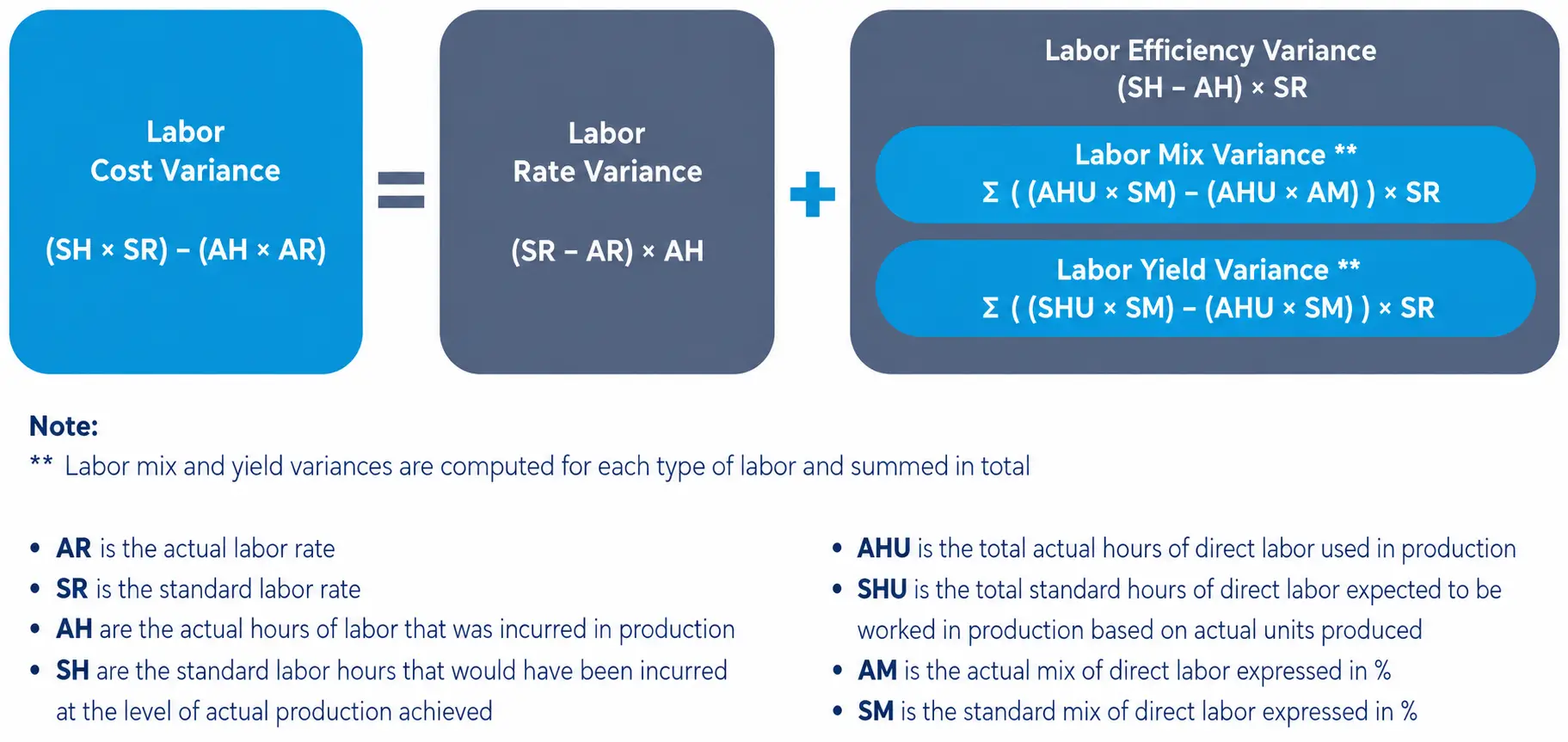
It can also be expressed in terms of the formulas:
AH are the actual hours of labor that was incurred in production
SH are the standard labor hours that would have been incurred at the level of actual production achieved
It is essential to understand the reasons behind these variances to interpret them correctly. For instance, if the Standard Cost of Standard Hours for Actual Production (SH) exceed the Actual Hours (AH), this reflects labor efficiency. Such a scenario is considered favorable for the company, as it indicates that less labor time was required than anticipated, leading to cost savings and improved operational performance.
The labor efficiency variance can be further analyzed through its two subcategories:
labor mix variance; and
labor yield variance
Together, these subcategories provide deeper insights into whether variances arise from changes in the composition of the workforce or inefficiencies in labor utilization.
Labor mix variance
This variance evaluates the cost impact of deviations in the proportions of different labor types (e.g., skilled vs. unskilled) used in production compared to the standard mix. This variance occurs when the actual labor mix differs from the planned mix, potentially leading to higher costs or productivity issues.
Expressed in formula:
Labor Mix Variance=Standard Cost of Total Actual Hours Used in Standard Proportion−Standard Cost of Total Actual Hours Used in Actual Proportion
It can also be expressed in terms of other formulas:
Labor Mix Variance=((Total Actual Hours Used×Standard Mix)−(Total Actual Hours Used×Actual Mix))×Standard Rate=((AHU×SM)−(AHU×AM))×SR=((AHU×SM)−AH)×SR
Where:
SR is the standard labor rate per hour
AHU is the total actual hours of direct labor used in production
SM is the standard mix of direct labor expressed in %
AM is the actual mix of direct labor expressed in %
AH is the actual hours of labor used for that specific type of labor
It is good to note that (AHU × AM) is equal to AH for that specific type of labor and there is no need to perform computations for this part of the formula. This is because when the Actual Mix (AM) is applied to total actual hours, it results to the Actual Hours (AH) for that specific type of input.
The formulas above are computed for each type of labor used in production and added together to the total labor mix variance.
Labor yield variance
This variance measures the efficiency of overall labor usage by assessing whether the total labor hours worked resulted in the expected level of output. It reflects the effect of changes in labor yield on labor cost, indicating how effectively labor inputs are converted into finished products.
Expressed in formulas:
Labor Yield Variance=Standard Cost of Total Standard Labor Usage in Standard Proportion−Standard Cost of Total Actual Labor Usage in Standard Proportion
It can also be expressed in terms of other formulas:
Labor Yield Variance=((Total Standard Labor Usage×Standard Mix)−(Total Actual Labor Usage×Standard Mix))×Standard Rate=((SHU×SM)−(AHU×SM))×SR
Where:
SR is the standard rate of direct labor
AHU is the total actual hours of direct labor used in production
SHU is the total standard hours of direct labor expected to be worked in production based on actual units produced
SM is the standard mix of direct labor expressed in %
The formulas above are computed for each type of direct labor used in production and added together to the total labor yield variance.
Labor efficiency variances
Measures difference: actual vs. standard labor hours for actual production
Formula: (SH−AH)×SR
SH = standard hours for actual output, AH = actual hours, SR = standard rate
Driven by operational factors: workflow, productivity, training, equipment
Mix & yield variance concepts
Standard Mix (SM) %: standard quantity of input / total standard quantity
Actual Mix (AM) %: actual quantity of input / total actual quantity
Both SM% and AM% across all inputs sum to 100%
Labor mix variance
Assesses cost impact of deviations in labor type proportions (e.g., skilled vs. unskilled)
Formula: ((AHU×SM)−(AHU×AM))×SR
AHU = total actual hours used, SM = standard mix %, AM = actual mix %, SR = standard rate
Calculated for each labor type, then summed
Labor yield variance
Measures efficiency of converting labor hours into output
Formula: ((SHU×SM)−(AHU×SM))×SR
SHU = total standard hours for actual output, AHU = total actual hours, SM = standard mix %, SR = standard rate
Calculated for each labor type, then summed
Sign up for free to take 15 quiz questions on this topic
The labor efficiency variance arises from the difference between the actual working hours and the standard working hours applied to the actual production. This variance is typically the responsibility of operations or production managers, as it reflects how efficiently labor hours are utilized during production. This variance is influenced by internal factors such as workflow processes, workforce productivity, employee training, and equipment availability. Unfavorable variances may result from inefficiencies like idle time, untrained staff, or machine downtime, while favorable variances indicate effective resource utilization. Since the variance is driven by operational efficiencies and processes, it is within the control of production teams to address and improve performance.
In terms of formula:
Labor Efficiency Variance=Standard Cost of Standard Hours for Actual Production−Standard Cost of Actual Hours
It can also be expressed in terms of the formulas:
AH are the actual hours of labor that was incurred in production
SH are the standard labor hours that would have been incurred at the level of actual production achieved
It is essential to understand the reasons behind these variances to interpret them correctly. For instance, if the Standard Cost of Standard Hours for Actual Production (SH) exceed the Actual Hours (AH), this reflects labor efficiency. Such a scenario is considered favorable for the company, as it indicates that less labor time was required than anticipated, leading to cost savings and improved operational performance.
The labor efficiency variance can be further analyzed through its two subcategories:
labor mix variance; and
labor yield variance
Together, these subcategories provide deeper insights into whether variances arise from changes in the composition of the workforce or inefficiencies in labor utilization.
Labor mix variance
This variance evaluates the cost impact of deviations in the proportions of different labor types (e.g., skilled vs. unskilled) used in production compared to the standard mix. This variance occurs when the actual labor mix differs from the planned mix, potentially leading to higher costs or productivity issues.
Expressed in formula:
Labor Mix Variance=Standard Cost of Total Actual Hours Used in Standard Proportion−Standard Cost of Total Actual Hours Used in Actual Proportion
It can also be expressed in terms of other formulas:
Labor Mix Variance=((Total Actual Hours Used×Standard Mix)−(Total Actual Hours Used×Actual Mix))×Standard Rate=((AHU×SM)−(AHU×AM))×SR=((AHU×SM)−AH)×SR
Where:
SR is the standard labor rate per hour
AHU is the total actual hours of direct labor used in production
SM is the standard mix of direct labor expressed in %
AM is the actual mix of direct labor expressed in %
AH is the actual hours of labor used for that specific type of labor
It is good to note that (AHU × AM) is equal to AH for that specific type of labor and there is no need to perform computations for this part of the formula. This is because when the Actual Mix (AM) is applied to total actual hours, it results to the Actual Hours (AH) for that specific type of input.
The formulas above are computed for each type of labor used in production and added together to the total labor mix variance.
Labor yield variance
This variance measures the efficiency of overall labor usage by assessing whether the total labor hours worked resulted in the expected level of output. It reflects the effect of changes in labor yield on labor cost, indicating how effectively labor inputs are converted into finished products.
Expressed in formulas:
Labor Yield Variance=Standard Cost of Total Standard Labor Usage in Standard Proportion−Standard Cost of Total Actual Labor Usage in Standard Proportion
It can also be expressed in terms of other formulas:
Labor Yield Variance=((Total Standard Labor Usage×Standard Mix)−(Total Actual Labor Usage×Standard Mix))×Standard Rate=((SHU×SM)−(AHU×SM))×SR
Where:
SR is the standard rate of direct labor
AHU is the total actual hours of direct labor used in production
SHU is the total standard hours of direct labor expected to be worked in production based on actual units produced
SM is the standard mix of direct labor expressed in %
The formulas above are computed for each type of direct labor used in production and added together to the total labor yield variance.