




Achievable logoAchievable logo
CMA Part 1
Sign in
Sign up
Purchase
Textbook
Practice exams
Support
How it works
Exam catalog
Mountain with a flag at the peak
Textbook
1. External financial reporting decisions
2. Planning, budgeting, and forecasting
3. Performance management
4. Cost management
5. Internal control
6. Technology and analytics
Achievable logoAchievable logo
3.1.4.6.3 Production volume variance
Achievable CMA Part 1
3. Cost and variance measures
3.1. Management by exception and standard cost systems
3.1.4. Fixed overhead (FOH) cost variance
Our CMA Part 1 course is currently in development and is a work-in-progress.

Production volume variance

5 min read
Font
Discuss
Share
Feedback
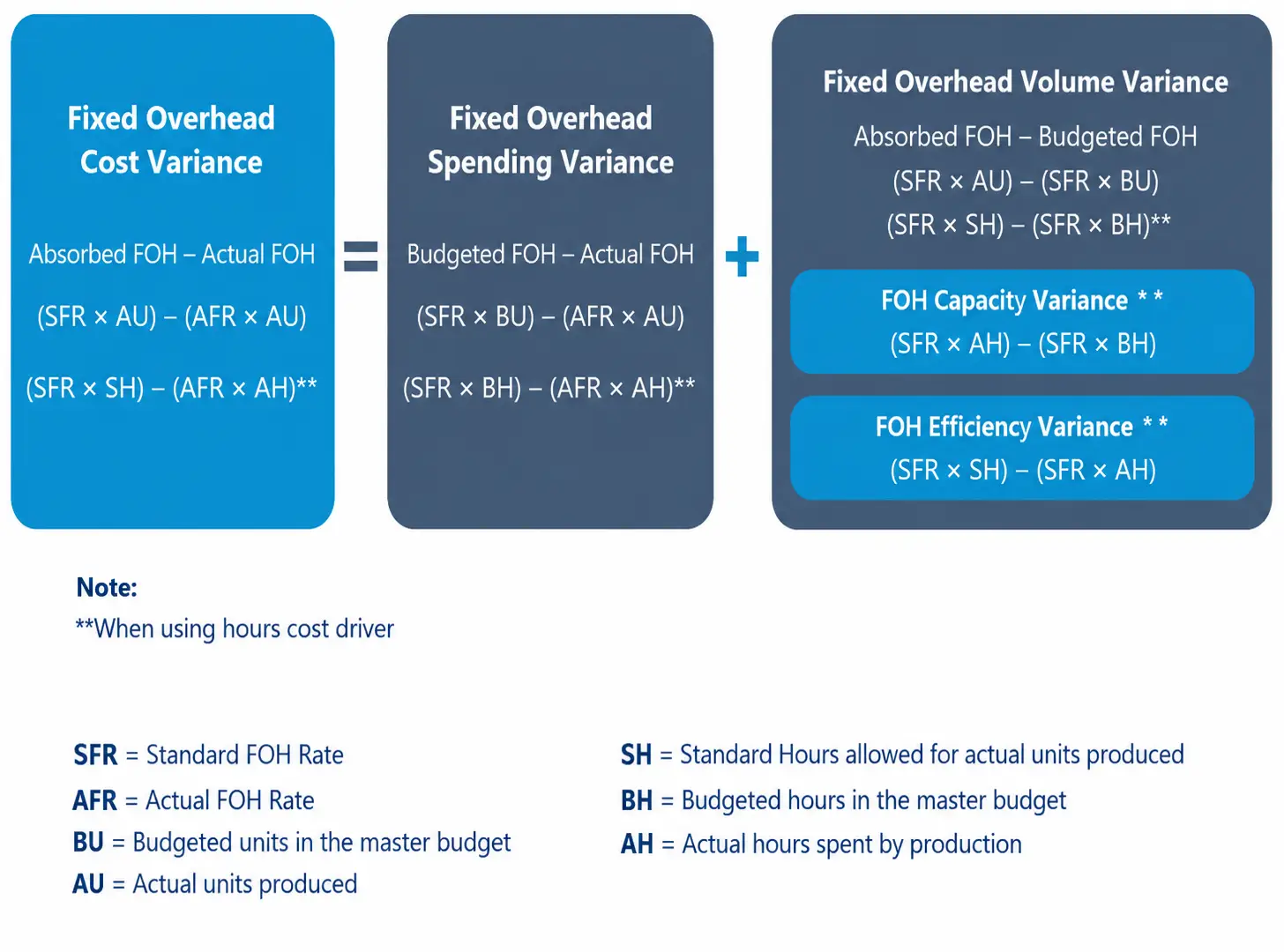
Formulas for fixed overhead cost, spending, volume, capacity, and efficiency variances.
FOH Variances Formulas

Production volume variance

The formula for calculating fixed overhead volume variance is:

FOH Volume Variance=Absorbed FOH−Budgeted FOH

Where:

  • Absorbed FOH means the amount of FOH included as unit cost by actual production. This is computed by applying the standard FOH rate to actual production
  • Budgeted FOH is the amount in the master budget

The following formula may also be helpful in case the CMA problem provided different inputs:

FOH Volume Variance​=(SFR × AU) − (SFR × BU)=(SFR × SH) − (SFR × BH)​

Where, if the cost driver is units produced:

  • SFR is the standard FOH rate. This could be calculated using the master budget.
  • BU are the budgeted units expected to be produced in the master budget.
  • AU are the actual units produced.

Mathematically, since the SFR is constant in the formula, we are computing the effects of the differences between Actual Units produced (AU) versus the Budgeted Units (BU).

Where, if the cost driver is not units produced:

  • BH are the budgeted hours in the master budget
  • SH are the standard hours allowed for the actual units produced.

It should be emphasized that when the cost driver is not in units produced, SH represents the standard hours allowed for actual production and not the Actual Hours (AH) incurred. AH will be used only when computing the FOH capacity and efficiency variances below.

Using the scenarios presented in the previous section, we can calculate the FOH volume variances for each scenario:

FOH volume variance scenarios


Using the scenarios presented in the previous sections, we can verify the FOH cost variances by adding up the spending and volume variance:

FOH variances summary of the scenario


When the cost drivers for the FOH are not the units of production (e.g. machine hours), the fixed overhead (FOH) volume variance can be further analyzed through its two subcategories:

  1. Capacity variance; and
  2. efficiency variance

Together, these subcategories provide deeper insights into whether variances arise from the under- or over-utilization of available production capacity or inefficiencies in the actual output relative to standard expectations.

FOH capacity variance

The FOH capacity variance is a component of the volume variance and it calculates the difference of the actual hours incurred by production versus the budgeted hours from the master budget, applying the standard FOH rate. Mathematically:

FOH capacity Variance=(SFR × AH) − (SFR × BH)

Where:

  • SFR is the standard FOH rate. This could be calculated using the master budget.
  • BH are the budgeted hours expected to be produced in the master budget.
  • AH are the actual hours incurred by production.

The portion of the formula (SFR × BH) refers to the Budgeted FOH in the master budget.

Since the SFR is constant in the formula, we are computing the effects of the differences between Actual Hours incurred by production (AH) versus the Budgeted Hours (BH).

When actual hours exceed budgeted hours, the variance is favorable because it indicates better utilization of production capacity. This means fixed overhead costs, which remain constant regardless of activity, are spread over more hours, effectively reducing the cost per unit of output and improving resource efficiency. Conversely, fewer actual hours result in an unfavorable variance, as capacity is underutilized, leading to higher fixed costs per unit.

FOH efficiency variance

The FOH efficiency variance is a component of the volume variance and it calculates the difference between the standard hours allowed for the actual units produced versus the actual hours incurred by production:

FOH Efficiency Variance=(SFR × SH) − (SFR × AH)

Where:

  • SFR is the standard FOH rate. This could be calculated using the master budget.
  • SH are the standard hours allowed for the actual units produced.
  • AH are the actual hours incurred by production.

The portion of the formula (SFR × SH) refers to the Absorbed FOH.

Since the SFR is constant in the formula, we are computing the effects of the differences between Standard Hours allowed for actual production (SH) versus the Actual Hours incurred by production (AH).

When standard hours exceed actual hours, the variance is favorable, as it indicates efficient use of labor or resources (i.e. less time was required to produce the expected output). Conversely, when actual hours exceed standard hours, the variance is unfavorable, as it suggests inefficiencies in production, requiring more time than expected to achieve the same level of output. This variance highlights how effectively production resources are utilized relative to expectations.

Production volume variance

  • Measures difference: Absorbed FOH vs. Budgeted FOH
  • Key formula: FOH Volume Variance = (SFR × AU) − (SFR × BU) or (SFR × SH) − (SFR × BH)
    • SFR = standard FOH rate; AU = actual units; BU = budgeted units; SH = standard hours; BH = budgeted hours
  • Focus: Impact of actual vs. budgeted production (units or hours) on FOH absorption

FOH capacity variance

  • Measures: (SFR × AH) − (SFR × BH)
    • AH = actual hours; BH = budgeted hours
  • Indicates utilization of production capacity
    • Favorable if AH > BH (better utilization)
    • Unfavorable if AH < BH (underutilization)

FOH efficiency variance

  • Measures: (SFR × SH) − (SFR × AH)
    • SH = standard hours allowed for actual output; AH = actual hours
  • Indicates efficiency in resource use
    • Favorable if SH > AH (efficient)
    • Unfavorable if AH > SH (inefficient)

Subcategories of FOH volume variance

  • Volume variance = Capacity variance + Efficiency variance
  • Analyzes under/over-utilization and production efficiency separately

Sign up for free to take 10 quiz questions on this topic

Previous
Next  | 3.1.4.6.4 FOH cost variance scenario
All rights reserved ©2016 - 2026 Achievable, Inc.

Production volume variance

Production volume variance

The formula for calculating fixed overhead volume variance is:

FOH Volume Variance=Absorbed FOH−Budgeted FOH

Where:

  • Absorbed FOH means the amount of FOH included as unit cost by actual production. This is computed by applying the standard FOH rate to actual production
  • Budgeted FOH is the amount in the master budget

The following formula may also be helpful in case the CMA problem provided different inputs:

FOH Volume Variance​=(SFR × AU) − (SFR × BU)=(SFR × SH) − (SFR × BH)​

Where, if the cost driver is units produced:

  • SFR is the standard FOH rate. This could be calculated using the master budget.
  • BU are the budgeted units expected to be produced in the master budget.
  • AU are the actual units produced.

Mathematically, since the SFR is constant in the formula, we are computing the effects of the differences between Actual Units produced (AU) versus the Budgeted Units (BU).

Where, if the cost driver is not units produced:

  • BH are the budgeted hours in the master budget
  • SH are the standard hours allowed for the actual units produced.

It should be emphasized that when the cost driver is not in units produced, SH represents the standard hours allowed for actual production and not the Actual Hours (AH) incurred. AH will be used only when computing the FOH capacity and efficiency variances below.

Using the scenarios presented in the previous section, we can calculate the FOH volume variances for each scenario:


Using the scenarios presented in the previous sections, we can verify the FOH cost variances by adding up the spending and volume variance:


When the cost drivers for the FOH are not the units of production (e.g. machine hours), the fixed overhead (FOH) volume variance can be further analyzed through its two subcategories:

  1. Capacity variance; and
  2. efficiency variance

Together, these subcategories provide deeper insights into whether variances arise from the under- or over-utilization of available production capacity or inefficiencies in the actual output relative to standard expectations.

FOH capacity variance

The FOH capacity variance is a component of the volume variance and it calculates the difference of the actual hours incurred by production versus the budgeted hours from the master budget, applying the standard FOH rate. Mathematically:

FOH capacity Variance=(SFR × AH) − (SFR × BH)

Where:

  • SFR is the standard FOH rate. This could be calculated using the master budget.
  • BH are the budgeted hours expected to be produced in the master budget.
  • AH are the actual hours incurred by production.

The portion of the formula (SFR × BH) refers to the Budgeted FOH in the master budget.

Since the SFR is constant in the formula, we are computing the effects of the differences between Actual Hours incurred by production (AH) versus the Budgeted Hours (BH).

When actual hours exceed budgeted hours, the variance is favorable because it indicates better utilization of production capacity. This means fixed overhead costs, which remain constant regardless of activity, are spread over more hours, effectively reducing the cost per unit of output and improving resource efficiency. Conversely, fewer actual hours result in an unfavorable variance, as capacity is underutilized, leading to higher fixed costs per unit.

FOH efficiency variance

The FOH efficiency variance is a component of the volume variance and it calculates the difference between the standard hours allowed for the actual units produced versus the actual hours incurred by production:

FOH Efficiency Variance=(SFR × SH) − (SFR × AH)

Where:

  • SFR is the standard FOH rate. This could be calculated using the master budget.
  • SH are the standard hours allowed for the actual units produced.
  • AH are the actual hours incurred by production.

The portion of the formula (SFR × SH) refers to the Absorbed FOH.

Since the SFR is constant in the formula, we are computing the effects of the differences between Standard Hours allowed for actual production (SH) versus the Actual Hours incurred by production (AH).

When standard hours exceed actual hours, the variance is favorable, as it indicates efficient use of labor or resources (i.e. less time was required to produce the expected output). Conversely, when actual hours exceed standard hours, the variance is unfavorable, as it suggests inefficiencies in production, requiring more time than expected to achieve the same level of output. This variance highlights how effectively production resources are utilized relative to expectations.

Key points

Production volume variance

  • Measures difference: Absorbed FOH vs. Budgeted FOH
  • Key formula: FOH Volume Variance = (SFR × AU) − (SFR × BU) or (SFR × SH) − (SFR × BH)
    • SFR = standard FOH rate; AU = actual units; BU = budgeted units; SH = standard hours; BH = budgeted hours
  • Focus: Impact of actual vs. budgeted production (units or hours) on FOH absorption

FOH capacity variance

  • Measures: (SFR × AH) − (SFR × BH)
    • AH = actual hours; BH = budgeted hours
  • Indicates utilization of production capacity
    • Favorable if AH > BH (better utilization)
    • Unfavorable if AH < BH (underutilization)

FOH efficiency variance

  • Measures: (SFR × SH) − (SFR × AH)
    • SH = standard hours allowed for actual output; AH = actual hours
  • Indicates efficiency in resource use
    • Favorable if SH > AH (efficient)
    • Unfavorable if AH > SH (inefficient)

Subcategories of FOH volume variance

  • Volume variance = Capacity variance + Efficiency variance
  • Analyzes under/over-utilization and production efficiency separately

More from Fixed overhead (FOH) cost variance

  • FOH cost variance scenario
  • FOH spending variance
  • Overview of FOH cost variance formula