



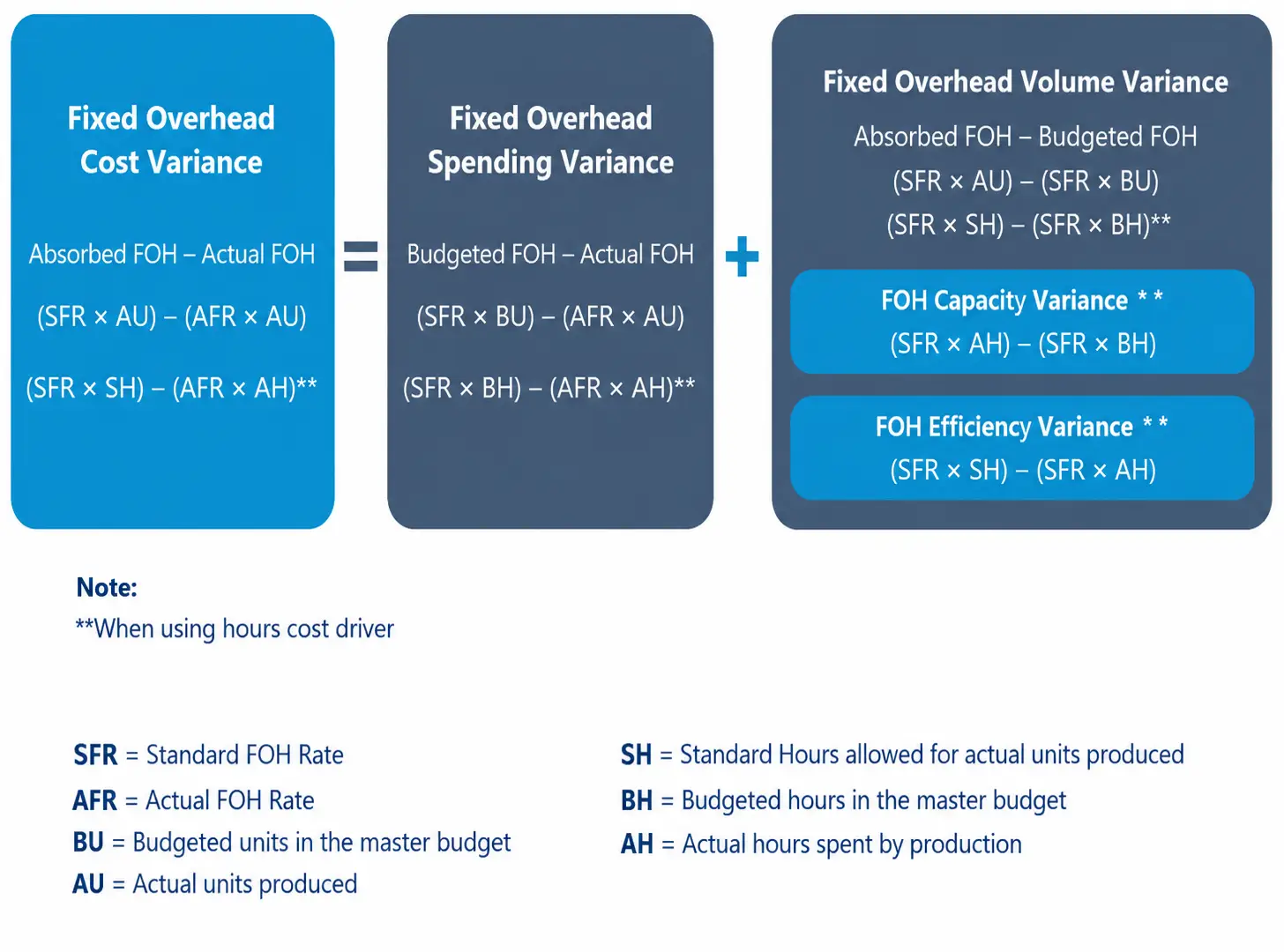

FOH spending variance
Fixed overhead spending variance
The formula for calculating fixed overhead spending variance is:
Where:
- is the amount of FOH in the master budget
- is the actual FOH incurred during the period
This variance is typically easier to compute since both items are typically readily available. However, the following formulas may also be helpful in case the exam problem provided different inputs:
Where:
- is the actual FOH rate
- is the standard FOH rate. This could be calculated using the master budget.
- are the budgeted units expected to be produced in the master budget.
- are the budgeted hours in the master budget. When the cost driver of the FOH is not units produced.
- are the actual units produced.
- are the actual hours incurred by production. When the cost driver of the FOH is not units produced.
The FOH spending variance measures the difference between the budgeted FOH from the master budget and the actual FOH incurred during the period. A positive variance indicates a favorable outcome, where actual fixed overhead costs were lower than budgeted, while a negative variance signifies an unfavorable outcome, where actual fixed overhead costs exceeded the budget.
This variance is relatively straightforward to compute since both the budgeted and actual fixed overhead amounts are readily available. Understanding the reasons behind these variances is crucial. For example, if actual FOH exceeds the budgeted amount, it may result from unexpected expenses such as higher maintenance costs or higher factory rent than budgeted, which can negatively impact the company’s financial performance.
Using the scenarios presented in the previous section, we can calculate the FOH spending variances for each scenario: