



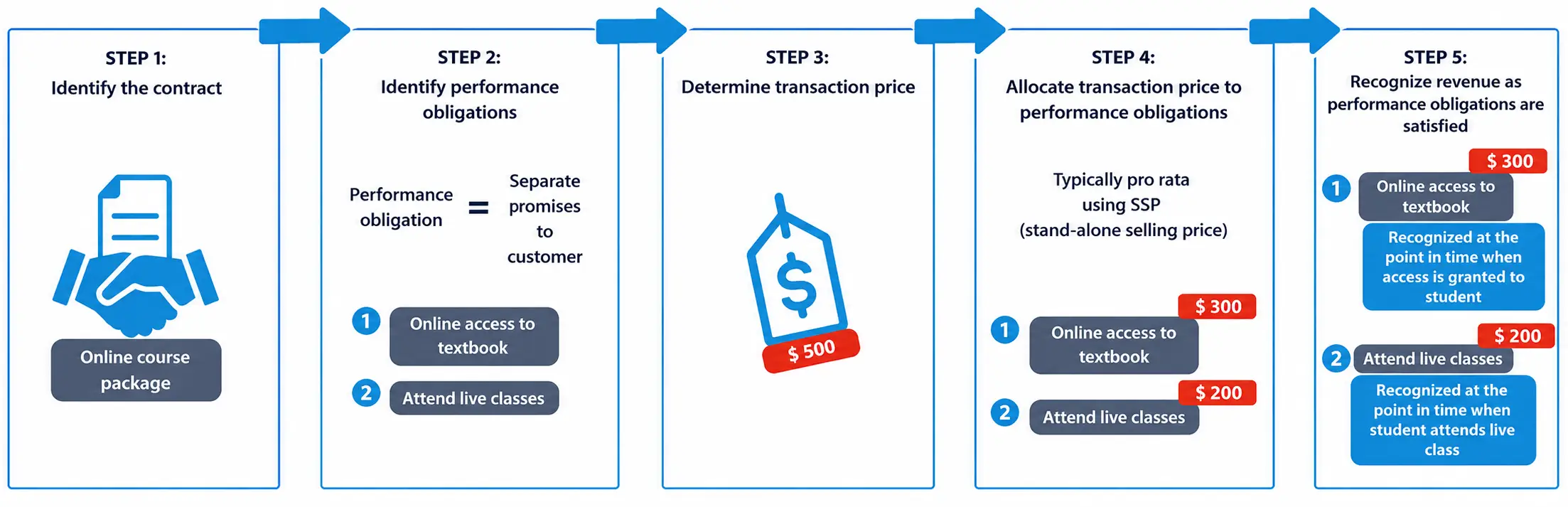
Revenue recognition steps
The core principle of revenue recognition is for an entity to recognize revenue to depict the transfer of promised goods or services to customers in an amount that reflects the consideration to which the entity expects to be entitled in exchange for those goods or services.
The application of this core principle is further reflected in the five-step model:
- Step 1 - Identify the contract
- Step 2 - Identify the performance obligations
- Step 3 - Determine the transaction price
- Step 4 - Allocate the transaction price to the performance obligations
- Step 5 - Recognize revenue as the performance obligations are satisfied
These are further encapsulated in the below concept map for this section:
Step 1 - Identify the contract
The first step in applying the revenue standard is to determine if the contract is within the scope of the ASC 606 as a contract with a customer.
This assessment is done on a contract-by-contract basis. Since certain arrangements are specifically covered by other standards, Step 1 involves an assessment of whether the arrangement is covered by another guidance, and therefore excluded from ASC 606. Examples of contracts covered by other standards are as follows:
- Leases under ASC 842
- Insurance contracts under ASC 944
- Certain financial instruments and contractual rights under various standards
- Nonmonetary exchanges between reporting entities in the same line of business
- Guarantees under ASC 460
When it is confirmed that the arrangement is not covered by another guidance, the company should then assess if it falls within the definition of a contract with a customer by satisfying all of the criteria below:
- The contract has been approved whether in writing, orally or with customary business practices, and the parties are committed to perform their obligations
- The company can identify each party’s rights regarding the goods or services to be transferred
- The company can identify the payment terms in exchange for the goods or services to be transferred
- The contract has commercial substance, which implies that the contract has an expected impact on the company’s future results and cash flows
- It is probable that the company will be able to collect substantially all of the consideration it is entitled to based on the contract
The criteria above determines whether there are enforceable rights and obligations in a contract and if not all of the criteria above are satisfied, it is questionable whether the contract falls under the scope of the revenue guidance.
ASC 606 provides further guidance on how to re-assess the contract especially when the certain criteria are subsequently met and when the company already received a consideration from the customer. These provisions are not covered by the CMA exams.
Step 2 - Identify the performance obligations
After confirming from Step 1 that the arrangement is a contract with a customer within the scope of the revenue guidance, we need to examine the contract for the promised goods and services and to identify which of them are separate performance obligations.
Revenues are recognized based on performance obligations and it is important to identify them because when a contract has multiple performance obligations in exchange for a single consideration, the performance obligations become the unit of account for which we split the consideration to recognize the revenues.
A contract may contain multiple promises and the revenue standard has provided some guidance to determine which provisions are considered distinct promises to the customer by answering a few questions:
- Can the customer benefit from the good or service on its own or with other readily available resources?
- Is the entity’s promise to transfer the good or service separately identifiable from other promises in the contract?
If the answer to any of the questions above is “no”, then the promise is not distinct. The company should group it with other promises within the contract until a distinct bundle is identified as a separate performance obligation.
Step 3 - Determine the transaction price
After identifying the performance obligations in Step 2, we need to determine the total consideration that needs to be split later (in Step 4) for these performance obligations. This consideration is referred to as the transaction price.
The process can be a straightforward exercise since in most simple cases, the transaction price is specifically identified in the contract. However, it can be complicated when variable considerations and financing components are concerned.
The table below summarizes the most common items to be included in the transaction price.
| Fixed consideration | XX |
| Variable consideration | XX |
| Significant financing component | (XX) or XX |
| Non-cash component | XX |
| Total transaction price | XX |
The components of the consideration aside from the fixed component are discussed below.
Variable consideration
This arises in a contract in which the amount of consideration that the entity is expected to be entitled to is not fixed.
This could be because of provisions in the contract that depend on some future milestone such as incentives and bonuses to the company; or provisions that reduce the consideration for any reasons such as customer dissatisfaction, as in the case for rebates, refunds, and penalties.
An entity is required to estimate the amount of variable consideration by using either of two methods:
- The expected value method - The sum of probability-weighted amounts in a range of possible consideration amounts which may be appropriate if the contract has large number of possible outcomes; or
- The most likely amount method - The single most likely amount in a range of possible consideration amounts which may be appropriate if the contract has a few possible outcomes (i.e., when outcomes are meeting the milestone or not).
Once the estimate has been computed, the company should apply the “variable consideration constraint” by recognizing (i.e., only including in the transaction price) an amount that reflects the extent it is probable that a significant reversal in the amount of revenue recognized will not occur when the uncertainty associated with the variable consideration is resolved.
At the end of each accounting period, the company must re-assess the estimated transaction price for any changes in circumstances.
Significant financing component
A contract contains a significant financing component when the consideration is expected to be paid for more than one year.
In this case, the amount included in the transaction price is the total of the future payments adjusted for the time value of money. The amount included in the transaction price is recognized as revenue when the performance obligations are fulfilled while the difference between the total consideration and the discounted future payments are recognized as interest income over time. This approach fulfills the objective of recognizing revenues on the contract at an amount that reflects the cash selling price of the good or service.
The payments are discounted at a discount rate that would be reflected in a separate financing transaction between the entity and its customer at contract inception. This discount rate is not updated for any change in circumstances.
Non-cash consideration
When the contract with the customer involves a non-cash consideration, the company should measure the non-cash consideration at fair value at the inception of the contract (i.e., when the criteria for contract existence is met in Step 1).
The fair value of the non-cash consideration becomes part of the transaction price. However, when the fair value cannot be reasonably estimated, the non-cash consideration can be indirectly measured by the stand-alone selling price of the goods or service promised to the customer in the contract.
Non-cash considerations could be in the form of inventories, stocks or warrants, PPE or other types of assets.
Step 4 - Allocate the transaction price to the performance obligations
After determining the transaction price in Step 3, the next step is to allocate this amount to the individual performance obligations identified in Step 2.
The allocation is generally based on the relative fair values of the individual performance obligations and the best indicator of the fair values are the standalone selling prices (SSP) of the performance obligations.
When SSPs are available for all performance obligations, the company simply allocates the transaction price on a prorata basis using the SSPs then proceeds to Step 5 for the recognition of the revenues. If the standalone selling price is not directly observable, then it must be estimated.
When estimating the SSP of a performance obligation, the best way is to look at what a company actually charges for it when they sell it separately to similar customers. However, sometimes goods aren’t sold separately, so we need to estimate the standalone selling price. This can be tricky and often involves judgment, especially when dealing with unique goods or services that are usually bundled with other products. Hence, in practice, there could be different ways of estimating the SSPs depending on the reporting entity’s customary practices.
It’s important to remember that we determine the standalone selling price of each item in a contract at inception. Even if the price changes later on, we don’t go back and adjust the original allocation performed in this step.
In the case of a discount, the company has to determine if the discount pertains to one or more individual performance obligations and allocate the discount proportionately to those performance obligations only. If there is no evidence that the discount pertains to specific performance obligations, then the discount is allocated to all performance obligations proportionately using the SSPs. This could be the case when companies typically sell products in bundles.
Step 5 - Recognize revenue as the performance obligations are satisfied
The last step of revenue recognition follows after the company has determined the share of each individual performance obligation of the transaction price.
The main concept of Step 5 is the determination of when the performance obligation is satisfied because it triggers the recognition of the revenue allocated to that performance obligation.
A company satisfies its performance obligation to the customer by transferring control of the goods or service related to the performance obligation which could be done in two cases:
- Performance obligations are satisfied over time
- Performance obligations are satisfied at a point in time
Case 1: Performance obligations satisfied over time
This means the revenue allocated is recognized based on a measure of progress determined by the entity. The performance obligation is satisfied over time when one of the following criteria are met:
- There is simultaneous receipt and consumption of the benefits provided by the company’s performance of the obligations from the contract
- The company’s performance of the obligations from the contract enhances or creates an asset controlled by the customer
- The company’s performance of the obligations from the contract does not create an asset with an alternative use to the company, and the company has an enforceable right to payment for performance completed to date.
Case 2: Performance obligations satisfied at a point in time
This means the whole revenue allocated to the performance obligations is recognized at once, when the performance obligation (i.e., the promise to the customer) is satisfied.
If a performance obligation is not satisfied over time based on the three criteria identified above, then the performance obligation is satisfied at a point in time.
Generally, the customer obtains control of the asset when they have:
- Direct control of the asset; and
- When they can obtain substantially the remaining benefits of the asset after the transfer.