



Revenue transactions
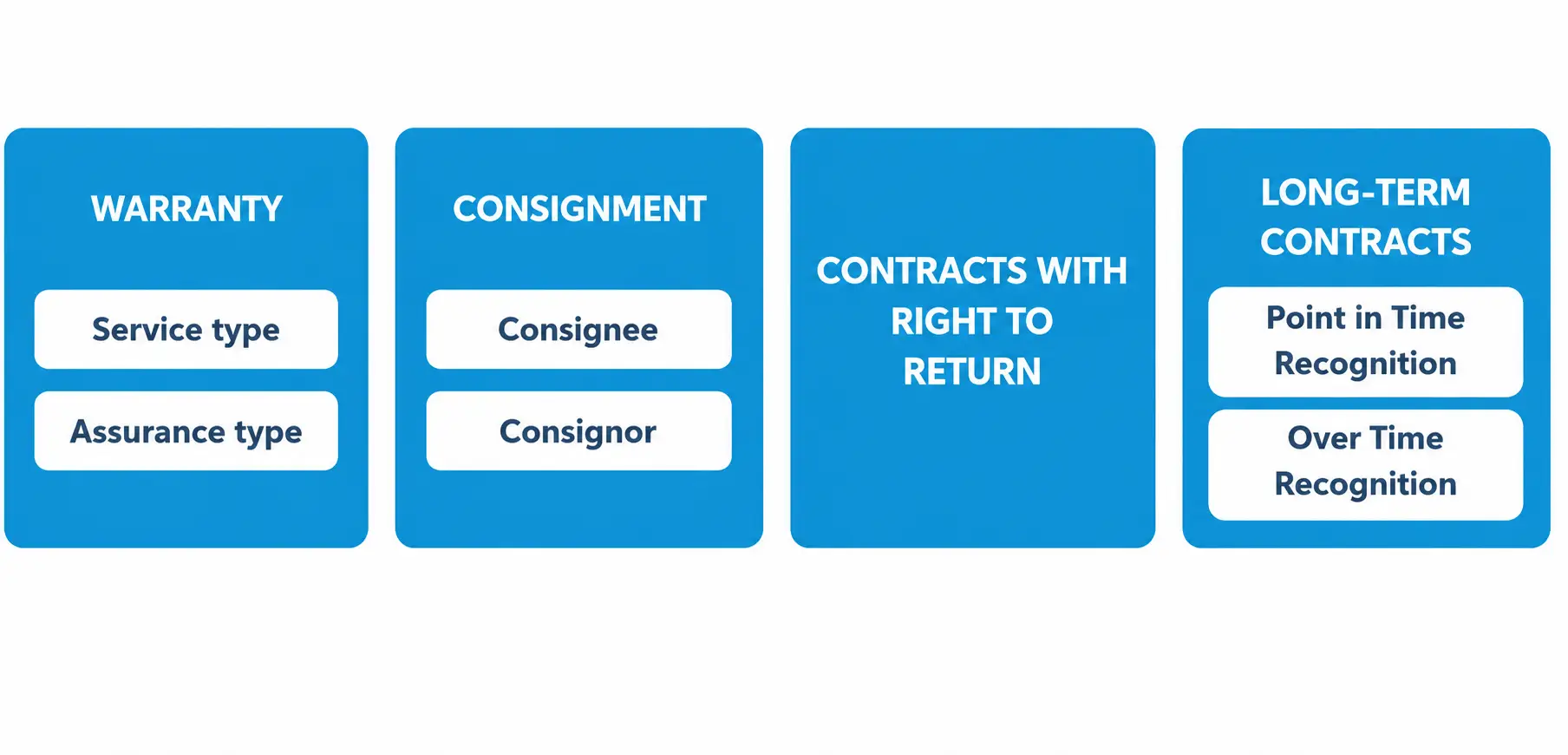
Although there are several types of special transactions affecting revenue recognition, the transactions relevant for the CMA exam are the following:
- Warranties
- Consignment sales
- Contracts with right to return
- Long-term contracts (discussed in the next section)
Warranties
Warranties have been discussed in a separate section since it was identified to have a separate learning outcome statement. However, it may be good to revisit that section once you have learned more about the concepts of performance obligations from this section.
As a recap, there are two types of warranties:
- Service type warranty
- Assurance type warranty
Service type warranties
These are warranties that are considered separate performance obligations in the revenue recognition assessment under ASC 606. These warranties can either be purchased as a separate product or they provide an additional service to the customer in order to comply with the warranty agreement such as providing extended repairs and replacement services.
This indicates that the company will provide additional services beyond the normal assurance that the product functions as intended.
Assurance type warranties
These are warranties that are not separate performance obligations.
These warranties do not provide additional service to the customer but only provide assurance that a product will comply with certain agreed specifications. These types of warranties are not available to be purchased separately, such as providing a warranty for manufacturing defects up to one year after the sale. These are covered by ASC 460 on contingencies.
Consignment sales
Consignment sales have been partially discussed in the section about inventories with the particular focus on the inventory side of the transaction.
In this section it will be re-discussed while highlighting the concepts about revenue recognition.
Consignor’s books
Since the consignor is the owner of the goods until the time they are sold by the consignee, the main accounting by the consignor upon delivery of the goods to the consignee is just to transfer the cost of the goods from the main inventory account to an inventories out on consignment account and capitalize all freight costs paid when delivering the goods to the consignee’s warehouse.
| Account | Debit | Credit | Financial statement element |
| Inventories out on consignment | XXX | Asset | |
| Inventories | XXX | Asset | |
| Cash | XXX | Asset | |
| To record delivery of inventories out on consignment | |||
The credit in cash in the journal entry above represents the costs to deliver inventories to the consignee. These are capitalizable costs and should not be expensed.
When the inventory is finally sold by the consignee, the consignor should record the full revenue from the sale. Any commissions paid to the consignee are recorded separately in an expense account and should not be netted from the revenues.
| Account | Debit | Credit | Financial statement element |
| Receivable from consignee | XXX | Asset | |
| Commission expense - consignee | XXX | Expense | |
| Revenue from consignment sales | XXX | Revenue | |
| To record sales by consignee with commission recorded as a separate expense | |||
Assuming the perpetual inventory system is used, the consignor should record the cost of goods sold.
| Account | Debit | Credit | Financial statement element |
| Cost of goods sold | XXX | Expense | |
| Inventory out on consignment | XXX | Asset | |
| To record cost of goods sold on consignee’s sales | |||
Consignee’s books
The consignee is just an agent of the consignor on the sale. Consignees do not record any journal entry when the goods have been received in their warehouse since they do not have ownership of the consigned goods. The revenues of the consignee are in the form of the commission revenues.
| Account | Debit | Credit | Financial statement element |
| Cash | XXX | Asset | |
| Payable to consignor | XXX | Liability | |
| Commission revenue | XXX | Revenue | |
| To record consignment sales | |||
The liability is then debited and cash is credited for the same amount upon remittance to the consignor.
Contracts with right to return
Some sales arrangements allow for customers to hold the goods but they are given a period in which to decide whether they will purchase or return the goods.
In such contracts the right to return the product is not treated as a separate performance obligation, however revenue is recorded only net of the expected returns. ASC 606 has provided guidance on how to account for such contracts. According to the Codification, the following should be recognized upon sale:
- Revenue for the transferred products net of the expected returns
- Refund liability based on the expected amounts to be refunded to the customers
- A refund asset representing the company’s right to recover products form the customer in settling the refund liability. This is recorded as an adjustment to the cost of goods sold originally recorded upon sale
Example: Sale with right of return
Assuming Achievable Co. sells 100 units of Product A to a customer with a right to return products for any reason for a full refund within 120 days. Product A costs $20 and is sold for $50 per unit. Based on Achievable’s Co.'s estimate 5% of the sales will be returned for a full refund. Achievable Co. has no further obligations to the customer after transferring control of product A.
Answer: The following are the journal entries under ASC 606.
| Account | Debit | Credit | Financial statement element |
| Cash | 5,000 | Asset | |
| Sales revenue | 4,750 | Revenue | |
| Refund liability | 250 | Liability | |
| To record the sales revenue net of estimated returns | |||
| Account | Debit | Credit | Financial statement element |
| Cost of goods sold | 1,900 | Expense | |
| Refund asset | 100 | Asset | |
| Inventory | 2,000 | Asset | |
| To record the cost of goods sold net of the return asset | |||
At the end of the period, the refund asset should be assessed for impairment and the return liability should be assessed for any expired agreements and revision of estimates.