


Achievable logoAchievable logo
CMA Part 1
Sign in
Sign up
Purchase
Textbook
Practice exams
Support
How it works
Exam catalog
Mountain with a flag at the peak
Textbook
1. External financial reporting decisions
2. Planning, budgeting, and forecasting
3. Performance management
4. Cost management
5. Internal control
6. Technology and analytics
Achievable logoAchievable logo
1.2.11.1.6 Over time recognition method
Achievable CMA Part 1
1. Financial transactions
1.2. Income statement
1.2.11. Revenue recognition
Our CMA Part 1 course is currently in development and is a work-in-progress.

Over time recognition method

14 min read
Font
Discuss
Share
Feedback
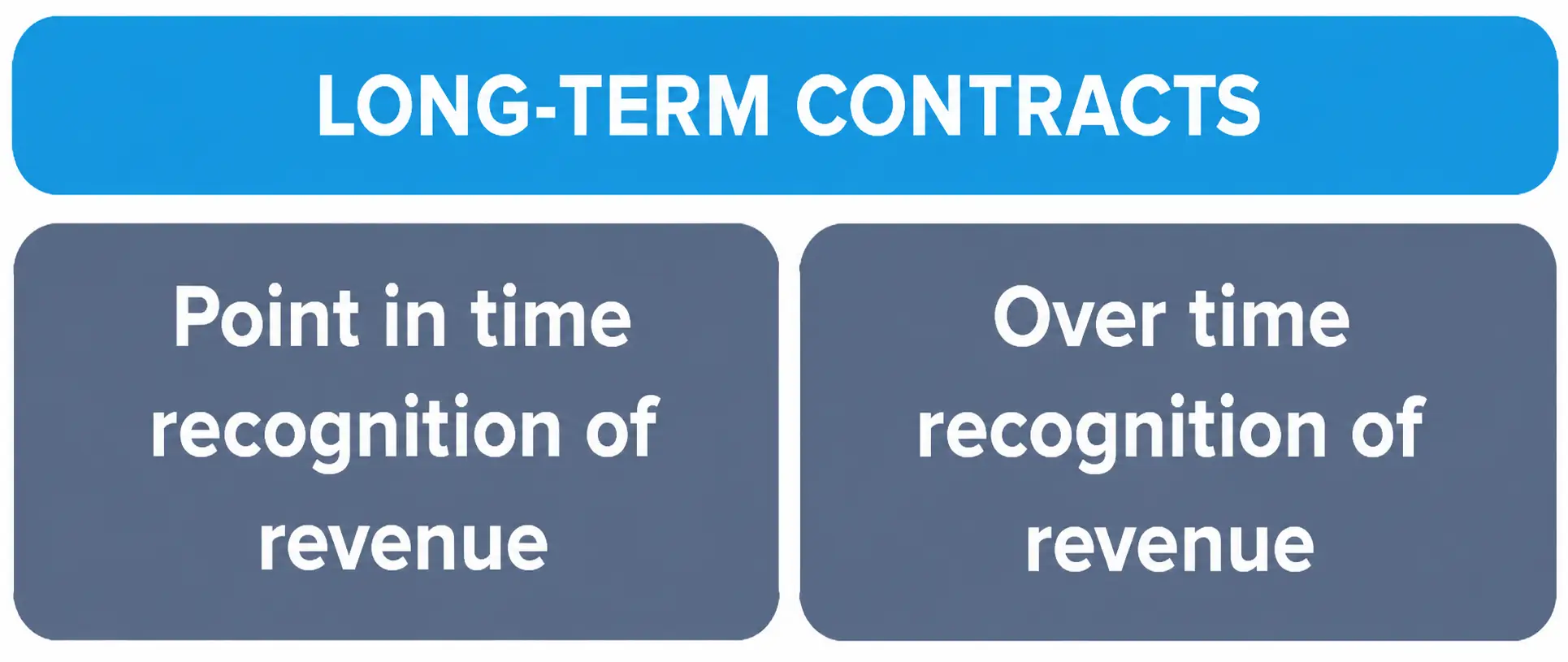
Showing long-term contract revenue recognized at a point in time or over time.
Long-Term Contract Recognition

Over time recognition method

When the contract requires some time to perform, and the performance obligations meet the criteria of being satisfied over time, the company records revenues, cost of sales and gross profit as the company fulfills its obligations in the contract.

This means that unlike the previous case of point in time recognition, the income statement is affected every year-end that the contract is not concluded.

In order for the revenue to be satisfied over time, any one of the criteria below should be met:

  1. There is simultaneous receipt and consumption of the benefits provided by the company’s performance of the obligations from the contract
  2. The company’s performance of the obligations from the contract enhances or creates an asset controlled by the customer
  3. The company’s performance of the obligations from the contract does not create an asset with an alternative use to the company, and the company has an enforceable right to payment for performance completed to date.

Recognition of the revenues can be straight-forward for some contracts in which the revenue is recognized on a straight-line basis. However, accounting for a construction contract can be more complex due to the application of the percentage of completion method. The following are the steps to follow in applying the method:

  1. Calculate the percentage of completion
  2. Calculate the total gross profit from the contract
  3. Calculate the revenue and gross profit to be recognized to date
  4. Record the relevant year-end journal entries
  5. Understand the financial statement presentation

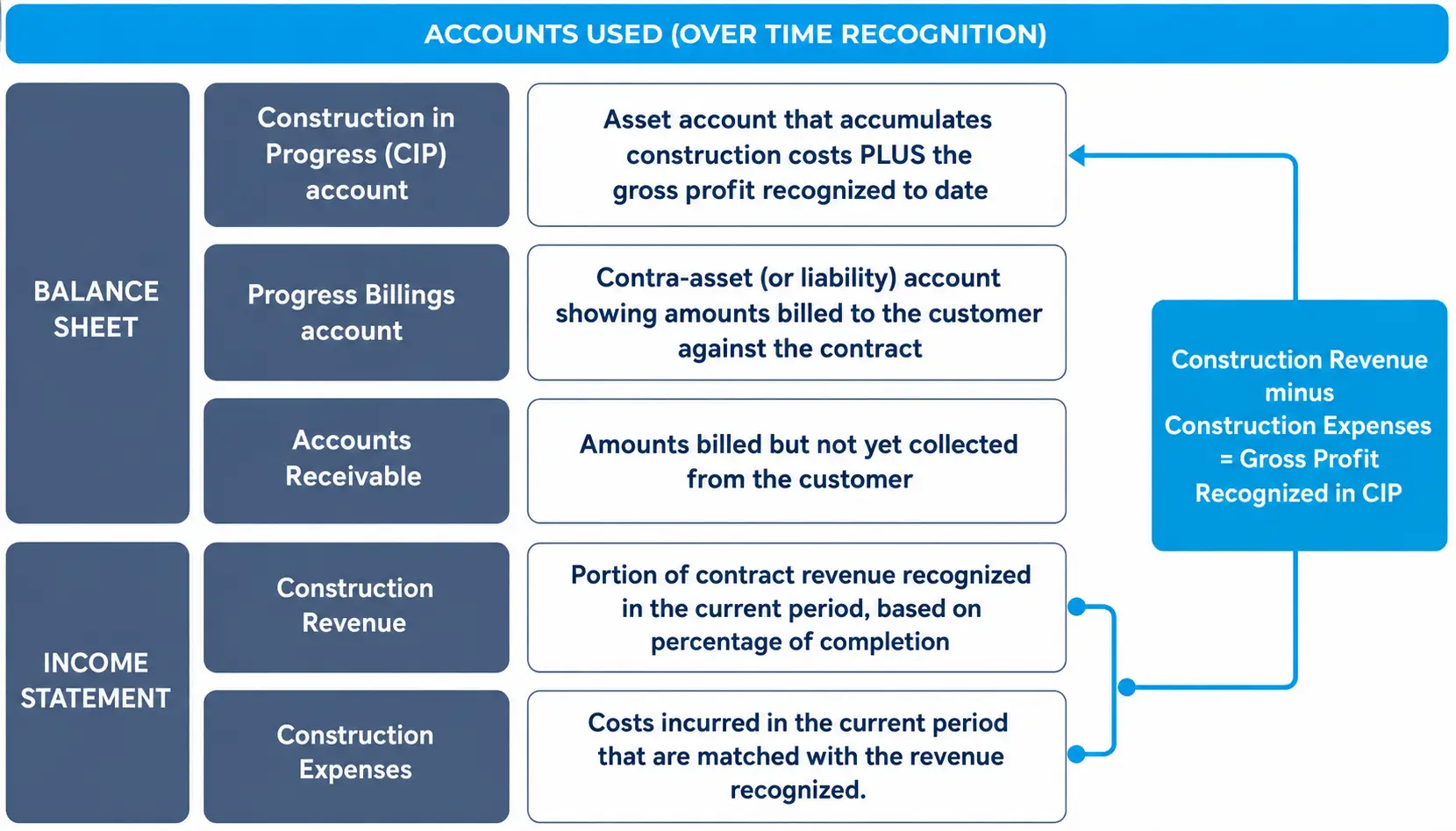
Accounting for long-term contracts in which revenues are recognized over time use specific accounts that students need to be familiar with because they are not typically used in other types of transactions:

Listing accounts used in over-time revenue recognition, showing construction in progress plus recognized gross profit.
Over-Time Recognition Accounts

The accounts are used the same way as in point-in-time recognition, with one key difference: the CIP account accumulates both the actual costs incurred to date and the gross profit recognized to date, not just the costs.

Step 1: Calculate the percentage of completion

The percentage of completion is calculated every end of the year to track the progress of the project.

There are two possible methods that companies can use depending on the specific circumstances of the project:

  • Output method which calculates the progress based on the value the customer has obtained from the contract such as number of units produced.
  • Input method which calculates the progress of the project using the inputs used in the construction such as consumed resources, labor hours, etc.

The most common method being used in exams is for the input method which is also called the cost-to-cost method.

Percentage of completion=Actual costs incurred to date+Estimated costs to completeActual costs incurred to date​

The denominator is also called total estimated contract costs. In the exams, candidates should be careful in determining the type of costs provided by the problem because it can provide directly the total estimated costs or a breakdown of it.

The examples moving forward pertain to the input method.

Step 2: Calculate the total gross profit from the contract

The total gross profit from the contract should also be calculated every year-end.

This is the estimated total profit that the company is expecting to obtain at the conclusion of the contract. The inputs used in the computation is similar to a normal gross profit computation as follows:

Contract price XX
Less: costs incurred to date (XX)
Less: estimated costs to incur (XX)
Estimated gross profit (loss) on the contract XX (XX)

This portion is important because, just like in point in time recognition method, estimated losses on a contract are also recognized immediately in full despite the percentage of completion while gross profits are recognized on a piecemeal basis using the percentage of completion computed from the previous step.

Reversal of previously recognized gross profit when a contract becomes loss-making

Under the over-time (percentage-of-completion) method, gross profit is recognized progressively as performance obligations are satisfied. However, if revised estimates indicate that a contract will result in an overall loss, U.S. GAAP requires that the entire expected loss be recognized immediately in the period the loss becomes evident.

This requirement has an important implication: the current-period loss recognized must bring the contract’s cumulative recognized income down to the full expected loss. Since prior periods may have already recognized gross profit, the current-period loss equals the total expected contract loss plus any gross profit recognized in prior periods - this is what effectively reverses that prior profit as part of recognizing the full expected loss.

Current-period loss=Total expected contract loss+gross profit previously recognized

The objective is to ensure that cumulative income recognized to date reflects the full expected loss on the contract. After this adjustment, the contract will show a cumulative loss position consistent with the revised estimate.

Step 3: Calculate the revenue and gross profit to be recognized to date

Now we are calculating inputs to the journal entries. For over time recognition of revenues, the following items are needed for the journal entries:

The revenues to be recognized in the current period is calculated as follows:

Contract price XX
Multiply: percentage of completion %
Total revenues to be recognized to date XX
Less: revenues recognized in prior periods (XX)
Total revenues to be recognized in the current period XX

The gross profit to be recognized follow the same logic as above except that the main input is the gross profit computed from the previous step:

Total estimated gross profit from the contract XX
Multiply: percentage of completion %
Total estimated gross profit to be recognized to date XX
Less: gross profits recognized in prior periods (XX)
Gross profit to be recognized in the current period XX

The costs to be recognized are in the form of the actual costs incurred in the current period and there is no need to create special computations.

If the calculations above are computed consistently, the following computation should hold true and becomes the basis of the year-end journal entries:

Total revenues to be recognized in the current period XX
Less: actual costs incurred during the period (XX)
Gross profit to be recognized in the current period XX

Step 4: Record the relevant year-end journal entries

The accounts to be used for this method are the same as the point in time recognition method but the journal entries are different because of the recognition of the gross profit in each year-end.

Step 4.1: Contract costs are accumulated in the CIP account similar to the previous method.

The journal entry below has an effect of including in the CIP account all the costs incurred in the current period. Since CIP is a balance sheet account, these costs are accumulated to eventually become an input to the formula for total estimated contract costs.

Account Debit Credit Financial statement element
Construction in progress (CIP) XXX Asset
Cash XXX Asset
Accounts payable XXX Liability
To record the costs incurred in the current period

Step 4.2: Contract revenues are recorded along with the gross profit.

This journal entry is specific to the over time recognition method. In this journal entry, we use the inputs determined in the preceding steps.

Account Debit Credit Financial statement element
Construction expense XXX Expense
Construction in progress (CIP) XXX Asset
Construction revenues XXX Revenue
To record the gross profit for the period

The sections of the journal entry are:

  • The debit in construction expense should be the same amount as the debit in CIP in the previous journal entry to record the actual construction costs.
  • The debit in CIP account is the gross profit computed in Step 3
  • The credit in construction revenues should be the same as the “revenue to be recognized in the current period” computed in Step 3

After the above journal entry, the CIP account in the balance sheet accumulates two items:

  1. actual costs incurred to date; and
  2. gross profit recognized to date.

This total makes it the same as the total revenues recognized to date. It is important to know this fact in relation to the nature of the Progress Billing account which will be discussed in the next journal entry.

Example: Applying the percentage-of-completion method

Ace Builders signs a contract to construct a warehouse for a contract price of $1,000,000. Total estimated contract costs are $600,000, so the total estimated gross profit on the contract is $400,000.

Year 1: Actual costs incurred to date are $180,000, and estimated costs to complete are $420,000.

  • Percentage of completion: $180,000+$420,000$180,000​=30%
  • Revenue to recognize in Year 1: 30%×$1,000,000=$300,000
  • Gross profit to recognize in Year 1: 30%×$400,000=$120,000
  • Costs incurred in Year 1: $180,000
  • Year 1 journal entry (Step 4.2): debit construction expense $180,000, debit CIP $120,000, credit construction revenues $300,000

Year 2: By year-end, actual costs incurred to date total $420,000 (an additional $240,000 spent during the year), and estimated costs to complete have dropped to $180,000.

  • Percentage of completion: $420,000+$180,000$420,000​=70%
  • Revenue recognized to date: 70%×$1,000,000=$700,000; less the $300,000 recognized in Year 1 leaves $400,000 to recognize in Year 2
  • Gross profit recognized to date: 70%×$400,000=$280,000; less the $120,000 recognized in Year 1 leaves $160,000 to recognize in Year 2
  • Year 2 journal entry (Step 4.2): debit construction expense $240,000, debit CIP $160,000, credit construction revenues $400,000

Answer: Cumulative gross profit of $280,000 after Year 2 equals 70% of the $400,000 total estimated gross profit, confirming the calculations are consistent.

Step 4.3: Progress billings are recorded the same way as the point in time recognition method.

Account Debit Credit Financial statement element
Account receivable XXX Asset
Progress billings XXX Liability
To record the progress billings

The Progress billings account is a balance sheet account with a normal balance in the credit side representing the portion of the contract price that has already been billed to the client. This is separate from the revenues recognized using the percentage of completion because the billings may be calculated using a different approach.

As mentioned previously, the revenues recognized on the contract are actually accumulated in the Construction in progress (CIP) account in the balance sheet with a normal balance in the debit side.

Both accounts (CIP and progress billings) are presented at net in the balance sheet at year-end with the following implications:

  • If CIP>progress billings: means there is a net contract asset. This can also be understood as an unbilled revenue since the revenues recognized to date are greater than the revenues billed from the customer.
  • If CIP<progress billings: means there is a net contract liability. This can also be understood as an unearned revenue since the company billed more than what was actually earned.

Step 4.4: Collections of accounts are recorded against the accounts receivable previously set-up, just like in a point in time recognition method.

The progress billings account is not affected by the collections.

Account Debit Credit Financial statement element
Cash XXX Asset
Account receivable XXX Asset
To record the collections of accounts receivables

Step 4.5: The conclusion of the contract is recorded by closing the CIP and progress billings accounts with each other.

Unlike the point in time recognition method where the CIP is closed to construction expenses and the progress billings are closed to construction revenues, the journal entry upon the conclusion of the contract for an over time recognition of revenue is to simply close the CIP against the progress billings account. This is possible because at the end of the contract, the total revenues recognized to date (i.e., CIP) should be equal to the progress billings since we will bill the contract price in full.

Account Debit Credit Financial statement element
Progress billings XXX Liability
Construction in progress (CIP) XXX Asset
To record the conclusion of the construction contract

Step 5: Understand the financial statement presentation

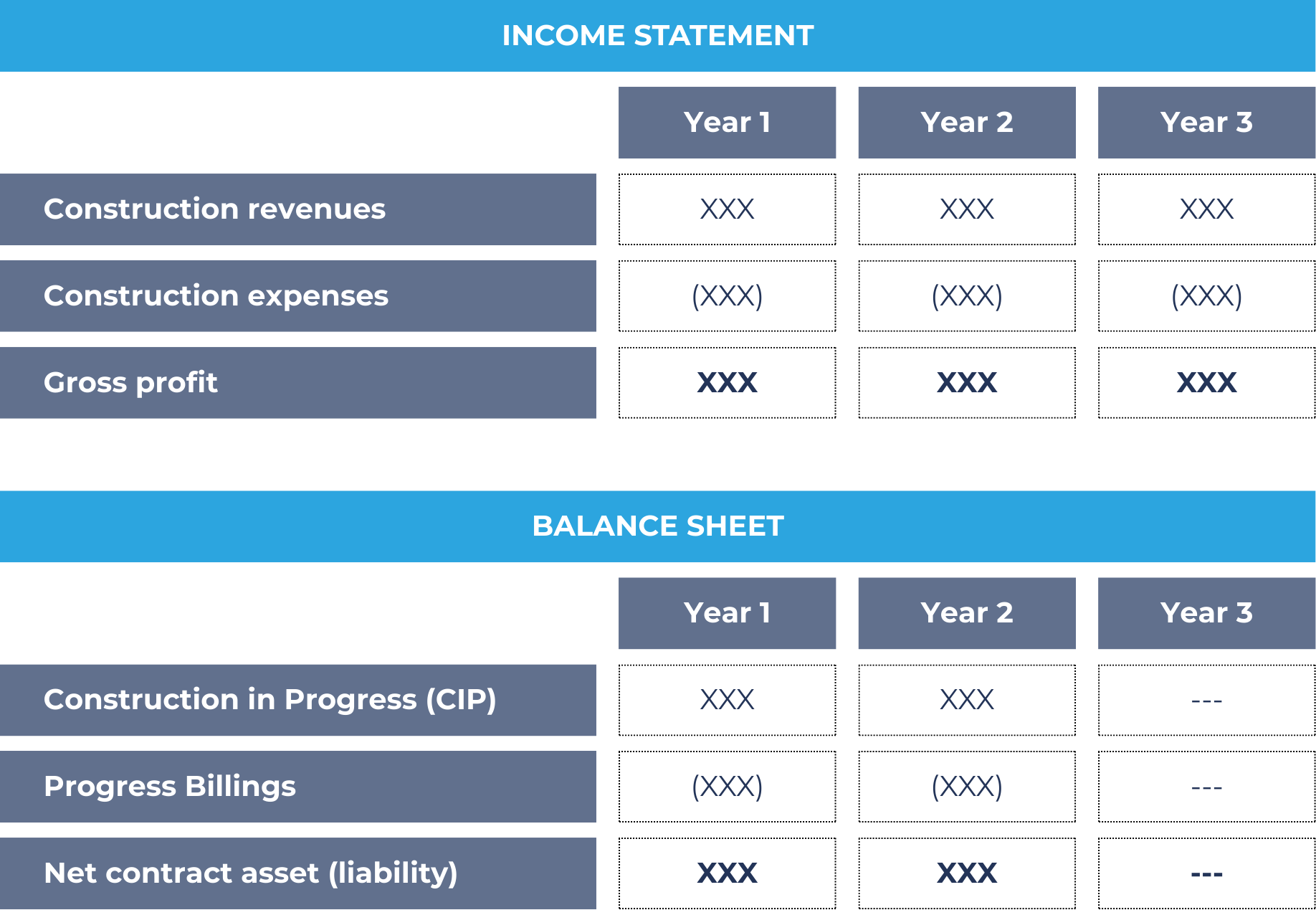
The pro forma presentation for the income statement and balance sheet is presented below. Notice that the main difference of this method when compared to the point in time recognition method is the presence of income statement items in Years 1 and 2, despite the contract not yet concluded.

Financial statements impact of over time recognition

Over time recognition method

  • Revenue, cost of sales, and gross profit recognized progressively as obligations are fulfilled
  • Criteria (any one must be met):
    • Simultaneous receipt/consumption by customer
    • Creation/enhancement of customer-controlled asset
    • No alternative use + enforceable right to payment for work to date
  • Used for long-term contracts (e.g., construction) meeting above criteria

Accounts used

  • CIP (Construction in Progress): accumulates costs and gross profit recognized to date
  • Construction revenues: recognized progressively (not just at completion)
  • Construction expenses: matched to revenue recognized each period

Step 1: Calculate percentage of completion

  • Most common: input (cost-to-cost) method
    • Formula:
      Percentage of completion=Total estimated contract costsActual costs incurred to date​
  • Output method (less common): based on units produced/delivered

Step 2: Calculate total gross profit from contract

  • Formula:
    • Contract price
    • Less: costs incurred to date
    • Less: estimated costs to complete
    • = Estimated gross profit (or loss)
  • Losses: recognized in full immediately if contract becomes loss-making
    • Reverse prior gross profit if necessary

Step 3: Calculate revenue and gross profit to recognize

  • Revenue to recognize in current period:
    • (Contract price × % completion) – revenue recognized in prior periods
  • Gross profit to recognize in current period:
    • (Estimated gross profit × % completion) – gross profit recognized in prior periods
  • Costs recognized: actual costs incurred in current period

Step 4: Year-end journal entries

  • Accumulate contract costs in CIP (debit CIP, credit cash/AP)
  • Recognize revenue and gross profit (debit construction expense & CIP [gross profit], credit construction revenues)
  • Record progress billings (debit A/R, credit progress billings)
  • Collections (debit cash, credit A/R)
  • At contract completion: close CIP against progress billings

Balance sheet presentation

  • Net CIP and progress billings:
    • If CIP > progress billings: net contract asset (unbilled revenue)
    • If CIP < progress billings: net contract liability (unearned revenue)
  • Income statement: revenue, expense, and gross profit recognized each year as work progresses, not just at contract conclusion

Sign up for free to take 11 quiz questions on this topic

Previous
Next  | 1.2.12.1 Learning outcomes
All rights reserved ©2016 - 2026 Achievable, Inc.

Over time recognition method

Over time recognition method

When the contract requires some time to perform, and the performance obligations meet the criteria of being satisfied over time, the company records revenues, cost of sales and gross profit as the company fulfills its obligations in the contract.

This means that unlike the previous case of point in time recognition, the income statement is affected every year-end that the contract is not concluded.

In order for the revenue to be satisfied over time, any one of the criteria below should be met:

  1. There is simultaneous receipt and consumption of the benefits provided by the company’s performance of the obligations from the contract
  2. The company’s performance of the obligations from the contract enhances or creates an asset controlled by the customer
  3. The company’s performance of the obligations from the contract does not create an asset with an alternative use to the company, and the company has an enforceable right to payment for performance completed to date.

Recognition of the revenues can be straight-forward for some contracts in which the revenue is recognized on a straight-line basis. However, accounting for a construction contract can be more complex due to the application of the percentage of completion method. The following are the steps to follow in applying the method:

  1. Calculate the percentage of completion
  2. Calculate the total gross profit from the contract
  3. Calculate the revenue and gross profit to be recognized to date
  4. Record the relevant year-end journal entries
  5. Understand the financial statement presentation

Accounting for long-term contracts in which revenues are recognized over time use specific accounts that students need to be familiar with because they are not typically used in other types of transactions:

The accounts are used the same way as in point-in-time recognition, with one key difference: the CIP account accumulates both the actual costs incurred to date and the gross profit recognized to date, not just the costs.

Step 1: Calculate the percentage of completion

The percentage of completion is calculated every end of the year to track the progress of the project.

There are two possible methods that companies can use depending on the specific circumstances of the project:

  • Output method which calculates the progress based on the value the customer has obtained from the contract such as number of units produced.
  • Input method which calculates the progress of the project using the inputs used in the construction such as consumed resources, labor hours, etc.

The most common method being used in exams is for the input method which is also called the cost-to-cost method.

Percentage of completion=Actual costs incurred to date+Estimated costs to completeActual costs incurred to date​

The denominator is also called total estimated contract costs. In the exams, candidates should be careful in determining the type of costs provided by the problem because it can provide directly the total estimated costs or a breakdown of it.

The examples moving forward pertain to the input method.

Step 2: Calculate the total gross profit from the contract

The total gross profit from the contract should also be calculated every year-end.

This is the estimated total profit that the company is expecting to obtain at the conclusion of the contract. The inputs used in the computation is similar to a normal gross profit computation as follows:

Contract price XX
Less: costs incurred to date (XX)
Less: estimated costs to incur (XX)
Estimated gross profit (loss) on the contract XX (XX)

This portion is important because, just like in point in time recognition method, estimated losses on a contract are also recognized immediately in full despite the percentage of completion while gross profits are recognized on a piecemeal basis using the percentage of completion computed from the previous step.

Reversal of previously recognized gross profit when a contract becomes loss-making

Under the over-time (percentage-of-completion) method, gross profit is recognized progressively as performance obligations are satisfied. However, if revised estimates indicate that a contract will result in an overall loss, U.S. GAAP requires that the entire expected loss be recognized immediately in the period the loss becomes evident.

This requirement has an important implication: the current-period loss recognized must bring the contract’s cumulative recognized income down to the full expected loss. Since prior periods may have already recognized gross profit, the current-period loss equals the total expected contract loss plus any gross profit recognized in prior periods - this is what effectively reverses that prior profit as part of recognizing the full expected loss.

Current-period loss=Total expected contract loss+gross profit previously recognized

The objective is to ensure that cumulative income recognized to date reflects the full expected loss on the contract. After this adjustment, the contract will show a cumulative loss position consistent with the revised estimate.

Step 3: Calculate the revenue and gross profit to be recognized to date

Now we are calculating inputs to the journal entries. For over time recognition of revenues, the following items are needed for the journal entries:

The revenues to be recognized in the current period is calculated as follows:

Contract price XX
Multiply: percentage of completion %
Total revenues to be recognized to date XX
Less: revenues recognized in prior periods (XX)
Total revenues to be recognized in the current period XX

The gross profit to be recognized follow the same logic as above except that the main input is the gross profit computed from the previous step:

Total estimated gross profit from the contract XX
Multiply: percentage of completion %
Total estimated gross profit to be recognized to date XX
Less: gross profits recognized in prior periods (XX)
Gross profit to be recognized in the current period XX

The costs to be recognized are in the form of the actual costs incurred in the current period and there is no need to create special computations.

If the calculations above are computed consistently, the following computation should hold true and becomes the basis of the year-end journal entries:

Total revenues to be recognized in the current period XX
Less: actual costs incurred during the period (XX)
Gross profit to be recognized in the current period XX

Step 4: Record the relevant year-end journal entries

The accounts to be used for this method are the same as the point in time recognition method but the journal entries are different because of the recognition of the gross profit in each year-end.

Step 4.1: Contract costs are accumulated in the CIP account similar to the previous method.

The journal entry below has an effect of including in the CIP account all the costs incurred in the current period. Since CIP is a balance sheet account, these costs are accumulated to eventually become an input to the formula for total estimated contract costs.

Account Debit Credit Financial statement element
Construction in progress (CIP) XXX Asset
Cash XXX Asset
Accounts payable XXX Liability
To record the costs incurred in the current period

Step 4.2: Contract revenues are recorded along with the gross profit.

This journal entry is specific to the over time recognition method. In this journal entry, we use the inputs determined in the preceding steps.

Account Debit Credit Financial statement element
Construction expense XXX Expense
Construction in progress (CIP) XXX Asset
Construction revenues XXX Revenue
To record the gross profit for the period

The sections of the journal entry are:

  • The debit in construction expense should be the same amount as the debit in CIP in the previous journal entry to record the actual construction costs.
  • The debit in CIP account is the gross profit computed in Step 3
  • The credit in construction revenues should be the same as the “revenue to be recognized in the current period” computed in Step 3

After the above journal entry, the CIP account in the balance sheet accumulates two items:

  1. actual costs incurred to date; and
  2. gross profit recognized to date.

This total makes it the same as the total revenues recognized to date. It is important to know this fact in relation to the nature of the Progress Billing account which will be discussed in the next journal entry.

Example: Applying the percentage-of-completion method

Ace Builders signs a contract to construct a warehouse for a contract price of $1,000,000. Total estimated contract costs are $600,000, so the total estimated gross profit on the contract is $400,000.

Year 1: Actual costs incurred to date are $180,000, and estimated costs to complete are $420,000.

  • Percentage of completion: $180,000+$420,000$180,000​=30%
  • Revenue to recognize in Year 1: 30%×$1,000,000=$300,000
  • Gross profit to recognize in Year 1: 30%×$400,000=$120,000
  • Costs incurred in Year 1: $180,000
  • Year 1 journal entry (Step 4.2): debit construction expense $180,000, debit CIP $120,000, credit construction revenues $300,000

Year 2: By year-end, actual costs incurred to date total $420,000 (an additional $240,000 spent during the year), and estimated costs to complete have dropped to $180,000.

  • Percentage of completion: $420,000+$180,000$420,000​=70%
  • Revenue recognized to date: 70%×$1,000,000=$700,000; less the $300,000 recognized in Year 1 leaves $400,000 to recognize in Year 2
  • Gross profit recognized to date: 70%×$400,000=$280,000; less the $120,000 recognized in Year 1 leaves $160,000 to recognize in Year 2
  • Year 2 journal entry (Step 4.2): debit construction expense $240,000, debit CIP $160,000, credit construction revenues $400,000

Answer: Cumulative gross profit of $280,000 after Year 2 equals 70% of the $400,000 total estimated gross profit, confirming the calculations are consistent.

Step 4.3: Progress billings are recorded the same way as the point in time recognition method.

Account Debit Credit Financial statement element
Account receivable XXX Asset
Progress billings XXX Liability
To record the progress billings

The Progress billings account is a balance sheet account with a normal balance in the credit side representing the portion of the contract price that has already been billed to the client. This is separate from the revenues recognized using the percentage of completion because the billings may be calculated using a different approach.

As mentioned previously, the revenues recognized on the contract are actually accumulated in the Construction in progress (CIP) account in the balance sheet with a normal balance in the debit side.

Both accounts (CIP and progress billings) are presented at net in the balance sheet at year-end with the following implications:

  • If CIP>progress billings: means there is a net contract asset. This can also be understood as an unbilled revenue since the revenues recognized to date are greater than the revenues billed from the customer.
  • If CIP<progress billings: means there is a net contract liability. This can also be understood as an unearned revenue since the company billed more than what was actually earned.

Step 4.4: Collections of accounts are recorded against the accounts receivable previously set-up, just like in a point in time recognition method.

The progress billings account is not affected by the collections.

Account Debit Credit Financial statement element
Cash XXX Asset
Account receivable XXX Asset
To record the collections of accounts receivables

Step 4.5: The conclusion of the contract is recorded by closing the CIP and progress billings accounts with each other.

Unlike the point in time recognition method where the CIP is closed to construction expenses and the progress billings are closed to construction revenues, the journal entry upon the conclusion of the contract for an over time recognition of revenue is to simply close the CIP against the progress billings account. This is possible because at the end of the contract, the total revenues recognized to date (i.e., CIP) should be equal to the progress billings since we will bill the contract price in full.

Account Debit Credit Financial statement element
Progress billings XXX Liability
Construction in progress (CIP) XXX Asset
To record the conclusion of the construction contract

Step 5: Understand the financial statement presentation

The pro forma presentation for the income statement and balance sheet is presented below. Notice that the main difference of this method when compared to the point in time recognition method is the presence of income statement items in Years 1 and 2, despite the contract not yet concluded.

Key points

Over time recognition method

  • Revenue, cost of sales, and gross profit recognized progressively as obligations are fulfilled
  • Criteria (any one must be met):
    • Simultaneous receipt/consumption by customer
    • Creation/enhancement of customer-controlled asset
    • No alternative use + enforceable right to payment for work to date
  • Used for long-term contracts (e.g., construction) meeting above criteria

Accounts used

  • CIP (Construction in Progress): accumulates costs and gross profit recognized to date
  • Construction revenues: recognized progressively (not just at completion)
  • Construction expenses: matched to revenue recognized each period

Step 1: Calculate percentage of completion

  • Most common: input (cost-to-cost) method
    • Formula:
      Percentage of completion=Total estimated contract costsActual costs incurred to date​
  • Output method (less common): based on units produced/delivered

Step 2: Calculate total gross profit from contract

  • Formula:
    • Contract price
    • Less: costs incurred to date
    • Less: estimated costs to complete
    • = Estimated gross profit (or loss)
  • Losses: recognized in full immediately if contract becomes loss-making
    • Reverse prior gross profit if necessary

Step 3: Calculate revenue and gross profit to recognize

  • Revenue to recognize in current period:
    • (Contract price × % completion) – revenue recognized in prior periods
  • Gross profit to recognize in current period:
    • (Estimated gross profit × % completion) – gross profit recognized in prior periods
  • Costs recognized: actual costs incurred in current period

Step 4: Year-end journal entries

  • Accumulate contract costs in CIP (debit CIP, credit cash/AP)
  • Recognize revenue and gross profit (debit construction expense & CIP [gross profit], credit construction revenues)
  • Record progress billings (debit A/R, credit progress billings)
  • Collections (debit cash, credit A/R)
  • At contract completion: close CIP against progress billings

Balance sheet presentation

  • Net CIP and progress billings:
    • If CIP > progress billings: net contract asset (unbilled revenue)
    • If CIP < progress billings: net contract liability (unearned revenue)
  • Income statement: revenue, expense, and gross profit recognized each year as work progresses, not just at contract conclusion

More from Revenue recognition

  • Learning outcomes
  • Revenue recognition steps
  • Contract assets and contract liabilities
  • Revenue transactions
  • Point in time recognition method