



Lean resource management techniques
Learning outcome statements
The learning outcome statements relevant for this section are:
- define lean resource management techniques
- identify and describe the operational benefits of implementing lean resource management techniques
- define material requirements planning (MRP)
- identify and describe the operational benefits of implementing a just-in-time (JIT) system
Lean resource management
Originating from the Toyota Production System (TPS), lean principles focus on improving efficiency, reducing non-value-added activities, and aligning operations more closely with customer demand.
The goal of lean is to create more value for customers using fewer resources. This is achieved by streamlining processes, eliminating bottlenecks, and engaging employees in continuous improvement. Lean techniques apply across industries, from manufacturing and logistics to healthcare and service environments, wherever resource optimization and quality improvement are priorities.
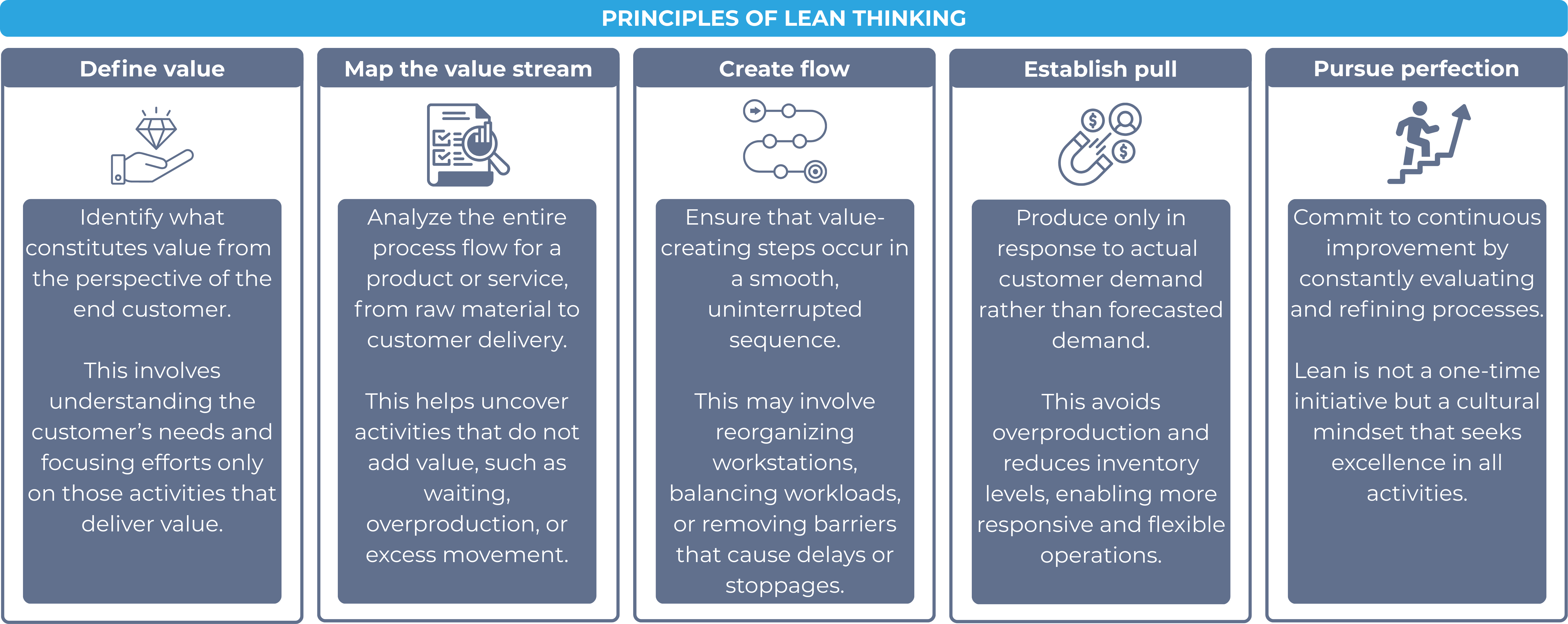
Although lean implementation may vary by organization, five core principles form the foundation of lean thinking:
Organizations that successfully implement lean resource management techniques can expect several operational advantages:
| Lean Principle | Operational Benefits |
| 1. Define Value |
|
| 2. Map the Value Stream |
|
| 3. Create Flow |
|
| 4. Establish Pull |
|
| 5. Pursue Perfection |
|
Materials Requirement Planning (MRP)
MRP is especially valuable in manufacturing environments where products are built from multiple components or subassemblies. It helps planners determine:
- What materials are needed
- How much of each material is required
- When the materials should be ordered or produced
The system uses backward scheduling, meaning it starts from a production due date and works backward to determine the necessary order and production dates for materials and components.
Core inputs of MRP
Material Requirements Planning (MRP) systems rely on three critical inputs to determine what materials are needed, how much is needed, and when they should be ordered or produced. These inputs ensure that production is aligned with demand while avoiding shortages or excess inventory.
1. Master Production Schedule (MPS)
The Master Production Schedule is the foundation of MRP. It specifies the quantity and timing of finished goods that must be produced to meet customer demand or sales forecasts. It breaks down overall production goals into weekly or daily targets and serves as the driver for material planning.
- The MPS answers the question: *What finished products are needed, when, and in what quantities?”
- It ensures that production planning aligns with marketing forecasts, customer orders, or contractual commitments.
The Bill of Materials is a comprehensive list of all components, subassemblies, and raw materials required to manufacture one unit of a finished product. It also specifies the quantity of each input and the hierarchy or level at which each component exists.
- The BOM answers the question: “What materials are required to make the product, and in what structure?”
- MRP systems use the BOM to explode the product structure, calculating total component needs across all levels of the product.
Inventory records provide real-time data on material availability. This includes on-hand inventory levels, open purchase orders, lead times for procurement or production, safety stock policies, lot-sizing rules, and scheduled receipts.
- Inventory records answer: “What do we already have, and what is already on order?”
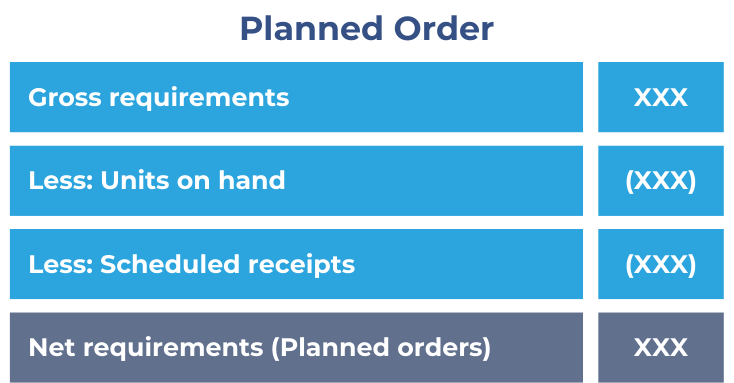
- These records are crucial to calculating net material requirements by subtracting available inventory and expected deliveries from gross requirements.
Example of MRP analysis
To deepen understanding of MRP mechanics, let’s examine a simplified example showing how raw material needs are calculated from a finished product’s bill of materials (BOM), and how timing plays a critical role in planning.
Benefits of MRP
Implementing MRP provides a range of operational and strategic advantages:
- Reduces excess inventory by producing and ordering only what is needed.
- Ensures material availability for scheduled production, reducing delays.
- Provides precise timing for order placement, reducing last-minute procurement issues.
- Aligns purchasing, manufacturing, and sales with real-time inventory and demand data.
Just-in-Time (JIT) system
This approach is closely aligned with lean management principles and emphasizes the elimination of non-value-adding activities, reduction of inventory costs, and improvement of product quality.
JIT was originally popularized by Japanese manufacturers, most notably Toyota, as part of the broader Toyota Production System (TPS), and has since been widely adopted in both manufacturing and service industries worldwide.
The key features of a JIT system are as follows:
- Demand-pull production: Items are produced or purchased only in response to actual demand, not in anticipation of future sales.
- Small lot sizes: Production is done in small batches to increase flexibility and reduce inventory holding costs.
- Zero inventory mindset: Inventory is treated as a liability rather than an asset, motivating firms to reduce it as much as possible.
- High supplier coordination: Frequent, reliable deliveries of small quantities from suppliers are critical for success.
- Streamlined layout and workflows: Production lines are optimized to minimize movement, wait time, and excess processing.
Implementing a JIT system yields numerous operational advantages that contribute directly to improved financial and non-financial performance:
- Reduced inventory costs: With minimal raw materials and finished goods on hand, storage, insurance, and obsolescence costs are significantly lowered.
- Improved cash flow: Less capital is tied up in inventory, freeing resources for other operational needs or investment.
- Enhanced product quality: JIT promotes quality at the source and continuous improvement since errors or delays immediately disrupt production.
- Increased efficiency: Leaner operations encourage better workflow design, less rework, and faster throughput.
- Greater responsiveness: Organizations can adapt more quickly to changes in customer demand with shorter production cycles and less stock inertia.
JIT versus MRP
While both JIT and MRP aim to improve inventory control and align production with demand, their approaches differ:
| Feature | JIT | MRP |
| Planning Basis | Actual demand (pull system) | Forecasted demand (push system) |
| Inventory Approach | Minimized, near-zero | Planned buffer inventories |
| Flexibility | High (but fragile to disruptions) | Moderate (more robust to variability) |
| System Complexity | Operationally lean but sensitive | Data-intensive and structured |
| Industry Fit | High-volume, stable environments | Complex, multi-stage production lines |