



Overhead allocation methods
Overhead allocation methods
In manufacturing and service organizations, indirect costs, commonly referred to as overhead, must be allocated to cost objects such as products, jobs, or departments. Since overhead cannot be traced directly, a systematic and rational method is required for allocation. This section discusses various approaches to calculating and applying overhead rates, including corporate-wide, departmental, and activity-specific rates, as well as the selection and use of appropriate allocation bases.
Common overhead rate structures
Overhead can be applied using different rate structures, depending on the complexity of operations and the level of detail required. The three most common are:
Understanding the strengths and weaknesses of each overhead allocation method helps organizations choose the most appropriate system for their operations. Below is a comparison of the three commonly used methods:
| Method | Benefits | Limitations |
| Corporate-wide overhead rate | Simple to implement and maintain Low administrative cost Suitable for uniform operations | May distort costs in complex or multi-department environments Ignores departmental or activity differences Poor cost traceability for decision-making |
| Departmental overhead rates | More accurate than a single rate Reflects differences in departmental cost structures Enhances cost control at the departmental level | Still assumes uniformity within departments Requires tracking of departmental costs and activities More complex than corporate-wide method |
| Activity-based overhead rate | Highly accurate cost allocation Aligns overhead with resource consumption Supports strategic decisions (e.g., pricing, profitability) | Data-intensive and complex to implement High system and training costs May not be cost-effective for simple operations |
Allocation bases for overhead
Choosing the right allocation base is critical for meaningful cost assignment. The base should reflect a cause-and-effect relationship between the incurrence of overhead and the cost object’s use of resources.
The formula for Fixed Overhead Application Rate:
For example, a company expects $100,000 in fixed overhead and 10,000 labor hours of practical capacity. The overhead rate is:
This rate is then multiplied by the actual labor hours used to determine the amount of overhead applied to jobs or units.
Predetermined overhead rate and application in production
In most practical settings, overhead costs are applied to production using a predetermined overhead rate, rather than waiting until actual costs are known. This rate is computed in advance of the accounting period based on estimated figures, providing timely cost information that supports budgeting, pricing, and performance evaluation.
The estimated total overhead costs include both fixed and variable components expected for the upcoming period. The allocation base can be labor hours, machine hours, or any other activity driver depending on the nature of operations.
This predetermined rate is then applied to actual production activity during the period to assign overhead costs to products or jobs.
Why Use a Predetermined Rate?
- Timeliness: Managers need cost data during the period, not just after actuals are finalized.
- Cost Control: Allows for variance analysis by comparing applied vs. actual overhead.
- Standardization: Ensures consistent costing, particularly important for inventory valuation under absorption costing.
Comparison of this approach with Other Overhead Application Approaches:
| Method | Overhead Used | Timing | Characteristics |
| Actual Overhead Rate | Actual costs / Actual base | After period-end | Highly accurate but not timely. Not suitable for interim use. |
| Normal Costing | Predetermined OH rate × Actual base | During the period | Balances accuracy and timeliness. Most widely used in practice. |
| Standard Costing | Standard OH rate × Standard base | During the period | Supports budgeting and variance analysis. May require frequent updates. |
Note that in normal costing, direct materials and direct labor are recorded at actual amounts, but overhead is applied using a predetermined rate, allowing for prompt recording of production costs. This is the approach commonly being presented in the CMA Examinations.
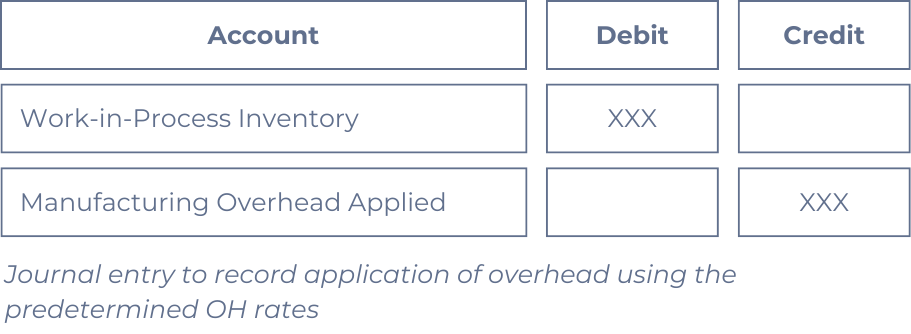
Once the predetermined rate is established, it is used to apply overhead to Work-in-Process (WIP) during production:
At the end of the period, the difference between applied and actual overhead is assessed. Overapplied or underapplied overhead must be reconciled and adjusted, typically through Cost of Goods Sold (COGS), or proportionally across WIP, Finished Goods, and COGS accounts. This is discussed further in the next section.