


This browser is too old to run Achievable.

Update it, or open this page in a current version of Chrome, Safari, Firefox or Edge. On an iPhone or iPad, update iOS: every browser there runs on the version of Safari that comes with it.

Achievable logoAchievable logo
CMA Part 1
Sign in
Sign up
Purchase
Textbook
Practice exams
Support
How it works
Resources
Exam catalog
Mountain with a flag at the peak
Textbook
Introduction
1. External financial reporting decisions
2. Planning, budgeting, and forecasting
3. Performance management
4. Cost management
4.1 Measurement concepts
4.2 Costing systems
4.2.1 Job order costing
4.2.2 Activity-based costing (ABC)
4.2.3 Life-cycle costing
4.2.4 Process costing systems
4.3 Overhead costs
4.4 Supply chain management
4.5 Business process improvement
5. Internal control
6. Technology and analytics
Wrapping up
Achievable logoAchievable logo
4.2.4 Process costing systems
Achievable CMA Part 1
4. Cost management
4.2. Costing systems
Our CMA Part 1 course is currently in development and is a work-in-progress.

Process costing systems

6 min read
Font
Discuss
Share
Feedback

Learning outcome statements

The learning outcome statements relevant for this section are:

  1. demonstrate an understanding of process costing and the concept of equivalent units (no calculations required)

Process costing

Definitions
Process costing
A method of accumulating and assigning production costs to units of output in industries where products are homogeneous and produced in a continuous flow. This system is best suited for environments in which it is not practical to distinguish one unit from another, and where production passes through multiple departments or processes.

Common industries that use process costing include:

  • Chemical manufacturing
  • Oil refining
  • Food and beverage production
  • Paints and plastics
  • Paper and pulp processing

In contrast to job order costing, where costs are traced to specific jobs, process costing averages total departmental costs over all units produced during a period. This makes it efficient and cost-effective for high-volume production with repetitive operations.

Cost flows in a process costing environment

In a typical process costing system, production moves sequentially from one department to another. Costs are accumulated within each department and then transferred to the next stage.

Stages of cost flow:

  1. Direct materials, direct labor, and applied manufacturing overhead are added to the Work-in-process (WIP) account for each department.

  2. Once processing is complete, costs and units are transferred to the next department or to finished goods inventory, depending on the stage.

  3. Upon sale, the costs are finally transferred to cost of goods sold (COGS).

Example: Process costing flow

Let’s consider a company that produces fruit juice and uses two departments: Mixing and Bottling.

Department Input costs (for May) Units completed
Mixing $50,000 10,000 liters
Bottling $30,000 10,000 liters

All units flow from Mixing to Bottling without loss. Total cost per liter:

  • Mixing: $50,000 ÷ 10,000 = $5.00
  • Bottling: $30,000 ÷ 10,000 = $3.00
  • Total cost per liter = $8.00

When the juice is bottled and sent to Finished Goods, the cost per unit reflects the cumulative processing cost. The example is a simple one because we assumed that there are no unfinished units for each department and all 10,000 liters flowed completely in and out of production. When this is not the case, the concept of equivalent units is used to estimate the costs of the WIP, inventories and COGS.

Equivalent units

In continuous production systems, it is common for a department to have units still in process at the end of an accounting period. Because these units are only partially completed, we cannot count them as full units when calculating the average cost per unit. Instead, we use the concept of equivalent units of production, which expresses incomplete units as a fraction of a complete unit, based on their percentage of completion.

This concept allows costs to be fairly divided between:

  • Completed units transferred to the next department or finished goods
  • Partially completed units still in Work-in-process (WIP) at the end of the period

For the exam, focus on what equivalent units represent and why they matter, not on detailed calculations.

Example 1: Partial completion in a single department

Suppose a chocolate factory’s Mixing Department started 10,000 units in March. There is no beginning inventory. By month-end:

  • 8,000 units were fully completed and transferred to the next department
  • 2,000 units were still in WIP, but only 40% complete

These 2,000 partially complete units are treated as 800 equivalent units (2,000 × 40%).

Equivalent units​=Fully completed units+Partially completed units=8,000+(2,000×40%)=8,000+800=8,800 units​

Assuming all costs are added evenly throughout processing, the department’s total costs are spread over 8,800 equivalent units, not 10,000 physical units. (If materials are added at a different point than labor and overhead, equivalent units are computed separately for each cost type, as shown later.) These 8,800 units form the basis for dividing total costs incurred in the Mixing Department, ensuring a fair share is retained in WIP for unfinished units.

If a company mistakenly uses full physical units instead of converting them to equivalent units, costs get misallocated: WIP inventory is overstated, cost per unit is understated, and profit margins may be distorted.

Example 2: Two departments – transfer and remaining WIP

In a textile plant, the Weaving Department processes 5,000 meters of fabric. By month-end:

  • 4,000 meters are completed and transferred to the Finishing Department
  • 1,000 meters are still in process, 60% complete

Equivalent units​=Fully completed units+Partially completed units=4,000+(1,000×60%)=4,000+600=4,600 units​

Total costs for the month (materials, labor, and overhead) will be spread over these 4,600 units (instead of 5,000 units). And then these costs are treated as follows:

  1. The cost assigned to the 4,000 completed meters is transferred to the Finishing Department
  2. The cost assigned to the 600 equivalent units remains in the Weaving WIP inventory

How equivalent units affect inventory flow

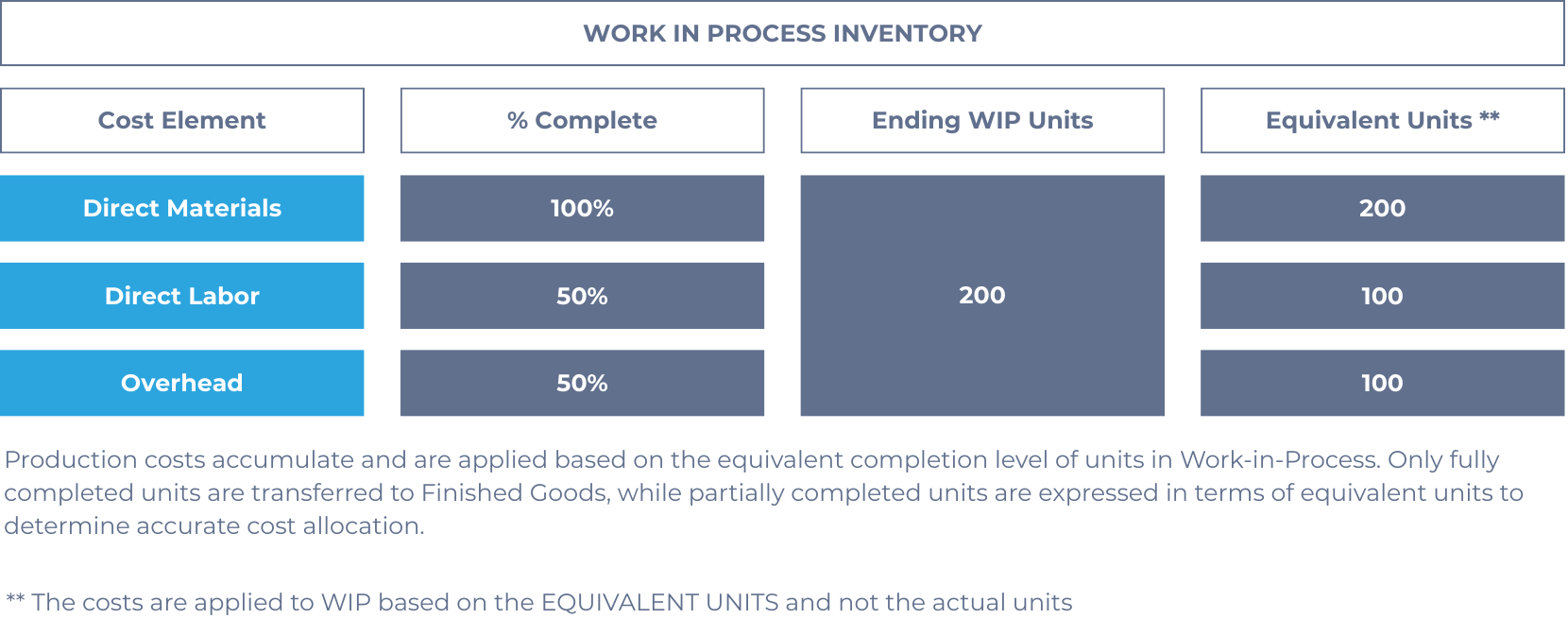
The concept of equivalent units directly affects how production costs are classified and recorded. Since the costs in these inventories are recorded per type (DM, DL or overhead), the equivalent units are typically computed per type of cost, and costs are then applied using the equivalent units per type, as shown below:

Equivalent units per cost type
Achievable

Advantages and limitations of process costing

Advantages

  • Simplifies accounting for uniform production processes
  • Ideal for large-scale, repetitive manufacturing
  • Cost per unit is easy to calculate and track over time

Limitations

  • Not suitable for customized or small-batch production
  • Less flexible for firms producing varied or irregular items
  • May obscure cost inefficiencies without additional analysis (e.g., ABC)

Comparison to job order costing

Feature Job order costing Process costing
Product type Customized, unique jobs Homogeneous, continuous production
Cost tracing To individual jobs To departments/processes
Unit cost determination Per job Average cost per unit
Inventory flow Job-specific Department to department
Cost records Detailed per job Summarized by process

Process costing basics

  • Used for homogeneous products in continuous flow (chemicals, oil refining, food/beverage, paints, paper)
  • Averages total departmental costs over all units produced, rather than tracing costs to individual jobs
  • Efficient for high-volume, repetitive production

Cost flow through departments

  • Direct materials, direct labor, and applied overhead accumulate in each department’s WIP account
  • Completed costs/units transfer sequentially to next department, then to Finished Goods, then to COGS upon sale
  • Cost per unit = total department cost ÷ units completed; cumulative cost builds as units move through departments

Equivalent units concept

  • Expresses partially completed units as a fraction of a complete unit based on % completion
  • Formula: equivalent units = fully completed units + (partially completed units × % complete)
  • Needed because ending WIP units are incomplete and shouldn’t be costed as full units
  • Costs often computed separately by cost type (DM, DL, overhead) since each may be added at different stages
  • Used to fairly split costs between units transferred out and units remaining in WIP

Why equivalent units matter

  • Misusing physical units instead of equivalent units overstates WIP inventory and understates cost per unit
  • Distorts profit margins and inventory valuation
  • Key exam focus: understand the concept/purpose, not detailed calculations

Advantages vs. limitations

  • Advantages: simplifies costing for uniform/repetitive production, easy unit cost tracking
  • Limitations: poor fit for customized/small-batch production, can hide inefficiencies without extra analysis (e.g., ABC)

Process costing vs. job order costing

  • Product type: homogeneous/continuous vs. customized/unique jobs
  • Cost tracing: by department/process vs. by individual job
  • Unit cost: average cost per unit vs. per-job cost
  • Records: summarized by process vs. detailed per job

Sign up for free to take 7 quiz questions on this topic

Previous
Next  | 4.3.1 Overhead classification and cost behavior
All rights reserved ©2016 - 2026 Achievable, Inc.

Process costing systems

Learning outcome statements

The learning outcome statements relevant for this section are:

  1. demonstrate an understanding of process costing and the concept of equivalent units (no calculations required)

Process costing

Definitions
Process costing
A method of accumulating and assigning production costs to units of output in industries where products are homogeneous and produced in a continuous flow. This system is best suited for environments in which it is not practical to distinguish one unit from another, and where production passes through multiple departments or processes.

Common industries that use process costing include:

  • Chemical manufacturing
  • Oil refining
  • Food and beverage production
  • Paints and plastics
  • Paper and pulp processing

In contrast to job order costing, where costs are traced to specific jobs, process costing averages total departmental costs over all units produced during a period. This makes it efficient and cost-effective for high-volume production with repetitive operations.

Cost flows in a process costing environment

In a typical process costing system, production moves sequentially from one department to another. Costs are accumulated within each department and then transferred to the next stage.

Stages of cost flow:

  1. Direct materials, direct labor, and applied manufacturing overhead are added to the Work-in-process (WIP) account for each department.

  2. Once processing is complete, costs and units are transferred to the next department or to finished goods inventory, depending on the stage.

  3. Upon sale, the costs are finally transferred to cost of goods sold (COGS).

Example: Process costing flow

Let’s consider a company that produces fruit juice and uses two departments: Mixing and Bottling.

Department Input costs (for May) Units completed
Mixing $50,000 10,000 liters
Bottling $30,000 10,000 liters

All units flow from Mixing to Bottling without loss. Total cost per liter:

  • Mixing: $50,000 ÷ 10,000 = $5.00
  • Bottling: $30,000 ÷ 10,000 = $3.00
  • Total cost per liter = $8.00

When the juice is bottled and sent to Finished Goods, the cost per unit reflects the cumulative processing cost. The example is a simple one because we assumed that there are no unfinished units for each department and all 10,000 liters flowed completely in and out of production. When this is not the case, the concept of equivalent units is used to estimate the costs of the WIP, inventories and COGS.

Equivalent units

In continuous production systems, it is common for a department to have units still in process at the end of an accounting period. Because these units are only partially completed, we cannot count them as full units when calculating the average cost per unit. Instead, we use the concept of equivalent units of production, which expresses incomplete units as a fraction of a complete unit, based on their percentage of completion.

This concept allows costs to be fairly divided between:

  • Completed units transferred to the next department or finished goods
  • Partially completed units still in Work-in-process (WIP) at the end of the period

For the exam, focus on what equivalent units represent and why they matter, not on detailed calculations.

Example 1: Partial completion in a single department

Suppose a chocolate factory’s Mixing Department started 10,000 units in March. There is no beginning inventory. By month-end:

  • 8,000 units were fully completed and transferred to the next department
  • 2,000 units were still in WIP, but only 40% complete

These 2,000 partially complete units are treated as 800 equivalent units (2,000 × 40%).

Equivalent units​=Fully completed units+Partially completed units=8,000+(2,000×40%)=8,000+800=8,800 units​

Assuming all costs are added evenly throughout processing, the department’s total costs are spread over 8,800 equivalent units, not 10,000 physical units. (If materials are added at a different point than labor and overhead, equivalent units are computed separately for each cost type, as shown later.) These 8,800 units form the basis for dividing total costs incurred in the Mixing Department, ensuring a fair share is retained in WIP for unfinished units.

If a company mistakenly uses full physical units instead of converting them to equivalent units, costs get misallocated: WIP inventory is overstated, cost per unit is understated, and profit margins may be distorted.

Example 2: Two departments – transfer and remaining WIP

In a textile plant, the Weaving Department processes 5,000 meters of fabric. By month-end:

  • 4,000 meters are completed and transferred to the Finishing Department
  • 1,000 meters are still in process, 60% complete

Equivalent units​=Fully completed units+Partially completed units=4,000+(1,000×60%)=4,000+600=4,600 units​

Total costs for the month (materials, labor, and overhead) will be spread over these 4,600 units (instead of 5,000 units). And then these costs are treated as follows:

  1. The cost assigned to the 4,000 completed meters is transferred to the Finishing Department
  2. The cost assigned to the 600 equivalent units remains in the Weaving WIP inventory

How equivalent units affect inventory flow

The concept of equivalent units directly affects how production costs are classified and recorded. Since the costs in these inventories are recorded per type (DM, DL or overhead), the equivalent units are typically computed per type of cost, and costs are then applied using the equivalent units per type, as shown below:

Advantages and limitations of process costing

Advantages

  • Simplifies accounting for uniform production processes
  • Ideal for large-scale, repetitive manufacturing
  • Cost per unit is easy to calculate and track over time

Limitations

  • Not suitable for customized or small-batch production
  • Less flexible for firms producing varied or irregular items
  • May obscure cost inefficiencies without additional analysis (e.g., ABC)

Comparison to job order costing

Feature Job order costing Process costing
Product type Customized, unique jobs Homogeneous, continuous production
Cost tracing To individual jobs To departments/processes
Unit cost determination Per job Average cost per unit
Inventory flow Job-specific Department to department
Cost records Detailed per job Summarized by process
Key points

Process costing basics

  • Used for homogeneous products in continuous flow (chemicals, oil refining, food/beverage, paints, paper)
  • Averages total departmental costs over all units produced, rather than tracing costs to individual jobs
  • Efficient for high-volume, repetitive production

Cost flow through departments

  • Direct materials, direct labor, and applied overhead accumulate in each department’s WIP account
  • Completed costs/units transfer sequentially to next department, then to Finished Goods, then to COGS upon sale
  • Cost per unit = total department cost ÷ units completed; cumulative cost builds as units move through departments

Equivalent units concept

  • Expresses partially completed units as a fraction of a complete unit based on % completion
  • Formula: equivalent units = fully completed units + (partially completed units × % complete)
  • Needed because ending WIP units are incomplete and shouldn’t be costed as full units
  • Costs often computed separately by cost type (DM, DL, overhead) since each may be added at different stages
  • Used to fairly split costs between units transferred out and units remaining in WIP

Why equivalent units matter

  • Misusing physical units instead of equivalent units overstates WIP inventory and understates cost per unit
  • Distorts profit margins and inventory valuation
  • Key exam focus: understand the concept/purpose, not detailed calculations

Advantages vs. limitations

  • Advantages: simplifies costing for uniform/repetitive production, easy unit cost tracking
  • Limitations: poor fit for customized/small-batch production, can hide inefficiencies without extra analysis (e.g., ABC)

Process costing vs. job order costing

  • Product type: homogeneous/continuous vs. customized/unique jobs
  • Cost tracing: by department/process vs. by individual job
  • Unit cost: average cost per unit vs. per-job cost
  • Records: summarized by process vs. detailed per job

More from Costing systems

  • Life-cycle costing