



Life-cycle costing
Learning outcome statements
The learning outcome statements relevant for this section are:
- demonstrate an understanding of the concept of life-cycle costing and the strategic value of including upstream costs, manufacturing costs, and downstream costs
Life-cycle costing
Life-cycle costing (LCC) is a costing approach that captures all costs associated with a product over its entire life cycle, from the earliest stages of conception and design, through production and use, to disposal or retirement. The goal is to provide a comprehensive view of the total cost of ownership and operation of a product, not just its manufacturing or acquisition costs.
This approach is particularly useful in long-term planning, pricing, and investment decisions, where future costs (e.g., maintenance, service, disposal) are material.
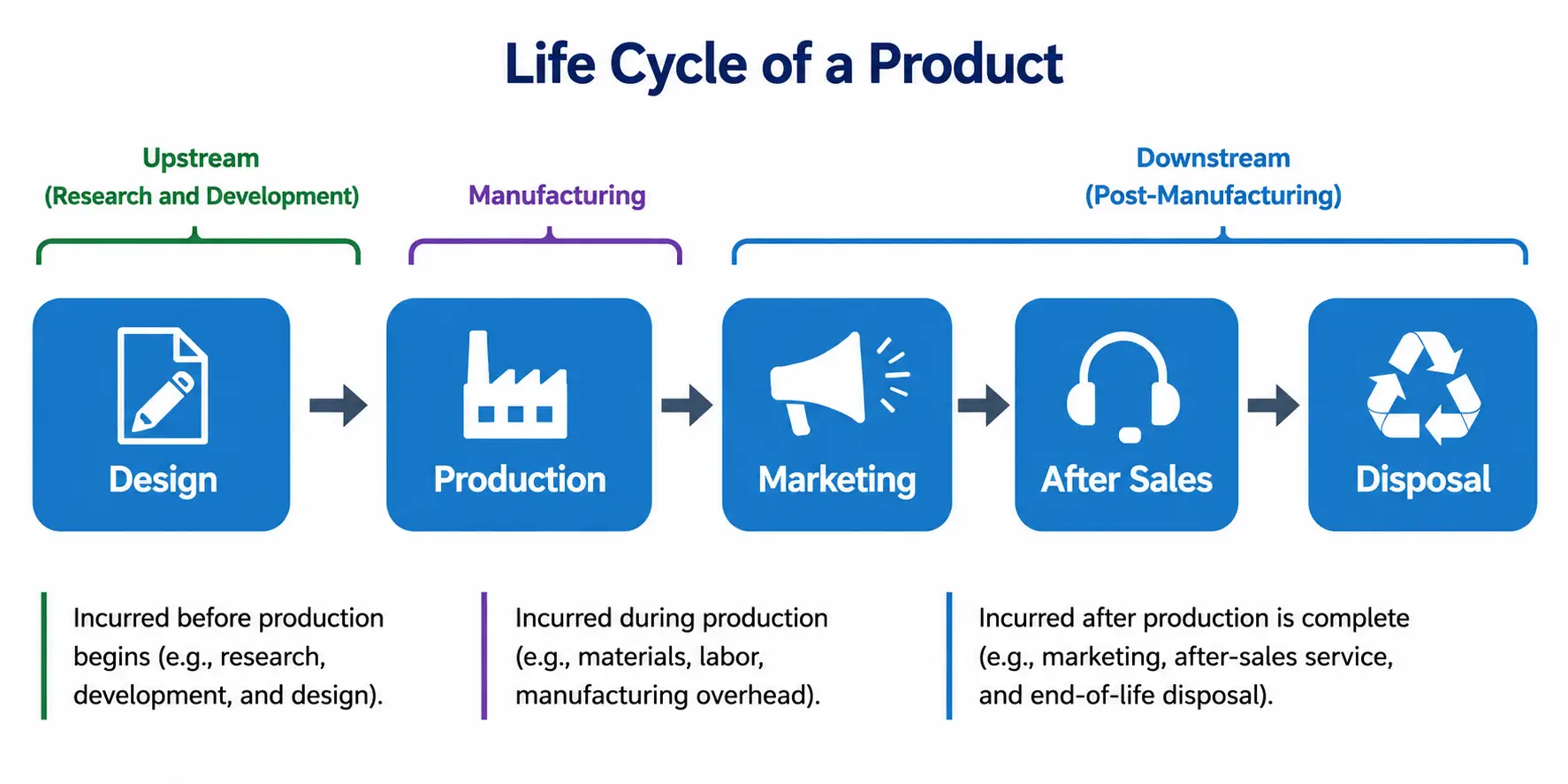
Life-cycle costing divides the product life into three broad phases:
| Phase | Typical costs included |
| Upstream costs | Research and development (R&D), design, prototyping, market research, product testing |
| Manufacturing costs | Direct materials, direct labor, overhead, quality assurance, rework, production line setup |
| Downstream costs | Marketing, distribution, after-sales service, warranty, customer support, product disposal |
Unlike traditional cost systems that focus primarily on production, LCC provides a more complete cost picture, especially important when post-sale costs (like warranties or repairs) are significant.
Strategic value of life-cycle costing
Life-cycle costing helps managers understand cost behavior over time and make better long-term decisions. Key strategic benefits include:
- Incorporating total cost exposure allows for more accurate and profitable pricing strategies.
- Early design decisions often determine 70–80% of a product’s life-cycle cost. LCC encourages selecting materials and features that reduce long-term costs, not just initial costs.
- Choosing suppliers or solutions based on total life-cycle cost, not just upfront purchase price, improves value.
- Reducing downstream costs such as warranty claims and service issues can improve product reliability and brand trust.
- LCC supports green initiatives by considering environmental costs, end-of-life recycling, and waste management.