



Process costing systems
Learning outcome statements
The learning outcome statements relevant for this section are:
- demonstrate an understanding of process costing and the concept of equivalent units (no calculations required)
Process costing
Common industries that use process costing include:
- Chemical manufacturing
- Oil refining
- Food and beverage production
- Paints and plastics
- Paper and pulp processing
In contrast to job order costing, where costs are traced to specific jobs, process costing averages total departmental costs over all units produced during a period. This makes it efficient and cost-effective for high-volume production with repetitive operations.
Cost flows in a process costing environment
In a typical process costing system, production moves sequentially from one department to another. Costs are accumulated within each department and then transferred to the next stage.
Stages of cost flow:
-
Direct materials, direct labor, and applied manufacturing overhead are added to the Work-in-Process (WIP) account for each department.
-
Once processing is complete, costs and units are transferred to the next department or to Finished Goods Inventory, depending on the stage.
-
Upon sale, the costs are finally transferred to Cost of Goods Sold (COGS).
Equivalent units
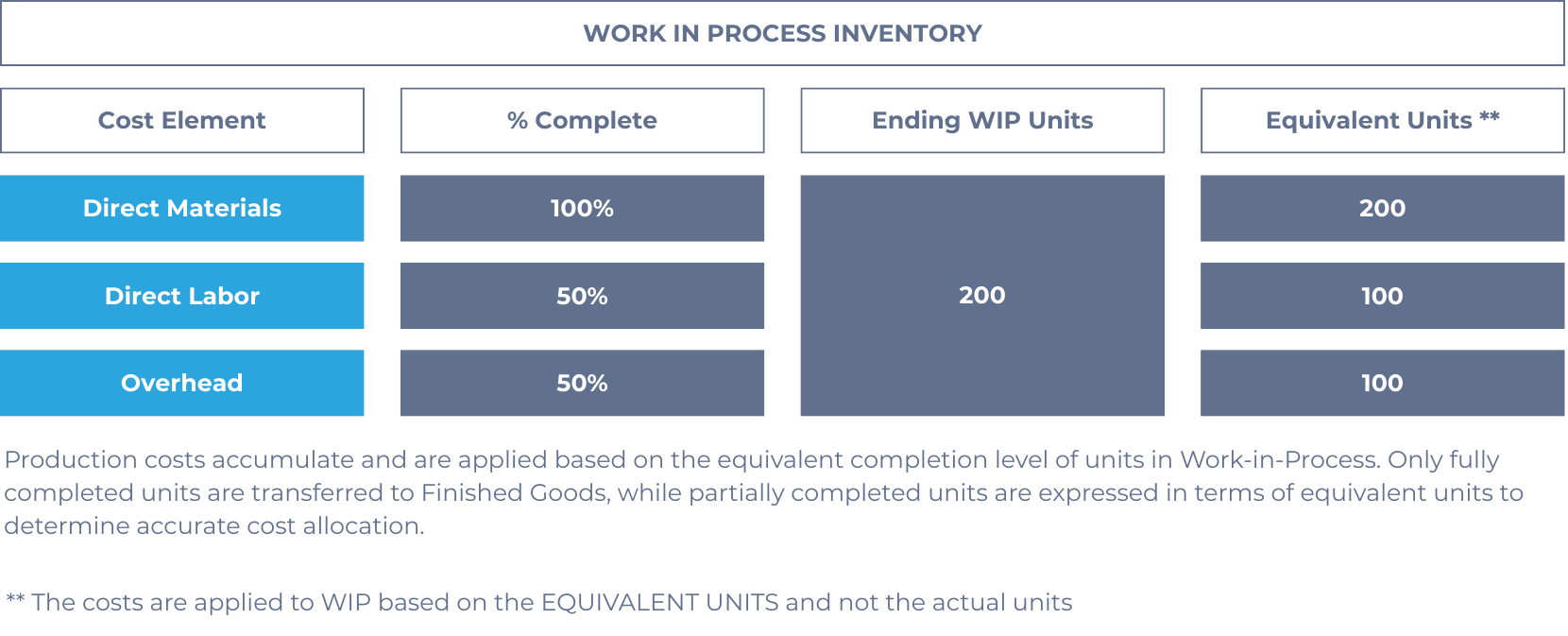
In continuous production systems, it is common for a department to have units still in process at the end of an accounting period. Because these units are only partially completed, we cannot count them as full units when calculating the average cost per unit. Instead, we use the concept of equivalent units of production, which expresses incomplete units as a fraction of a complete unit, based on their percentage of completion.
This concept allows costs to be fairly divided between:
- Completed units transferred to the next department or finished goods
- Partially completed units still in Work-in-Process (WIP) at the end of the period
In the CMA exam, it is included in the learning statements that only the concept of equivalent units will be tested and not detailed calculations.
How Equivalent units affect inventory flow
The concept of equivalent units directly affects how production costs are classified and recorded:
| Production Stage | Description |
| Work-in-Process (WIP) | Costs related to equivalent units for partially completed goods remain here |
| Finished Goods | Fully completed units transferred from the final department |
| Cost of Goods Sold | When finished goods are sold, costs flow from Finished Goods to COGS |
Since the costs in these inventories are recorded per type (DM, DL or Overhead), the equivalent units are typically computed per type of cost and then costs are applied using the equivalent units per type. Just like in the illustration below:
By using equivalent units, companies ensure accurate and fair allocation of costs, particularly when some work remains unfinished at period-end. This prevents over- or under-stating inventory values and contributes to more accurate profit measurement.
Advantages and limitations of process costing
Advantages:
- Simplifies accounting for uniform production processes
- Ideal for large-scale, repetitive manufacturing
- Cost per unit is easy to calculate and track over time
Limitations:
- Not suitable for customized or small-batch production
- Less flexible for firms producing varied or irregular items
- May obscure cost inefficiencies without additional analysis (e.g., ABC)
Comparison to job order costing
| Feature | Job order costing | Process costing |
| Product Type | Customized, unique jobs | Homogeneous, continuous production |
| Cost Tracing | To individual jobs | To departments/processes |
| Unit Cost Determination | Per job | Average cost per unit |
| Inventory Flow | Job-specific | Department to department |
| Cost Records | Detailed per job | Summarized by process |