


Achievable logoAchievable logo
CCMA
Sign in
Sign up
Purchase
Textbook
Practice exams
Support
How it works
Exam catalog
Mountain with a flag at the peak
Textbook
1. Medical assistant
2. Electronic records
3. Medical terminology and anatomy
4. The fundamentals of infection control
5. Introduction to vital signs
6. The patient interview and history
7. The physical examination
8. Appointment scheduling
9. Insurance billing
10. Diagnostic coding and the ICD-10-CM System
11. Procedural coding
12. Medical billing and reimbursement essentials
13. Assisting with medical specialties
14. Assisting with the musculoskeletal system
15. Assisting with the cardiovascular system
16. Assisting with the respiratory system
17. Assisting with the nervous system
18. Anatomy and physiology of the urinary system
19. Assisting in obstetrics and gynecology
20. Assisting in endocrinology
21. Assisting in ophthalmology & otolaryngology
22. Assisting in gastroenterology
23. Assisting in the immune & lymphatic systems
24. Assisting in pediatrics: the developmental stages and care
25. The medical assistant’s role in caring for the older patient
26. The role of the medical assistant in physical therapy examination and assessment
26.1 Immobilization and treatment techniques
26.2 Assisting in physical therapy & rehabilitation
26.3 Assisting with cold and heat therapies
26.4 Assistive devices: crutches, walkers, canes, and wheelchairs
27. Preparing for minor surgery: room, solutions, and supplies
28. Introduction to the clinical laboratory
29. Urinalysis
30. Blood collection
31. Analysis of blood
32. Electrocardiography and heart structure
33. The principles of pharmacology
34. Essential calculations and measurement systems
35. Solid, liquid, & solutions medication doses
36. Administering medications
37. Metabolism and core nutrient roles
38. Medical emergencies in the healthcare setting
Achievable logoAchievable logo
26.3 Assisting with cold and heat therapies
Achievable CCMA
26. The role of the medical assistant in physical therapy examination and assessment
Our CCMA course is currently in development and is a work-in-progress.

Assisting with cold and heat therapies

9 min read
Font
Discuss
Share
Feedback

Cold and heat therapeutic modalities or treatments are used for orthopedic injuries and infections. The applications can be as follows:

  • Dry: No moisture is left on the skin. Dry applications tend to pull moisture out of the skin.
  • Moist: Moisture is left on the skin. Moist applications tend to increase tissue elasticity and allow heat or cold to penetrate deeper into the tissues.
  • When using heat or cold applications, the medical assistant should ask the patient if it feels too hot or too cold. The medical assistant should monitor the area being treated. Some patients are at higher risk for tissue injury with heat or cold applications:
  • Younger children because of their thinner skin
  • Older adults due to their reduced sensitivity to pain
  • People with impaired circulation (e.g., those with peripheral vascular diseases and diabetes mellitus)
  • People with altered sensitivity (e.g., those who are confused or have neurologic disorders, including diabetic neuropathy and spinal cord damage)
  • Those for whom the application is placed on an open wound, broken skin, or stoma (this tissue is more sensitive)
  • Those for whom the application is placed on edematous or scarred areas (scars and edema reduce sensitivity)

Patient education for cold and heat applications

  • Know what supplies are required and where they can be purchased.
  • Use a protective covering between the skin and the application.
  • Never fall asleep with an application on the skin.
  • Never place an application over metal jewelry.
  • Know the length of time for each application, the number of times a day ordered, and the number of days for treatment.
  • Heat and cold therapy should be applied for 15 to 20 minutes. Additional time can harm the tissues.
  • After the session, remove the application. Allow the skin to return to its normal temperature before applying again.
  • Prolonged erythema or paleness, pain, swelling, and blisters should be reported to the provider.

Cold therapy

Cold therapy is typically used for sprains, strains, fractures, joint injuries, shin splints, and other injuries. In some facilities, it is a common practice to provide a cold pack to a patient who comes in with a recent injury.

A cold application causes vasoconstriction, which reduces blood flow to the area. As a result, tissue metabolism decreases, less oxygen is used, and less swelling occurs. The nerve endings in the area become numb. The blood viscosity increases, which can cause clotting. Cold therapy helps to reduce pain and inflammation and prevents edema (swelling) in the injured area.

Heat therapy

Heat therapy can be used to relieve the following conditions:

  • Acute pain (e.g., back and menstrual) and chronic pain (e.g., arthritis)
  • Sinus congestion
  • Infection (e.g., localized abscesses)

Heat therapy can help with muscle relaxation. It can produce local vasodilation, which increases circulation. The increased blood supply to a local area helps to absorb the extra fluid (from edema). Additional types of heat therapy will be discussed.

Paraffin bath therapy

Paraffin provides deep heat therapy. The heat can reduce pain and tenderness. It has been found to maintain muscle strength and increase mobility. Paraffin therapy is a common treatment for arthritis and other conditions that cause pain and stiffness.

Types of cold applications:

Type Dry or Moist Description
Cold compress Moist Washcloth or other soft cloth is dampened with a cold solution (e.g., water) and applied to the skin.
Chemical cold pack Dry Comes in a variety of sizes. Stored at room temperature. Contains inner areas of a dry chemical and water. When activated, the water and chemical mix creates coldness.
Ice bag Dry A bag with cubes or pieces of ice.
Gel pack Dry Aqueous gel that freezes. Reusable. Stored in freezer.
Bead pack Dry Little beads of gel conform to the site even when frozen. Similar to a frozen bag of peas. Reusable. Stored in freezer.

Types of hot applications

Type Dry or Moist Description
Hot soak/ whirlpool bath (Hydrotherapy) Moist Part of the body is submerged in warm water or a warm medicated solution. Should be warmed to 105°F to 110°F (40.6°C to 43.3°F).
Hot compress Moist Washcloth or other soft cloth is dampened with a hot solution (e.g., water) and applied to the skin.
Heating pad Dry Electric pad that warms. Inspect for safety purposes.
Chemical hot pack Dry Comes in a variety of sizes. Stored at room temperature. Contains inner areas of a dry chemical and water. When activated, the water and chemical mix, creating heat for a period of time.
Gel pack Dry Aqueous gel that can be microwaved. Reusable.
Bead pack Dry Little beads of gel that can be microwaved. Reusable.

A paraffin bath uses melted paraffin and mineral oil warmed to about 125°F (51.7°C). The patient bathes a foot or hand in the bath. Once the extremity is coated, the patient should lift it out and let it dry for a few seconds. This process is repeated until the patient has 10 to 12 layers of wax built up on the extremity. The foot or hand is wrapped in plastic and then in a towel to retain the moisture and heat. After 20 minutes, it is unwrapped, and the wax is removed.

Heat lamp therapy

Two commonly used heat lamp therapies are red light therapy and near infrared light therapy. Red light therapy is used to treat skin conditions. Near infrared light therapy penetrates deeper, killing pathogens, healing tissue, improving circulation, and relieving pain.

Physical therapy treatments

Different physical therapy treatments can be used to help treat musculoskeletal conditions. The medical assistant should be familiar with the treatments.

Ultrasound therapy

Ultrasound therapy has been used for a long time to treat pain and promote healing. The ultrasound transducer head produces sound waves. Ultrasound gel is applied to the skin. As the transducer head is moved over the skin, the gel helps with the transmission of sound waves into the soft tissue. There are two main types of ultrasound therapy: thermal and mechanical. The main difference between these types is the speed at which the sound waves penetrate the soft tissue. Ultrasound therapy must be done by a trained therapist. This treatment is often provided in chiropractic, sports medicine, physical therapy, and occupational therapy facilities.

RICE therapy

For orthopedic injuries, RICE is commonly ordered as a treatment, usually for the first 48 to 72 hours. After 72 hours, moist heat is prescribed. Here is what RICE stands for:

  • Rest: Reduce activities for a period of time. Crutches can help an injured leg/ankle rest.
  • Ice: Apply a cold pack to the injured area for 15 to 20 minutes, four to eight times daily.
  • Compression: Use elastic bandage (e.g., ACE Wrap) or splints to reduce swelling. It is important to monitor the CMST of a wrapped extremity.
  • Elevation: Elevate the injured extremity higher than the level of the heart to reduce swelling.

Exercise therapy

Often patients are encouraged to exercise to maintain their strength and joint mobility. Patients recovering from surgery (e.g., orthopedic, cardiac) may need to see a physical therapist or an occupational therapist. These therapists work with patients to help them regain their mobility and strength. Isometric, isotonic, and range-of-motion exercises are encouraged to maintain strength, flexibility, and mobility.

Isometric contractions do not change the muscle length, but they do increase the muscle tension. Isometric exercises help to maintain a person’s strength. Isotonic contractions cause muscles to shorten and thicken and cause movement at a joint. Isotonic exercises help restore movement after an injury and relieve stiffness and pain. ROM exercises help to maintain flexibility and joint mobility and reduce stiffness. Active ROM exercises are done by the patient, whereas passive ROM exercises are done by a caregiver or therapist. For patients who have had a stroke or other trauma that affects movement, daily ROM exercises are critical to prevent joints from freezing up. Frozen joints have limited to no movement.

Electrical muscle stimulation

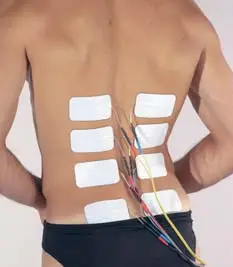
A transcutaneous electrical nerve stimulation (TENS) unit is used for pain relief (Figure 36.10). Electrodes are placed on the skin in specific locations. The adjustable low-voltage machine sends electrical current through disposable gel electrodes into the skin. The current stimulates specific nerves, producing a tingling or massaging sensation that reduces pain. TENS units have been used for passive exercise of muscles when a patient cannot exercise the extremity (e.g., due to injury or stroke). The electrical stimulation can prevent atrophy of normal muscles. TENS units are also used to treat the pain from muscle, joint, or other orthopedic conditions.

TENS unit used for pain management therapy
TENS unity
Wikimedia Commons
/
CC BY-SA 3.0

Cold and heat therapies: general principles

  • Dry vs. moist applications:
    • Dry: pulls moisture from skin
    • Moist: increases tissue elasticity, deeper penetration
  • Monitor patient for discomfort, tissue injury risk higher in:
    • Children, older adults, impaired circulation/sensitivity, open wounds, edematous/scarred areas

Patient education for cold and heat applications

  • Use protective covering between skin and application
  • Limit therapy to 15–20 minutes per session
  • Never sleep with application or place over metal jewelry
  • Watch for adverse reactions (erythema, paleness, pain, swelling, blisters)

Cold therapy

  • Indications: sprains, strains, fractures, joint injuries, shin splints
  • Effects: vasoconstriction, reduced blood flow, decreased tissue metabolism, reduced pain/inflammation, prevents edema
  • Types:
    • Cold compress (moist)
    • Chemical cold pack, ice bag, gel pack, bead pack (dry)

Heat therapy

  • Indications: acute/chronic pain, sinus congestion, localized infection
  • Effects: vasodilation, increased circulation, muscle relaxation, fluid absorption
  • Types:
    • Hot soak/whirlpool bath, hot compress (moist)
    • Heating pad, chemical hot pack, gel pack, bead pack (dry)

Paraffin bath therapy

  • Deep heat therapy for pain/stiffness (e.g., arthritis)
  • Uses melted paraffin and mineral oil, repeated layering, wrapped for 20 minutes

Heat lamp therapy

  • Red light: treats skin conditions
  • Near infrared: deeper penetration, kills pathogens, heals tissue, improves circulation, relieves pain

Physical therapy treatments

  • Variety of treatments for musculoskeletal conditions
  • Medical assistant should be familiar with available options

Ultrasound therapy

  • Uses sound waves for pain relief and healing
  • Gel applied to skin for transmission
  • Two types: thermal and mechanical (differ in wave speed)
  • Must be performed by trained therapist

RICE therapy

  • Standard for initial orthopedic injury care (first 48–72 hours)
    • Rest: limit activity
    • Ice: 15–20 min, 4–8 times/day
    • Compression: elastic bandage, monitor CMST
    • Elevation: above heart level

Exercise therapy

  • Maintains strength, flexibility, joint mobility
  • Types:
    • Isometric: increases tension, no muscle length change
    • Isotonic: muscle shortens/thickens, joint movement
    • ROM (range-of-motion): maintains flexibility, prevents stiffness
      • Active: patient performs
      • Passive: caregiver/therapist performs

Electrical muscle stimulation (TENS)

  • TENS unit: pain relief via electrical nerve stimulation
  • Electrodes placed on skin, adjustable low-voltage current
  • Uses: pain management, passive muscle exercise, prevents atrophy

Sign up for free to take 17 quiz questions on this topic

Previous
Next  | 26.4 Assistive devices: crutches, walkers, canes, and wheelchairs
All rights reserved ©2016 - 2026 Achievable, Inc.

Assisting with cold and heat therapies

Cold and heat therapeutic modalities or treatments are used for orthopedic injuries and infections. The applications can be as follows:

  • Dry: No moisture is left on the skin. Dry applications tend to pull moisture out of the skin.
  • Moist: Moisture is left on the skin. Moist applications tend to increase tissue elasticity and allow heat or cold to penetrate deeper into the tissues.
  • When using heat or cold applications, the medical assistant should ask the patient if it feels too hot or too cold. The medical assistant should monitor the area being treated. Some patients are at higher risk for tissue injury with heat or cold applications:
  • Younger children because of their thinner skin
  • Older adults due to their reduced sensitivity to pain
  • People with impaired circulation (e.g., those with peripheral vascular diseases and diabetes mellitus)
  • People with altered sensitivity (e.g., those who are confused or have neurologic disorders, including diabetic neuropathy and spinal cord damage)
  • Those for whom the application is placed on an open wound, broken skin, or stoma (this tissue is more sensitive)
  • Those for whom the application is placed on edematous or scarred areas (scars and edema reduce sensitivity)

Patient education for cold and heat applications

  • Know what supplies are required and where they can be purchased.
  • Use a protective covering between the skin and the application.
  • Never fall asleep with an application on the skin.
  • Never place an application over metal jewelry.
  • Know the length of time for each application, the number of times a day ordered, and the number of days for treatment.
  • Heat and cold therapy should be applied for 15 to 20 minutes. Additional time can harm the tissues.
  • After the session, remove the application. Allow the skin to return to its normal temperature before applying again.
  • Prolonged erythema or paleness, pain, swelling, and blisters should be reported to the provider.

Cold therapy

Cold therapy is typically used for sprains, strains, fractures, joint injuries, shin splints, and other injuries. In some facilities, it is a common practice to provide a cold pack to a patient who comes in with a recent injury.

A cold application causes vasoconstriction, which reduces blood flow to the area. As a result, tissue metabolism decreases, less oxygen is used, and less swelling occurs. The nerve endings in the area become numb. The blood viscosity increases, which can cause clotting. Cold therapy helps to reduce pain and inflammation and prevents edema (swelling) in the injured area.

Heat therapy

Heat therapy can be used to relieve the following conditions:

  • Acute pain (e.g., back and menstrual) and chronic pain (e.g., arthritis)
  • Sinus congestion
  • Infection (e.g., localized abscesses)

Heat therapy can help with muscle relaxation. It can produce local vasodilation, which increases circulation. The increased blood supply to a local area helps to absorb the extra fluid (from edema). Additional types of heat therapy will be discussed.

Paraffin bath therapy

Paraffin provides deep heat therapy. The heat can reduce pain and tenderness. It has been found to maintain muscle strength and increase mobility. Paraffin therapy is a common treatment for arthritis and other conditions that cause pain and stiffness.

Types of cold applications:

Type Dry or Moist Description
Cold compress Moist Washcloth or other soft cloth is dampened with a cold solution (e.g., water) and applied to the skin.
Chemical cold pack Dry Comes in a variety of sizes. Stored at room temperature. Contains inner areas of a dry chemical and water. When activated, the water and chemical mix creates coldness.
Ice bag Dry A bag with cubes or pieces of ice.
Gel pack Dry Aqueous gel that freezes. Reusable. Stored in freezer.
Bead pack Dry Little beads of gel conform to the site even when frozen. Similar to a frozen bag of peas. Reusable. Stored in freezer.

Types of hot applications

Type Dry or Moist Description
Hot soak/ whirlpool bath (Hydrotherapy) Moist Part of the body is submerged in warm water or a warm medicated solution. Should be warmed to 105°F to 110°F (40.6°C to 43.3°F).
Hot compress Moist Washcloth or other soft cloth is dampened with a hot solution (e.g., water) and applied to the skin.
Heating pad Dry Electric pad that warms. Inspect for safety purposes.
Chemical hot pack Dry Comes in a variety of sizes. Stored at room temperature. Contains inner areas of a dry chemical and water. When activated, the water and chemical mix, creating heat for a period of time.
Gel pack Dry Aqueous gel that can be microwaved. Reusable.
Bead pack Dry Little beads of gel that can be microwaved. Reusable.

A paraffin bath uses melted paraffin and mineral oil warmed to about 125°F (51.7°C). The patient bathes a foot or hand in the bath. Once the extremity is coated, the patient should lift it out and let it dry for a few seconds. This process is repeated until the patient has 10 to 12 layers of wax built up on the extremity. The foot or hand is wrapped in plastic and then in a towel to retain the moisture and heat. After 20 minutes, it is unwrapped, and the wax is removed.

Heat lamp therapy

Two commonly used heat lamp therapies are red light therapy and near infrared light therapy. Red light therapy is used to treat skin conditions. Near infrared light therapy penetrates deeper, killing pathogens, healing tissue, improving circulation, and relieving pain.

Physical therapy treatments

Different physical therapy treatments can be used to help treat musculoskeletal conditions. The medical assistant should be familiar with the treatments.

Ultrasound therapy

Ultrasound therapy has been used for a long time to treat pain and promote healing. The ultrasound transducer head produces sound waves. Ultrasound gel is applied to the skin. As the transducer head is moved over the skin, the gel helps with the transmission of sound waves into the soft tissue. There are two main types of ultrasound therapy: thermal and mechanical. The main difference between these types is the speed at which the sound waves penetrate the soft tissue. Ultrasound therapy must be done by a trained therapist. This treatment is often provided in chiropractic, sports medicine, physical therapy, and occupational therapy facilities.

RICE therapy

For orthopedic injuries, RICE is commonly ordered as a treatment, usually for the first 48 to 72 hours. After 72 hours, moist heat is prescribed. Here is what RICE stands for:

  • Rest: Reduce activities for a period of time. Crutches can help an injured leg/ankle rest.
  • Ice: Apply a cold pack to the injured area for 15 to 20 minutes, four to eight times daily.
  • Compression: Use elastic bandage (e.g., ACE Wrap) or splints to reduce swelling. It is important to monitor the CMST of a wrapped extremity.
  • Elevation: Elevate the injured extremity higher than the level of the heart to reduce swelling.

Exercise therapy

Often patients are encouraged to exercise to maintain their strength and joint mobility. Patients recovering from surgery (e.g., orthopedic, cardiac) may need to see a physical therapist or an occupational therapist. These therapists work with patients to help them regain their mobility and strength. Isometric, isotonic, and range-of-motion exercises are encouraged to maintain strength, flexibility, and mobility.

Isometric contractions do not change the muscle length, but they do increase the muscle tension. Isometric exercises help to maintain a person’s strength. Isotonic contractions cause muscles to shorten and thicken and cause movement at a joint. Isotonic exercises help restore movement after an injury and relieve stiffness and pain. ROM exercises help to maintain flexibility and joint mobility and reduce stiffness. Active ROM exercises are done by the patient, whereas passive ROM exercises are done by a caregiver or therapist. For patients who have had a stroke or other trauma that affects movement, daily ROM exercises are critical to prevent joints from freezing up. Frozen joints have limited to no movement.

Electrical muscle stimulation

A transcutaneous electrical nerve stimulation (TENS) unit is used for pain relief (Figure 36.10). Electrodes are placed on the skin in specific locations. The adjustable low-voltage machine sends electrical current through disposable gel electrodes into the skin. The current stimulates specific nerves, producing a tingling or massaging sensation that reduces pain. TENS units have been used for passive exercise of muscles when a patient cannot exercise the extremity (e.g., due to injury or stroke). The electrical stimulation can prevent atrophy of normal muscles. TENS units are also used to treat the pain from muscle, joint, or other orthopedic conditions.

Key points

Cold and heat therapies: general principles

  • Dry vs. moist applications:
    • Dry: pulls moisture from skin
    • Moist: increases tissue elasticity, deeper penetration
  • Monitor patient for discomfort, tissue injury risk higher in:
    • Children, older adults, impaired circulation/sensitivity, open wounds, edematous/scarred areas

Patient education for cold and heat applications

  • Use protective covering between skin and application
  • Limit therapy to 15–20 minutes per session
  • Never sleep with application or place over metal jewelry
  • Watch for adverse reactions (erythema, paleness, pain, swelling, blisters)

Cold therapy

  • Indications: sprains, strains, fractures, joint injuries, shin splints
  • Effects: vasoconstriction, reduced blood flow, decreased tissue metabolism, reduced pain/inflammation, prevents edema
  • Types:
    • Cold compress (moist)
    • Chemical cold pack, ice bag, gel pack, bead pack (dry)

Heat therapy

  • Indications: acute/chronic pain, sinus congestion, localized infection
  • Effects: vasodilation, increased circulation, muscle relaxation, fluid absorption
  • Types:
    • Hot soak/whirlpool bath, hot compress (moist)
    • Heating pad, chemical hot pack, gel pack, bead pack (dry)

Paraffin bath therapy

  • Deep heat therapy for pain/stiffness (e.g., arthritis)
  • Uses melted paraffin and mineral oil, repeated layering, wrapped for 20 minutes

Heat lamp therapy

  • Red light: treats skin conditions
  • Near infrared: deeper penetration, kills pathogens, heals tissue, improves circulation, relieves pain

Physical therapy treatments

  • Variety of treatments for musculoskeletal conditions
  • Medical assistant should be familiar with available options

Ultrasound therapy

  • Uses sound waves for pain relief and healing
  • Gel applied to skin for transmission
  • Two types: thermal and mechanical (differ in wave speed)
  • Must be performed by trained therapist

RICE therapy

  • Standard for initial orthopedic injury care (first 48–72 hours)
    • Rest: limit activity
    • Ice: 15–20 min, 4–8 times/day
    • Compression: elastic bandage, monitor CMST
    • Elevation: above heart level

Exercise therapy

  • Maintains strength, flexibility, joint mobility
  • Types:
    • Isometric: increases tension, no muscle length change
    • Isotonic: muscle shortens/thickens, joint movement
    • ROM (range-of-motion): maintains flexibility, prevents stiffness
      • Active: patient performs
      • Passive: caregiver/therapist performs

Electrical muscle stimulation (TENS)

  • TENS unit: pain relief via electrical nerve stimulation
  • Electrodes placed on skin, adjustable low-voltage current
  • Uses: pain management, passive muscle exercise, prevents atrophy

More from The role of the medical assistant in physical therapy examination and assessment

  • Immobilization and treatment techniques
  • Assisting in physical therapy & rehabilitation
  • Assistive devices: crutches, walkers, canes, and wheelchairs