


Achievable logoAchievable logo
CCMA
Sign in
Sign up
Purchase
Textbook
Practice exams
Support
How it works
Exam catalog
Mountain with a flag at the peak
Textbook
1. Medical assistant
2. Electronic records
3. Medical terminology and anatomy
4. The fundamentals of infection control
5. Introduction to vital signs
6. The patient interview and history
7. The physical examination
8. Appointment scheduling
9. Insurance billing
9.1 Health insurance basics
9.2 Government health plans: Medicare and Medicaid programs
9.3 Other government and private health plans
9.4 The medical assistant's role
9.5 HIPAA overview and the privacy rule
9.6 Other private laws
9.7 Healthcare laws overview
10. Diagnostic coding and the ICD-10-CM System
11. Procedural coding
12. Medical billing and reimbursement essentials
13. Assisting with medical specialties
14. Assisting with the musculoskeletal system
15. Assisting with the cardiovascular system
16. Assisting with the respiratory system
17. Assisting with the nervous system
18. Anatomy and physiology of the urinary system
19. Assisting in obstetrics and gynecology
20. Assisting in endocrinology
21. Assisting in ophthalmology & otolaryngology
22. Assisting in gastroenterology
23. Assisting in the immune & lymphatic systems
24. Assisting in pediatrics: the developmental stages and care
25. The medical assistant’s role in caring for the older patient
26. The role of the medical assistant in physical therapy examination and assessment
27. Preparing for minor surgery: room, solutions, and supplies
28. Introduction to the clinical laboratory
29. Urinalysis
30. Blood collection
31. Analysis of blood
32. Electrocardiography and heart structure
33. The principles of pharmacology
34. Essential calculations and measurement systems
35. Solid, liquid, & solutions medication doses
36. Administering medications
37. Metabolism and core nutrient roles
38. Medical emergencies in the healthcare setting
Achievable logoAchievable logo
9.6 Other private laws
Achievable CCMA
9. Insurance billing
Our CCMA course is currently in development and is a work-in-progress.

Other private laws

5 min read
Font
Discuss
Share
Feedback

HITECH Act

One of the issues with HIPAA was the limited enforcement and penalties. In 2009, as part of the American Recovery and Reinvestment Act, the Health Information Technology for Economic and Clinical Health (HITECH) Act was passed. HITECH Act is enforced by the OCR.

The HITECH Act contains provisions that increase the enforcement of the privacy and security of electronic transmission and health information. HITECH Act modified HIPAA in the following ways:

  • Made business associates directly liable for compliance with HIPAA.
  • Prohibited the sale of PHI without the patient’s authorization.
  • Created a tiered violation category that included unknowing, reasonable cause, willful neglect–corrected, and willful neglect–uncorrected. Violation penalties range from $100 for each “unknowing” violation to $1.5 million per calendar year. The greater the violation, the greater the penalty amount. Individuals, healthcare agencies, and business associations could be penalized and fined.
  • Breach notification requirements were increased. Individuals must be notified of the breach via mail or email. If the facility does not have up-to-date contact information for 10 or more patients, then a notice must be posted on the company’s website for at least 90 days. If more than 500 individuals were affected, the media and the OCR secretary must be notified. A list of breaches reported is published on the OCR website.

It is important for the medical assistant to be aware of the importance of keeping the PHI secure. Any breaches or loss/theft of computer equipment must be reported immediately to the facility’s security officer.

Drug laws

The Food, Drug, and Cosmetic Act and the Controlled Substance Act regulate medications in the United States. The following sections describe each law and how it impacts healthcare.

Food, Drug, and Cosmetic Act (FDA)

In 1906, the Food and Drug Act became law. It prohibited the misbranding of food and drugs. It was replaced in 1938 by the Food, Drug, and Cosmetic Act, which is still enforced today. The US Food and Drug Administration (FDA) enforces the act. The FDA is responsible for the safety, effectiveness, security, and quality of drugs, cosmetics, and food. Some of the areas overseen by the FDA include human and veterinary drugs, vaccines, biological products (e.g., blood components), medical devices, food, cosmetics, dietary supplies, and products that give off radiation. When you see recalls of food, cosmetics, or medications, the FDA is involved with the process.

The FDA website provides useful information for the healthcare facility. The website is the resource for information and recalls on the areas overseen by the FDA. Many times, the medical assistant is responsible for maintaining the stock medications and equipment in the department. Any medications or medical devices recalled need to be removed immediately and not used. The providers should be notified of recalls.

Controlled Substances Act

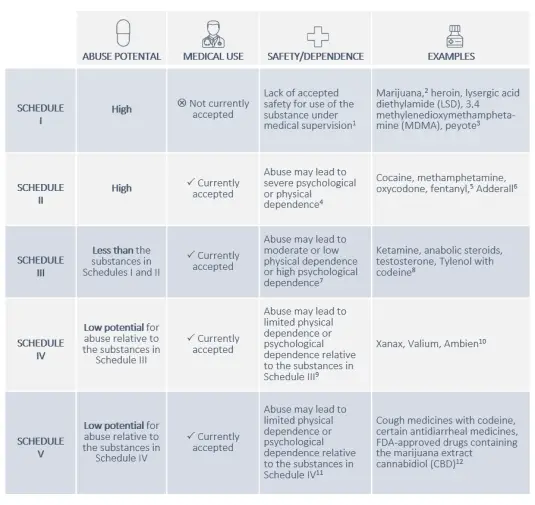
The Controlled Substances Act (part of the Comprehensive Drug Abuse Prevention and Control Act of 1970) is a federal law. The US Drug Enforcement Agency (DEA) enforces the law. The DEA oversees the manufacturing, importation, possession, use, and distribution of certain drugs and chemicals. The DEA handles both illegal and legal controlled substances. The Controlled Substances Act has five schedules of medications. These schedules are arranged from greatest to least abuse potential. State statutes also address procedures related to scheduled medications. Some scheduled medication prescriptions are handled differently. It is important for the medical assistant to be aware of the schedule of medications.

Each provider prescribing scheduled medications needs to have a unique DEA number. The DEA number needs to be renewed every 3 years. The medical assistant may need to assist the provider in renewing or obtaining a DEA number. This can be done at the DEA website.

DEA drug schedules and classifications listed
Drug schedules
Wikimedia Commons
/
Public Domain

Workplace safety laws

The Occupational Safety and Health Act and the Needlestick Safety and Prevention Act mandate standards that help protect employees. The following sections describe each law and how it impacts the healthcare setting, making the environment safe for employees.

Occupational Safety and Health Act

The Occupational Safety and Health Act of 1970 (OSH Act) is enforced by the Occupational Safety and Health Administration (OSHA). Based on this act, OSHA sets workplace standards and conducts inspections to ensure employee safety. Employers must comply with all of OSHA’s regulations.

Needlestick Safety and Prevention Act

The Needlestick Safety and Prevention Act was signed into law in 2000. The goal of the act was to reduce the risk of healthcare workers’ exposure to bloodborne diseases. The act required OSHA to update its Bloodborne Pathogens Standard. The revised standards apply to all employees with anticipated occupational exposure to blood or other potentially infectious materials (OPIM).

Healthcare workers must use safer medical devices. For example, many needles can be capped with a special safety device after use. The facility’s Exposure Control Plan must include a sharps injury log documenting all instances of injuries from sharps (e.g., used needles, blades). Used needles, blades, and other sharps must be put in sharps disposal containers.

Personal protective equipment (PPE) (i.e., gloves, mask, and gown) must be worn if there is a risk of blood or body fluid exposure.

HITECH Act

  • Strengthened HIPAA enforcement and penalties
  • Business associates directly liable for HIPAA compliance
  • Tiered violation categories; penalties up to $1.5 million/year
  • Enhanced breach notification requirements:
    • Notify individuals, post on website if >10 unreachable, notify media/OCR if >500 affected

Food, Drug, and Cosmetic Act (FDA)

  • Enforced by US Food and Drug Administration (FDA)
  • Regulates safety, effectiveness, and quality of drugs, food, cosmetics, medical devices
  • FDA oversees recalls; medical assistants must remove recalled items and notify providers

Controlled Substances Act

  • Enforced by US Drug Enforcement Agency (DEA)
  • Regulates manufacturing, distribution, and use of controlled substances
  • Five drug schedules based on abuse potential
  • Providers need unique DEA number (renew every 3 years); medical assistants may assist with process

Occupational Safety and Health Act

  • Enforced by Occupational Safety and Health Administration (OSHA)
  • Sets and enforces workplace safety standards
  • Employers must comply with OSHA regulations and inspections

Needlestick Safety and Prevention Act

  • Updated OSHA Bloodborne Pathogens Standard (2000)
  • Requires use of safer medical devices (e.g., safety needles)
  • Exposure Control Plan must include sharps injury log
  • Mandatory use of personal protective equipment (PPE) when risk of exposure to blood or body fluids

Sign up for free to take 13 quiz questions on this topic

Previous
Next  | 9.7 Healthcare laws overview
All rights reserved ©2016 - 2026 Achievable, Inc.

Other private laws

HITECH Act

One of the issues with HIPAA was the limited enforcement and penalties. In 2009, as part of the American Recovery and Reinvestment Act, the Health Information Technology for Economic and Clinical Health (HITECH) Act was passed. HITECH Act is enforced by the OCR.

The HITECH Act contains provisions that increase the enforcement of the privacy and security of electronic transmission and health information. HITECH Act modified HIPAA in the following ways:

  • Made business associates directly liable for compliance with HIPAA.
  • Prohibited the sale of PHI without the patient’s authorization.
  • Created a tiered violation category that included unknowing, reasonable cause, willful neglect–corrected, and willful neglect–uncorrected. Violation penalties range from $100 for each “unknowing” violation to $1.5 million per calendar year. The greater the violation, the greater the penalty amount. Individuals, healthcare agencies, and business associations could be penalized and fined.
  • Breach notification requirements were increased. Individuals must be notified of the breach via mail or email. If the facility does not have up-to-date contact information for 10 or more patients, then a notice must be posted on the company’s website for at least 90 days. If more than 500 individuals were affected, the media and the OCR secretary must be notified. A list of breaches reported is published on the OCR website.

It is important for the medical assistant to be aware of the importance of keeping the PHI secure. Any breaches or loss/theft of computer equipment must be reported immediately to the facility’s security officer.

Drug laws

The Food, Drug, and Cosmetic Act and the Controlled Substance Act regulate medications in the United States. The following sections describe each law and how it impacts healthcare.

Food, Drug, and Cosmetic Act (FDA)

In 1906, the Food and Drug Act became law. It prohibited the misbranding of food and drugs. It was replaced in 1938 by the Food, Drug, and Cosmetic Act, which is still enforced today. The US Food and Drug Administration (FDA) enforces the act. The FDA is responsible for the safety, effectiveness, security, and quality of drugs, cosmetics, and food. Some of the areas overseen by the FDA include human and veterinary drugs, vaccines, biological products (e.g., blood components), medical devices, food, cosmetics, dietary supplies, and products that give off radiation. When you see recalls of food, cosmetics, or medications, the FDA is involved with the process.

The FDA website provides useful information for the healthcare facility. The website is the resource for information and recalls on the areas overseen by the FDA. Many times, the medical assistant is responsible for maintaining the stock medications and equipment in the department. Any medications or medical devices recalled need to be removed immediately and not used. The providers should be notified of recalls.

Controlled Substances Act

The Controlled Substances Act (part of the Comprehensive Drug Abuse Prevention and Control Act of 1970) is a federal law. The US Drug Enforcement Agency (DEA) enforces the law. The DEA oversees the manufacturing, importation, possession, use, and distribution of certain drugs and chemicals. The DEA handles both illegal and legal controlled substances. The Controlled Substances Act has five schedules of medications. These schedules are arranged from greatest to least abuse potential. State statutes also address procedures related to scheduled medications. Some scheduled medication prescriptions are handled differently. It is important for the medical assistant to be aware of the schedule of medications.

Each provider prescribing scheduled medications needs to have a unique DEA number. The DEA number needs to be renewed every 3 years. The medical assistant may need to assist the provider in renewing or obtaining a DEA number. This can be done at the DEA website.

Workplace safety laws

The Occupational Safety and Health Act and the Needlestick Safety and Prevention Act mandate standards that help protect employees. The following sections describe each law and how it impacts the healthcare setting, making the environment safe for employees.

Occupational Safety and Health Act

The Occupational Safety and Health Act of 1970 (OSH Act) is enforced by the Occupational Safety and Health Administration (OSHA). Based on this act, OSHA sets workplace standards and conducts inspections to ensure employee safety. Employers must comply with all of OSHA’s regulations.

Needlestick Safety and Prevention Act

The Needlestick Safety and Prevention Act was signed into law in 2000. The goal of the act was to reduce the risk of healthcare workers’ exposure to bloodborne diseases. The act required OSHA to update its Bloodborne Pathogens Standard. The revised standards apply to all employees with anticipated occupational exposure to blood or other potentially infectious materials (OPIM).

Healthcare workers must use safer medical devices. For example, many needles can be capped with a special safety device after use. The facility’s Exposure Control Plan must include a sharps injury log documenting all instances of injuries from sharps (e.g., used needles, blades). Used needles, blades, and other sharps must be put in sharps disposal containers.

Personal protective equipment (PPE) (i.e., gloves, mask, and gown) must be worn if there is a risk of blood or body fluid exposure.

Key points

HITECH Act

  • Strengthened HIPAA enforcement and penalties
  • Business associates directly liable for HIPAA compliance
  • Tiered violation categories; penalties up to $1.5 million/year
  • Enhanced breach notification requirements:
    • Notify individuals, post on website if >10 unreachable, notify media/OCR if >500 affected

Food, Drug, and Cosmetic Act (FDA)

  • Enforced by US Food and Drug Administration (FDA)
  • Regulates safety, effectiveness, and quality of drugs, food, cosmetics, medical devices
  • FDA oversees recalls; medical assistants must remove recalled items and notify providers

Controlled Substances Act

  • Enforced by US Drug Enforcement Agency (DEA)
  • Regulates manufacturing, distribution, and use of controlled substances
  • Five drug schedules based on abuse potential
  • Providers need unique DEA number (renew every 3 years); medical assistants may assist with process

Occupational Safety and Health Act

  • Enforced by Occupational Safety and Health Administration (OSHA)
  • Sets and enforces workplace safety standards
  • Employers must comply with OSHA regulations and inspections

Needlestick Safety and Prevention Act

  • Updated OSHA Bloodborne Pathogens Standard (2000)
  • Requires use of safer medical devices (e.g., safety needles)
  • Exposure Control Plan must include sharps injury log
  • Mandatory use of personal protective equipment (PPE) when risk of exposure to blood or body fluids

More from Insurance billing

  • Health insurance basics
  • Government health plans: Medicare and Medicaid programs
  • Other government and private health plans
  • The medical assistant's role
  • HIPAA overview and the privacy rule