



Cardiac emergencies and choking
Cardiac emergencies
Chest pain or angina can be associated with heart and lung disease, in addition to a few other conditions. It can be quite serious; a patient with chest pain is treated as a cardiac emergency until a provider has ruled this out. A heart attack, or myocardial infarction, usually is caused by blockage of the coronary arteries, which reduces the amount of blood delivered to the myocardium. The most common signal of a heart attack is an uncomfortable pressure, squeezing, fullness, or pain in the center of the chest (symptoms in women, which may be different, are presented in the following box). This may spread to the shoulder, neck, jaw, or arms. The pain may not be severe. The lips and fingernails may turn blue, which is a sign of cyanosis, or the patient may have a gray, ashen appearance. Frequently the patient clutches the chest in pain. This pain may radiate from the mediastinum down the left arm and up the left side of the neck. The pulse may be rapid and weak, and the patient often complains of nausea. Other symptoms include sweating (diaphoresis); indigestion; shortness of breath (SOB); cold, clammy skin; and a feeling of weakness (general malaise). Unfortunately, most people deny that the problem is serious until they require immediate medical attention.
Signs and symptoms of myocardial infarction in women
Women may experience symptoms that are different from those traditionally associated with a heart attack. Women’s symptoms include a combination of the following:
- Back pain or aching and throbbing in the biceps or forearms
- Shortness of breath (SOB)
- Clammy perspiration
- Dizziness (vertigo): Unexplained lightheadedness or syncopal episodes
- Edema, especially of the ankles and/or lower legs
- Fluttering heartbeat or tachycardia
- Gastric upset
- Feeling of heaviness or fullness in the mediastinum
Immediately report any of these signs or symptoms to the provider. If the provider is not available, activate EMS. Use a wheelchair to move the patient to an examination room. Breathing will be easier if the patient’s head is slightly elevated or if the patient is in a Fowler’s or semi-Fowler’s position. Keep the patient quiet and warm. Loosen all tight clothing. Take vital signs, including both apical and radial pulses. The provider may order oxygen started on the patient to rerelieve dyspnea. Bring the emergency cart into the room and open the medication drawer so that the provider can quickly prepare the medications needed. These may include epinephrine (adrenaline), atropine, digitalis, calcium chloride, or morphine.
If the patient is conscious, ask about any medication that he or she has recently taken or is carrying. If the patient has an established heart disorder, the person may be carrying nitroglycerin tablets; these tablets are administered sublingually and may be given with the patient’s consent. If the provider is in the office or is on the way, connect the patient to the electrocardiograph machine and record a few tracings. If the patient becomes unresponsive before the provider or EMS arrives, it may be necessary to start rescue breathing if no evidence of respirations is noted. If chest pain progresses to cardiac arrest and loss of circulation, CPR must be performed until help arrives.
Choking
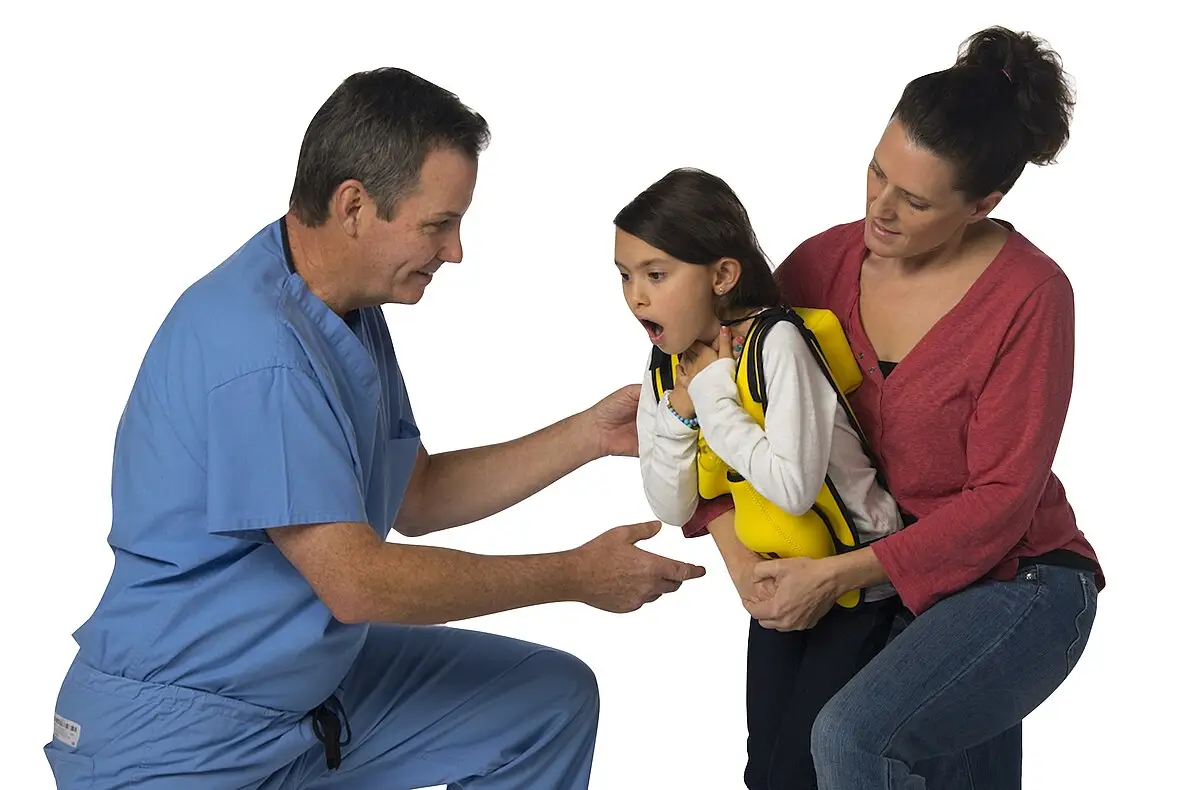
Choking is usually caused by a foreign object, often a bolus of food, lodged in the upper airway. The victim may clutch the neck between the thumb and the index finger; this universal distress signal should be viewed as a sign the victim needs help. If the victim has good air exchange or only partial airway obstruction and can speak, cough, or breathe, do not interfere, but encourage the patient to continue coughing until the object is expelled. Monitor the patient for signs of respiratory distress, such as pallor and cyanosis. If the patient has a pronounced wheeze or a very weak cough, he or she has a partial airway obstruction with poor air exchange and may need help. If the patient is unable to speak, breathe, or cough, a complete airway obstruction exists, and quick action must be taken to clear the airway. With complete obstruction, the patient eventually loses consciousness from lack of oxygen to the brain. This condition may lead to respiratory and cardiac arrest. If the object is not removed, the victim may die within 4 to 6 minutes. The procedure for removal of a foreign airway obstruction is exactly the same for a child older than 1 year of age.
Relieving choking in an adult or a child older than 1 year
Act as soon as the patient cannot speak, cough, or breathe. Stand or kneel behind the patient and:
- Deliver 5 back blows with the heel of your hand, between the shoulder blades.
- Deliver 5 abdominal thrusts. Make a fist and place the thumb side against the abdomen, slightly above the navel and well below the tip of the sternum. Grasp your fist with your other hand and give quick inward and upward thrusts.
- Alternate 5 back blows and 5 abdominal thrusts until the object is expelled or the patient becomes unresponsive.
If the patient becomes unresponsive, lower the person to the floor, activate EMS if that has not already been done, and begin CPR starting with chest compressions. Each time you open the airway to give a breath, look in the mouth and remove the object only if you can see it. Never perform a blind finger sweep; it can push the obstruction farther into the airway.
To dislodge a foreign object from the airway of an infant up to 1 year of age, place the baby face down over your forearm and across your thigh. The head should be lower than the trunk, and you should support the baby’s head and neck with one hand. Using the heel of your other hand, deliver 5 blows to the back, between the infant’s shoulder blades. Holding the baby between your arms, turn the infant face up, keeping the head lower than the trunk. Using the heel of one hand, deliver 5 chest thrusts in the middle of the chest, over the lower half of the sternum - just below the nipple line - at about 1 per second. Repeat the sequence of up to 5 back blows and up to 5 chest thrusts until the object is expelled or the infant becomes unresponsive. Do not stop to give rescue breaths, and do not stop to look in the mouth, while the infant is still responsive. If the infant becomes unresponsive, place the baby on a firm, flat surface, activate EMS if that has not already been done, and begin CPR starting with chest compressions. Each time you open the airway to give a breath, look in the mouth and remove the object only if you can see it. Never perform a blind finger sweep on an infant. A baby’s oral cavity is too small for a finger sweep, and such an action may only push the obstruction farther into the airway.
If a choking victim is in the late stages of pregnancy, or if you cannot reach far enough around the patient’s abdomen to give abdominal thrusts, give chest thrusts instead. Stand behind the patient, place the thumb side of your fist against the lower half of the sternum, grasp the fist with your other hand, and give quick inward thrusts. The hands stay on the sternum rather than on the abdomen - keeping pressure off the uterus is the whole point of the substitution.
The abdominal thrust maneuver also can be performed on yourself if you are choking and no one is nearby to help you. Press your fist into your upper abdomen with quick, upward thrusts, or lean forward and press the abdomen quickly against a firm object, such as the back of a chair.