



The medical assistant’s role in examinations, diagnostic procedures, and treatments
Endocrine diseases and disorders are common in primary care and endocrinology departments. Medical assistants help the provider with examinations, diagnostic procedures, and treatments.
Assisting with the examination
When the medical assistant is rooming a patient, it is important to accurately measure the vital signs and obtain the medical history. Encouraging the patient to voice any concerns or issues is vital. The medical assistant may be required to ask specific screening questions. Peripheral neuropathy screening questions for patients with DM may include the following:
- Do you have tingling, burning, numbness, cramps, or sharp pains in your hands and feet?
- Do you have a reduced ability to feel temperatures or pain in your hands and feet?
- Are your hands or feet more sensitive to touch?
- Do your hands or feet feel weaker?
- Do you have any problems with loss of balance or coordination?
- Do you have any sores, blisters, or any concerns with your feet?
When completing the medication section of the medical history, the medical assistant must verify the medication name, the dose amount, and the number of doses taken each day. Sometimes the information in the health record is different from what the patient is really doing. Having accurate information in the health record helps the provider evaluate the complete picture of the patient’s health.
During the physical exam, the provider often needs to examine the patient’s feet for any abnormalities. The medical assistant should assist the patient in removing shoes and socks as needed. For infection control purposes, the patient’s bare feet should never touch the floor. The medical assistant should place a piece of paper towel or some other barrier between the patient’s feet and the floor.
Many providers have medical assistants perform peripheral neuropathy screening using the monofilament foot exam. This test checks for loss of protective sensation - the inability to feel a light touch that would normally signal an injury - and is commonly done for diabetic patients, though it should be performed on any patient reporting neuropathy symptoms.
Assisting with diagnostic procedures
The medical assistant may be responsible for coaching patients on diagnostic procedures done in other departments. As with other diagnostic procedures, the medical assistant should coach the patient regarding the following:
- Patient preparation (e.g., dietary restrictions and medications to hold)
- Location and time of the test
- What to expect during the procedure
- Any follow-up required after the procedure
Assisting with treatments
Some endocrine disorders are treated with surgery. Many endocrine disorders are treated with medications. The following are some of the more common classifications of medications:
- Antihyperglycemic: Used to manage diabetes mellitus
- Hormone replacement: Used to maintain adequate hormone levels
- Estrogen: Used for menopause
- Estrogen and progestin: Used for menopause
- Insulin: Used to treat type 1 and type 2 diabetes mellitus
- Thyroid hormone: Used for hypothyroidism
- Vasopressin: Used for diabetes insipidus
Medical assistants should be familiar with medications that are prescribed to patients.
In the ambulatory care facility, when a patient is prescribed insulin for the first time, the medical assistant may need to do some coaching if the patient is not seeing a diabetic educator immediately. What an MA may perform or delegate here is set by state law, not a single national rule, so the medical assistant must confirm this coaching is within their scope of practice before addressing the following topics with the patient:
- How to draw up and give an insulin injection
- Signs and symptoms of hyperglycemia and hypoglycemia
- Immediate treatments for hyperglycemia and hypoglycemia
- How to use a glucometer to monitor blood glucose levels
- When to contact the provider or seek additional care
- Storage of supplies and how to discard used needles
Insulin
Insulin is used to treat type 1 and, in some cases, type 2 diabetes mellitus. Most commonly, insulin is injected subcutaneously several times a day. The onset is the length of time before the insulin begins to work. The peak is the period when the insulin is most effective. The duration is the length of time the insulin exerts an effect on the body.
Many people take two types of insulin a day. Premixed insulins combine a longer-acting insulin with a rapid- or short-acting insulin in a single injection. For example, Humalog Mix 75/25 combines 75% insulin lispro protamine (intermediate-acting) with 25% insulin lispro (rapid-acting).
Insulin can be given in the following ways:
- Syringe and vial: Insulin is drawn up in the syringe, and then the injection is given. Adaptive equipment is available to help patients see the calibration lines on the syringe.
- Insulin pump: This is a computerized device that administers insulin through a needle-tipped catheter attached to tubing and the medication container. The needle can be inserted in several locations, including the abdomen, outer thigh, back of the arm, hip, and buttock. The pump is programmed to deliver a basal rate, or the continuous infusion of a small dose of insulin over a 24-hour period. The person can also set the pump to deliver extra insulin to cover the carbohydrates being consumed. This method more closely resembles the body’s normal surge of insulin and is designed to maintain blood glucose levels consistently within normal limits.
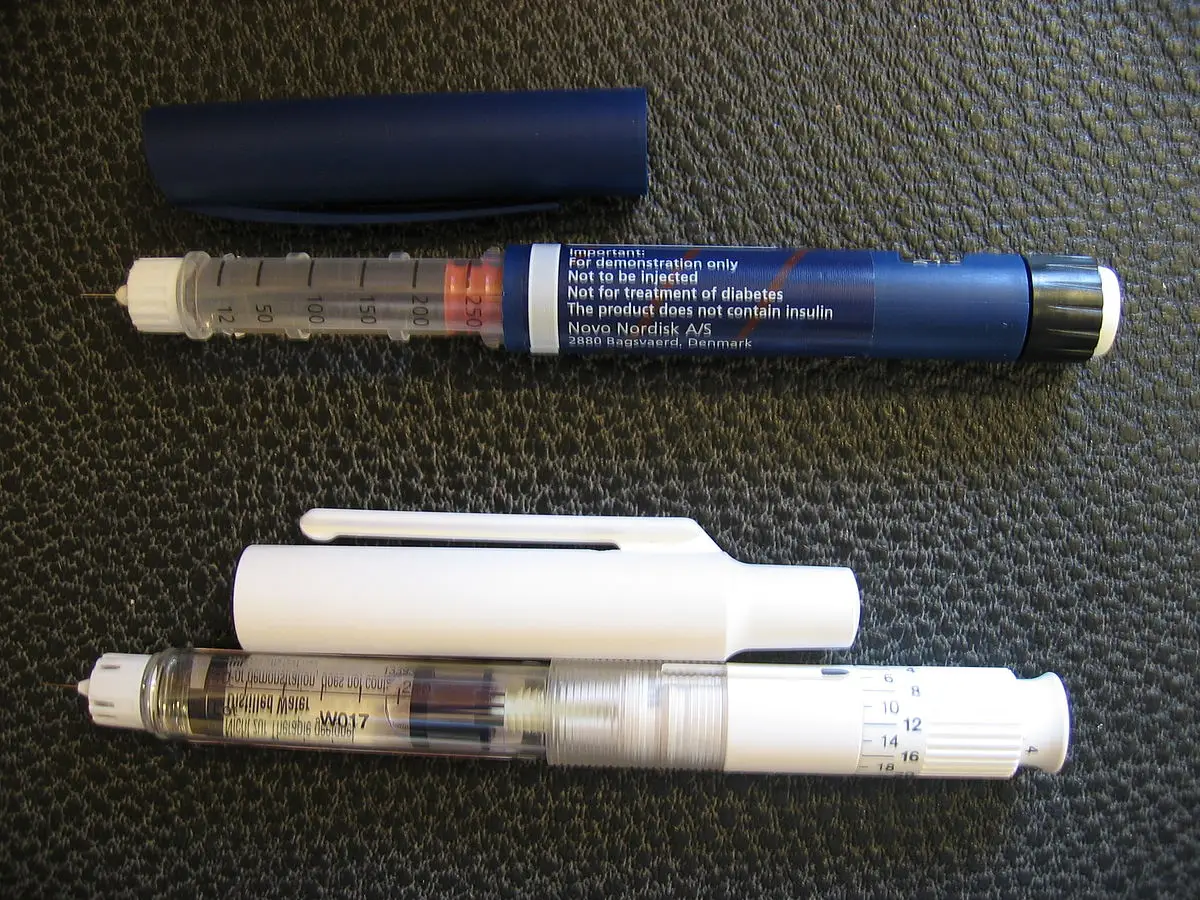
- Injector pen: An injection device that is preloaded with insulin cartridges for easy use. Insulin pens are disposable or refillable and easily portable and therefore can be used by patients with diabetes when they are away from home.
- Inhaler: A cartridge containing the insulin is loaded into the inhaler. The person breathes in the insulin.
Insulin strengths
U-100 is the most common insulin strength in the United States. U-100 means that 100 units of insulin are dissolved or suspended in each milliliter (mL) of fluid. Additional insulin strengths are more concentrated:
- Humalog KwikPen contains 200 units of insulin per mL (U-200 insulin).
- Insulin glargine U-300 (Toujeo) contains 300 units of insulin in each mL of fluid or three times the amount of insulin compared to U-100 insulin.
- Humulin R U-500 contains 500 units of insulin in each mL of fluid or five times the amount of insulin compared to U-100 insulin.
More concentrated forms of insulin require additional patient education and special equipment (e.g., syringes or pens) to prevent insulin overdoses.
Storage of insulin
Most insulin manufacturers recommend that insulin should be stored in the refrigerator. Because injecting cold insulin is uncomfortable, usually, the vial being used is stored at room temperature. An insulin vial stored at room temperature will last for about 1 month. It is important to keep insulin away from extreme heat or cold (e.g., freezer, direct sunlight, or in the glove compartment of a vehicle).
Afrezza, the inhaled insulin, should be stored in the refrigerator in the original closed container and warmed at room temperature for 10 minutes before use. Once opened, the cartridges and inhaler have limited shelf lives and must be discarded per the manufacturer’s schedule.
Patient coaching
The medical assistant can coach the patient on proper foot care. It is important for patients to check their feet daily and also to care for their feet daily. The following points should be reinforced with patients who have neuropathy:
- Check your shoes for damaged areas or stones before putting them on. Wear good-fitting shoes at all times to protect your feet.
- Check your feet when taking off your shoes. Look at all sides of your feet and between the toes. Check for redness, blisters, swelling, sores, and so forth.
- Keep your toenails trimmed to a proper length.
- Wash your feet every day with lukewarm water and soap. Dry well with a soft towel. Use lotion, lanolin, or oil on dry skin, but do not put it between the toes because this could cause an infection.
- Seek medical care immediately for foot sores.
- Avoid putting pressure on areas with nerve damage for long periods of time.
- Use an elbow instead of the toes or hands to check the bathwater temperature.
Legal and ethical issues
Pathophysiology of the endocrine system can have far-reaching effects on the body’s ability to function. Patient education interventions should be documented completely to establish legal proof of the information shared with the patient. Never just assume that the patient understands the disease process and treatment recommendations. The following suggestions can help ensure the patient’s welfare and promote risk management.
- Advise patients that a MedicAlert bracelet with their diagnosis and medication information is an important safeguard.
- Patients must take medication as prescribed, following the directions for dosage, route of administration, and storage; they also must be alert for possible side effects.
- Patients newly diagnosed with diabetes should not drive until glycemic control has stabilized. These patients also should be warned about possible visual impairment from the disease.
- Remember that you are always representing your profession and employer, and respond to each situation accordingly.
- Ask for assistance or further information if you feel unprepared to perform a procedure or give accurate information.
Patient-centered care
Providing patients and families with information, education, and emotional support is part of providing patient-centered care. When working with patients with endocrinology disorders, especially diabetes mellitus, the medical assistant has an important role in connecting patients with additional resources. These can include local support groups, medication discount programs, and websites, including the following:
- American Diabetes Association: www.diabetes.org
- US National Library of Medicine: MedlinePlus: https://medlineplus.gov
Professional behaviors
An important part of becoming a professional medical assistant is a commitment to lifelong learning. This chapter focused on the details of diabetes mellitus because it is the most common endocrine system disease and also one of the most serious. Regardless of where you work as a medical assistant, you will end up caring for patients with diabetes and interacting with their families on some level. Diabetes researchers are constantly discovering more information about the disease: how it is diagnosed, the best treatment methods, and the pathophysiology of possible complications. You must commit to continual learning about diabetes so that you are best prepared to care for patients with this life-threatening disorder.