


Achievable logoAchievable logo
CCMA
Sign in
Sign up
Purchase
Textbook
Practice exams
Support
How it works
Resources
Exam catalog
Mountain with a flag at the peak
Textbook
Introduction
1. Medical assistant
2. Electronic records
3. Medical terminology and anatomy
4. The fundamentals of infection control
5. Introduction to vital signs
6. The patient interview and history
7. The physical examination
8. Appointment scheduling
9. Insurance billing
10. Diagnostic coding and the ICD-10-CM System
11. Procedural coding
12. Medical billing and reimbursement essentials
13. Assisting with medical specialties
14. Assisting with the musculoskeletal system
15. Assisting with the cardiovascular system
16. Assisting with the respiratory system
17. Assisting with the nervous system
18. Anatomy and physiology of the urinary system
19. Assisting in obstetrics and gynecology
20. Assisting in endocrinology
20.1 The neuroendocrine system and major endocrine glands
20.2 The pancreas, thymus, gonads, and pineal gland
20.3 Endocrine physiology and pituitary gland disorders
20.4 Thyroid and parathyroid gland diseases and disorders
20.5 Adrenal gland diseases and disorders
20.6 Pancreatic diseases and disorders
20.7 The medical assistant’s role in examinations, diagnostic procedures, and treatments
21. Assisting in ophthalmology & otolaryngology
22. Assisting in gastroenterology
23. Assisting in the immune & lymphatic systems
24. Assisting in pediatrics: the developmental stages and care
25. The medical assistant’s role in caring for the older patient
26. The role of the medical assistant in physical therapy examination and assessment
27. Preparing for minor surgery: room, solutions, and supplies
28. Introduction to the clinical laboratory
29. Urinalysis
30. Blood collection
31. Analysis of blood
32. Electrocardiography and heart structure
33. The principles of pharmacology
34. Essential calculations and measurement systems
35. Solid, liquid, & solutions medication doses
36. Administering medications
37. Metabolism and core nutrient roles
38. Medical emergencies in the healthcare setting
Achievable logoAchievable logo
20.2 The pancreas, thymus, gonads, and pineal gland
Achievable CCMA
20. Assisting in endocrinology

The pancreas, thymus, gonads, and pineal gland

3 min read
Font
Discuss
Share
Feedback

Anatomy of other endocrine glands

Additional endocrine glands include the pancreas, thymus gland, gonads, and pineal gland. The following sections describe these glands.

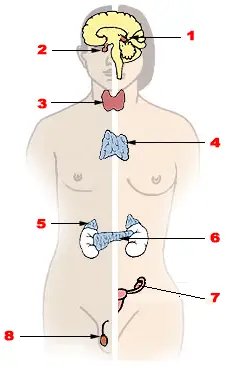
Pancreas: The pancreas is located inferior and posterior to the stomach. It has both endocrine and exocrine functions. As already discussed, an endocrine gland releases hormones into the blood, whereas an exocrine gland releases secretions through ducts. The pancreas releases digestive enzymes into the small intestine through pancreatic ducts.

The pancreas contains pancreatic islets or islets of Langerhans, which produce hormones. The pancreas produces several hormones:

  • Glucagon: Secreted by the alpha islet cells. It raises the blood glucose level in two different ways. It stimulates the stored glycogen in the liver to be converted into glucose. It also stimulates amino acids in the liver to be converted into glucose (gluconeogenesis). The glucose is absorbed by the bloodstream, which increases the blood glucose level.
  • Insulin: Secreted by the beta islet cells. Normally after a meal, the blood glucose level is elevated. This triggers the pancreas to release insulin. Insulin helps move the blood glucose from the blood to the cells. This lowers the blood glucose level. This is an example of a negative feedback loop.
  • Somatostatin: Secreted by the delta islet cells; it regulates the other pancreatic hormones and inhibits the secretion of growth hormones.
  • Ghrelin (GHRL): Secreted by the epsilon islet cells; it signals hunger to the brain before meals and helps regulate food intake, body weight, and glucose metabolism.

Watch out: it’s easy to mix up the alpha and beta islet cells. Alpha cells release glucagon, which raises blood glucose. Beta cells release insulin, which lowers it.

Thymus gland

The thymus gland is in the mediastinum behind the sternum (breastbone) and secretes thymosin and thymopoietin hormones. These hormones stimulate the production and maturity of T cells, a type of lymphocyte (white blood cell). T cells have an important role in immunity.

Gonads

The gonads are considered the primary sex organs. The male gonads are the testes, and the female gonads are the ovaries. Both types of gonads produce hormones:

  • Testes: Secrete testosterone, which stimulates the development of male secondary sexual characteristics (e.g., voice changes, growth of facial and pubic hair). Testosterone also promotes sperm production and muscle development.
  • Ovaries: Produce estrogen and progesterone. Estrogen stimulates the development of breasts and other female secondary sexual characteristics. Progesterone helps maintain a pregnancy. Both estrogen and progesterone are important in the menstrual cycle.

Pineal gland

The pineal gland is located deep within the brain and secretes the hormone melatonin. Melatonin helps regulate waking and sleeping patterns and may affect seasonal reactions to the availability of sunlight.

Glands and organs of the endocrine system labeled
The endocrine system
Wikimedia Commons
/
Public Domain

Sign up for free to take 9 quiz questions on this topic

Previous
Next  | 20.3 Endocrine physiology and pituitary gland disorders
All rights reserved ©2016 - 2026 Achievable, Inc.

The pancreas, thymus, gonads, and pineal gland

Anatomy of other endocrine glands

Additional endocrine glands include the pancreas, thymus gland, gonads, and pineal gland. The following sections describe these glands.

Pancreas: The pancreas is located inferior and posterior to the stomach. It has both endocrine and exocrine functions. As already discussed, an endocrine gland releases hormones into the blood, whereas an exocrine gland releases secretions through ducts. The pancreas releases digestive enzymes into the small intestine through pancreatic ducts.

The pancreas contains pancreatic islets or islets of Langerhans, which produce hormones. The pancreas produces several hormones:

  • Glucagon: Secreted by the alpha islet cells. It raises the blood glucose level in two different ways. It stimulates the stored glycogen in the liver to be converted into glucose. It also stimulates amino acids in the liver to be converted into glucose (gluconeogenesis). The glucose is absorbed by the bloodstream, which increases the blood glucose level.
  • Insulin: Secreted by the beta islet cells. Normally after a meal, the blood glucose level is elevated. This triggers the pancreas to release insulin. Insulin helps move the blood glucose from the blood to the cells. This lowers the blood glucose level. This is an example of a negative feedback loop.
  • Somatostatin: Secreted by the delta islet cells; it regulates the other pancreatic hormones and inhibits the secretion of growth hormones.
  • Ghrelin (GHRL): Secreted by the epsilon islet cells; it signals hunger to the brain before meals and helps regulate food intake, body weight, and glucose metabolism.

Watch out: it’s easy to mix up the alpha and beta islet cells. Alpha cells release glucagon, which raises blood glucose. Beta cells release insulin, which lowers it.

Thymus gland

The thymus gland is in the mediastinum behind the sternum (breastbone) and secretes thymosin and thymopoietin hormones. These hormones stimulate the production and maturity of T cells, a type of lymphocyte (white blood cell). T cells have an important role in immunity.

Gonads

The gonads are considered the primary sex organs. The male gonads are the testes, and the female gonads are the ovaries. Both types of gonads produce hormones:

  • Testes: Secrete testosterone, which stimulates the development of male secondary sexual characteristics (e.g., voice changes, growth of facial and pubic hair). Testosterone also promotes sperm production and muscle development.
  • Ovaries: Produce estrogen and progesterone. Estrogen stimulates the development of breasts and other female secondary sexual characteristics. Progesterone helps maintain a pregnancy. Both estrogen and progesterone are important in the menstrual cycle.

Pineal gland

The pineal gland is located deep within the brain and secretes the hormone melatonin. Melatonin helps regulate waking and sleeping patterns and may affect seasonal reactions to the availability of sunlight.

More from Assisting in endocrinology

  • The neuroendocrine system and major endocrine glands
  • Endocrine physiology and pituitary gland disorders
  • Thyroid and parathyroid gland diseases and disorders
  • Adrenal gland diseases and disorders
  • Pancreatic diseases and disorders