


This browser is too old to run Achievable.

Update it, or open this page in a current version of Chrome, Safari, Firefox or Edge. On an iPhone or iPad, update iOS: every browser there runs on the version of Safari that comes with it.

Achievable logoAchievable logo
ASVAB
Sign in
Sign up
Purchase
Textbook
Practice exams
Support
How it works
Resources
Exam catalog
Mountain with a flag at the peak
Textbook
Introduction
1. Word Knowledge
2. Mathematics Knowledge
3. Paragraph Comprehension
4. Arithmetic Reasoning
5. General Science
6. Mechanical Comprehension
7. Electronics Information
8. Shop Information
9. Auto Information
10. Assembling Objects
10.1 Connection Items
10.2 Puzzle Items
Wrapping up
Achievable logoAchievable logo
10.2 Puzzle Items
Achievable ASVAB
10. Assembling Objects
Our ASVAB course is currently in development and is a work-in-progress.

Puzzle Items

3 min read
Font
Discuss
Share
Feedback

In the Puzzle Items section, you’ll be asked to visualize how different objects would come together to make a whole. The prompt box on the left will have several separate shapes. You’ll then mentally assemble them together and choose which of your four answer options on the right is the best match.

Strategies

The main strategy for assembling objects is process of elimination.

First, count the number of fragments, and eliminate any answers with too many or too few.

Second, analyze the types of cuts: smooth, jagged, or curved. Eliminate any answers that don’t match.

Third, look for size differences and easily-identified shapes. Is there a long skinny rectangle? One large triangle? A small rhombus? Eliminate any answer options that don’t match what you’ve identified.

Let’s look at an example.

Example 1

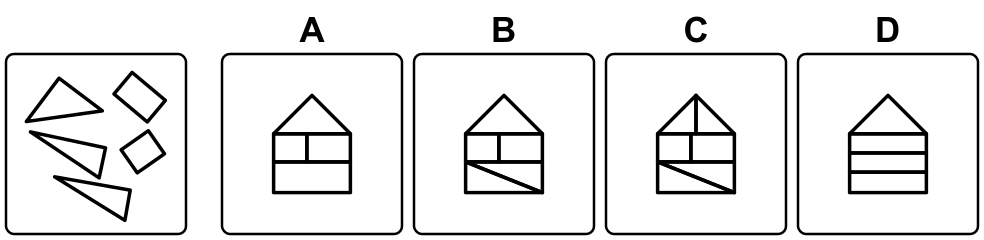
Assembling Objects puzzle question. The first box shows several loose flat pieces. Boxes A through D each show a different figure built from pieces.
Puzzle Items Example
Achievable

Let’s use our process-of-elimination steps to solve this puzzle. First, we count the number of shapes in the prompt box. There are five shapes there, so we can eliminate option A, which has four shapes, option C, which has six shapes, and option D, which has four shapes. Because we only have one answer option left (option B), we do not have to go through the other process-of-elimination steps. We can simply stop here and say that the correct answer is B.

Knowledge check 2:

Assembling Objects puzzle question. The first box shows several loose flat pieces. Boxes A through D each show a different figure built from pieces.
Geometric shape transformation puzzle
Achievable

(spoiler)

A is the correct answer

Puzzle Items overview

  • Task: mentally assemble separate shapes from a prompt box into a whole
  • Choose the answer option (of four) that correctly matches the assembled result

Process of elimination strategy

  • Step 1: count the number of fragments in the prompt; eliminate answers with mismatched counts
  • Step 2: examine cut types (smooth, jagged, curved); eliminate answers with non-matching edges
  • Step 3: identify distinctive shapes/sizes (e.g., long rectangle, large triangle, small rhombus); eliminate answers missing these features
  • Stop as soon as only one option remains — no need to apply every step

Sign up for free to take 5 quiz questions on this topic

Previous
Next  | Wrapping up
All rights reserved ©2016 - 2026 Achievable, Inc.

Puzzle Items

In the Puzzle Items section, you’ll be asked to visualize how different objects would come together to make a whole. The prompt box on the left will have several separate shapes. You’ll then mentally assemble them together and choose which of your four answer options on the right is the best match.

Strategies

The main strategy for assembling objects is process of elimination.

First, count the number of fragments, and eliminate any answers with too many or too few.

Second, analyze the types of cuts: smooth, jagged, or curved. Eliminate any answers that don’t match.

Third, look for size differences and easily-identified shapes. Is there a long skinny rectangle? One large triangle? A small rhombus? Eliminate any answer options that don’t match what you’ve identified.

Let’s look at an example.

Example 1

Let’s use our process-of-elimination steps to solve this puzzle. First, we count the number of shapes in the prompt box. There are five shapes there, so we can eliminate option A, which has four shapes, option C, which has six shapes, and option D, which has four shapes. Because we only have one answer option left (option B), we do not have to go through the other process-of-elimination steps. We can simply stop here and say that the correct answer is B.

Knowledge check 2:

(spoiler)

A is the correct answer

Key points

Puzzle Items overview

  • Task: mentally assemble separate shapes from a prompt box into a whole
  • Choose the answer option (of four) that correctly matches the assembled result

Process of elimination strategy

  • Step 1: count the number of fragments in the prompt; eliminate answers with mismatched counts
  • Step 2: examine cut types (smooth, jagged, curved); eliminate answers with non-matching edges
  • Step 3: identify distinctive shapes/sizes (e.g., long rectangle, large triangle, small rhombus); eliminate answers missing these features
  • Stop as soon as only one option remains — no need to apply every step

More from Assembling Objects

  • Connection Items