


This browser is too old to run Achievable.

Update it, or open this page in a current version of Chrome, Safari, Firefox or Edge. On an iPhone or iPad, update iOS: every browser there runs on the version of Safari that comes with it.

Achievable logoAchievable logo
ASVAB
Sign in
Sign up
Purchase
Textbook
Practice exams
Support
How it works
Resources
Exam catalog
Mountain with a flag at the peak
Textbook
Introduction
1. Word Knowledge
2. Mathematics Knowledge
3. Paragraph Comprehension
4. Arithmetic Reasoning
5. General Science
6. Mechanical Comprehension
7. Electronics Information
8. Shop Information
9. Auto Information
10. Assembling Objects
10.1 Connection Items
10.2 Puzzle Items
Wrapping up
Achievable logoAchievable logo
10.1 Connection Items
Achievable ASVAB
10. Assembling Objects

Connection Items

5 min read
Font
Discuss
Share
Feedback

The Assembling Objects section of the ASVAB measures your spatial reasoning skills. It tests your ability to mentally manipulate and compare shapes by connecting, rotating, or assembling them. Because this section asks you to visualize how objects relate to one another in space, it feels different from the other subtests.

The key to success here is don’t get intimidated. You simply need a strategy to solve these, which we will guide you through.

There are two types of questions in this section:

  • Connection items
  • Puzzle items

For each question, you’ll be given five boxes, each with a picture inside. The box on the far left is the prompt box with the question. The four boxes to the right are your answer options, labeled A, B, C, and D.

Connection items

In the connection items section, you’ll be asked to identify the correct way to draw a straight line from one object to another. In the prompt box, you’ll see two objects, each with a black dot, labeled a and b. Then you’ll be asked to select the answer option that correctly shows how to connect those two dots with a line. The question stem usually reads something like, “Which figure best shows how the objects in the left box will touch if the letters for each object are matched?”

Strategies

Use a three-step process: identify each anchor point, eliminate mismatches, then check the remaining shapes for flips or distortions.

The anchor point is where each dot is positioned on its object. For instance, is the dot on the side of the object or at a corner? If on the side, is it on a curved side, flat side, short side, or long side? Is it in the middle or closer to one edge? Knowing where your dot is on each object is key.

Next, use the process of elimination to rule out options that don’t match your anchor points. Watch for a line attached to the wrong spot, or a dot moved to a nearby but different spot.

Finally, check the options that remain for a mirrored (flipped), resized, or stretched shape. Rotating a shape is fine; mirroring, resizing, or stretching one is always wrong.

Let’s work through an example.

Example 1

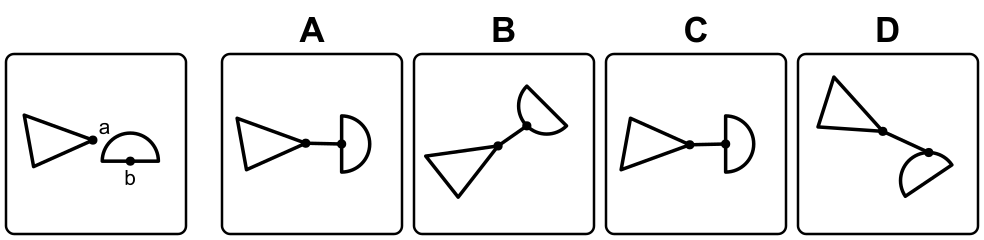
Assembling Objects connection question. The first box shows two shapes, each with a marked point labeled a or b. Boxes A through D each show the two shapes joined by a line.
Connection Items Example 1
Achievable

Using our process from above, let’s start with dot labeled a and see where it anchors to its object. We would describe it as “on the tip of the triangle”. Checking our answers, all of them have dot a in the correct location, so we cannot eliminate any options yet.

Let’s move to the next dot. Dot b can be described as “in the middle of the straight side” of its object. We can now eliminate answer options B and D, as both have the dot on the curved side rather than the straight side.

We’re now down to just options A and C. The location of the dots and connections is correct in both of these options, but option C shows a mirror image of the triangle - it’s flipped, not just rotated. Thus, option A is our best answer.

Knowledge check:

Assembling Objects connection question. First box: a rectangle with dot a at a corner, and a diamond with dot b at its top point. A: the line runs from the middle of the rectangle’s short side to the diamond’s top point. B: from a corner of the rectangle to the diamond’s top point. C: from a corner of the rectangle to the diamond’s side point. D: from the middle of the rectangle’s long side to the diamond’s top point.
Connection item knowledge check
Achievable

(spoiler)

Answer B is correct. Dot a is at a corner of the rectangle, which eliminates A (middle of the short side) and D (middle of the long side). Dot b is at the diamond’s top point, which eliminates C (side point). Only B matches both anchor points.

Assembling Objects overview

  • Measures spatial reasoning: connecting, rotating, assembling shapes mentally
  • Two question types: connection items and puzzle items
  • Format: prompt box (far left) plus four answer options (A–D)

Connection items

  • Prompt shows two objects, each with a labeled dot (a, b)
  • Task: pick the answer showing the correct line connecting the two dots

Solving strategy (three-step process)

  • Identify anchor points: note exact dot location on each object (corner vs. side; flat vs. curved; middle vs. edge; short vs. long side)
  • Eliminate mismatches: rule out options where the line attaches to the wrong spot or the dot has shifted position
  • Check remaining options for distortions: mirrored (flipped), resized, or stretched shapes are always wrong — only rotation is acceptable

Sign up for free to take 5 quiz questions on this topic

Previous
Next  | 10.2 Puzzle Items
All rights reserved ©2016 - 2026 Achievable, Inc.

Connection Items

The Assembling Objects section of the ASVAB measures your spatial reasoning skills. It tests your ability to mentally manipulate and compare shapes by connecting, rotating, or assembling them. Because this section asks you to visualize how objects relate to one another in space, it feels different from the other subtests.

The key to success here is don’t get intimidated. You simply need a strategy to solve these, which we will guide you through.

There are two types of questions in this section:

  • Connection items
  • Puzzle items

For each question, you’ll be given five boxes, each with a picture inside. The box on the far left is the prompt box with the question. The four boxes to the right are your answer options, labeled A, B, C, and D.

Connection items

In the connection items section, you’ll be asked to identify the correct way to draw a straight line from one object to another. In the prompt box, you’ll see two objects, each with a black dot, labeled a and b. Then you’ll be asked to select the answer option that correctly shows how to connect those two dots with a line. The question stem usually reads something like, “Which figure best shows how the objects in the left box will touch if the letters for each object are matched?”

Strategies

Use a three-step process: identify each anchor point, eliminate mismatches, then check the remaining shapes for flips or distortions.

The anchor point is where each dot is positioned on its object. For instance, is the dot on the side of the object or at a corner? If on the side, is it on a curved side, flat side, short side, or long side? Is it in the middle or closer to one edge? Knowing where your dot is on each object is key.

Next, use the process of elimination to rule out options that don’t match your anchor points. Watch for a line attached to the wrong spot, or a dot moved to a nearby but different spot.

Finally, check the options that remain for a mirrored (flipped), resized, or stretched shape. Rotating a shape is fine; mirroring, resizing, or stretching one is always wrong.

Let’s work through an example.

Example 1

Using our process from above, let’s start with dot labeled a and see where it anchors to its object. We would describe it as “on the tip of the triangle”. Checking our answers, all of them have dot a in the correct location, so we cannot eliminate any options yet.

Let’s move to the next dot. Dot b can be described as “in the middle of the straight side” of its object. We can now eliminate answer options B and D, as both have the dot on the curved side rather than the straight side.

We’re now down to just options A and C. The location of the dots and connections is correct in both of these options, but option C shows a mirror image of the triangle - it’s flipped, not just rotated. Thus, option A is our best answer.

Knowledge check:

(spoiler)

Answer B is correct. Dot a is at a corner of the rectangle, which eliminates A (middle of the short side) and D (middle of the long side). Dot b is at the diamond’s top point, which eliminates C (side point). Only B matches both anchor points.

Key points

Assembling Objects overview

  • Measures spatial reasoning: connecting, rotating, assembling shapes mentally
  • Two question types: connection items and puzzle items
  • Format: prompt box (far left) plus four answer options (A–D)

Connection items

  • Prompt shows two objects, each with a labeled dot (a, b)
  • Task: pick the answer showing the correct line connecting the two dots

Solving strategy (three-step process)

  • Identify anchor points: note exact dot location on each object (corner vs. side; flat vs. curved; middle vs. edge; short vs. long side)
  • Eliminate mismatches: rule out options where the line attaches to the wrong spot or the dot has shifted position
  • Check remaining options for distortions: mirrored (flipped), resized, or stretched shapes are always wrong — only rotation is acceptable

More from Assembling Objects

  • Puzzle Items